
February 20, 2026

Thank you! Your submission has been received!
Oops! Something went wrong while submitting the form.

By late 2024 and throughout 2025, the DTC market for hemp‑derived intoxicating products ran into a three‑way squeeze:
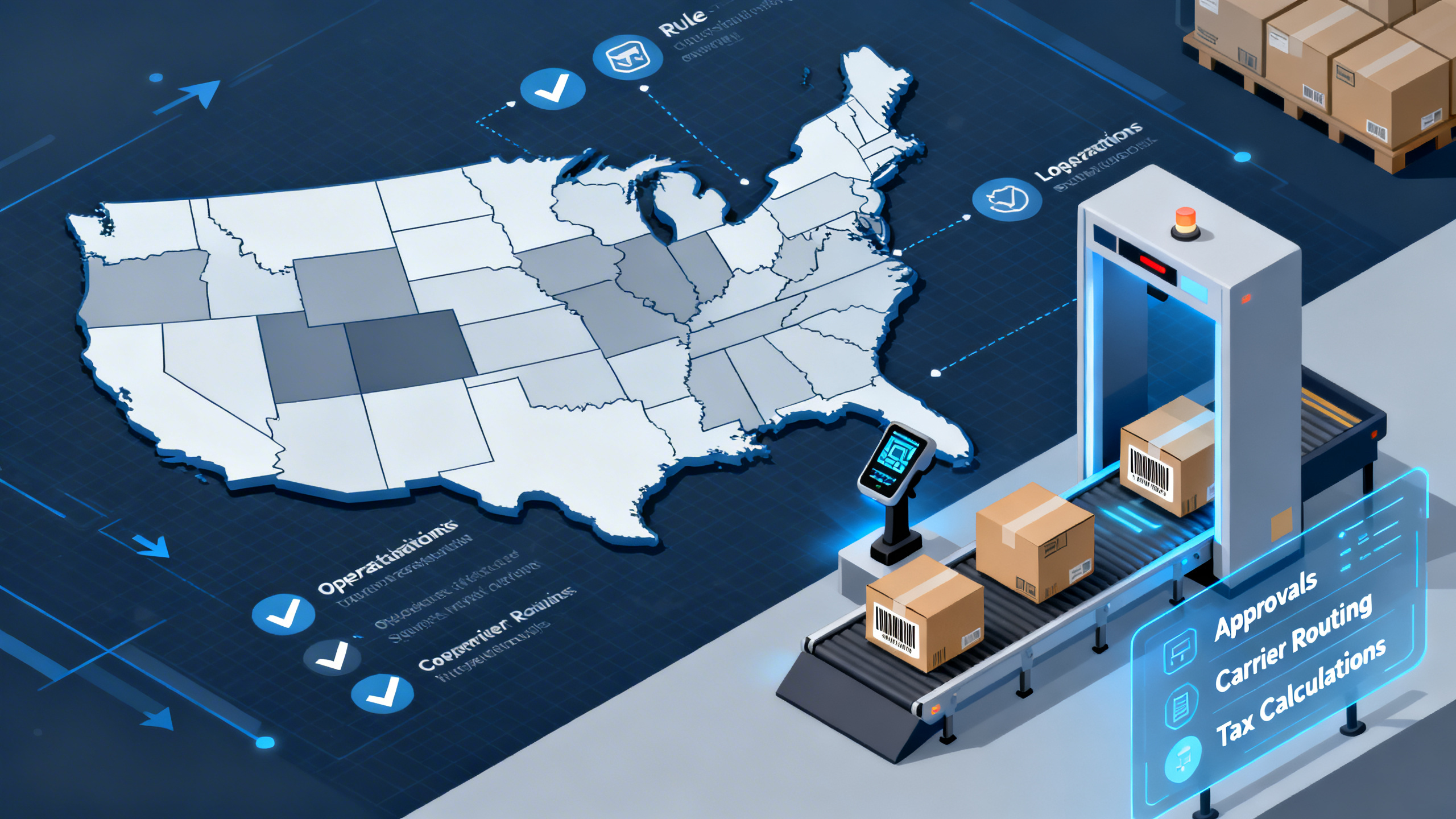
If your compliance is still a spreadsheet + a customer service script, Q4 volume becomes the breaking point. A ship‑block compliance engine is the practical answer: an automated rules system that evaluates every cart, address, SKU, and fulfillment path and either (a) assigns a compliant route with the right taxes and verification steps or (b) blocks the order before it becomes a regulatory, chargeback, or carrier‑seizure event.
This article is informational only and not legal advice.
At a minimum, a ship‑block engine is a set of machine‑enforceable policies that run at two moments:
A mature engine does six jobs reliably:
The key concept: you are not building “a list of banned states.” You are building a decision engine that can explain why an order is permitted or blocked and can prove it later.
The main driver for automation is that state definitions moved faster than DTC operations. Across 2024–2025, many states targeted one or more of the following:
Because these details are jurisdiction‑specific and frequently updated via emergency rules, guidance, or legislative amendments, compliance teams need a system that can version and deploy rules quickly.
Your rules model should support patterns such as:
Even when two states have “10 mg per serving” on paper, their definitions of what counts toward the limit (delta‑9 only vs. total THC vs. delta‑9 + THCA) can differ. A ship‑block engine must store the formula, not just the number.
DTC brands often discover carrier constraints late—after a pickup refusal, an account suspension, or a claims denial. In 2025, the practical requirement is: your fulfillment system should not generate a label unless the order has passed carrier eligibility checks.
USPS allows mailing of hemp in certain circumstances, but shippers must be prepared to show compliance with federal requirements and USPS guidance (including documentation that the product qualifies as hemp and meets applicable federal law).
External reference: USPS hemp guidance and mailing standards resources are typically consolidated on USPS’s site (start here: https://www.usps.com/ship/shipping-restrictions.htm and search USPS for “hemp”).
Operational takeaway:
Private carriers commonly rely on shipper agreements, restricted commodities lists, and account‑level approvals. Even when a product is legal in the destination state, a carrier may restrict it based on internal policy or risk classification.
Your engine should model:
External starting points:
Important: carriers update internal enforcement faster than public webpages. Build your system so carrier rules can be overridden by account‑level configuration and updated without code releases.
If you sell through a marketplace (or operate one), 2025 enforcement pressure pushed platforms toward “facilitator‑level” compliance:
Even for standalone Shopify/WooCommerce brands, payment partners and risk teams increasingly expect defensible controls for restricted products. The ship‑block engine becomes part of your payments survival kit: it reduces chargebacks, mitigates “illegal goods” allegations, and supports merchant underwriting.
A reliable engine is not one big rules file. It’s a policy service with clear inputs, deterministic outputs, and logs.
You need normalized geodata:
Store rules with:
Every SKU should carry structured compliance attributes—don’t rely on marketing copy.
Minimum recommended fields:
This is where many DTC brands fail: they store a PDF COA but not the extractable numbers needed for automated evaluation.
A modern pattern is a hybrid:
Implementation options:
Core requirement: the engine must produce a decision + explanation:
Age‑gating is not a single checkbox. A defensible workflow often includes:
Integrations typically include an IDV provider (document + selfie, database checks, or both) and fraud tooling.
Design tip: treat IDV as a policy condition that can vary by jurisdiction, basket risk, and order value.
Q4 is where tax errors become expensive. Your engine should decide:
For many brands, the best approach is:
Critical: store tax decisions in your audit log with the inputs used (jurisdiction, SKU attributes, tax category mapping).
Even outside regulated supply chains, 2025 saw growing interest in machine‑readable packaging to support verification and recall readiness.
GS1’s move toward 2D barcodes (e.g., QR/DataMatrix) enables embedding:
External reference: GS1 2D transition resources (start here: https://www.gs1.org/standards/2d-barcodes)
How it helps ship‑block:
When something goes wrong, “we tried” is not a defense. You need a record of what your system did.
A ship‑block engine should keep immutable logs for:
Security reference baseline: NIST control families for logging/monitoring are a useful framework even for ecommerce (start here: https://csrc.nist.gov/publications/detail/sp/800-53/rev-5/final).
Implementation best practice:
Manual review fails in predictable ways:
A rules engine, by contrast:
Just as importantly, it helps with operational consistency: customer messaging, refund flows, and inventory allocation can all be tied to the decision output.
If you’re building (or rebuilding) your DTC compliance stack for 2025–2026, use https://cannabisregulations.ai/ to track rule changes, map licensing and shipping constraints by jurisdiction, and translate regulations into operational controls your checkout and fulfillment teams can actually run.
By late 2024 and throughout 2025, the DTC market for hemp‑derived intoxicating products ran into a three‑way squeeze:
If your compliance is still a spreadsheet + a customer service script, Q4 volume becomes the breaking point. A ship‑block compliance engine is the practical answer: an automated rules system that evaluates every cart, address, SKU, and fulfillment path and either (a) assigns a compliant route with the right taxes and verification steps or (b) blocks the order before it becomes a regulatory, chargeback, or carrier‑seizure event.
This article is informational only and not legal advice.
At a minimum, a ship‑block engine is a set of machine‑enforceable policies that run at two moments:
A mature engine does six jobs reliably:
The key concept: you are not building “a list of banned states.” You are building a decision engine that can explain why an order is permitted or blocked and can prove it later.
The main driver for automation is that state definitions moved faster than DTC operations. Across 2024–2025, many states targeted one or more of the following:
Because these details are jurisdiction‑specific and frequently updated via emergency rules, guidance, or legislative amendments, compliance teams need a system that can version and deploy rules quickly.
Your rules model should support patterns such as:
Even when two states have “10 mg per serving” on paper, their definitions of what counts toward the limit (delta‑9 only vs. total THC vs. delta‑9 + THCA) can differ. A ship‑block engine must store the formula, not just the number.
DTC brands often discover carrier constraints late—after a pickup refusal, an account suspension, or a claims denial. In 2025, the practical requirement is: your fulfillment system should not generate a label unless the order has passed carrier eligibility checks.
USPS allows mailing of hemp in certain circumstances, but shippers must be prepared to show compliance with federal requirements and USPS guidance (including documentation that the product qualifies as hemp and meets applicable federal law).
External reference: USPS hemp guidance and mailing standards resources are typically consolidated on USPS’s site (start here: https://www.usps.com/ship/shipping-restrictions.htm and search USPS for “hemp”).
Operational takeaway:
Private carriers commonly rely on shipper agreements, restricted commodities lists, and account‑level approvals. Even when a product is legal in the destination state, a carrier may restrict it based on internal policy or risk classification.
Your engine should model:
External starting points:
Important: carriers update internal enforcement faster than public webpages. Build your system so carrier rules can be overridden by account‑level configuration and updated without code releases.
If you sell through a marketplace (or operate one), 2025 enforcement pressure pushed platforms toward “facilitator‑level” compliance:
Even for standalone Shopify/WooCommerce brands, payment partners and risk teams increasingly expect defensible controls for restricted products. The ship‑block engine becomes part of your payments survival kit: it reduces chargebacks, mitigates “illegal goods” allegations, and supports merchant underwriting.
A reliable engine is not one big rules file. It’s a policy service with clear inputs, deterministic outputs, and logs.
You need normalized geodata:
Store rules with:
Every SKU should carry structured compliance attributes—don’t rely on marketing copy.
Minimum recommended fields:
This is where many DTC brands fail: they store a PDF COA but not the extractable numbers needed for automated evaluation.
A modern pattern is a hybrid:
Implementation options:
Core requirement: the engine must produce a decision + explanation:
Age‑gating is not a single checkbox. A defensible workflow often includes:
Integrations typically include an IDV provider (document + selfie, database checks, or both) and fraud tooling.
Design tip: treat IDV as a policy condition that can vary by jurisdiction, basket risk, and order value.
Q4 is where tax errors become expensive. Your engine should decide:
For many brands, the best approach is:
Critical: store tax decisions in your audit log with the inputs used (jurisdiction, SKU attributes, tax category mapping).
Even outside regulated supply chains, 2025 saw growing interest in machine‑readable packaging to support verification and recall readiness.
GS1’s move toward 2D barcodes (e.g., QR/DataMatrix) enables embedding:
External reference: GS1 2D transition resources (start here: https://www.gs1.org/standards/2d-barcodes)
How it helps ship‑block:
When something goes wrong, “we tried” is not a defense. You need a record of what your system did.
A ship‑block engine should keep immutable logs for:
Security reference baseline: NIST control families for logging/monitoring are a useful framework even for ecommerce (start here: https://csrc.nist.gov/publications/detail/sp/800-53/rev-5/final).
Implementation best practice:
Manual review fails in predictable ways:
A rules engine, by contrast:
Just as importantly, it helps with operational consistency: customer messaging, refund flows, and inventory allocation can all be tied to the decision output.
If you’re building (or rebuilding) your DTC compliance stack for 2025–2026, use https://cannabisregulations.ai/ to track rule changes, map licensing and shipping constraints by jurisdiction, and translate regulations into operational controls your checkout and fulfillment teams can actually run.