May 23, 2026

Thank you! Your submission has been received!
Oops! Something went wrong while submitting the form.

Last updated: August 6, 2026 · By Compliance Carl, Senior Compliance Editor
Updated August 6, 2026: The DEA's broader rescheduling hearing ran June 29–July 15, 2026 and has concluded — post-hearing briefs are due August 17, with the judge's recommendation expected late 2026. TSA has still published no actual special instructions.
On April 27, 2026, the Transportation Security Administration updated the Medical Marijuana entry on its What Can I Bring? tool. The carry-on and checked-bag fields now read Yes (Special Instructions). The page used to say marijuana was federally illegal and that TSA officers, while not actively searching for it, were obligated to refer any discovered cannabis to law enforcement. Those paragraphs are gone. The new page is shorter, the green Yes labels are new, and the words Special Instructions link to nothing.
There is no quantity limit on the page. No documentation requirement. No list of qualifying states. No definition of what a qualifying state-issued license looks like at the checkpoint. The page lists the special instructions and does not give them.
That is the news, and it is genuinely unusual. Most categories on TSA's What Can I Bring? tool that carry a Special Instructions label have a corresponding instructions page that explains the limits. Firearms have a Special Instructions entry that covers declaration at check-in, hard-sided locked cases, ammunition packaging, and notification to the airline. Lithium batteries have an entry that distinguishes lithium-ion from lithium metal, sets watt-hour limits, and bans spares from checked baggage. Medical marijuana now has a Special Instructions label and no instructions.
The timing is not coincidental. Acting Attorney General Todd Blanche signed the DOJ rescheduling order on April 22, 2026, placing two specific categories of marijuana into Schedule III of the Controlled Substances Act. The corresponding DEA Final Rule published in the Federal Register on April 28, with an effective date the same day. DOJ's announcement describes the two categories as (1) FDA-approved drug products containing marijuana, and (2) marijuana subject to a qualifying state-issued license for medical purposes only. TSA's page change landed one day before the order took effect.
The two-category carve-out is doing all the work. Recreational cannabis sold under state-issued adult-use licenses is still Schedule I. Bulk marijuana outside a medical chain of custody is still Schedule I. Synthetic THC is still Schedule I. The Schedule III rescheduling is narrow and conditional, and the conditions — for medical purposes only, with documentary support — are exactly the thing TSA's blank Special Instructions page would presumably eventually explain. For the operator-side reading of the same split, see our two-tier federal cannabis market explainer and the 280E survival stack.
Whether the page will, at some point in 2026, fill in those instructions is unclear. As of early August, it had not. A TSA spokesperson told Snopes in early May that the agency's policy on medical marijuana has not changed, and that the screening protocol was the same one in force since at least 2019. The change, on TSA's own account, is a website-language change, not a screening-protocol change. GBH News reported on May 19 that the union representing New England TSA workers had not been briefed on the policy implications of the change as of mid-May.
The first Schedule III category is the cleanest: FDA-approved cannabis-derived prescription drugs. The four currently approved are Epidiolex (cannabidiol oral solution for refractory pediatric epilepsy and tuberous sclerosis complex), Marinol and Syndros (synthetic dronabinol), and Cesamet (nabilone). These products have always been the most travel-friendly cannabis-derived items: they come in original pharmacy packaging with a prescription label, a patient name, and a prescriber. TSA's general medication carry-on guidance applies. The rescheduling does not change handling at the checkpoint.
The second category is the harder one. State-licensed medical cannabis — flower, edibles, tinctures, vapes — produced and dispensed under a state medical program that DEA recognizes as qualifying, is now Schedule III. The qualifying-state-license question is where most of the operational uncertainty lives. A state license that authorizes both medical and adult-use activity does not, on the face of the DOJ order, qualify the medical activity for Schedule III. DEA has signaled it will look at operational separation — segregated inventory, separate registration, customer-facing program — rather than the paper of the license alone.
For the air-traveler reader, the practical translation is: a Florida medical marijuana patient with a state card and a state-licensed product is, in theory, carrying a Schedule III product when she walks through the LAX checkpoint. The TSA agent has no protocol for confirming any of that on the spot. If asked, she will produce her card and the dispensary packaging. Whether that conversation ends with her boarding her plane depends entirely on the screener and, if cannabis is found and the screener calls airport police, on the officer who responds.
The narrow April rescheduling is not the end of the question. DEA held a hearing from June 29 to July 15, 2026, at the agency's Arlington facility, to consider whether marijuana as a whole — including recreational — should move from Schedule I to Schedule III. The hearing has now concluded: participants must submit post-hearing briefs by August 17, 2026, the administrative law judge's recommendation is expected in late 2026, and the DEA Administrator makes the final decision after that — with court challenges likely whichever way it goes. Gibson Dunn's analysis of the procedural posture is thorough; we have walked the witness landscape and procedural footing in our Trump rescheduling executive order operational readiness piece.
If the broader rescheduling succeeds and survives APA challenge, the TSA Special Instructions question gets simpler — there would no longer be a meaningful federal distinction between medical and adult-use cannabis at the checkpoint. If it stalls or is enjoined, the current two-tier federal split becomes a permanent feature. The probability distribution between those two outcomes is genuinely uncertain, and operators making investment decisions on the strength of either outcome are exposing themselves to the other.
For travelers, the hearing's aftermath is mostly a watch-and-wait item. Nothing it produces will change the picture before the judge's recommendation lands late in the year, and likely much later — federal rulemaking does not move at travel-planning speed.
Three things the April update conspicuously does not move are worth being explicit about.
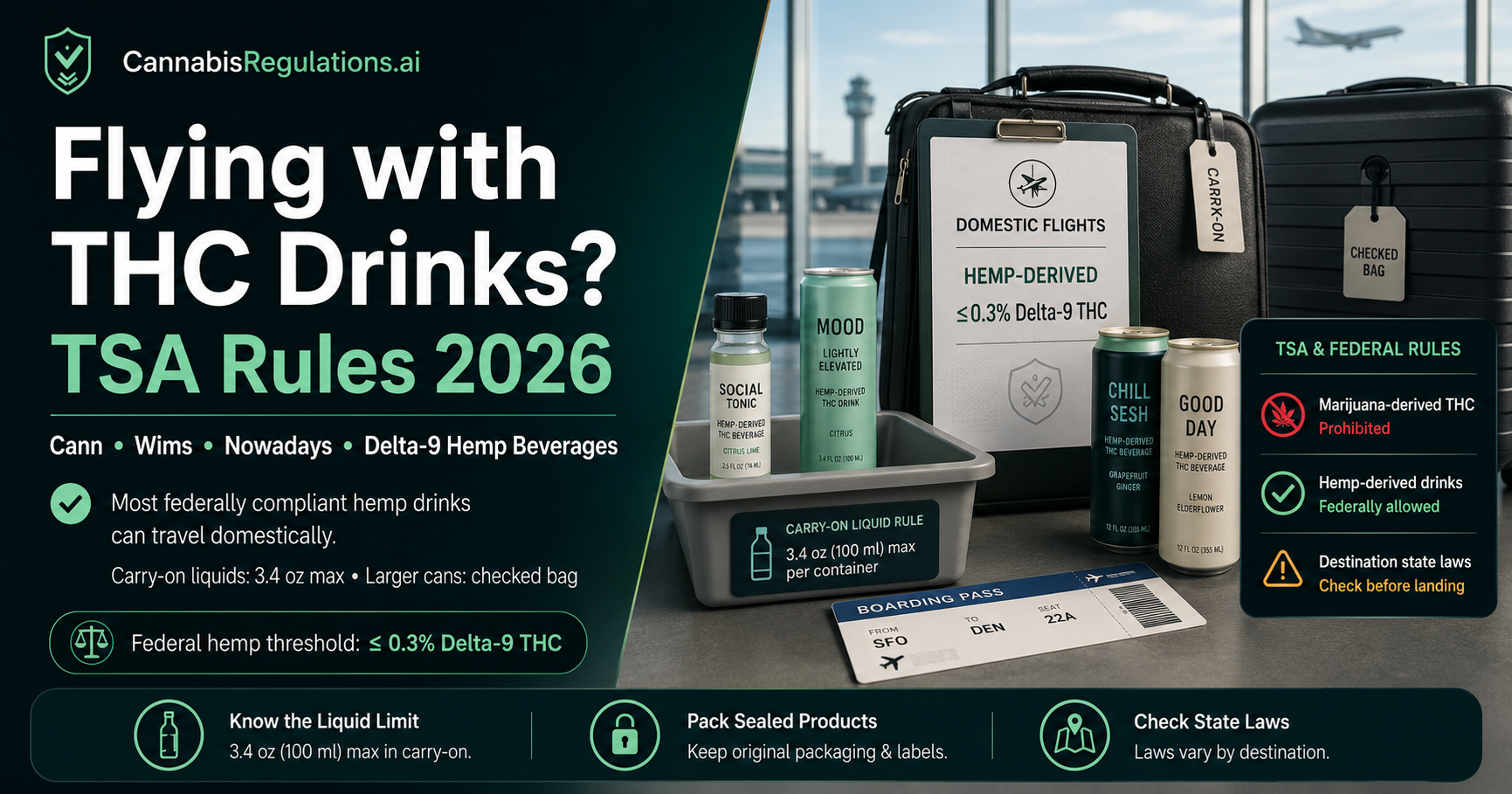
Recreational cannabis is still Schedule I. The carry-on and checked-bag picture for adult-use cannabis purchased recreationally has not changed at all. The TSA page's green Yes is conditional on the state-licensed-medical carve-out and does not extend to product purchased from an adult-use storefront, even in a state that recognizes both programs. Hemp-derived Delta-9 beverages, which sit in a different regulatory bucket entirely, continue to be governed by the 2018 Farm Bill's 0.3-percent-by-dry-weight definition through November 11; we covered the 2026 picture for those products in our THC drinks guide.
Customs and Border Protection has not moved. CBP enforces the Controlled Substances Act at U.S. ports of entry, treats both Schedule I marijuana and Farm Bill–compliant hemp as substances of interest, and has historically denied entry, issued lifetime bans, and seized product from travelers attempting to cross with cannabis in any form. The April rescheduling did not address the border. International cannabis travel — including across the U.S.–Canada border — remains an unforced-error category.
The Federal Aviation Administration's drug-testing rules for flight crew, ground crew with safety-sensitive functions, and air traffic controllers have not changed. Federal-employee and DOT-regulated employee drug-testing rules have not changed. A patient who flies as a passenger with a Schedule III medical cannabis product can be a Schedule III patient on Monday and a fired pilot on Tuesday if she has a positive drug test in the interim.
And state law has not been preempted by anything in the order. State and local police continue to enforce state criminal codes at the airport, and a federal Schedule III designation does not protect a traveler from arrest under, say, the Georgia Controlled Substances Act. The April rescheduling did not move the state-law calculus a single inch. For the airport-by-airport breakdown, see our 2026 TSA travel guide.
The April 27 TSA page change is real, narrow, and unaccompanied by the operational guidance that would tell a traveler or a screener what to do with it. The green Yes labels are an accurate reflection of where federal scheduling law now sits for two specific categories of cannabis product, and a misleading reflection of the experience most travelers will actually have at a checkpoint. The categories of traveler the change unambiguously helps are small: patients flying with FDA-approved cannabis prescription drugs in original pharmacy packaging, and patients flying with state-licensed medical cannabis from a recognized state program to and within other states that recognize the same program.
For everyone else — recreational consumers, hemp-derived Delta-9 drink fans, medical patients flying to a prohibitionist destination, anyone crossing an international border — the practical posture is what it was on April 26. Treat the green Yes as an accurate but incomplete signal. Pack accordingly.
If a checkpoint conversation goes sideways and state law is on the table, get state-specific representation. Our Cannabis Lawyer Directory indexes attorneys by state.
This article is editorial and does not constitute legal advice. State and federal cannabis law moves quickly; verify any specific question with counsel admitted in the relevant jurisdiction.
Last updated: August 6, 2026 · By Compliance Carl, Senior Compliance Editor
Updated August 6, 2026: The DEA's broader rescheduling hearing ran June 29–July 15, 2026 and has concluded — post-hearing briefs are due August 17, with the judge's recommendation expected late 2026. TSA has still published no actual special instructions.
On April 27, 2026, the Transportation Security Administration updated the Medical Marijuana entry on its What Can I Bring? tool. The carry-on and checked-bag fields now read Yes (Special Instructions). The page used to say marijuana was federally illegal and that TSA officers, while not actively searching for it, were obligated to refer any discovered cannabis to law enforcement. Those paragraphs are gone. The new page is shorter, the green Yes labels are new, and the words Special Instructions link to nothing.
There is no quantity limit on the page. No documentation requirement. No list of qualifying states. No definition of what a qualifying state-issued license looks like at the checkpoint. The page lists the special instructions and does not give them.
That is the news, and it is genuinely unusual. Most categories on TSA's What Can I Bring? tool that carry a Special Instructions label have a corresponding instructions page that explains the limits. Firearms have a Special Instructions entry that covers declaration at check-in, hard-sided locked cases, ammunition packaging, and notification to the airline. Lithium batteries have an entry that distinguishes lithium-ion from lithium metal, sets watt-hour limits, and bans spares from checked baggage. Medical marijuana now has a Special Instructions label and no instructions.
The timing is not coincidental. Acting Attorney General Todd Blanche signed the DOJ rescheduling order on April 22, 2026, placing two specific categories of marijuana into Schedule III of the Controlled Substances Act. The corresponding DEA Final Rule published in the Federal Register on April 28, with an effective date the same day. DOJ's announcement describes the two categories as (1) FDA-approved drug products containing marijuana, and (2) marijuana subject to a qualifying state-issued license for medical purposes only. TSA's page change landed one day before the order took effect.
The two-category carve-out is doing all the work. Recreational cannabis sold under state-issued adult-use licenses is still Schedule I. Bulk marijuana outside a medical chain of custody is still Schedule I. Synthetic THC is still Schedule I. The Schedule III rescheduling is narrow and conditional, and the conditions — for medical purposes only, with documentary support — are exactly the thing TSA's blank Special Instructions page would presumably eventually explain. For the operator-side reading of the same split, see our two-tier federal cannabis market explainer and the 280E survival stack.
Whether the page will, at some point in 2026, fill in those instructions is unclear. As of early August, it had not. A TSA spokesperson told Snopes in early May that the agency's policy on medical marijuana has not changed, and that the screening protocol was the same one in force since at least 2019. The change, on TSA's own account, is a website-language change, not a screening-protocol change. GBH News reported on May 19 that the union representing New England TSA workers had not been briefed on the policy implications of the change as of mid-May.
The first Schedule III category is the cleanest: FDA-approved cannabis-derived prescription drugs. The four currently approved are Epidiolex (cannabidiol oral solution for refractory pediatric epilepsy and tuberous sclerosis complex), Marinol and Syndros (synthetic dronabinol), and Cesamet (nabilone). These products have always been the most travel-friendly cannabis-derived items: they come in original pharmacy packaging with a prescription label, a patient name, and a prescriber. TSA's general medication carry-on guidance applies. The rescheduling does not change handling at the checkpoint.
The second category is the harder one. State-licensed medical cannabis — flower, edibles, tinctures, vapes — produced and dispensed under a state medical program that DEA recognizes as qualifying, is now Schedule III. The qualifying-state-license question is where most of the operational uncertainty lives. A state license that authorizes both medical and adult-use activity does not, on the face of the DOJ order, qualify the medical activity for Schedule III. DEA has signaled it will look at operational separation — segregated inventory, separate registration, customer-facing program — rather than the paper of the license alone.
For the air-traveler reader, the practical translation is: a Florida medical marijuana patient with a state card and a state-licensed product is, in theory, carrying a Schedule III product when she walks through the LAX checkpoint. The TSA agent has no protocol for confirming any of that on the spot. If asked, she will produce her card and the dispensary packaging. Whether that conversation ends with her boarding her plane depends entirely on the screener and, if cannabis is found and the screener calls airport police, on the officer who responds.
The narrow April rescheduling is not the end of the question. DEA held a hearing from June 29 to July 15, 2026, at the agency's Arlington facility, to consider whether marijuana as a whole — including recreational — should move from Schedule I to Schedule III. The hearing has now concluded: participants must submit post-hearing briefs by August 17, 2026, the administrative law judge's recommendation is expected in late 2026, and the DEA Administrator makes the final decision after that — with court challenges likely whichever way it goes. Gibson Dunn's analysis of the procedural posture is thorough; we have walked the witness landscape and procedural footing in our Trump rescheduling executive order operational readiness piece.
If the broader rescheduling succeeds and survives APA challenge, the TSA Special Instructions question gets simpler — there would no longer be a meaningful federal distinction between medical and adult-use cannabis at the checkpoint. If it stalls or is enjoined, the current two-tier federal split becomes a permanent feature. The probability distribution between those two outcomes is genuinely uncertain, and operators making investment decisions on the strength of either outcome are exposing themselves to the other.
For travelers, the hearing's aftermath is mostly a watch-and-wait item. Nothing it produces will change the picture before the judge's recommendation lands late in the year, and likely much later — federal rulemaking does not move at travel-planning speed.
Three things the April update conspicuously does not move are worth being explicit about.
Recreational cannabis is still Schedule I. The carry-on and checked-bag picture for adult-use cannabis purchased recreationally has not changed at all. The TSA page's green Yes is conditional on the state-licensed-medical carve-out and does not extend to product purchased from an adult-use storefront, even in a state that recognizes both programs. Hemp-derived Delta-9 beverages, which sit in a different regulatory bucket entirely, continue to be governed by the 2018 Farm Bill's 0.3-percent-by-dry-weight definition through November 11; we covered the 2026 picture for those products in our THC drinks guide.
Customs and Border Protection has not moved. CBP enforces the Controlled Substances Act at U.S. ports of entry, treats both Schedule I marijuana and Farm Bill–compliant hemp as substances of interest, and has historically denied entry, issued lifetime bans, and seized product from travelers attempting to cross with cannabis in any form. The April rescheduling did not address the border. International cannabis travel — including across the U.S.–Canada border — remains an unforced-error category.
The Federal Aviation Administration's drug-testing rules for flight crew, ground crew with safety-sensitive functions, and air traffic controllers have not changed. Federal-employee and DOT-regulated employee drug-testing rules have not changed. A patient who flies as a passenger with a Schedule III medical cannabis product can be a Schedule III patient on Monday and a fired pilot on Tuesday if she has a positive drug test in the interim.
And state law has not been preempted by anything in the order. State and local police continue to enforce state criminal codes at the airport, and a federal Schedule III designation does not protect a traveler from arrest under, say, the Georgia Controlled Substances Act. The April rescheduling did not move the state-law calculus a single inch. For the airport-by-airport breakdown, see our 2026 TSA travel guide.
The April 27 TSA page change is real, narrow, and unaccompanied by the operational guidance that would tell a traveler or a screener what to do with it. The green Yes labels are an accurate reflection of where federal scheduling law now sits for two specific categories of cannabis product, and a misleading reflection of the experience most travelers will actually have at a checkpoint. The categories of traveler the change unambiguously helps are small: patients flying with FDA-approved cannabis prescription drugs in original pharmacy packaging, and patients flying with state-licensed medical cannabis from a recognized state program to and within other states that recognize the same program.
For everyone else — recreational consumers, hemp-derived Delta-9 drink fans, medical patients flying to a prohibitionist destination, anyone crossing an international border — the practical posture is what it was on April 26. Treat the green Yes as an accurate but incomplete signal. Pack accordingly.
If a checkpoint conversation goes sideways and state law is on the table, get state-specific representation. Our Cannabis Lawyer Directory indexes attorneys by state.
This article is editorial and does not constitute legal advice. State and federal cannabis law moves quickly; verify any specific question with counsel admitted in the relevant jurisdiction.