

April 16, 2026

Thank you! Your submission has been received!
Oops! Something went wrong while submitting the form.

Last Updated: August 2026
Updated August 6, 2026: Added the Senate's proposed delay of the federal hemp deadline to December 11, 2026, and corrected New Jersey's hemp-beverage rules.
Quick Answer — August 2026
You've got a four-pack of Cann Roadies in your bag and a flight to catch. Can you bring them through security? The short answer is yes — probably. Hemp-derived delta 9 beverages occupy a specific and surprisingly favorable position under TSA rules. Here's exactly how it works — and how long the window stays open.
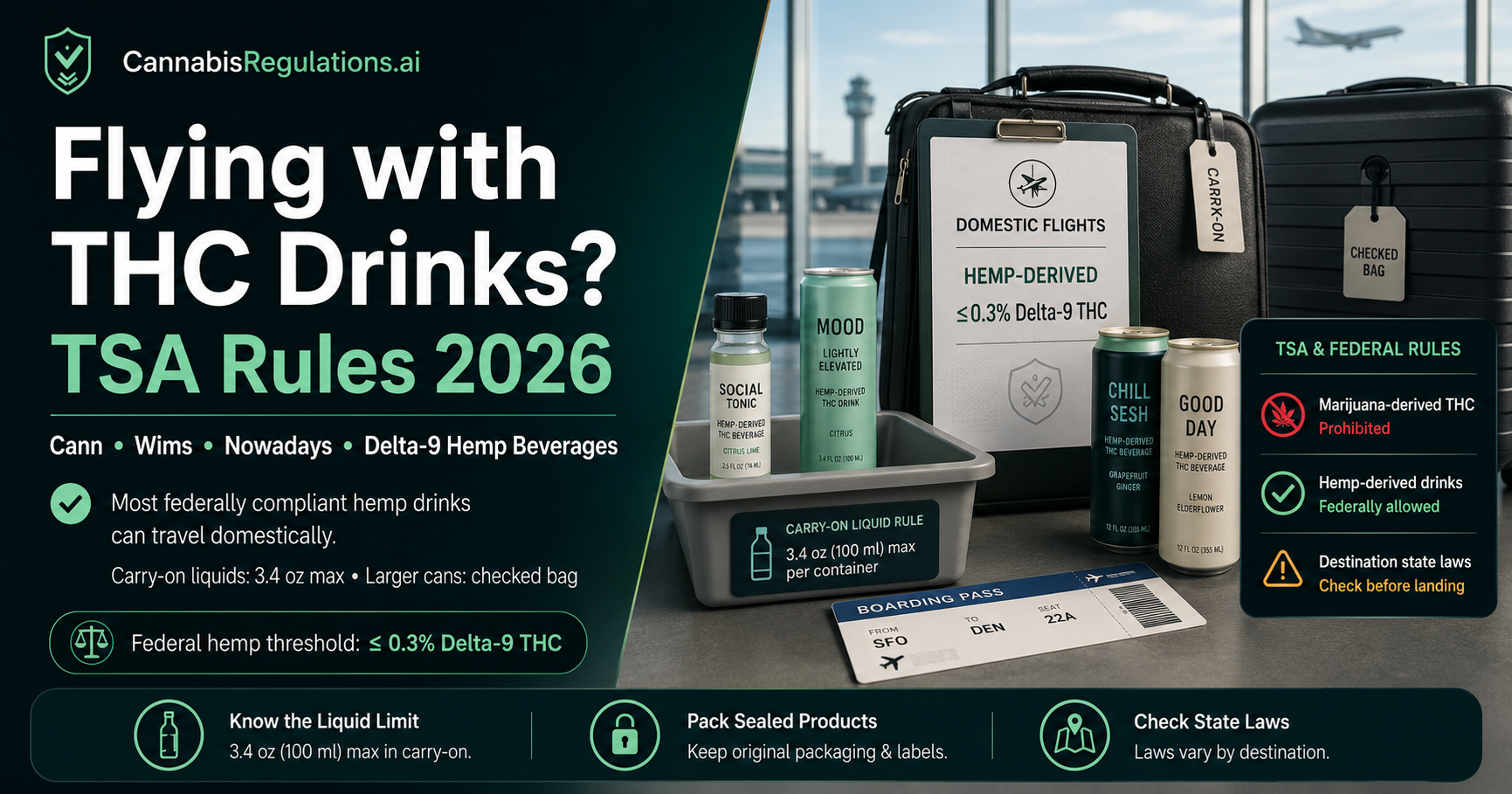
Most commercially available hemp THC beverages — including Cann Roadies, Wims Pocket Tonics, Nowadays, and similar brands — are compliant with federal hemp law and can be transported through airport security. TSA's official policy distinguishes between marijuana-derived THC (prohibited) and hemp-derived products that meet the 2018 Farm Bill's 0.3% delta-9 THC threshold (permitted under federal law). The critical number is 0.3% delta-9 THC by volume. Products from established hemp beverage brands are formulated specifically to meet this threshold. Note that this is the rule today: a federal redefinition of hemp takes effect November 12, 2026 and changes this analysis.
TSA agents are not chemists. Their mandate is security — explosives, weapons, threats. Per TSA's official guidance: "TSA security officers do not search for marijuana or other illegal drugs, but if any illegal substance is discovered during security screening, TSA will refer the matter to a law enforcement officer." Your Cann Roadies won't trigger a flagging based on appearance or odor. If a TSA agent notices them, the relevant question is whether they're federally legal — and hemp beverages at 0.3% delta-9 THC or below are federally legal.
For beverages, the primary constraint is the TSA liquids rule: carry-on liquids must be in containers of 3.4 oz (100mL) or less. Most hemp beverage cans are 8–12 oz, which means they should go in checked luggage. In checked luggage, you're not bound by the liquids restriction. Hemp beverages in their sealed original packaging travel fine as checked items.
| Product format | Examples | Carry-on | Checked bag |
|---|---|---|---|
| Shot / pocket tonic (≤3.4 oz / 100 mL) | Wims Pocket Tonic, THC shots | Yes — fits the liquids rule | Yes |
| Small can (4–7.5 oz) | Cann Roadies (4 oz) | No — exceeds 3.4 oz | Yes |
| Standard can (8–12 oz) | Cann Social Tonic, Nowadays, THC seltzers | No | Yes |
| Multi-packs / cases | 4-packs, variety packs | No | Yes — keep sealed original packaging |
This is the single most misunderstood part of flying with THC drinks. The Farm Bill threshold — 0.3% delta-9 THC — is a concentration, while the number on your can (2 mg, 5 mg, 10 mg) is a total dose. They measure different things. A 12 oz beverage weighs roughly 355 grams; 0.3% of that is over 1,000 mg of delta-9 THC. A 5 mg seltzer therefore sits at a tiny fraction of the federal concentration cap — which is exactly why beverages became the most comfortably compliant hemp category.
Practical takeaway: the milligram dose on the label tells you how strong the drink is, not whether it can fly. What matters at the airport is that the product is hemp-derived and the brand's certificate of analysis (COA) shows ≤0.3% delta-9 THC. Most major brands print a QR code linking to the COA on the can — one more reason to keep drinks in original packaging when you travel.
Yes. Cann produces drinks formulated explicitly for federal compliance — their full product line stays under the 0.3% delta-9 THC threshold. Cann Roadies are the travel-sized version of their Social Tonic. The answer is consistently: these are federally legal hemp products, the same category as CBD oil. One correction to a common assumption: Cann Roadies' 4 oz cans still exceed TSA's 3.4 oz carry-on liquids limit, so pack them — and all Cann formats — in your checked bag and avoid any conversation at security entirely.
Yes. Wims drinks are hemp-derived delta 9 beverages that comply with federal hemp law. The brand specifically designs its products for compliance. Wims' pocket-sized formats are the rare THC drink that can legitimately ride in a carry-on — if the container is 3.4 oz (100 mL) or less, the liquids rule is satisfied. Check the label; when in doubt, checked luggage in original sealed packaging is always the safe play.
Nowadays produces hemp-derived THC beverages that are federally compliant. Like Cann and Wims, the products are formulated to the 0.3% delta-9 threshold. Same guidance: checked luggage, original sealed packaging, federally compliant formulation.
The framework applies to any hemp-derived beverage that meets federal THC limits. If a brand's product complies with the 2018 Farm Bill definition of hemp, TSA's official policy doesn't prohibit it. One critical exception: dispensary beverages are marijuana-derived and cannot fly, even between two legal states.
| Brand | Typical format | Source (Aug 2026) | Can it fly? |
|---|---|---|---|
| Cann / Cann Roadies | 4 oz & 8 oz low-dose tonics | Hemp — Farm Bill compliant | Yes — checked bag |
| Wims | Pocket-size tonics | Hemp — Farm Bill compliant | Yes — carry-on if ≤3.4 oz |
| Nowadays | Bottles & cans | Hemp — Farm Bill compliant | Yes — checked bag |
| Crescent 9 | 12 oz seltzers | Hemp — Farm Bill compliant | Yes — checked bag |
| Cycling Frog | 12 oz seltzers | Hemp — Farm Bill compliant | Yes — checked bag |
| Cantrip | 12 oz seltzers | Hemp — Farm Bill compliant | Yes — checked bag |
| Happi | 12 oz seltzers | Hemp — Farm Bill compliant | Yes — checked bag |
| Artet | Aperitif bottles & cans (2.5 mg/serving) | Hemp — Farm Bill compliant | Yes — checked bag |
| Ceria Brewing | Hemp-derived THC beers | Hemp — Farm Bill compliant | Yes — checked bag |
| Sunmed THC Water | Bottled water | Hemp — Farm Bill compliant | Yes — checked bag |
| Uncle Arnie's | High-dose iced teas (dispensary) | Marijuana-derived | No — federally illegal to fly |
TSA controls the checkpoint, but the airline controls the aircraft. None of the four largest U.S. carriers — Delta, United, American, or Southwest — publishes a hemp-specific ban, and their contracts of carriage prohibit illegal substances, which compliant hemp beverages are not. Two practical rules keep you out of trouble. First, never open or consume a THC drink onboard — cabin crews treat visible cannabis consumption as a policy violation regardless of the product's legality, the same way you can't pour your own alcohol mid-flight. Second, airline policy follows the itinerary: on any international routing, the destination country's law controls, not TSA's. Policies change without notice, so check your carrier's restricted-items page the week you fly.
TSA agents who notice hemp beverages during screening have discretion. Most will not escalate a clearly labeled, commercially packaged hemp product. The scenario that goes sideways usually involves unlabeled products, homemade cannabis beverages, or products that appear to be marijuana-derived rather than hemp-derived. If a TSA agent refers the matter to airport law enforcement, the relevant question becomes: is this product federally legal? For compliant hemp beverages, the answer is yes.
Airport scanners image density and flag liquids — they cannot identify cannabinoids. A THC seltzer looks exactly like any other seltzer on the X-ray belt; if it gets pulled, it's because it's an oversized carry-on liquid, not because it's THC. As for dogs: the K9s working TSA checkpoints are overwhelmingly explosives-detection dogs, not narcotics dogs. Police narcotics dogs can detect cannabis odor compounds and cannot distinguish hemp from marijuana — but a sealed, commercially canned beverage emits minimal odor, and a federally legal hemp product isn't contraband even if noticed. The dog question matters far more for flower and vapes than for sealed drinks.
Domestic flights within the U.S. are the appropriate context for everything in this guide. Do not apply these rules to international travel. Hemp-derived products are treated very differently in other countries. Some destinations treat any cannabis-derived product as a controlled substance, with penalties up to imprisonment. Always check destination country law before packing any cannabinoid product for an international flight.
| Destination | Treatment of hemp THC drinks | Full guide |
|---|---|---|
| Japan | Zero tolerance — cannabis-derived products are controlled substances | Hemp laws in Japan |
| Singapore | Prohibited — among the world's strictest drug laws | Hemp laws in Singapore |
| United Arab Emirates | Prohibited — severe criminal penalties | Hemp laws in the UAE |
| Canada | Legal domestically, but transporting cannabis products across the border is prohibited | Hemp laws in Canada |
Even if you get through TSA cleanly, the destination state matters. Federal compliance does not override state law — several states ban or tightly restrict hemp THC drinks that are perfectly legal to carry under TSA's rules. If you're flying into a state with strict hemp restrictions, research destination laws before packing hemp beverages.
| Destination state | Rule for hemp THC drinks (Aug 2026) | Full guide |
|---|---|---|
| Idaho | Prohibited — only 0.0% THC hemp allowed | Idaho delta-9 laws |
| Kansas | Prohibited — zero-THC standard for consumables | Kansas delta-9 laws |
| New Jersey | Restricted — hemp THC drinks (≤5 mg/serving, ≤10 mg/container) only through liquor- or cannabis-licensed retailers until Nov 13, 2026; a 0.4 mg/container cap applies after | New Jersey delta-9 laws |
| California | Restricted — intoxicating hemp drinks pushed out of general retail into licensed cannabis channels | California delta-9 laws |
| Texas | In flux — 21+ age-gating with active legislative and executive action | Texas delta-9 laws |
| Minnesota | Legal — capped at 5 mg/serving, 50 mg/package | Minnesota delta-9 laws |
| Florida | Legal — Farm Bill-aligned with state hemp registration, 21+ | Florida delta-9 laws |
Everything above describes the law today — and today has an expiration date. The federal spending law enacted in November 2025 (Public Law 119-37) redefines hemp effective November 12, 2026. The new definition measures total THC (not just delta-9) and caps finished consumer products at 0.4 milligrams of total THC per container. A single 5 mg seltzer exceeds that cap by 12.5x; a 10 mg drink by 25x. Unless the product is reformulated below 0.4 mg, most hemp THC beverages on the market would fall outside the federal definition of hemp after that date — which removes the legal foundation this entire guide rests on.
Congress may still act: delay bills (H.R. 7024, S. 3686) and a repeal bill (H.R. 6209) are pending, and in early August 2026 the Senate Appropriations Committee advanced a fiscal 2027 funding bill that would push most of the new hemp restrictions back to December 11, 2026 — but as of this update none of these measures has become law, so November 12, 2026 remains the operative date. What this means for travelers is simple: the guidance in this article is reliable through November 11, 2026. If you're reading this after November 12, 2026, re-check the current status before flying with any THC beverage — and see our companion coverage of the November hemp ban countdown for the latest.
Confiscation of compliant hemp beverages is rare, but if an officer objects you have practical options: you can voluntarily surrender the item (the most common outcome — no report, no consequence), ask for a supervisor if you believe the product is being misidentified, or step out of line and return the drinks to your car or a checked bag. Keeping products sealed, labeled, and COA-scannable resolves most disputes on the spot. And remember the zero-risk alternative: hemp THC drinks are now stocked at retail in most legal states, so buying at your destination — and leaving the cans behind — is often easier than flying with them.
No — Cann standard cans (8 oz) and Cann Roadies (4 oz) both exceed TSA's 3.4 oz carry-on liquids limit. Pack them in checked luggage. The hemp compliance question is separate: yes, Cann is federally compliant.
Federally compliant hemp-derived delta 9 beverages — those at or below 0.3% delta-9 THC — are legal to take on domestic flights. TSA doesn't specifically search for hemp products. Marijuana-derived THC beverages are not permitted.
Yes. Checked luggage is the right place for THC drinks: the 3.4 oz liquids rule doesn't apply, there's no federal quantity limit for compliant hemp beverages, and sealed original packaging travels fine. Destination-state law still applies when you land.
Only if the container itself is 3.4 oz (100 mL) or smaller — a standard 12 oz seltzer can is not allowed in a carry-on regardless of THC content. The milligram dose is irrelevant to the liquids rule; container size is what matters at the checkpoint.
Yes — hemp-derived gummies under 0.3% delta-9 THC follow the same federal framework, and as solids they aren't subject to the liquids rule at all. See our full guide to bringing edibles on a plane.
TSA can refer suspicious items to law enforcement. For clearly labeled, commercially packaged hemp beverages, this rarely happens. Law enforcement in most airports are not prioritizing enforcement against federally legal hemp products.
No. X-ray scanners image density and flag liquids — they cannot identify cannabinoids. A THC seltzer looks like any other beverage; if it's flagged, it's because it's an oversized carry-on liquid, not because it contains THC.
No — hemp-derived beverages at or below 0.3% delta-9 THC are federally legal today, so flying with them domestically is not a crime. Marijuana-derived beverages are federally illegal on aircraft even between two legal states.
There is no TSA "approval" process for hemp drinks. Wims is a federally compliant hemp-derived beverage — which means it meets the standard TSA applies to hemp products. In practice: yes, Wims can travel domestically.
Any product exceeding 0.3% delta-9 THC is classified as marijuana under federal law and is not permitted on commercial flights. Check your product's COA before traveling.
Under current law, no — the federal redefinition taking effect November 12, 2026 caps hemp products at 0.4 mg total THC per container, which most THC drinks exceed many times over. Pending bills — including a Senate funding measure that would delay the change to December 11, 2026 — could postpone or repeal it; re-check this page before flying after that date.
Last Updated: August 2026
Updated August 6, 2026: Added the Senate's proposed delay of the federal hemp deadline to December 11, 2026, and corrected New Jersey's hemp-beverage rules.
Quick Answer — August 2026
You've got a four-pack of Cann Roadies in your bag and a flight to catch. Can you bring them through security? The short answer is yes — probably. Hemp-derived delta 9 beverages occupy a specific and surprisingly favorable position under TSA rules. Here's exactly how it works — and how long the window stays open.
Most commercially available hemp THC beverages — including Cann Roadies, Wims Pocket Tonics, Nowadays, and similar brands — are compliant with federal hemp law and can be transported through airport security. TSA's official policy distinguishes between marijuana-derived THC (prohibited) and hemp-derived products that meet the 2018 Farm Bill's 0.3% delta-9 THC threshold (permitted under federal law). The critical number is 0.3% delta-9 THC by volume. Products from established hemp beverage brands are formulated specifically to meet this threshold. Note that this is the rule today: a federal redefinition of hemp takes effect November 12, 2026 and changes this analysis.
TSA agents are not chemists. Their mandate is security — explosives, weapons, threats. Per TSA's official guidance: "TSA security officers do not search for marijuana or other illegal drugs, but if any illegal substance is discovered during security screening, TSA will refer the matter to a law enforcement officer." Your Cann Roadies won't trigger a flagging based on appearance or odor. If a TSA agent notices them, the relevant question is whether they're federally legal — and hemp beverages at 0.3% delta-9 THC or below are federally legal.
For beverages, the primary constraint is the TSA liquids rule: carry-on liquids must be in containers of 3.4 oz (100mL) or less. Most hemp beverage cans are 8–12 oz, which means they should go in checked luggage. In checked luggage, you're not bound by the liquids restriction. Hemp beverages in their sealed original packaging travel fine as checked items.
| Product format | Examples | Carry-on | Checked bag |
|---|---|---|---|
| Shot / pocket tonic (≤3.4 oz / 100 mL) | Wims Pocket Tonic, THC shots | Yes — fits the liquids rule | Yes |
| Small can (4–7.5 oz) | Cann Roadies (4 oz) | No — exceeds 3.4 oz | Yes |
| Standard can (8–12 oz) | Cann Social Tonic, Nowadays, THC seltzers | No | Yes |
| Multi-packs / cases | 4-packs, variety packs | No | Yes — keep sealed original packaging |
This is the single most misunderstood part of flying with THC drinks. The Farm Bill threshold — 0.3% delta-9 THC — is a concentration, while the number on your can (2 mg, 5 mg, 10 mg) is a total dose. They measure different things. A 12 oz beverage weighs roughly 355 grams; 0.3% of that is over 1,000 mg of delta-9 THC. A 5 mg seltzer therefore sits at a tiny fraction of the federal concentration cap — which is exactly why beverages became the most comfortably compliant hemp category.
Practical takeaway: the milligram dose on the label tells you how strong the drink is, not whether it can fly. What matters at the airport is that the product is hemp-derived and the brand's certificate of analysis (COA) shows ≤0.3% delta-9 THC. Most major brands print a QR code linking to the COA on the can — one more reason to keep drinks in original packaging when you travel.
Yes. Cann produces drinks formulated explicitly for federal compliance — their full product line stays under the 0.3% delta-9 THC threshold. Cann Roadies are the travel-sized version of their Social Tonic. The answer is consistently: these are federally legal hemp products, the same category as CBD oil. One correction to a common assumption: Cann Roadies' 4 oz cans still exceed TSA's 3.4 oz carry-on liquids limit, so pack them — and all Cann formats — in your checked bag and avoid any conversation at security entirely.
Yes. Wims drinks are hemp-derived delta 9 beverages that comply with federal hemp law. The brand specifically designs its products for compliance. Wims' pocket-sized formats are the rare THC drink that can legitimately ride in a carry-on — if the container is 3.4 oz (100 mL) or less, the liquids rule is satisfied. Check the label; when in doubt, checked luggage in original sealed packaging is always the safe play.
Nowadays produces hemp-derived THC beverages that are federally compliant. Like Cann and Wims, the products are formulated to the 0.3% delta-9 threshold. Same guidance: checked luggage, original sealed packaging, federally compliant formulation.
The framework applies to any hemp-derived beverage that meets federal THC limits. If a brand's product complies with the 2018 Farm Bill definition of hemp, TSA's official policy doesn't prohibit it. One critical exception: dispensary beverages are marijuana-derived and cannot fly, even between two legal states.
| Brand | Typical format | Source (Aug 2026) | Can it fly? |
|---|---|---|---|
| Cann / Cann Roadies | 4 oz & 8 oz low-dose tonics | Hemp — Farm Bill compliant | Yes — checked bag |
| Wims | Pocket-size tonics | Hemp — Farm Bill compliant | Yes — carry-on if ≤3.4 oz |
| Nowadays | Bottles & cans | Hemp — Farm Bill compliant | Yes — checked bag |
| Crescent 9 | 12 oz seltzers | Hemp — Farm Bill compliant | Yes — checked bag |
| Cycling Frog | 12 oz seltzers | Hemp — Farm Bill compliant | Yes — checked bag |
| Cantrip | 12 oz seltzers | Hemp — Farm Bill compliant | Yes — checked bag |
| Happi | 12 oz seltzers | Hemp — Farm Bill compliant | Yes — checked bag |
| Artet | Aperitif bottles & cans (2.5 mg/serving) | Hemp — Farm Bill compliant | Yes — checked bag |
| Ceria Brewing | Hemp-derived THC beers | Hemp — Farm Bill compliant | Yes — checked bag |
| Sunmed THC Water | Bottled water | Hemp — Farm Bill compliant | Yes — checked bag |
| Uncle Arnie's | High-dose iced teas (dispensary) | Marijuana-derived | No — federally illegal to fly |
TSA controls the checkpoint, but the airline controls the aircraft. None of the four largest U.S. carriers — Delta, United, American, or Southwest — publishes a hemp-specific ban, and their contracts of carriage prohibit illegal substances, which compliant hemp beverages are not. Two practical rules keep you out of trouble. First, never open or consume a THC drink onboard — cabin crews treat visible cannabis consumption as a policy violation regardless of the product's legality, the same way you can't pour your own alcohol mid-flight. Second, airline policy follows the itinerary: on any international routing, the destination country's law controls, not TSA's. Policies change without notice, so check your carrier's restricted-items page the week you fly.
TSA agents who notice hemp beverages during screening have discretion. Most will not escalate a clearly labeled, commercially packaged hemp product. The scenario that goes sideways usually involves unlabeled products, homemade cannabis beverages, or products that appear to be marijuana-derived rather than hemp-derived. If a TSA agent refers the matter to airport law enforcement, the relevant question becomes: is this product federally legal? For compliant hemp beverages, the answer is yes.
Airport scanners image density and flag liquids — they cannot identify cannabinoids. A THC seltzer looks exactly like any other seltzer on the X-ray belt; if it gets pulled, it's because it's an oversized carry-on liquid, not because it's THC. As for dogs: the K9s working TSA checkpoints are overwhelmingly explosives-detection dogs, not narcotics dogs. Police narcotics dogs can detect cannabis odor compounds and cannot distinguish hemp from marijuana — but a sealed, commercially canned beverage emits minimal odor, and a federally legal hemp product isn't contraband even if noticed. The dog question matters far more for flower and vapes than for sealed drinks.
Domestic flights within the U.S. are the appropriate context for everything in this guide. Do not apply these rules to international travel. Hemp-derived products are treated very differently in other countries. Some destinations treat any cannabis-derived product as a controlled substance, with penalties up to imprisonment. Always check destination country law before packing any cannabinoid product for an international flight.
| Destination | Treatment of hemp THC drinks | Full guide |
|---|---|---|
| Japan | Zero tolerance — cannabis-derived products are controlled substances | Hemp laws in Japan |
| Singapore | Prohibited — among the world's strictest drug laws | Hemp laws in Singapore |
| United Arab Emirates | Prohibited — severe criminal penalties | Hemp laws in the UAE |
| Canada | Legal domestically, but transporting cannabis products across the border is prohibited | Hemp laws in Canada |
Even if you get through TSA cleanly, the destination state matters. Federal compliance does not override state law — several states ban or tightly restrict hemp THC drinks that are perfectly legal to carry under TSA's rules. If you're flying into a state with strict hemp restrictions, research destination laws before packing hemp beverages.
| Destination state | Rule for hemp THC drinks (Aug 2026) | Full guide |
|---|---|---|
| Idaho | Prohibited — only 0.0% THC hemp allowed | Idaho delta-9 laws |
| Kansas | Prohibited — zero-THC standard for consumables | Kansas delta-9 laws |
| New Jersey | Restricted — hemp THC drinks (≤5 mg/serving, ≤10 mg/container) only through liquor- or cannabis-licensed retailers until Nov 13, 2026; a 0.4 mg/container cap applies after | New Jersey delta-9 laws |
| California | Restricted — intoxicating hemp drinks pushed out of general retail into licensed cannabis channels | California delta-9 laws |
| Texas | In flux — 21+ age-gating with active legislative and executive action | Texas delta-9 laws |
| Minnesota | Legal — capped at 5 mg/serving, 50 mg/package | Minnesota delta-9 laws |
| Florida | Legal — Farm Bill-aligned with state hemp registration, 21+ | Florida delta-9 laws |
Everything above describes the law today — and today has an expiration date. The federal spending law enacted in November 2025 (Public Law 119-37) redefines hemp effective November 12, 2026. The new definition measures total THC (not just delta-9) and caps finished consumer products at 0.4 milligrams of total THC per container. A single 5 mg seltzer exceeds that cap by 12.5x; a 10 mg drink by 25x. Unless the product is reformulated below 0.4 mg, most hemp THC beverages on the market would fall outside the federal definition of hemp after that date — which removes the legal foundation this entire guide rests on.
Congress may still act: delay bills (H.R. 7024, S. 3686) and a repeal bill (H.R. 6209) are pending, and in early August 2026 the Senate Appropriations Committee advanced a fiscal 2027 funding bill that would push most of the new hemp restrictions back to December 11, 2026 — but as of this update none of these measures has become law, so November 12, 2026 remains the operative date. What this means for travelers is simple: the guidance in this article is reliable through November 11, 2026. If you're reading this after November 12, 2026, re-check the current status before flying with any THC beverage — and see our companion coverage of the November hemp ban countdown for the latest.
Confiscation of compliant hemp beverages is rare, but if an officer objects you have practical options: you can voluntarily surrender the item (the most common outcome — no report, no consequence), ask for a supervisor if you believe the product is being misidentified, or step out of line and return the drinks to your car or a checked bag. Keeping products sealed, labeled, and COA-scannable resolves most disputes on the spot. And remember the zero-risk alternative: hemp THC drinks are now stocked at retail in most legal states, so buying at your destination — and leaving the cans behind — is often easier than flying with them.
No — Cann standard cans (8 oz) and Cann Roadies (4 oz) both exceed TSA's 3.4 oz carry-on liquids limit. Pack them in checked luggage. The hemp compliance question is separate: yes, Cann is federally compliant.
Federally compliant hemp-derived delta 9 beverages — those at or below 0.3% delta-9 THC — are legal to take on domestic flights. TSA doesn't specifically search for hemp products. Marijuana-derived THC beverages are not permitted.
Yes. Checked luggage is the right place for THC drinks: the 3.4 oz liquids rule doesn't apply, there's no federal quantity limit for compliant hemp beverages, and sealed original packaging travels fine. Destination-state law still applies when you land.
Only if the container itself is 3.4 oz (100 mL) or smaller — a standard 12 oz seltzer can is not allowed in a carry-on regardless of THC content. The milligram dose is irrelevant to the liquids rule; container size is what matters at the checkpoint.
Yes — hemp-derived gummies under 0.3% delta-9 THC follow the same federal framework, and as solids they aren't subject to the liquids rule at all. See our full guide to bringing edibles on a plane.
TSA can refer suspicious items to law enforcement. For clearly labeled, commercially packaged hemp beverages, this rarely happens. Law enforcement in most airports are not prioritizing enforcement against federally legal hemp products.
No. X-ray scanners image density and flag liquids — they cannot identify cannabinoids. A THC seltzer looks like any other beverage; if it's flagged, it's because it's an oversized carry-on liquid, not because it contains THC.
No — hemp-derived beverages at or below 0.3% delta-9 THC are federally legal today, so flying with them domestically is not a crime. Marijuana-derived beverages are federally illegal on aircraft even between two legal states.
There is no TSA "approval" process for hemp drinks. Wims is a federally compliant hemp-derived beverage — which means it meets the standard TSA applies to hemp products. In practice: yes, Wims can travel domestically.
Any product exceeding 0.3% delta-9 THC is classified as marijuana under federal law and is not permitted on commercial flights. Check your product's COA before traveling.
Under current law, no — the federal redefinition taking effect November 12, 2026 caps hemp products at 0.4 mg total THC per container, which most THC drinks exceed many times over. Pending bills — including a Senate funding measure that would delay the change to December 11, 2026 — could postpone or repeal it; re-check this page before flying after that date.