

Sign Up
Ready to replace complexity with clarity?
Answer your real world compliance questions (limited time) and save thousands in legal fees and avoided fines.
Automate Compliance Today

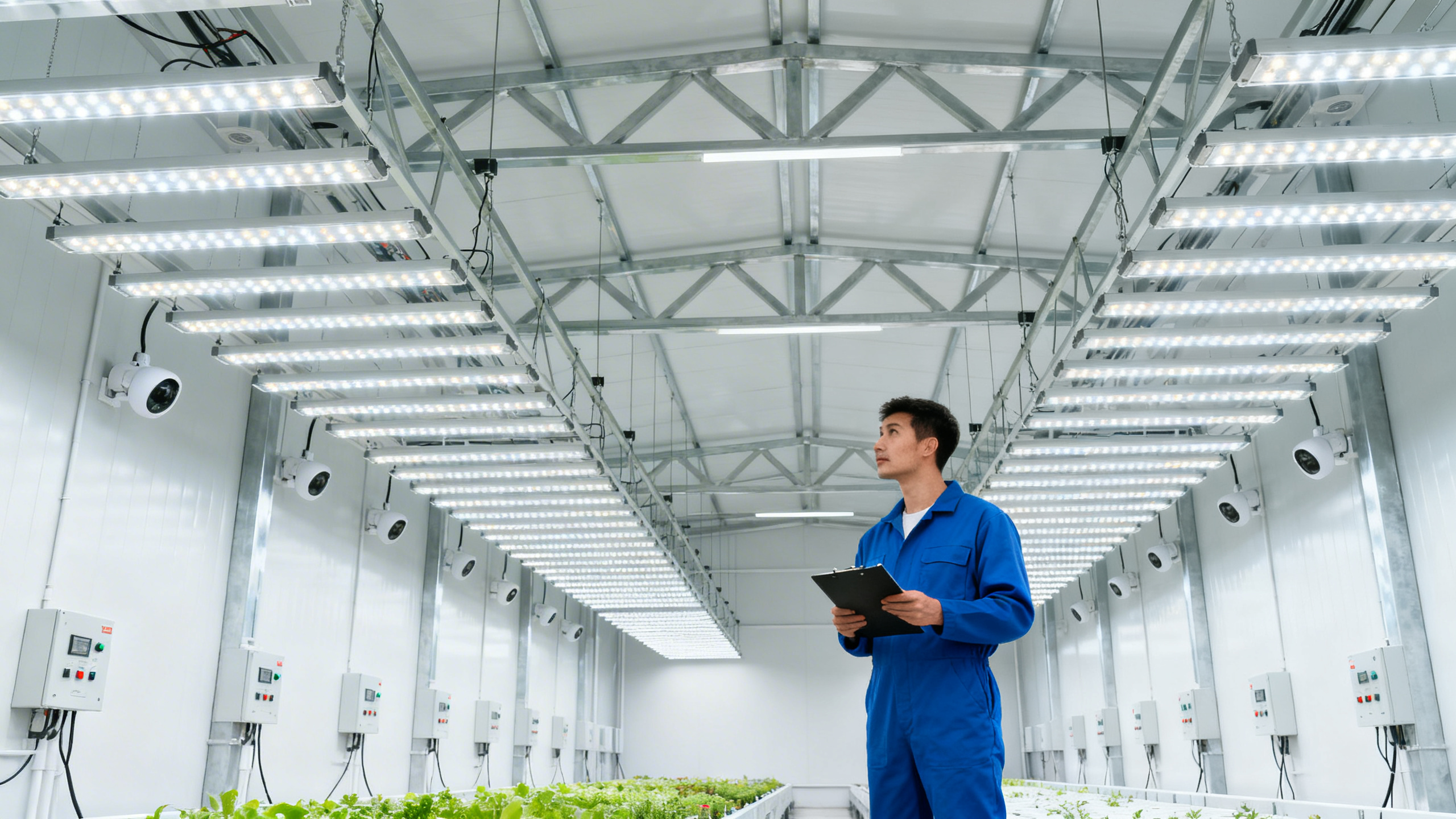
California’s Building Energy Efficiency Standards—better known as Title 24, Part 6—update on a three‑year cycle, and the 2025 Energy Code becomes effective January 1, 2026 for projects that submit for permit on/after that date. For controlled environment horticulture (CEH), the 2025 cycle continues a clear policy direction: treat high‑intensity cultivation lighting as a major building load that must be designed, controlled, verified, and documented like other high‑impact nonresidential systems.
The practical takeaway for operators is simple: if your facility is planning a new build, a tenant improvement, or a lighting retrofit that triggers energy code scope, you should assume that lighting efficacy targets will be harder to meet, lighting power allowances will be tighter, and acceptance testing documentation will be scrutinized.
Key references for compliance teams and designers:
Note: This article is informational and focuses on compliance planning. Always confirm your exact obligations with your project’s energy consultant, the Authority Having Jurisdiction (AHJ), and the applicable adopted code language.
Stakeholder materials for the 2025 cycle—especially the CASE report package—signal three areas where projects feel the squeeze:
Each of those interacts with typical cultivation constraints: high humidity, corrosive environments, frequent washdowns, dense overhead infrastructure, and the need for reliable emergency lighting and egress.
Most building lighting standards historically revolve around visual lighting: lumens and watts. CEH flips the script: your performance target is tied to photosynthetically active radiation (PAR) and the photons delivered to the canopy.
The Statewide CASE materials for CEH discuss minimum efficacy requirements for horticultural luminaires and emphasize efficiency improvements as the primary savings mechanism. In cultivation terms, efficacy is usually expressed as μmol/J (micromoles of photons per joule). Higher is better: you get more usable photons for the same electrical input.
Compliance planning implications:
Even when you choose high‑efficacy fixtures, your project can still fail if the overall installed lighting power is too high for the allowed method.
In practice, tighter LPD/power allowances force:
When stakeholders mention “removal of legacy compliance methods,” what they are usually warning about is the loss (or narrowing) of paths that previously allowed overly generous lighting power assumptions without strong performance justification.
Your energy code compliance documentation generally flows through:
The CEC hosts the official forms and instructions; Energy Code Ace also mirrors organized form libraries widely used by practitioners.
Start here:
One example that will look familiar to project teams is the CEC-NRCI-LTI-E “Indoor Lighting Certificate of Installation,” which explicitly calls out controls categories (time-switch, occupancy sensors, daylighting, demand response, institutional tuning, etc.). See: https://www.energy.ca.gov/filebrowser/download/8489?fid=8489
If your compliance approach uses performance modeling, the CEC lists approved tools for the 2025 cycle. The public domain suite is California Building Energy Code Compliance (CBECC). This matters because some CEH projects will be forced into performance approaches once prescriptive assumptions no longer pencil.
The 2025 Energy Code continues to treat lighting controls as a mandatory and enforceable component—not an optional add‑on. At a high level, the mandatory requirements for lighting controls appear in Section 110.9 (as published in code access platforms), and include categories like time-switch controls, daylight responsive controls, dimmers, and occupant/automatic controls.
For code text navigation (reference access): https://codes.iccsafe.org/content/CAEC2025P1
For CEH spaces, controls often collide with operational reality:
The better approach is to treat controls as part of the cultivation recipe:
Acceptance testing is where projects that “look fine” on paper can fail at final.
Acceptance testing is a required verification process—performed by a qualified technician under the Energy Code Compliance (ECC) program rules—intended to prove that installed controls and systems actually function as required.
CEC’s acceptance testing overview document (lighting controls acceptance testing procedures are referenced in the nonresidential appendices): https://www.energy.ca.gov/filebrowser/download/8651?fid=8651
CEH spaces are control-dense:
Each of those can create failure points:
Before final inspection, make sure your GC, electrician, controls contractor, and consultant can answer these without searching emails:
If acceptance testing is treated as an end-of-project paperwork step, it tends to become a rework step.
A common operator fear is that a tighter code means lower yields. In reality, the code is pushing teams toward a more measurable, modern design process.
Instead of “this room is 900 PPFD,” define:
This lets designers reduce wasted overlap and keep wattage within allowances.
Make sure your luminaire selection can be defended with:
Even if a product is excellent, you still need it to be documentable.
Dimming is not just energy savings—it’s operational flexibility:
Lighting watts become heat. When you reduce lighting power density, you may also change:
Aligning lighting and mechanical avoids the classic “we passed plan check but the room doesn’t hold setpoints” problem.
Greenhouse projects add a variable that indoor rooms don’t have: the sun.
Even when the exact code trigger language differs by zone type and daylit area thresholds, the compliance direction is consistent: daylight responsive behavior needs to be automatic, measurable, and verifiable.
Operator best practices:
The biggest risk is “paper compliance” with daylight controls that were never tuned, which can lead to acceptance testing failures or operational complaints.
Many operators plan lighting upgrades as “simple swaps.” Title 24’s additions and alterations rules can still apply depending on scope. The CEC CEH FAQ page explicitly discusses where CEH requirements live for additions/alterations and new construction.
Start with the CEH FAQ and then confirm with your energy consultant:
California investor-owned utility programs often use qualifying product lists and technical requirements (commonly via the DesignLights Consortium for many commercial lighting segments, including horticultural categories) as part of rebate eligibility screens. While rebate rules are not the same as Title 24 compliance, projects frequently need to satisfy both.
Best practice for finance and compliance teams:
Industry overview on QPL use in programs: https://inside.lighting/news/26-01/lighting-controls-get-rebate-boost-latest-dlc-guidelines
Your research note about conflicts with electrical and fire code is exactly right: energy compliance should never create a life-safety gap.
Common coordination points in humid/wet CEH environments:
Treat these as design constraints, not field fixes.
AHJs vary, but most plan check delays come from missing clarity rather than truly noncompliant designs.
A strong packet typically includes:
If you operate multiple sites, standardize this packet so every project starts with the same “compliance spine.”
For projects targeting permit submittal in 2026:
The reason to start early is not just code—it’s procurement. High-performing fixtures and controls can have long lead times.
California’s Title 24 updates are only one slice of the broader compliance stack that cultivation operators manage—building permits, operational compliance, inspections, and documentation retention.
Use https://www.cannabisregulations.ai/ to track California compliance updates, build inspection-ready documentation workflows, and reduce the operational risk of code-driven retrofits and facility expansions.