


Sign Up
Ready to replace complexity with clarity?
Answer your real world compliance questions (limited time) and save thousands in legal fees and avoided fines.
Automate Compliance Today

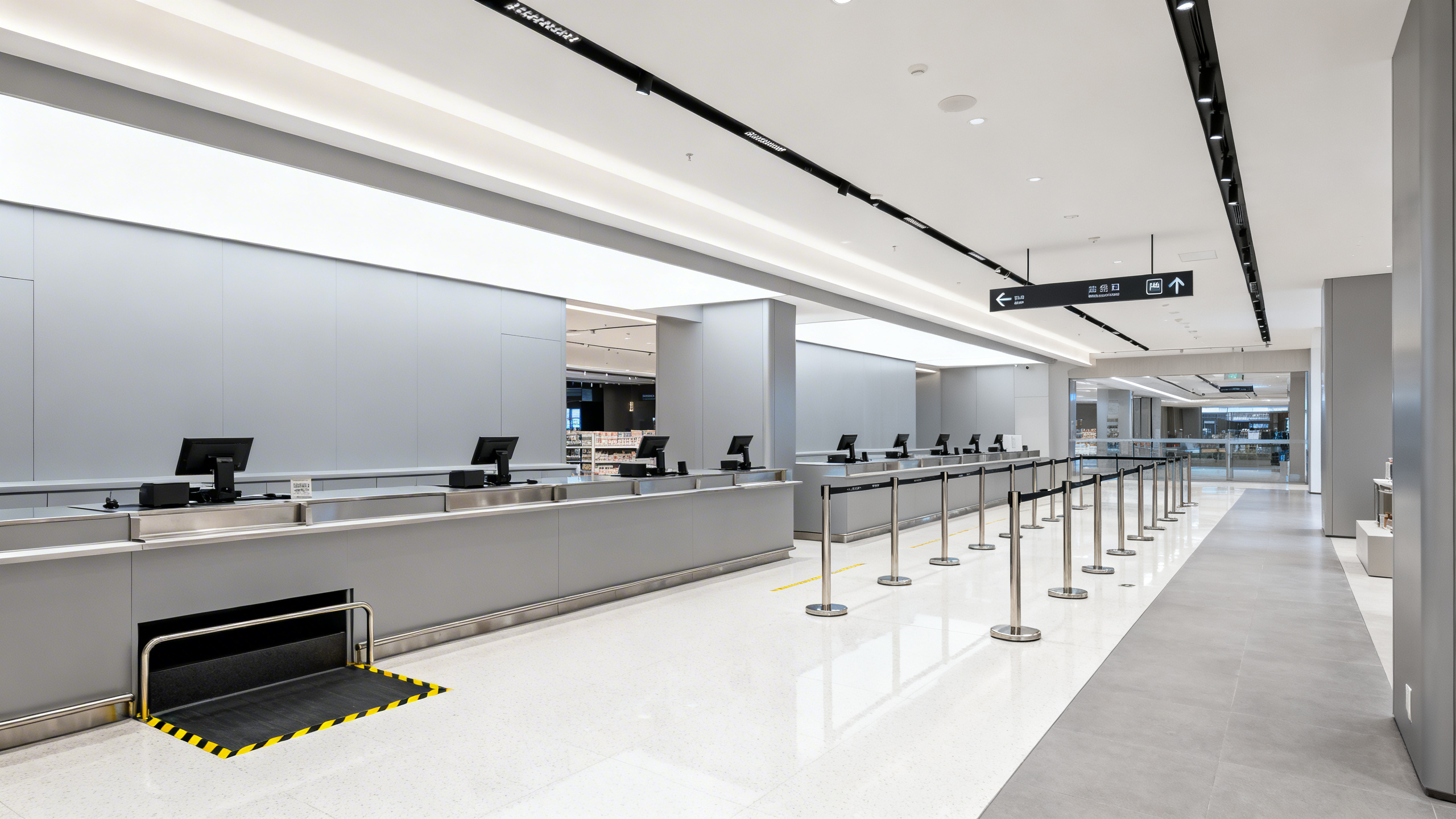
In the U.S., most retail stores open to the public—including age‑restricted retail formats—are treated as public accommodations under ADA Title III. That means customers with disabilities must have an equal opportunity to access the store’s goods, services, and facilities.
For many operators, ADA compliance conversations still skew heavily toward websites and e‑commerce. But the day‑to‑day risk in physical stores is often more immediate: an inaccessible transaction counter, a stanchioned queue that narrows below minimum clear width, an ID scanner mounted too high, or product displays that eliminate turning space.
Two other factors make this especially urgent in 2025–2026:
This article focuses on the most common brick‑and‑mortar pitfalls in cannabis/hemp retail build‑outs and remodels—especially around counters, queues, and ID checks—and ties them back to core federal requirements.
Informational only: This post is for general compliance education and is not legal advice. For project‑specific decisions, consult qualified counsel and a licensed design professional.
ADA compliance for physical retail has three layers operators should understand:
Title III requires equal access to goods and services. Practically, that drives expectations for how customers move from parking to entry to sales floor to point of sale, and how staff handle the ID‑check process.
The 2010 Standards include both scoping requirements (how many accessible elements you must have) and technical requirements (exact dimensions, clearances, heights, reach ranges). The official PDF is also available at https://archive.ada.gov/regs2010/2010ADAStandards/2010ADAStandards.pdf.
Even if your store is older, Title III can still require barrier removal where it is “readily achievable” (28 CFR § 36.304), and it requires maintenance of accessible features so they don’t get blocked by fixtures or merchandise (28 CFR § 36.211). See the eCFR versions:
In other words: even if you built it right, you can “operate it wrong” by letting displays, portable signs, or queue equipment obstruct the accessible route.
Transaction counters and service counters are where accessibility issues become visible fast—especially in controlled‑entry, age‑restricted formats that push every customer through an ID check and a checkout interaction.
Where counters are provided, at least one of each type of sales counter and service counter must comply (see the scoping rules in 2010 Standards Chapter 2, § 227.3 as implemented through the Standards’ counter requirements). Many stores have multiple “types” without realizing it:
If they function differently, treat them as different counter types when planning accessibility.
The 2010 Standards provide detailed counter requirements in § 904.4 Sales and Service Counters. Primary rule: provide an accessible portion with clear floor space.
Key technical points (see § 904.4 on Access Board’s site: https://www.access-board.gov/ada/chapter/ch09/ and the text‑specific mirror at https://www.corada.com/documents/2010ADAStandards/904-4):
Common pitfall in cannabis/hemp retail: a beautiful “monolithic” counter at 40–42 inches with no lowered section and a fixed payment device. Even if staff “can help,” the built environment often still fails the Standards.
Even if you include a 36"‑high accessible portion, the checkout can still fail if the customer must use:
The Standards’ reach range rules (§ 308) and operable parts rules (§ 309) are the backbone for these devices:
Practical fix operators use: a movable/tethered card terminal or a portable signature device that can be brought to the accessible counter portion. This is not a substitute for required built features in new construction/alterations, but it can be an important operational control—especially in existing stores while physical upgrades are planned.
Cannabis/hemp retail often relies on security‑driven queuing: controlled entry, check‑in, waiting, then a guided path to point of sale. This makes the queue layout one of the highest‑risk accessibility items in day‑to‑day operations.
Accessible routes and circulation paths generally require a 36 inches minimum clear width (2010 Standards § 403.5.1). See: https://www.corada.com/documents/2010ADAStandards/403-5-1.
The Standards allow limited pinch points (32" minimum for short distances under specific conditions), but stores should not design their primary queue around pinch‑point exceptions.
Common pitfall: stanchion bases, promotional signs, portable heaters/fans, or product “impulse” towers that reduce the queue corridor to 28–34 inches.
Two issues come up repeatedly in stanchioned lines:
In practice, the queue should be designed so a wheelchair user can:
Even when clear width is technically met, stanchions, ropes, wall‑mounted displays, and fixtures can create hazards for customers who are blind or have low vision.
The Standards’ protruding objects rule (§ 307.2) limits objects mounted 27"–80" above the floor to 4 inches maximum protrusion into circulation paths (see § 307 at https://www.corada.com/documents/2010ADAStandards/307).
Common pitfall: wall‑mounted menu monitors, decorative shelving, or small product cases projecting into the queue path at chest/shoulder height.
Age‑restricted retail adds a unique access point: the ID check. Many stores implement a “two‑step” entry:
1) ID verification at reception/vestibule2) Controlled entry to the sales floor
If your ID verification uses a fixed scanner or kiosk‑like device, treat it like any other operable element:
Even if your device vendor markets “accessible hardware,” your installation height and counter design are what matter.
Physical compliance is only half the story. Title III also requires reasonable modifications in policies, practices, or procedures when necessary to afford access, unless doing so would fundamentally alter the nature of the goods/services (see 28 CFR § 36.302: https://www.ecfr.gov/current/title-28/chapter-I/part-36/subpart-C/section-36.302).
For ID checks, that can mean having a clear, trained process for:
Stores also benefit from aligning these policies with security SOPs so staff don’t improvise under pressure.
If your ID check includes verbal instructions, security screening explanations, or transaction confirmations, remember Title III’s effective communication obligations. The DOJ’s general guidance is at https://www.ada.gov/resources/effective-communication/.
Examples of operational controls:
Cannabis/hemp retailers often change planograms frequently—seasonal product pushes, vendor takeovers, pop‑up displays, new accessory walls. These changes can unintentionally break accessibility.
The accessible route through the store must remain clear. The baseline 36" clear width is again the reference point (see § 403.5.1).
If you create narrow “discovery corridors,” ensure there is a compliant route to access goods/services. The DOJ Title III Technical Assistance Manual notes that even where making every aisle accessible may not be readily achievable in an existing facility, businesses should provide access to goods/services through alternative methods where required and should remove barriers where readily achievable (see manual landing page: https://www.ada.gov/resources/title-iii-manual/).
Don’t eliminate the ability to turn around at:
The turning space standard is typically 60" diameter (2010 Standards § 304).
Many stores use vestibules, security “mantraps,” or double‑door entry sequences. Door compliance issues frequently arise when queue stanchions or fixtures intrude into door maneuvering clearance.
Key door rules to remember:
Common pitfall: placing the queue so close to the entry door that a wheelchair user cannot position themselves to pull the door open or cannot clear the swing.
Many operators focus on interior layout and forget that Title III access starts at arrival.
The Standards require accessible spaces where parking is provided, located on the shortest accessible route to an accessible entrance (see § 208 on parking location: https://www.corada.com/documents/2010ADAStandards/208).
For dimensions and access aisles, see DOJ’s compliance brief on restriping parking at https://www.ada.gov/resources/restriping-parking-spaces/.
Accessible routes must connect key site arrival points (parking, public sidewalks, transit stops) to accessible entrances (see § 206.2.1 conceptually; the Standards’ accessible route framework is in Chapter 4).
In cannabis/hemp retail, this is especially relevant for:
ADA Title III enforcement happens via:
Retail accessibility has long been a DOJ focus area in technical assistance materials (including the Title III manual and DOJ publications on maintaining accessible features). A useful example resource on keeping accessible routes clear in retail environments is available via ADA centers and local government reposts, such as “Maintaining Accessible Features in Retail Establishments” (PDF repost example): https://www.mariposacounty.gov/DocumentCenter/View/89141/Maintaining-Accessible-Features-in-Retail-Establishments.
Even though some high‑profile actions focus on digital access, physical access claims remain straightforward to evaluate and quick to plead—especially where measurements show counter heights, door widths, and queue clearances outside the Standards.
Queueing and security layouts also implicate:
The ADA’s “accessible route” is not identical to a building code “means of egress,” but they interact. The Access Board notes that accessible means of egress concepts reference the International Building Code (IBC) framework in certain contexts (see Access Board guide: https://www.access-board.gov/ada/guides/chapter-4-accessible-means-of-egress/).
Best practice for 2025–2026 projects: when you revise a queue or add a security vestibule, coordinate the plan with your architect, fire marshal/building official, and accessibility consultant so:
Use this as a quick audit tool before opening day and anytime you change fixtures or queue layouts.
Strong accessibility practices reduce legal exposure and improve customer experience—especially in controlled‑entry retail where every customer must pass through the same checkpoints.
If you’re planning a new build‑out, renovation, or queue redesign, use https://cannabisregulations.ai/ to centralize your cannabis compliance workflow—policies, training logs, inspection checklists, and build‑out documentation—so ADA risk management becomes part of your standard operating playbook rather than a last‑minute scramble.