

Sign Up
Ready to replace complexity with clarity?
Answer your real world compliance questions (limited time) and save thousands in legal fees and avoided fines.
Automate Compliance Today

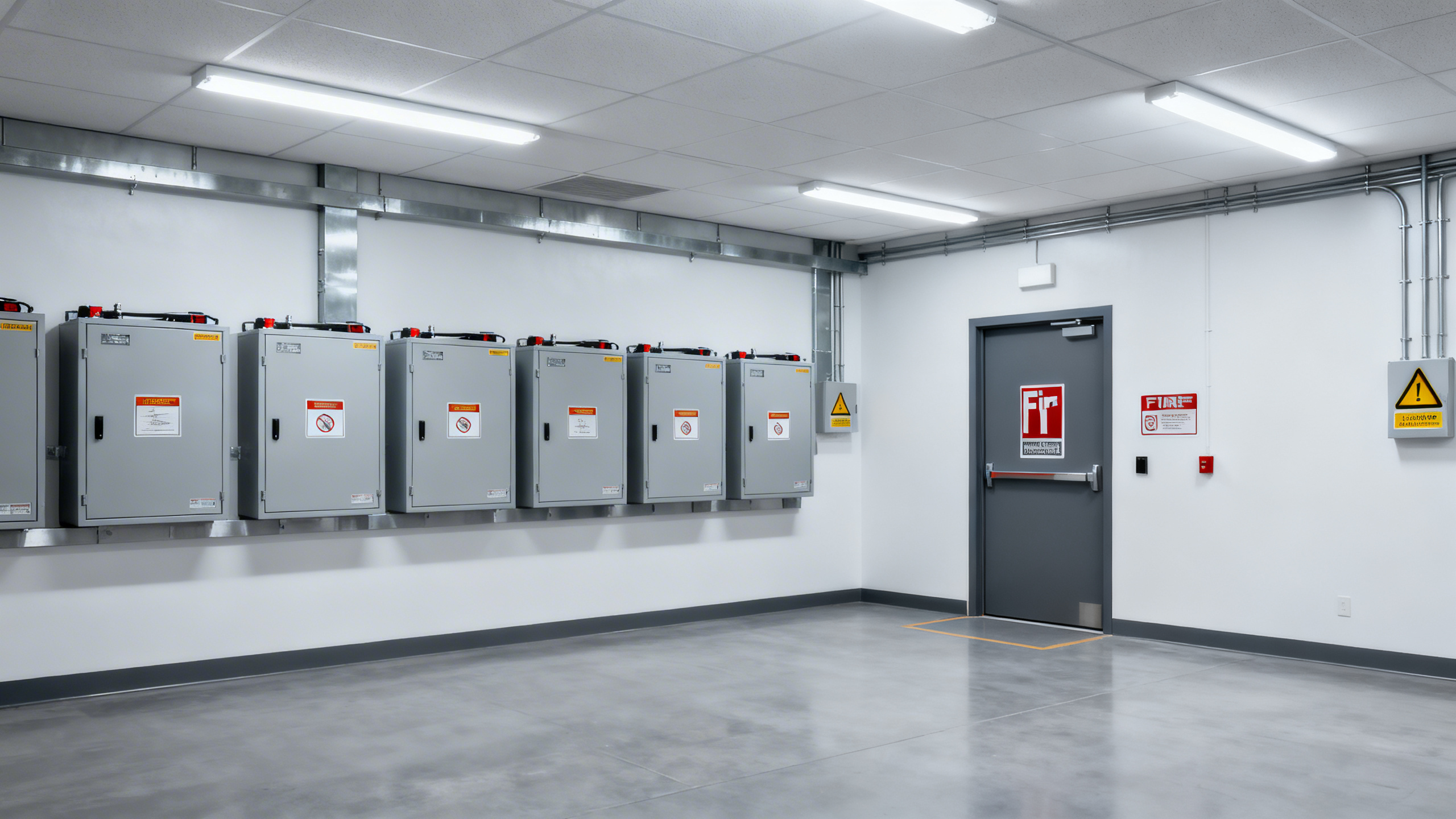
In California indoor cultivation and beverage co‑packing facilities, lithium‑ion energy storage systems (ESS) have moved from “nice-to-have” to “mission critical.” Operators are using batteries to reduce demand charges, smooth peak loads from HVAC and dehumidification, and ride through utility outages without relying solely on diesel.
At the same time, fire officials are taking a much closer look at ESS rooms—especially when they’re colocated with other higher‑hazard spaces such as extraction areas, solvent storage, charging areas for material handling equipment, and electrical rooms. By late 2025, many California jurisdictions are explicitly referencing NFPA 855, UL 9540, UL 9540A, and the International Fire Code (IFC) framework (often with local amendments).
This guide focuses on the real-world permitting pathway and “what plan reviewers actually ask for” in California, with a specific emphasis on the focus keyword: NFPA 855 cannabis energy storage compliance. It is informational only and not legal advice.
Indoor cultivation and beverage production sites have a few characteristics that make ESS permitting more complex than a typical warehouse battery install:
From a permitting standpoint, the shift in late 2025 is that many Authorities Having Jurisdiction (AHJs) no longer accept a generic cut sheet and a one-line diagram. They want to see the “story of safety”: testing evidence, room design strategy, shutdown and annunciation, and how responders will be informed and protected.
California projects typically encounter a stack of requirements rather than one single “ESS code.”
NFPA 855 is the primary installation safety standard for stationary energy storage. It addresses topics such as separation, fire protection, ventilation, gas detection, explosion control, commissioning, operations, and decommissioning. AHJs often use NFPA 855 as the lens for deciding whether your design is adequately prescriptive or whether you’ve justified a performance approach.
External reference: https://www.nfpa.org/product/nfpa-855-standard/p0855code
A practical late‑2025 takeaway: even when an AHJ is enforcing the California Fire Code edition currently adopted locally, plan reviewers frequently cite NFPA 855 as an “approved standard” to clarify expectations—especially around documentation such as hazard analyses and emergency planning.
These get confused constantly in submittals.
External reference (UL 9540A overview): https://www.ul.com/services/ul-9540a-test-method
In late 2025, the “fast track” path is usually: use a UL 9540 listed ESS and provide a UL 9540A report package that matches the exact configuration you’re installing. When the report doesn’t match (different cell chemistry, cabinet, module arrangement, or enclosure), expect additional engineering, testing justification, or more conservative prescriptive controls.
The IFC (and local adoption of it) is where you’ll typically see enforceable provisions for:
Reference (IFC 2024, Chapter 12 viewer): https://codes.iccsafe.org/content/IFC2024P1/chapter-12-energy-systems
If you’re designing or applying around the end of 2025, timing matters.
The California Energy Commission’s Energy Storage Permitting Guidebook notes:
External reference (CEC guidebook PDF): https://efiling.energy.ca.gov/GetDocument.aspx?tn=268282&DocumentContentId=105452
Even within the 2022 cycle, many AHJs use local amendments, bulletins, and policy memos that incorporate NFPA 855 concepts. In other words: don’t assume “older code cycle” equals “lighter ESS scrutiny.”
California is not one permitting jurisdiction. You will deal with:
Many departments now treat ESS as a specialized hazard. The outcome is predictable: early concept meetings with the AHJ save months of redesign.
A useful planning approach is to schedule a “30% design” consult and bring:
Below is a practical roadmap that aligns with late‑2025 expectations and keeps your team focused on the typical plan-review friction points.
Before design drawings, define what the battery will actually do:
This matters because it drives the electrical architecture, shutdown logic, and what must remain powered during an emergency.
Most indoor operators want the ESS near the main electrical service to reduce conduit runs. Fire reviewers want to see that you’ve considered:
Late‑2025 best practice is to treat the ESS area as its own “battery room” or rated enclosure unless you have strong UL 9540A data and an approved alternative design.
AHJs commonly ask: “Is this UL 9540A report for this exact product and this exact installation arrangement?”
To avoid delays, confirm the report(s) address the relevant test level(s) for your installation:
If you’re using multiple cabinets, different inverter skids, or stacking configurations, be prepared to show how the test configuration matches your site design.
UL provides an AHJ-focused checklist concept for reviewing UL 9540A data; even if you don’t submit that checklist, using it internally helps you anticipate reviewer questions.
External reference (UL 9540A AHJ checklist PDF): https://code-authorities.ul.com/wp-content/uploads/sites/46/2020/09/UL-9540A-AHJ-Checklist_Rev-2.pdf
In late 2025, reviewers are less interested in brand names and more interested in whether your chosen strategy is consistent with:
Sprinklers are common because they are familiar, code-recognized, and provide exposure protection; however, you must plan for water flow, discharge management, and post-event cleanup.
Clean agent systems may help protect equipment but can be challenged by re‑ignition potential and the need for room integrity. Some AHJs will request strong supporting test evidence before accepting clean agent as the primary control for thermal runaway scenarios.
A property insurer may also drive requirements. FM’s loss prevention guidance for lithium-ion ESS (Data Sheet 5-33) is frequently referenced by risk engineers.
External reference (FM DS 5-33 PDF): https://www.fm.com/FMAApi/data/ApprovalStandardsDownload?itemId=%7BFB314761-0A9C-4B8C-9410-A31D6792170B%7D
Plan reviewers increasingly look for an integrated narrative covering:
In many NFPA 855 discussions and training materials, an exhaust ventilation rate (often cited as 1 cfm/ft² in certain contexts) is used as a design reference point, with the design objective of keeping flammable gases below a fraction of the lower flammability limit (LFL). Whether that exact rate applies to your project will depend on the adopted code, system characteristics, and the UL 9540A gas generation data.
Spacing is one of the clearest places where UL 9540A and NFPA 855 meet.
Your drawings should clearly show:
If you’re placing ESS near other regulated spaces (including extraction rooms classified C1D1/C1D2), your team must evaluate whether the ESS room creates new ignition sources, changes ventilation balance, or complicates hazardous location boundaries.
Expect questions like:
A strong submittal includes a simple cause-and-effect matrix in narrative form (not a table), describing what happens when:
Late‑2025 AHJs increasingly expect a commissioning plan that proves the ESS safety functions work as installed. Even when not explicitly required by your local code edition, providing it voluntarily can reduce inspection friction.
Your commissioning plan should cover:
Reference (IFC commissioning plan hooks exist in Chapter 12): https://codes.iccsafe.org/content/IFC2024P1/chapter-12-energy-systems
Below is a field-ready checklist you can adapt so it dovetails with extraction room hazardous classifications and broader facility life safety.
FM’s guidance emphasizes preparing emergency response procedures to enable safe entry and response in the ESS area—this aligns well with what many California fire prevention bureaus want to see in practice.
External reference (FM DS 5-33 PDF): https://www.fm.com/FMAApi/data/ApprovalStandardsDownload?itemId=%7BFB314761-0A9C-4B8C-9410-A31D6792170B%7D
Fix: request a permitting package from the manufacturer that includes a non-confidential executive summary plus the portions needed to verify gas generation assumptions, propagation behavior, and required mitigation measures.
Fix: provide a mechanical narrative with the design basis (gas generation assumptions, LFL target), and include detector alarm setpoints and corresponding ventilation commands.
Fix: submit system design criteria, listing/approval documentation, and explain how the chosen suppression strategy is supported by testing or engineering analysis for the particular ESS.
Fix: define exactly what is de-energized, what remains energized, and how responders will operate the shutdown without entering hazardous areas.
Fix: include adjacent hazards on plans, not just the ESS room. When extraction rooms are present, include a brief code coordination note addressing hazardous location boundaries and interlocks.
External reference (CEC guidebook PDF): https://efiling.energy.ca.gov/GetDocument.aspx?tn=268282&DocumentContentId=105452
While ESS rooms are typically back-of-house, their safety design affects:
If you have public-facing components (tours, retail areas, tastings), ensure your emergency action plan accounts for ESS alarms and potential smoke movement pathways.
This article is for general informational purposes about California permitting and fire/life safety considerations for stationary energy storage systems. It does not constitute legal advice, engineering advice, or a substitute for consulting your local AHJ and qualified licensed professionals.
Battery rooms touch cannabis compliance in a very practical way: they can delay opening, trigger corrective construction, or become a renewal/inspection issue if installed without proper permits and documentation.
To keep your licensing and facility compliance programs aligned with the evolving fire-code landscape, use https://cannabisregulations.ai/ to track California regulatory expectations, build inspection-ready documentation, and standardize your NFPA 855 cannabis energy storage compliance workflow across sites.