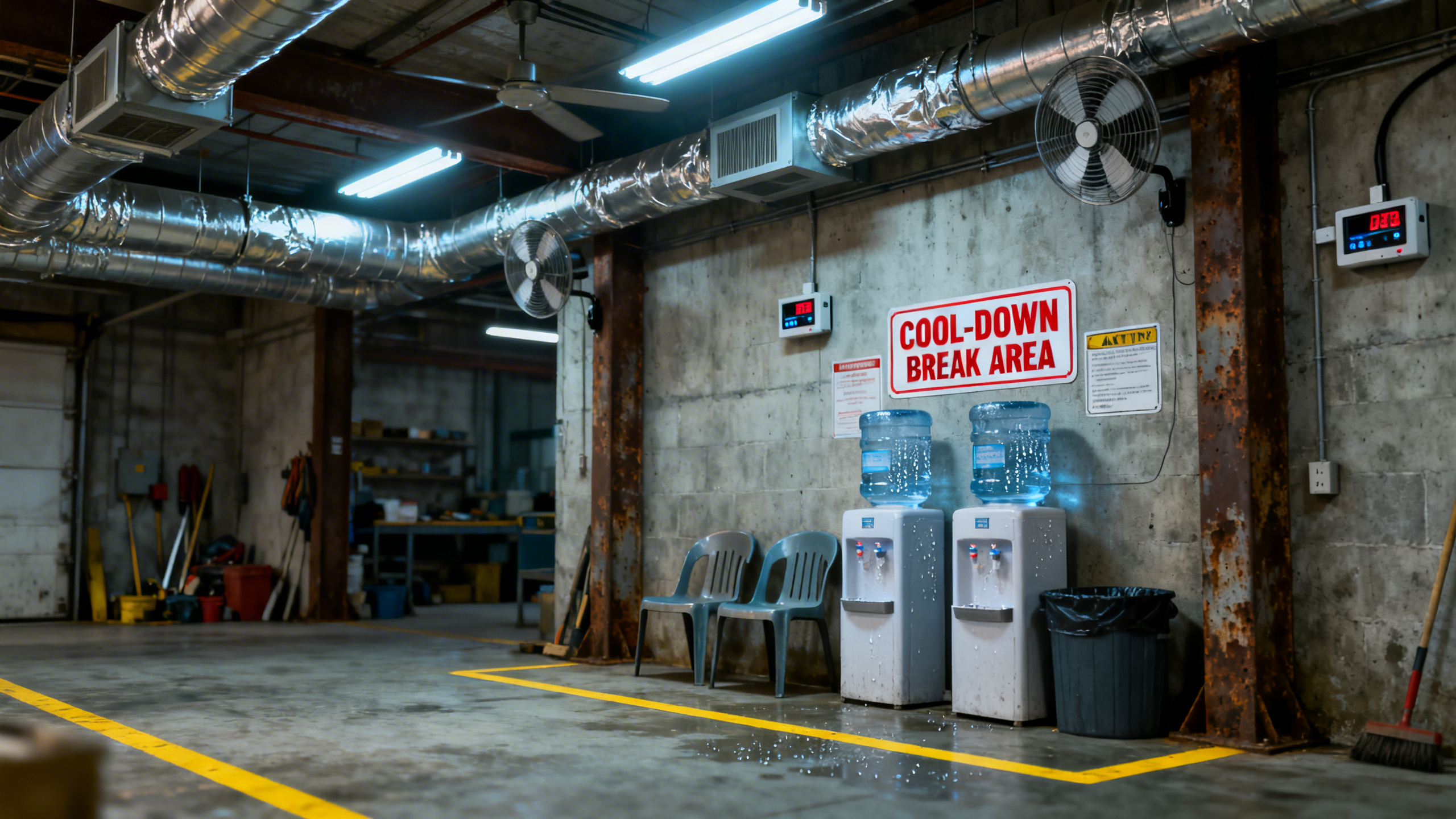
California’s indoor facilities are not immune to heat risk—especially high-load environments like indoor cultivation, extraction, commercial kitchens, and beverage production. Since July 23, 2024, California employers have had to comply with Cal/OSHA’s Heat Illness Prevention in Indoor Places of Employment standard, 8 CCR §3396, which applies broadly to indoor work areas where heat can build up.
For operators planning capital improvements and winter maintenance cycles, this rule is a “now” obligation—but winter 2025 is a practical deadline for getting monitoring, HVAC controls, training, and written program elements fully operational before the next warm season and before the next busy production cycle.
This article summarizes what the regulation requires, how to monitor indoor heat (temperature vs. heat index), and how to integrate compliance into existing Cal/OSHA programs such as the Injury and Illness Prevention Program (IIPP) and Hazard Communication. It also walks through cannabis-specific scenarios and provides a gap-assessment worksheet and equipment/vendor option categories to speed implementation.
Informational only — not legal advice.
What Cal/OSHA’s Indoor Heat Standard (8 CCR §3396) Requires
Cal/OSHA’s official regulation text is published by the Department of Industrial Relations (DIR):
Coverage: When does §3396 apply?
Section 3396 generally applies to indoor work areas where the temperature equals or exceeds 82°F when employees are present. This includes many warehouse and manufacturing-type spaces that were not historically treated as “hot work” sites.
A commonly discussed exception is for incidental heat exposures—for example, short-duration entry into warm areas. Cal/OSHA references incidental exposures in guidance and stakeholder summaries; employers should confirm how the definition applies to their operations based on the regulation text and the DIR FAQ.
Two key trigger concepts to understand: 82°F and 87°F (and sometimes “whichever is greater”)
The practical compliance triggers in the standard revolve around:
- 82°F: baseline applicability in most cases.
- 87°F: a higher trigger point that matters for certain measurement/recordkeeping and acclimatization “close observation” requirements.
- 82°F in high-radiant heat or restrictive clothing areas: the standard recognizes that the same air temperature can be riskier when radiant heat is high (e.g., under intense lighting) or when clothing restricts heat removal.
The regulation also uses the concept of temperature or heat index, whichever is greater, in several places (see §3396 text).
Compliance Big Picture: Your Indoor Heat Illness Prevention Plan (IHIPP)
Cal/OSHA requires employers to establish, implement, and maintain an effective written Indoor Heat Illness Prevention Plan (often referred to as an IHIPP). DIR provides a model program that can be adapted:
At a minimum, your IHIPP should be written in a way that matches how your facility actually runs—shift schedules, production peaks, and the real “hot spots” employees work in.
Required written plan elements (what to include)
Based on DIR’s indoor heat guidance and §3396 requirements, your written plan should address the following core topics.
Water (potable drinking water)
Your plan must explain how drinking water will be made available, at no cost, and how employees will be encouraged/reminded to drink it (the DIR FAQ highlights the importance of specifying how reminders occur).
Operational notes for regulated cannabis facilities:
- In cultivation and manufacturing environments with hygiene controls, define water locations that do not compromise sanitation (e.g., break areas just outside controlled rooms).
- For CO₂-enriched areas, water stations should not require extended travel through higher-risk zones.
Cool-down areas
You need defined cool-down areas that are accessible when heat conditions trigger the program. “Accessible” should be interpreted operationally: it has to be feasible for an employee to get there quickly without asking permission or crossing restricted zones that delay access.
Examples:
- A cooled break room adjacent to a grow corridor
- A designated cooled office or training room near extraction suites
- A cooled “rest pod” area inside a large warehouse (if that can be done safely)
Preventive rest periods (cool-down rests)
Your plan must allow preventative rest periods to reduce heat stress risk. These are not merely “meal and rest” breaks; they are heat-risk controls. The key is to define:
- Who can authorize a preventative rest (best practice: empower employees to self-initiate)
- Where rest occurs (cool-down area)
- How the line continues safely (cross-trained coverage)
Acclimatization and close observation
The standard includes close observation requirements for employees newly assigned to certain hotter areas (e.g., where temperature or heat index reaches at least 87°F). Plan details should include:
- Who performs close observation (supervisor or designee)
- How to do it in practice (check-ins, buddy system, symptom screening)
- What to do if symptoms appear
Cannabis-specific examples:
- Seasonal staffing increases during harvest and trimming
- New hires assigned to packaging lines adjacent to warm mechanical rooms
Training (employees and supervisors)
Training must cover heat illness hazards, symptoms, prevention steps, and the site’s IHIPP procedures. Make sure training is:
- Language-appropriate
- Delivered to both employees and supervisors
- Documented (who attended, date, topics)
DIR’s heat illness prevention resource page is a reliable starting point: https://www.dir.ca.gov/dosh/heatillnessinfo.html
Also note: Cal/OSHA has an industry-specific workplace safety page for cannabis employers that points back to core Cal/OSHA programs and resources: https://www.dir.ca.gov/dosh/cannabis-industry-health-and-safety.html
Emergency response procedures
Your IHIPP must include procedures for prompt emergency response. The DIR Indoor FAQ emphasizes that workers showing signs/symptoms should not be left alone or simply sent home without being offered first aid or emergency medical services.
At minimum, your written plan should specify:
- How to summon help (phone/radio protocols, address and cross-streets posted)
- Who meets EMS and guides them in
- Cooling/first-aid steps (cool towels, moving to cool-down area, etc.)
- When to call 911
- Post-incident reporting and investigation steps
Monitoring: Temperature vs. Heat Index (and why it matters in grows and plants)
What §3396 expects you to measure
The regulation uses both temperature and heat index (and in some triggers, “whichever is greater”). Heat index accounts for humidity, which is critical in cultivation and beverage environments.
Why this matters:
- A trimming room at 80–84°F with high humidity can create a much higher heat index than air temperature suggests.
- A dehumidification strategy that fails during peak transpiration can cause humidity spikes and raise heat index rapidly.
Practical monitoring approaches
Most facilities end up using a tiered monitoring approach:
- Screening: wall-mounted temperature/RH sensors integrated into the building management system (BMS)
- Compliance-grade spot checks: handheld meters and logged readings in representative areas
- High-risk area continuous logging: data loggers with alerts for excursions
The standard’s requirements can implicate recordkeeping; some summaries note keeping measurements for 12 months. Confirm your record retention approach by aligning your internal SOPs to the regulation text and DIR guidance.
Consider WBGT for operational decision-making
Even though §3396 references temperature/heat index, many safety programs use WBGT (wet bulb globe temperature) as a more holistic heat stress indicator because it incorporates radiant heat and air movement more directly.
Federal OSHA notes WBGT is recommended by multiple bodies for heat stress measurement: https://www.osha.gov/heat-exposure/hazards
NIOSH heat criteria also provides detailed scientific background and prevention methods: https://www.cdc.gov/niosh/docs/2016-106/default.html
Compliance tip: Using WBGT does not replace §3396 requirements, but it can improve decision-making about break schedules, job rotation, and engineering controls in high radiant heat spaces.
Engineering, Administrative, and PPE Controls: The “Feasible Controls” Hierarchy
Section 3396 prioritizes controls similarly to other Cal/OSHA frameworks:
- Feasible engineering controls first
- Administrative controls if engineering controls don’t reduce and maintain conditions sufficiently
- Personal heat-protective equipment when engineering + administrative controls are insufficient, unless infeasible
The regulation text explicitly discusses keeping conditions below 87°F (temperature and heat index) when employees are present, and below 82°F in certain higher-risk indoor situations (high radiant heat areas or restrictive clothing). See: https://www.dir.ca.gov/title8/3396.html
Engineering controls (common in cannabis facilities)
- HVAC capacity upgrades (tonnage, airflow, zoning)
- Dedicated make-up air units for humidity control
- Heat-rejection improvements (roof insulation, reflective coatings, dock seals)
- Local exhaust and heat capture in process areas
- Equipment isolation (moving compressors/boilers to separate ventilated mechanical rooms)
Important: If you are planning HVAC replacement, factor in the industry’s transition to A2L refrigerants and related code considerations. California building standards have already moved to support A2Ls in recent cycles, and federal equipment transition timelines began shifting in 2025 for certain product classes. Treat this as a design and permitting schedule risk—not merely a refrigerant selection issue.
A practical overview of codes and refrigerants (DOE webinar material referencing CA adoption): https://www.energycodes.gov/sites/default/files/2024-08/Refrigerants_and_Codes_Webinar_Website_File.pdf
Administrative controls (what inspectors will look for)
- Preventative rest breaks tied to trigger thresholds
- Work/rest schedules for high-metabolic tasks (rack moving, substrate handling)
- Rotating staff out of hot zones (e.g., beverage hot-fill line)
- Scheduling heat-producing activities during cooler hours
- Increasing supervision and observation during acclimatization
Personal heat-protective equipment (when needed)
When engineering and administrative controls don’t minimize risk, consider:
- Cooling vests (phase-change or active)
- Cooling neck wraps
- Heat-reflective barriers where radiant heat is intense
Ensure PPE does not introduce new hazards (entanglement, sanitation cross-contamination, or incompatibility with protective clothing required for chemical processes).
Integration With Existing Cal/OSHA Programs (IIPP, HazCom, and more)
IIPP (8 CCR §3203): Make indoor heat part of your core safety management
California requires employers to maintain an Injury and Illness Prevention Program (IIPP) under 8 CCR §3203. Indoor heat controls should not live in a silo. Integrate:
- Hazard identification for heat (hot zones list)
- Inspections/audits (daily checks during warm periods)
- Corrective actions (work orders tied to heat excursions)
- Training documentation and effectiveness checks
Hazard Communication (8 CCR §5194): Don’t forget chemical + heat interactions
Heat stress risk is amplified by chemical exposures and PPE requirements. HazCom requires a written program, SDS access, labels, and training: https://www.dir.ca.gov/title8/5194.html
Operational examples:
- Solvent handling PPE increases heat burden
- Some cleaning chemicals may require protective clothing that restricts heat removal
Cross-program linkage in regulated cannabis operations
Cannabis employers are already expected to manage multiple Cal/OSHA-aligned hazards (ergonomics for trimming/packing, chemical safety in extraction, machine guarding on bottling lines). DIR’s cannabis industry safety page is a useful compliance map: https://www.dir.ca.gov/dosh/cannabis-industry-health-and-safety.html
Cannabis-Specific Scenarios (Where Indoor Heat Risk Hides)
These examples are written to mirror real facility layouts and common process bottlenecks.
1) Trimming rooms with aggressive dehumidification
Risk pattern:
- Dehumidifiers and fans dump heat into the room
- Doors stay closed for odor/security controls
- Temp may look “manageable,” but heat index can spike when dehu performance lags or when worker density rises
Controls to consider:
- Separate heat-rejection (ducted dehu exhaust)
- Continuous RH/temp logging with alarms
- Scheduled rotations and cool-down rests during peak trim throughput
2) Solvent-recovery rooms and extraction suites
Risk pattern:
- Pumps, chillers, compressors, and recovery equipment add heat
- PPE requirements (chemical-resistant clothing, gloves) restrict heat removal
- Limited door openings due to process control and security
Controls to consider:
- Localized spot cooling or increased supply air
- Heat capture/exhaust improvements in equipment zones
- Enhanced acclimatization procedures for newly assigned staff
3) Hot-fill beverage lines and adjacent utility spaces
Risk pattern:
- Hot product, steam, and pasteurization/hot water loops add radiant and ambient heat
- Peak demand periods increase line speed and metabolic load
Controls to consider:
- Ventilation hoods and heat curtains near the filler
- Chilled rest area close to the line (not across the facility)
- Work/rest scheduling triggered by measured conditions
4) Warehouses with mezzanines, racking, and low air movement
Risk pattern:
- Stratification: upper levels get hotter
- Forklift/charger rooms add heat
- Large roll-up doors create humidity swings
Controls to consider:
- HVLS fans (verify they don’t interfere with filtration/pressure relationships in controlled areas)
- Zoning and destratification strategies
- Representative measurement locations at worker height on mezzanines
Enforcement Reality: What Cal/OSHA Has Signaled
DIR announced the indoor heat protections were approved and went into effect July 23, 2024, and emphasized broad coverage across indoor workplaces: https://www.dir.ca.gov/DIRNews/2024/2024-59.html
This means:
- Inspectors can evaluate your written plan, training, and real-world implementation now
- Heat illness incidents, complaints, or visible high-heat conditions can trigger scrutiny
Also remember: federal OSHA has been moving toward a national heat standard; California’s rule puts CA operators under a more mature framework today. Federal rulemaking status: https://www.osha.gov/heat-exposure/rulemaking
Implementation Timeline: “Before Winter 2025” as a practical compliance target
Even though the rule is already effective, many facilities need time for capital upgrades and procurement. A realistic project timeline for indoor heat compliance often looks like this:
Phase 1 (0–30 days): Program foundation
- Draft/update IHIPP
- Identify hot zones and tasks
- Purchase basic monitoring tools (temp/RH meters)
- Launch interim training and signage
Phase 2 (30–90 days): Monitoring + documentation
- Install continuous sensors in priority areas
- Create logging SOPs and record retention system
- Implement rest/cool-down workflows and supervisor checklists
Phase 3 (3–9 months): Engineering upgrades
- HVAC load study and airflow balancing
- Targeted improvements (dehu heat rejection, ventilation, zoning)
- Procurement lead times for equipment
Phase 4 (9–15 months): Optimization before next warm season
- Commissioning and seasonal testing
- Drill emergency response
- Audit training effectiveness and update procedures
If you want to be stable by the next warm season, use winter 2025 to lock in design decisions, permitting, and procurement—especially if HVAC replacement intersects with refrigerant transition constraints.
Vendor/Equipment Options (Categories) to Support Compliance
The goal here is not to endorse specific brands, but to help you build a procurement checklist.
Monitoring and alerting
- Handheld temperature/RH meters for spot checks
- Data loggers with downloadable records
- Heat index-capable monitors (temp + RH with computed heat index)
- WBGT meters for high radiant heat decision-making
- BMS integrations with alarms and audit trails
Procurement timeline guidance:
- Handheld meters: days to 2 weeks
- Logger networks/BMS expansions: 4–12+ weeks depending on integrator
HVAC and facility retrofits
- Load calculations and commissioning services
- Dehumidification system redesign (ducting, heat rejection)
- Air distribution improvements (balancing, diffusers, destratification)
- Refrigerant transition-ready equipment planning (A2L-compatible where applicable)
Timeline guidance:
- Engineering assessment: 2–6 weeks
- Permitting/procurement: 1–6 months
- Install/commission: 2–12 weeks depending on scope
- Digital forms for logs and supervisor observations
- Learning management systems (LMS) for training records
- QR codes linking employees to the IHIPP and emergency steps
Gap-Assessment Worksheet (Copy/Paste for Your Internal Audit)
Use this as a quick self-audit. For each line item, mark Yes / No / In Progress, assign an owner, and set a due date.
A) Applicability and triggers
- We have identified all indoor areas where temperature can reach 82°F when employees are present.
- We have identified areas where high radiant heat exists (e.g., under intense lighting, near boilers, near hot-fill lines).
- We have identified tasks requiring restrictive clothing/PPE that increases heat burden.
- We have determined where the standard’s incidental exposure concept might apply and documented our rationale.
B) Written IHIPP
- We have a written Indoor Heat Illness Prevention Plan that matches our current operations.
- The plan includes water procedures (locations, replenishment, reminders).
- The plan defines cool-down areas (where, capacity, access rules).
- The plan includes preventative rest period procedures.
- The plan includes acclimatization/close observation procedures.
- The plan includes training procedures for employees and supervisors.
- The plan includes emergency response procedures (EMS access, communication, first aid steps).
C) Monitoring and records
- We measure temperature in representative work areas.
- We measure or calculate heat index where humidity is a factor.
- We know which areas need continuous logging vs. spot checks.
- We retain monitoring records for the required period (define retention schedule).
- We have escalation steps when thresholds are met (who is notified, what changes).
D) Controls
- Engineering controls have been evaluated and implemented where feasible.
- Administrative controls (breaks, rotation, scheduling) are defined and used in practice.
- PPE/cooling options are evaluated for tasks where other controls are insufficient.
E) Training and communication
- Heat illness training is delivered on hire and refreshed as needed.
- Supervisors are trained on their responsibilities.
- Training is provided in languages understood by employees.
- Employees know how to report symptoms without fear of retaliation.
F) Integration with other programs
- Indoor heat hazards are included in our IIPP (8 CCR §3203) processes.
- Chemical/PPE heat-burden interactions are addressed in HazCom (8 CCR §5194) training and SDS reviews.
- Maintenance work orders and commissioning records are linked to heat-risk corrective actions.
Key Takeaways for Operators
- §3396 is already in effect (effective July 23, 2024). Treat winter 2025 as the deadline to be fully stabilized before the next warm season.
- Build your program around the real triggers: 82°F, 87°F, and “temperature or heat index, whichever is greater.”
- In cultivation and beverage environments, humidity makes heat index the hidden driver—do not rely on air temperature alone.
- Use the hierarchy: engineering controls first, then administrative controls, then personal heat-protective equipment if needed.
- Integrate indoor heat compliance into your IIPP and HazCom so inspections and audits show a single coherent safety system.
How CannabisRegulations.ai Can Help
If you operate in California and need to turn §3396 into facility-ready SOPs, logs, and training documentation, CannabisRegulations.ai can help you build a compliance package that integrates cannabis compliance, licensing, and workplace safety requirements into one operational system.
Use https://cannabisregulations.ai/ to streamline your internal audits, keep your written plans current, and stay ahead of enforcement expectations as indoor heat rules become a routine part of Cal/OSHA inspections.