


Sign Up
Ready to replace complexity with clarity?
Answer your real world compliance questions (limited time) and save thousands in legal fees and avoided fines.
Automate Compliance Today

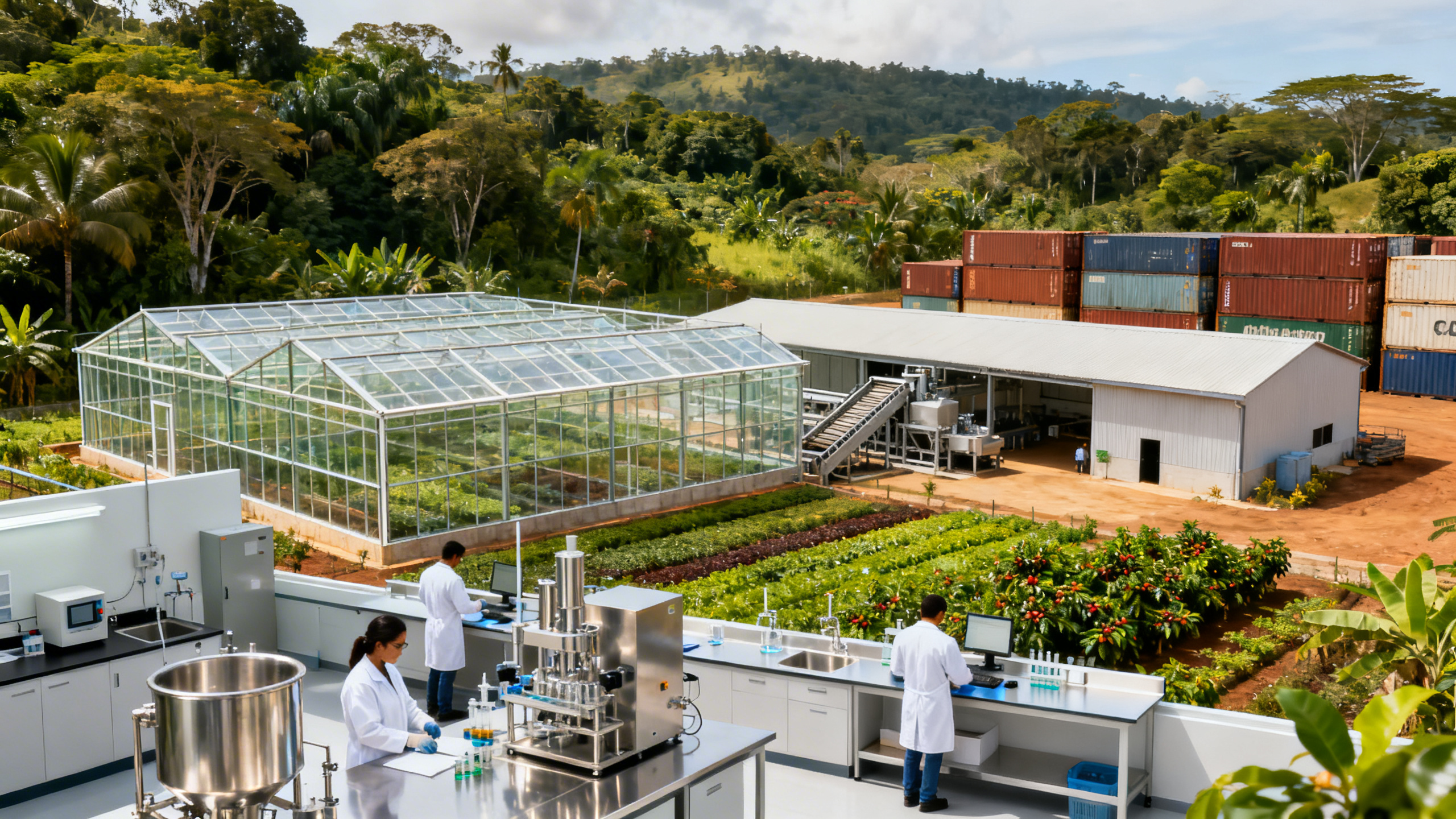
Costa Rica’s regulated hemp economy moved from “framework” to “buildout” in 2025—driven by licensing throughput, clearer product-category rules, and rising export interest.
Industry reporting in-country has repeatedly pointed to 50+ authorizations, often cited as 57 licenses/authorizations issued, as operators line up cultivation, industrialization, and derivative product plans for 2025–2026. What matters for compliance teams is not just the count—it’s the architecture behind it: multiple agencies, multiple pathways, and different requirements depending on whether you’re selling an ingredient, a finished food, a supplement, or a topical.
This article is informational only and not legal advice.
Costa Rica’s hemp program sits under Law No. 10113 (“Ley del Cannabis para uso medicinal y terapéutico y del cáñamo para uso alimentario e industrial”), with implementing regulations distributed across the Ministry of Agriculture and Livestock (MAG) and the Ministry of Health (Ministerio de Salud).
For businesses, the practical takeaway is that you should think of the market as a two-layer system:
Official starting points:
A major operational update heading into 2026 is the government’s push to streamline filings through the Ventanilla Única de Inversión (VUI). In February 2026, the Ministry of Health announced a centralized digital mechanism for hemp and related categories, intended to reduce friction across production, industrialization, import/export, and commercialization workflows.
Source: Ministry of Health press release (Feb 16, 2026): https://www.ministeriodesalud.go.cr/index.php/prensa/67-noticias-2026/2361-plataforma-digital-del-vui-facilita-tramites-para-canamo-y-cannabis-en-costa-rica
In compliance terms, one of the most important documents for hemp-derived “products of sanitary interest” is RTCR 511:2023, published in La Gaceta in February 2025 (per multiple summaries and the legal publication record).
RTCR 511:2023 is relevant because it ties hemp inputs to:
Costa Rica splits oversight primarily between:
The MAG hemp page explicitly points applicants to Executive Decree No. 44585-MP-MAG-MS for requirements (articles 8 and 9 for hemp industrial cultivation authorization), and provides access routes to those documents.
Source: MAG hemp page: https://www.mag.go.cr/Canamo/Canamo.html
While exact naming and scope can vary by filing and the applicant’s activity, operators typically need to map whether they are:
From a program-design standpoint, your internal controls should treat these as separate compliance modules with separate evidence requirements (facility controls, SOPs, QA systems, recordkeeping, and—when applicable—phytosanitary and customs documentation).
The Ministry of Health’s “Autorizaciones Cáñamo” procedure describes authorizations aimed at:
Source: Ministry of Health hemp authorizations page: https://www.ministeriodesalud.go.cr/index.php/tramites/empresas?view=article&id=1412:autorizaciones-canamo&catid=22
Costa Rica’s hemp buildout is exciting, but many projects slow down at the moment they transition from “licensed activity” to “legal product on shelf.” The key is classifying what you are making—and aligning formulation, claims, and evidence accordingly.
Below is a practical pathway lens that many compliance teams use.
Typical items
Why these are sensitive
Even if an ingredient is legal to produce under an authorization, it may still be restricted in end-use (e.g., not permitted in supplements in certain jurisdictions, or considered “novel” in the EU).
Compliance actions
Costa Rica routes foods through the Ministry of Health’s sanitary controls. For foods, you should plan around:
A key regional reference for food labeling used across Central America is RTCA 67.01.07:10 (General Labeling of Prepackaged Foods). While companies often access this via local compliance libraries, the legal principle is consistent: labels must not be false, misleading, or deceptive.
A public PDF copy commonly used by compliance professionals: https://www.bufetemejia.com/downloads/regulatory/RTCA%2067.01.0710.pdf
Practical compliance reminder: even if the hemp ingredient is allowed, your label and marketing must match the product category. “Wellness” positioning can quickly drift into implied therapeutic claims.
Supplements are typically more claim-sensitive than foods. If your product is positioned as a supplement:
For domestic registration mechanics, the Ministry of Health’s Regístrelo platform is central to multiple product categories.
Ministry of Health food registration page (Regístrelo, costs, validity): https://www.ministeriodesalud.go.cr/index.php/tramites/empresas?view=article&id=156:registro-de-alimentos&catid=28
Topicals can be attractive for market entry because they may avoid some of the highest-friction “ingestible” debates abroad. However, they raise their own set of compliance duties:
Costa Rica’s RTCR 511:2023 is widely discussed as covering multiple “sanitary interest” categories, including cosmetics, when they contain hemp-derived components.
Official legal entry for RTCR 511:2023: https://pgrweb.go.cr/scij/Busqueda/Normativa/Normas/nrm_texto_completo.aspx?param1=NRTC&nValor1=1&nValor2=103842&nValor3=144873&strTipM=TC
Across jurisdictions, the most common enforcement trigger in hemp wellness categories is not the ingredient—it’s the claim.
A robust claims control program should:
If you intend to export ingestible products to the U.S., your team must account for FDA’s position that a lawful pathway for CBD in conventional foods and dietary supplements remains unresolved at the federal level.
FDA’s statement concluding current food/supplement frameworks are not appropriate for CBD (and calling for a new pathway): https://www.fda.gov/news-events/press-announcements/fda-concludes-existing-regulatory-frameworks-foods-and-supplements-are-not-appropriate-cannabidiol
Export readiness implication: many exporters pivot to U.S. channels that are not federally “food/supplement” (or they ship non-ingestible categories), or they work with counsel on narrower strategies. Even then, claims discipline remains essential.
Costa Rica’s regulations and technical standards interact with the global reality: buyers, distributors, and importers will require a compliance-grade dossier.
A practical minimum testing and QA package for export-oriented hemp derivatives often includes:
Even where Costa Rica’s category rules apply domestically, export partners may impose stricter specifications—so build your QC plan to the stricter of (a) domestic rule, (b) destination rule, (c) customer contract.
For companies targeting the EU, the headline issue for many cannabinoid-containing ingestibles is Novel Food status.
Under Regulation (EU) 2015/2283, foods not consumed to a significant degree in the EU before 15 May 1997 may require pre-market authorization.
EFSA has repeatedly treated CBD as a novel food ingredient with data gaps, and in 2026 EFSA updated its safety perspective by establishing a provisional safe intake level for CBD in certain supplement formulations.
What this means for Costa Rica exporters (2025–2026):
Even after Novel Food authorization (or if you sell allowed hemp seed ingredients), EU food and supplement marketing is constrained by:
Your export dossier should include claim substantiation maps and approved claims lists for each member state where you’ll sell.
For the U.S., export readiness often becomes a two-track plan:
U.S. importers of hemp seed for planting generally require a phytosanitary certificate and must meet entry requirements.
CBP guidance: “Hemp seed for planting may be imported… if accompanied by a phytosanitary certificate.” https://www.help.cbp.gov/s/article/Article-1342
On the Costa Rica side, exporters commonly interface with the Servicio Fitosanitario del Estado (SFE) for export procedures and phytosanitary documentation.
SFE export procedures landing page: https://www.sfe.go.cr/SitePages/Tramites/tramites_exportacion_vegetales.aspx
Many destination markets and importers ask for a Certificate of Free Sale (or equivalent) to demonstrate the product is legally sold in the country of origin.
Costa Rica’s Ministry of Health provides a CLV procedure page:
Export readiness implication: if your business model is “manufacture in Costa Rica and export,” you should build a CLV-ready documentation bundle early (registration evidence, label versions, batch records, GMP/quality documents).
Costa Rica’s domestic “hemp wellness” retail is evolving. Typical early channels include:
Costa Rica’s hemp category is not inherently an “adult-use intoxicant” retail model, but age-gating is increasingly used as a risk control—especially online—because:
A practical approach many compliance teams adopt is:
Even as guidance is refined, “baseline” packaging discipline reduces enforcement and recall risk:
Where food products are concerned, align with RTCA general labeling principles (non-misleading presentation) and ensure Spanish-language compliance for domestic sale.
Costa Rica’s ministries have signaled that as authorizations expand, market surveillance will follow.
To stay inspection-ready:
Businesses building in Costa Rica should plan around these practical milestones:
Sources:
If your focus keyword is Costa Rica hemp licenses 2025, the strategic message is simple: licensing momentum is real, but the winners in 2025–2026 will be the companies that design for compliance in three dimensions simultaneously—authorization, product category, and destination-market legality.
Operating across Costa Rica and export markets requires continuous monitoring and evidence-based decisions. Use https://www.cannabisregulations.ai/ to track regulatory updates, build claims-compliant label language, and structure a documentation set that holds up under domestic inspections and international buyer due diligence.