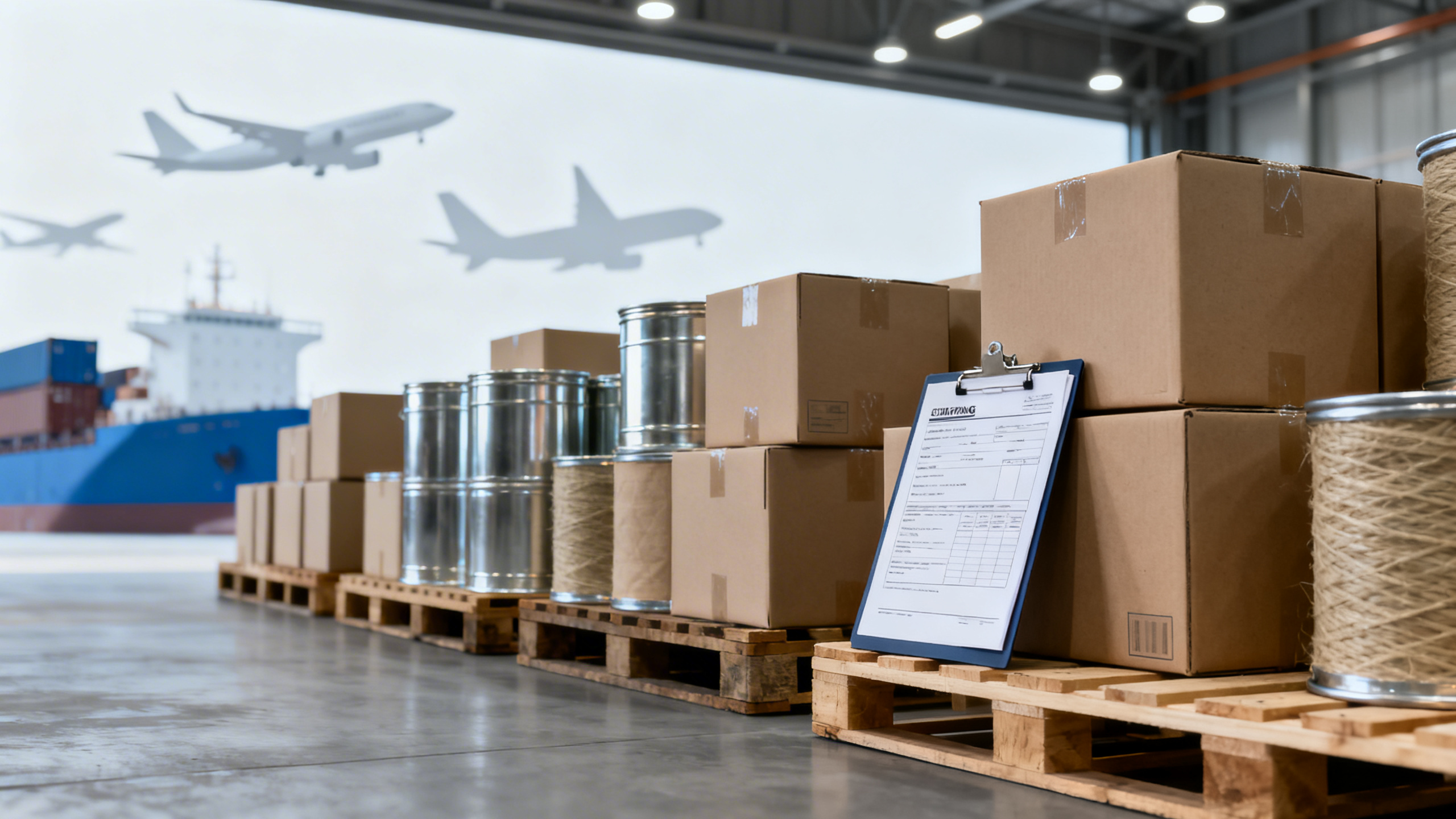
In 2025, international shipments of hemp seed and hemp biomass are seeing tighter screening on both sides of the Atlantic. In the U.S., CBP agriculture and trade enforcement teams are increasingly quick to place shipments on hold when commodity classification, plant health paperwork, or THC documentation doesn’t line up. In the EU, ICS2 Release 3 is turning vague descriptors into a measurable risk factor—especially when filings don’t include house‑level data.
This guide is informational only (not legal advice). It’s written for importers/exporters, brokers, compliance teams, and logistics providers moving hemp seed and biomass in the EU–US lane who want fewer mismatches, fewer holds, and fewer seizures.
What changed in 2025 (and why scrutiny is higher)
Three converging trends explain why “we’ve always shipped it this way” stopped working:
- Commodity classification enforcement is sharper. Misclassifying seed (for sowing vs. non‑sowing) or biomass (fiber vs. “vegetable products not elsewhere specified”) can trigger reclassification, holds, or penalties.
- Plant health controls remain strict. Seed shipments are routinely treated as regulated plant products; missing phytosanitary documents is one of the most common reasons for detention.
- Advance data regimes are less forgiving. EU ICS2 Release 3 expands mandatory pre‑arrival safety/security data and pushes more responsibility to forwarders and other house‑level filers. Data gaps now stop cargo.
U.S. imports: CBP + USDA APHIS—your clearance depends on plant health paperwork
For U.S. arrivals, many issues blamed on “CBP holds” are actually triggered by USDA APHIS requirements for seeds and other plant products.
CBP’s own public guidance emphasizes that hemp seed for planting may be imported (from countries other than Canada) if accompanied by a phytosanitary certificate, and shipments are inspected upon arrival to confirm APHIS compliance.
External links:
Seed is not “just another commodity”
Even when your shipment is commercially packaged and lab‑tested, customs may still view it as a plant health risk. For seed shipments, build your timeline assuming:
- inspection at first port of entry
- possible routing to a designated inspection station
- quarantine/hold until APHIS requirements are confirmed
“Small lots of seed” is a common trap
If you’re relying on “small lots” programs, confirm eligibility in writing. APHIS PPQ 587 guidance indicates that some small lots of eligible seed may be imported without a phytosanitary certificate with a written permit—but that is not a blanket exemption, and the conditions can be narrow.
HS codes and classification: the #1 avoidable seizure/hold trigger
Classification mistakes create a cascade:
1) wrong HS/HTS code2) wrong partner government agency (PGA) flags3) wrong admissibility assumptions4) discrepancies between invoice, lab report, and filing
In high‑risk categories, “close enough” descriptions are not close enough.
Hemp seed: sowing vs. non‑sowing is a different risk profile
For hemp seed, the compliance outcome changes dramatically depending on whether it is for sowing (planting) or not for sowing (e.g., food ingredient, hulled kernels, processing).
Practical takeaways:
- If it’s for sowing, expect plant health documentation and more inspection sensitivity.
- If it’s not for sowing, your documentation should clearly state “NOT FOR SOWING” and support that with packaging/processing facts (e.g., hulled, heat‑treated) where accurate.
EU reference point: EU rules historically identify hemp seed for sowing under CN code ex 1207 99 20 with accompanying THC proof requirements. See EUR‑Lex Commission Regulation (EC) No 651/2002 (as amended): https://eur-lex.europa.eu/legal-content/EN/TXT/HTML/?uri=CELEX:32002R0651
U.S. reference point: HTSUS chapter material identifies hemp seed distinctions in Chapter 12; always confirm the current year’s HTS text in the USITC database: https://hts.usitc.gov/
“Hemp biomass” is a trade term, not a customs classification. CBP classification can vary based on:
- plant part (flowers/leaves/stalks)
- processing level (raw, dried, milled, extracted)
- intended use (fiber applications, further industrial processing)
One common compliance pitfall is trying to force all biomass into a fiber heading (or into an “extracts” heading) without matching the product’s objective characteristics.
A notable example in CBP’s ruling database: CBP has classified certain “hemp biomass” products under HTSUS 1404.90.9090 (“Vegetable products not elsewhere specified”), rejecting a fiber heading position in that fact pattern. See NY N305504 (via CustomsMobile mirror): https://www.customsmobile.com/rulings/docview?doc_id=NY%20N305504
Also note that “true hemp” fiber headings exist in Chapter 53 (Heading 5302) for raw/processed fiber not spun; confirm applicability carefully to your product form and processing. HTS Chapter 53 (USITC): https://hts.usitc.gov/
THC documentation: treat it like a “matching exercise,” not a lab attachment
Even where the product is lawful to trade, border agencies look for internal consistency:
- Does the invoice description match the lab report matrix?
- Does the net weight match what was tested (lot/batch linkage)?
- Are units consistent (%, mg/g, dry weight basis)?
- Is the sampling method documented and credible?
What to include in lab documentation for cross‑border shipments
Aim for a lab report/COA packet that includes:
- Lot/batch identifier that matches packaging and invoice
- Sample date, method, and lab accreditation (where applicable)
- Dry weight basis statement
- cannabinoid panel fields relevant to your trade lane (at minimum delta‑9 THC; often THCa/“total THC” is requested by counterparties)
Compliance note: enforcement focus can differ by agency and jurisdiction; build documentation for the strictest plausible review to reduce “secondary inspection” probability.
EU-bound shipments: ICS2 Release 3 makes data quality a clearance issue
The EU’s Import Control System 2 (ICS2) is an advance cargo information system for safety and security data filed via Entry Summary Declarations (ENS).
Official EU overview: https://taxation-customs.ec.europa.eu/customs/customs-security/import-control-system-2_en
What Release 3 means operationally
Release 3 extends and deepens requirements across transport modes and expands house‑level data expectations.
The European Commission’s trade update notes that as of April 1, 2025, road and rail carriers must complete the new ENS under ICS2 prior to arrival, with the warning that goods may be stopped at the border if traders do not meet the requirements on time: https://trade.ec.europa.eu/access-to-markets/en/news/ics2-extends-entry-summary-declarations-ens-rail-and-road-transport-1-april-2025
The Commission also announced that, as of September 1, 2025, ICS2 is fully operational in all Member States for road and rail, with some limited temporary derogations for certain Member States: https://taxation-customs.ec.europa.eu/news/transition-ics2-release-3-complete-limited-temporary-derogations-some-member-states-2025-08-29_en
Why “hemp products” is a risky descriptor under ICS2
ICS2 risk analysis is data-driven. Filings that use vague commodity descriptions (for example, “hemp products” or “plant material”) can trigger:
- risk flags for ambiguous goods
- requests for more information
- loading delays or border stops
Write descriptions that are specific, factual, and consistent across:
- commercial invoice
- packing list
- house bill
- ENS dataset
Examples of better descriptors (adapt to your actual product):
- “Industrial seed for planting (certified variety), packaged 25 kg bags”
- “Dehulled seed for food processing, heat‑treated, packaged 20 kg cartons, not for sowing”
- “Dried plant biomass (stalk/leaf), for industrial extraction, non‑retail, packaged 200 kg fiber drums”
The practical “document stack” (what should travel with every shipment)
Build a standardized packet and do not deviate shipment-to-shipment unless the commodity truly changes.
Core documents (EU–US both directions)
- Commercial invoice with accurate HS/HTS (and CN where relevant), Incoterms, currency, and full party details
- Packing list with case counts, gross/net weights, and lot identifiers
- Bill of lading / airway bill consistent with invoice parties and addresses
- Certificate of origin (and preferential origin documentation when claimed)
- Lab report/COA tied to the specific lots shipped
Seed (for sowing) add-ons
- Phytosanitary certificate issued by the exporting country’s NPPO (where required)
- Import permit where applicable (e.g., APHIS PPQ 587 in the U.S.)
- variety/cultivar documentation and seed certification paperwork (where required by destination)
Biomass add-ons (common best practices)
- specification sheet describing plant part(s), moisture, and processing level
- statement of intended industrial use (truthful and consistent)
- SDS where required/used by carriers and warehouses
Section 321 de minimis in the U.S.: avoid “duty-free” assumptions in 2025
Many operators historically tried to move small shipments under Section 321 (the de minimis pathway) and treated it as a simplified compliance lane. That approach is getting riskier.
In January 2025, CBP published an NPRM on “Entry of Low‑Value Shipments,” proposing new processes and expanded data requirements (including more robust advance information), and proposing that shipments claiming the de minimis exemption provide more precise classification data in the “basic entry process.”
Key sources:
Practical de minimis pitfalls to avoid
- Splitting shipments to chase the $800 threshold can still create pattern-based risk flags, especially when consignee data, product descriptors, or shipper relationships repeat.
- Weak data (generic descriptions, missing 10‑digit classification where requested, unclear manufacturer/shipper identity) increases inspection probability.
- PGA goods (including items with agriculture/plant health sensitivities) may not behave like ordinary consumer goods even when low value.
Operational recommendation: treat de minimis as a customs entry type—not as a compliance shortcut.
Broker’s checklist: pre-clearance controls that prevent holds
Use this checklist before tendering cargo to the carrier.
1) Classification and admissibility
- Confirm HS6 and correct national extensions (HTSUS 10‑digit; EU CN 8‑digit)
- Confirm sowing vs. non‑sowing is accurately documented
- Confirm whether the product triggers APHIS plant health controls (U.S.) or plant health requirements (EU Member State rules)
- Confirm whether any import licence regime is implicated for the destination
2) Invoice quality controls
- Invoice description matches packing list, lab report, and filings
- Include lot/batch IDs on invoice or packing list
- List country of origin (manufacture/growth origin as appropriate) consistently
- Ensure Incoterms are correct and realistic for who is filing/importer of record
3) Plant health paperwork
- Phytosanitary certificate present (when required) and references the shipment accurately
- Permit numbers included where applicable
- Seed certification paperwork attached for sowing seed
4) Data consistency controls (the “mismatch killer”)
- Shipper/consignee names match across all documents (no abbreviations drifting)
- Addresses match including postal codes
- Weights and package counts reconcile exactly
- HS codes in ENS / ACE / AES match invoice HS/Schedule B
5) Chain-of-custody and packaging
- Tamper-evident sealing and clear outer labeling
- No retail-style claims or ambiguous marketing language on cartons
- Product name avoids high-risk slang or vague “plant product” phrasing
Sample data fields to reduce ENS / AEI filing errors
The goal is not to memorize every schema field; it’s to ensure your commercial documents contain the information your filer needs.
ICS2 ENS (EU) — house-level data elements to gather
Collect these fields in a consistent “shipping instruction” template:
- ENS Declarant (carrier vs. house-level filer) and the responsible party’s EORI
- Consignor and consignee legal names, full addresses
- Buyer / seller where required by the dataset and available at house level
- House bill number and linkage to master bill
- Commodity code (HS6)
- Accurate goods description (avoid “hemp products”)
- Gross mass and package count/type
- Country of origin
- Place of loading and first office of entry
For more detailed implementation guidance, see the official ICS2 page and national customs guidance documents linked there: https://taxation-customs.ec.europa.eu/customs/customs-security/import-control-system-2_en
U.S. export filings (AES/EEI / AEI): core fields to standardize
When exporting from the U.S., EEI filing through AES is commonly required based on value thresholds or licensing requirements. The U.S. Department of Commerce’s International Trade Administration provides an overview: https://www.trade.gov/filing-your-export-shipments-through-automated-export-system-aes
Standardize these data fields for your authorized agent:
- USPPI name/address/EIN
- Consignee name/address
- Schedule B (10‑digit) and description
- Quantity and unit of measure aligned to Schedule B reporting
- Value per Schedule B line
- Export control classification where applicable
- License type / license number if required
- Parties to transaction
- Origin state and port of export
Tip: build one internal “master commodity record” per SKU/lot type with the correct Schedule B/HTS, reporting quantity units, and description language. Most EEI errors are master data errors, not filing typos.
Seizure avoidance: what actually works in practice
Seizure risk usually comes from inconsistency and ambiguity, not from one missing document alone.
The most effective controls
- Use ruling-grade descriptions (objective product facts, not marketing)
- Match lot IDs across invoice, packing list, and lab report
- Don’t improvise HS codes—if the product changed, reclassify and document why
- Pre-align on filing responsibility for ICS2 (carrier vs. forwarder) and confirm who supplies house‑level data
- Build a “port packet” (PDF bundle) and transmit it to your broker/forwarder before arrival, not after a hold
Red flags to eliminate
- “Hemp products” as the only descriptor
- inconsistent weights between documents
- “seed” described as “grain” or “animal feed” without supporting facts
- missing phytosanitary certificates for sowing seed
- COA that doesn’t match the shipped lot or uses a different product name
Key takeaways for 2025 EU–US operators
- Classification is foundational: sowing vs. non‑sowing for seed and accurate biomass classification prevent most holds.
- Treat THC documentation as a data-matching system tied to lots, not a generic attachment.
- ICS2 Release 3 makes house‑level ENS quality an operational requirement; vague descriptors increase risk.
- De minimis is under reform pressure; assume more data, not less, and avoid “duty-free means compliant” thinking.
Next step: operationalize compliance (without slowing shipments)
If you want to reduce CBP holds, prevent ICS2 data mismatches, and build a repeatable document stack for seed and biomass shipments, use https://cannabisregulations.ai/ to centralize your cannabis compliance workflows, classification notes, shipment templates, and regulatory monitoring—so your team and your broker are always filing from the same source of truth.