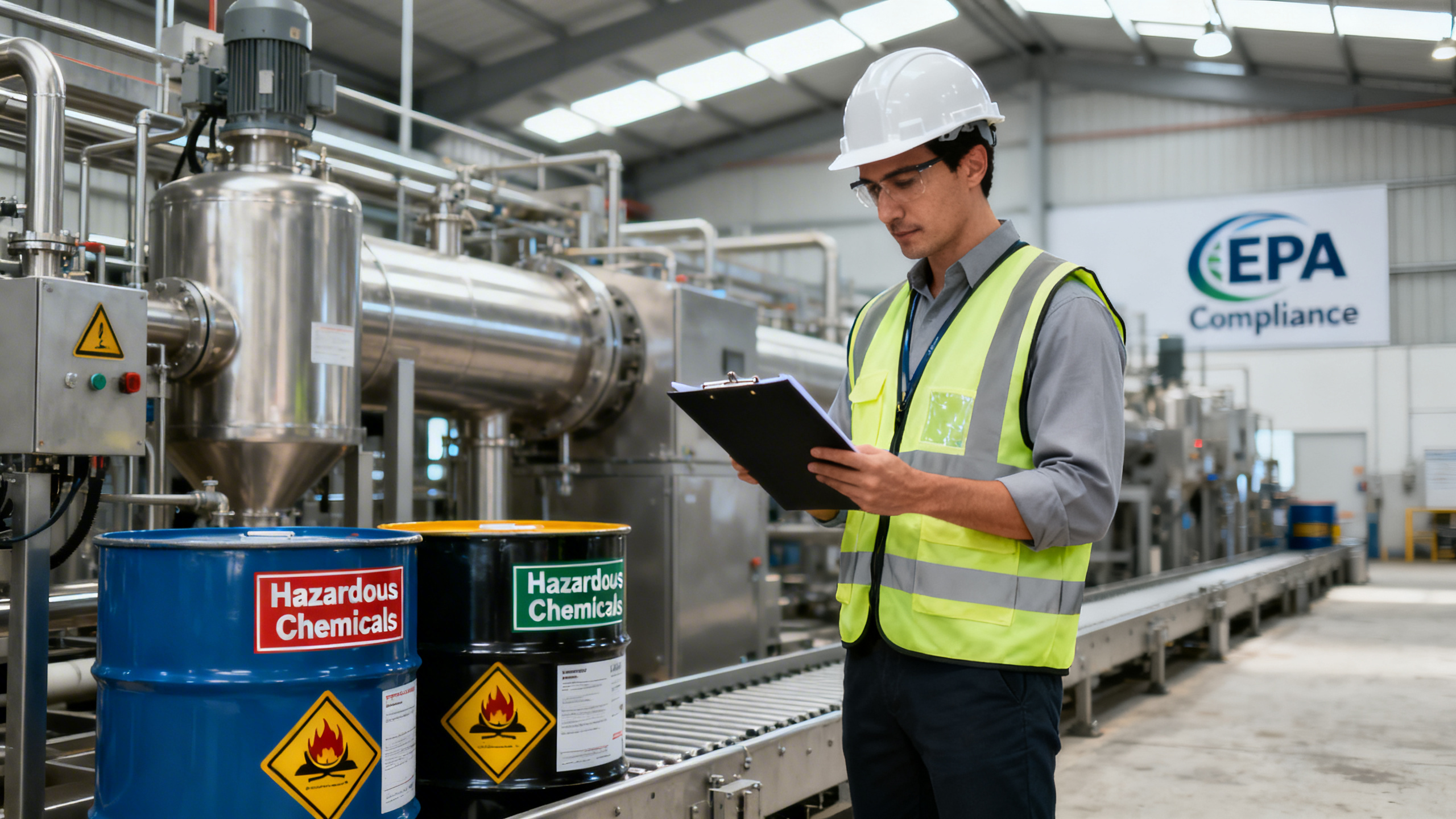
Between tighter chemical risk rules under TSCA, expanded process safety expectations under the Clean Air Act Risk Management Program (RMP), and rapidly evolving PFAS and wastewater expectations, U.S. operators that manufacture infused beverages, run extraction/processing lines, or store significant volumes of solvents and flammable gases are facing a widening environmental compliance net.
What’s changed in the past two years is not just the number of rules—it’s the way they stack. A facility can be “small” in headcount or square footage and still trigger major compliance obligations if it:
- brings a restricted solvent like methylene chloride onsite
- crosses flammable threshold quantities for propane/butane in a process
- generates characteristic or listed hazardous waste
- discharges process wastewater to a municipal sewer subject to pretreatment and local limits
- handles or imports PFAS-containing materials that create new reporting, cleanup, and disclosure exposure
This article provides an informational (non-legal-advice) 2025–2027 checklist designed for compliance teams, plant managers, and investors to align budgets and SOP updates with the most relevant federal EPA program signals.
External references throughout link to the most current EPA rule pages and Federal Register notices available as of Feb 20, 2026.
Why EPA convergence matters for extraction and beverage sites
EPA programs often feel “general industry”—until an inspection asks for your chemical inventory, waste determinations, and process safety documentation in the same visit.
Three dynamics are driving the convergence:
- Chemical-specific TSCA risk management is restricting certain uses outright and imposing detailed worker protection programs for remaining uses.
- Accidental release prevention expectations are rising for facilities with covered quantities of regulated toxics/flammables, especially where communities are nearby.
- PFAS is moving from “emerging contaminant” to a multi-statute compliance category: reporting, cleanup liability, supplier notifications, and (increasingly) wastewater and stormwater monitoring.
For operators, the key is to treat environmental compliance as a single integrated management system: one accurate inventory and document set should feed TSCA/RMP/RCRA/CWA/EPCRA duties.
Use this as a budgeting and SOP-update backbone.
2025–2027 dates tied to key EPA actions
Unified 2025–2027 Environmental Compliance Checklist
The checklist below is structured so you can assign owners (EHS, operations, engineering, quality, procurement, legal) and convert items into SOPs, CAPAs, and audit protocols.
1) Build a defensible facility-wide chemical inventory (the “master spine”)
A reliable inventory is the fastest way to reduce surprise applicability findings.
Action items
- Create a single master chemical inventory that includes:
- chemical name and synonyms
- CAS number
- maximum onsite quantity (by container and aggregated)
- storage location and container type
- process step where used (e.g., extraction, blending, CIP sanitation, maintenance)
- Safety Data Sheet (SDS) link/version control
- waste streams generated from the chemical (spent solvent, filters, emulsified washwater, contaminated PPE)
- Tie inventory outputs to the following determinations:
- TSCA restrictions (e.g., methylene chloride)
- RMP threshold calculations for covered processes (flammables/regulated toxics)
- EPCRA Tier II and emergency planning triggers
- RCRA hazardous waste determination logic
- Pretreatment and local-limit concerns for sewer discharges
Inspection reality: Inspectors frequently ask for SDSs, onsite quantities, and “what happens to it when you are done.” If your inventory cannot answer that in one step, your team will look unprepared.
2) TSCA methylene chloride (DCM): substitute or implement the WCPP
Methylene chloride (also called dichloromethane or DCM) shows up in some cleaning, analytical, and specialized processing contexts. Under EPA’s TSCA risk management, most uses are prohibited or heavily restricted; remaining uses require the Workplace Chemical Protection Program.
Primary sources
Action items
- Screen your inventory for methylene chloride and methylene-chloride-containing mixtures.
- For each identified use, document:
- whether the use is prohibited or an allowed condition of use
- your phase-out timeline and substitution plan
- If an allowed condition of use applies, budget and implement WCPP elements typically including:
- establishment of regulated areas
- inhalation exposure monitoring
- an exposure control plan
- respiratory and dermal protection program integration
- worker training and recordkeeping
- Add procurement controls:
- block purchasing of DCM-containing products unless EHS approves
- require vendor disclosure of DCM content for maintenance and lab supplies
Budget note (2025–2027): Even if you plan to substitute, you may need interim monitoring, ventilation improvements, and documentation controls to avoid a “we still have it onsite” compliance gap.
3) RMP threshold review for propane/butane (LPGs) in extraction and storage processes
If your facility uses regulated flammables in a process above threshold quantities, you may be subject to 40 CFR Part 68 requirements.
Primary sources
Key threshold concept
- For regulated flammables like propane and butane, the threshold quantity is 10,000 pounds in a process (unless an exemption applies—confirm with the rule and your counsel).
Action items
- Map each “process” boundary (vessels, interconnected piping, cylinders/manifolds, storage bullets, day tanks).
- Calculate maximum quantity present at any time for each regulated flammable.
- For mixtures, apply EPA’s mixture rules (do not assume you can “split” quantities across vessels or chemicals).
- If RMP potentially applies:
- conduct an RMP applicability memo (signed and dated)
- build an implementation plan for prevention program elements, emergency response coordination, and RMP submission
- confirm whether any state has an RMP-delegated program with additional requirements
Practical takeaway: Many mid-sized operations believe they are “below threshold” because they count only a single storage container. EPA guidance emphasizes how interconnected systems and mixtures can change the analysis.
4) EPCRA Tier II (and emergency planning): align quantities with local responder expectations
Even where RMP is not triggered, facilities storing hazardous chemicals above reporting thresholds have annual EPCRA inventory obligations.
Primary source
Action items
- Confirm whether you must submit SDSs or chemical lists under EPCRA sections 311/312 and whether your state requires a specific portal.
- Build a Tier II dataset directly from your master inventory:
- maximum onsite quantity by reporting category
- storage conditions and locations
- emergency contacts (keep current—inspectors and fire marshals do check)
- Run an annual pre-submission quality review (quantities, units, missing SDSs, incorrect hazard categories).
Why this matters: Tier II errors commonly surface during inspections because they are easy to cross-check against purchase records, tank specs, and fire code permits.
5) Hazardous waste: characterize solvents, emulsifiers, and contaminated materials—then document it
RCRA compliance problems are often paperwork problems: missing determinations, incorrect codes, unlabeled containers, or accumulation area controls.
Primary source
Action items
- Create a written waste determination SOP that covers:
- when a material becomes a waste
- how you evaluate listed wastes (e.g., spent solvents) vs characteristic wastes (ignitable, toxic, etc.)
- what evidence supports the determination (SDS, supplier statement, analytical results)
- Identify common high-risk waste streams at extraction and beverage facilities:
- spent ethanol/isopropanol blends
- hydrocarbon residues and contaminated adsorbents/filters
- emulsified washwater (oil-in-water mixtures) from cleaning or changeovers
- off-spec batches and rinsates
- solvent-contaminated wipes/PPE (manage per applicable exclusions only if all conditions are met)
- Ensure container management basics are auditable:
- correct labels (including “Hazardous Waste” where required)
- closed containers, compatible materials
- accumulation start dates where applicable
- inspection logs for central accumulation areas per generator category and state rules
- Validate downstream disposal:
- approved transporter and TSDF
- land disposal restriction (LDR) paperwork when applicable
- manifests retained and reconciled
e-Manifest operational updateIf you are an SQG or LQG, plan for ongoing e-Manifest account administration, internal training, and data correction workflows. EPA’s e-Manifest user fee and program information is here: https://www.epa.gov/e-manifest/e-manifest-user-fees-and-payment-information
6) Wastewater and pretreatment: stop assuming “it’s just food/beverage”
Infused beverage operations and processing facilities often discharge to a POTW (publicly owned treatment works). Even when federal categorical standards do not apply, the general and specific prohibitions and local limits can be strict—especially for oils/grease, solvents, metals, pH, and emerging contaminants.
Primary sources
Action items
- Determine your discharge category:
- sanitary only vs process wastewater
- indirect discharge to POTW vs direct discharge under NPDES
- Obtain and review your POTW’s:
- industrial user permit (if any)
- local limits ordinance
- sampling requirements and enforcement policy
- Characterize “non-obvious” pollutants that show up in modern beverage/process operations:
- emulsifiers and stabilizers that increase COD/BOD and create difficult-to-treat emulsions
- oils and grease from process lines and sanitation
- solvents from cleaning, maintenance, and lab work
- Implement controls:
- segregation (keep solvents out of drains)
- neutralization/pH control where needed
- FOG management (grease interceptors if required)
- batch discharge approvals for high-strength cleaning water
- Put a sampling plan in place that matches reality:
- where samples are taken (after any pretreatment)
- frequency and parameters
- chain-of-custody and lab accreditation
PFAS intersection: Even if EPA’s PFAS wastewater rules are still developing, many POTWs are tightening source control. Treat PFAS as a procurement and ingredient disclosure topic now to avoid future forced changes.
7) PFAS: treat as reporting + liability + supply chain (not just a lab test issue)
PFAS is now embedded across multiple statutes, with fast-moving expectations.
CERCLA cleanup liability
TSCA one-time PFAS reporting
TRI disclosure pressureEPA continues to expand TRI PFAS coverage and removed key exemptions by designating PFAS as chemicals of special concern. EPA’s TRI PFAS rule and updates page: https://www.epa.gov/toxics-release-inventory-tri-program/addition-certain-and-polyfluoroalkyl-substances-toxics-release
Action items
- Conduct a PFAS touchpoint review across:
- imported articles (packaging components, gaskets, hoses, coatings)
- processing aids and additives (where relevant)
- firefighting foams (legacy AFFF concerns)
- lab supplies and stain-resistant treatments used onsite
- Build supplier questionnaires and contract clauses:
- request PFAS disclosures and any available analytical data
- require notification if formulations change
- Prepare for TSCA reporting if you “manufactured” PFAS as defined (including import):
- assemble records since 2011 where applicable
- map uses, volumes, disposal, and worker exposure information
- identify who will file and who will certify submissions
Budget note (2026–2027): Plan for data work (procurement + EHS + legal), not just sampling. The biggest lift for many organizations will be historical record reconstruction.
8) Stormwater: plan now for the 2026 MSGP landscape (including possible PFAS monitoring)
Even facilities without direct wastewater discharge can have stormwater obligations if industrial materials are exposed to rain/runoff.
Primary source
Action items
- Determine if you are in an EPA-authority jurisdiction for MSGP coverage (or if your state runs its own industrial stormwater program).
- Update or create a Stormwater Pollution Prevention Plan (SWPPP) that matches actual operations:
- solvent storage areas
- waste accumulation areas
- loading docks and compactors
- outdoor tanks/cylinders
- Improve “inspection-ready” evidence:
- routine site inspection logs
- corrective action documentation
- training records
- Watch PFAS developments: EPA’s proposed MSGP materials and related commentary have raised the prospect of expanded monitoring. Even where not final, you should inventory potential PFAS sources that could affect stormwater.
9) Air permitting: VOC/HAP potential-to-emit checks tied to solvent use
Federal air permitting (Title V/major source, synthetic minor, minor source permits) is typically state-delegated, but your federal compliance exposure starts with accurate potential-to-emit calculations.
Primary source
Action items
- Develop an emissions inventory for:
- ethanol/isopropanol use
- fugitive VOCs from processing and storage
- combustion sources (boilers, emergency generators)
- Confirm whether any listed hazardous air pollutants (HAPs) are present in solvents or additives.
- If you use controls (carbon adsorption, condensers, VOC capture), document:
- design parameters
- maintenance schedule
- monitoring evidence
What inspectors commonly request (documentation readiness list)
Treat this as your “grab-and-go” inspection binder list (digital is fine, but it must be organized).
Core documentation
- Facility-wide chemical inventory with SDS library and quantity basis
- Written applicability memos for:
- TSCA methylene chloride (if present)
- RMP threshold and process boundary calculations
- stormwater permit applicability
- Waste determinations for each recurring waste stream + supporting evidence (analytical results or rationale)
- Hazardous waste program documents:
- EPA/state ID number documentation (if applicable)
- training records
- inspection logs
- manifests/e-Manifest reconciliation and exception reporting procedures
- Wastewater/pretreatment documents:
- industrial user permit (if any)
- sampling results, chain-of-custody, lab reports
- BMP and maintenance logs (e.g., interceptors)
- EPCRA:
- Tier II submissions and confirmation receipts
- emergency contact list and coordination notes with responders
- PFAS:
- supplier disclosures/questionnaires
- TSCA reporting project plan (if applicable)
Operational proof
- Preventive maintenance records for ventilation, solvent recovery, and control devices
- Incident reports and corrective actions (spills, releases, near misses)
- Contractor management and training records (maintenance crews are often where chemical controls break)
Budgeting and SOP planning tips for 2025–2027
- Fund the inventory first: chemical/waste inventories are the cheapest controls per risk reduced.
- Don’t wait for a project to be “big”: small retrofits (ventilation, secondary containment, segregation plumbing) often avoid larger permitting and enforcement costs.
- Integrate procurement into compliance: many TSCA/PFAS issues begin with purchasing a product the facility never intended to regulate.
- Run a mock inspection annually: use the documentation list above and time how long it takes to produce each item.
Key takeaways
- Federal EPA requirements increasingly affect small and mid-sized facilities when restricted solvents, flammable threshold quantities, and complex wastewater streams are present.
- The fastest path to readiness is an integrated system: one inventory, clear applicability memos, documented waste determinations, and inspection-ready binders.
- 2026 is a major planning year due to TSCA PFAS reporting timing and the transition to the next industrial stormwater permit framework.
Stay current and operationalize your checklist
Environmental compliance is a moving target—especially for TSCA chemical risk rules, RMP expectations, and PFAS reporting and liability.
For ongoing updates, jurisdictional tracking, and SOP-ready compliance workflows, use https://www.cannabisregulations.ai/ to monitor rule changes, map obligations to your facility type, and keep your documentation inspection-ready.
Disclaimer: This content is for informational purposes only and does not constitute legal advice. Consult qualified counsel and your relevant state/local agencies for facility-specific requirements.