
February 20, 2026

One Market, Two CBD Limits: Reconciling EFSA’s 2 mg/day with the UK’s 10 mg/day for Cross‑Border Sales (2025–2026 Compliance Playbook)

One Market, Two CBD Limits: Reconciling EFSA’s 2 mg/day with the UK’s 10 mg/day for Cross‑Border Sales (2025–2026 Compliance Playbook)

E‑commerce has made it easy to sell the same ingestible CBD product into multiple jurisdictions—but food law does not travel as easily as parcels do. As of early 2026, operators targeting both the European Union and Great Britain face a practical contradiction in intake messaging:

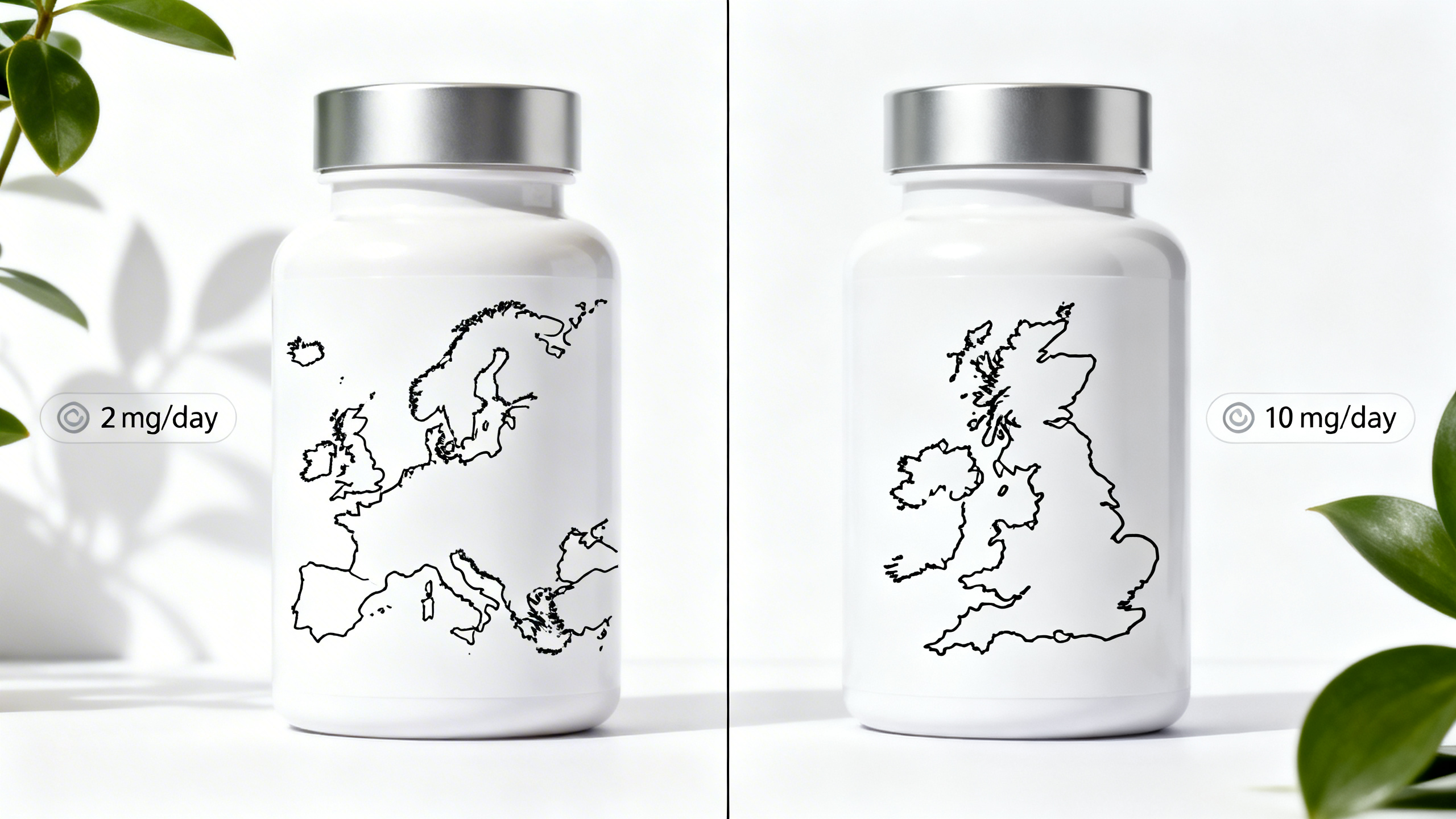
  • EFSA has established a provisional safe intake level of 0.0275 mg/kg body weight/day (about 2 mg/day for a 70 kg adult) for high‑purity CBD in food supplements, while highlighting persistent scientific data gaps.
  • The UK Food Standards Agency (FSA) continues to advise healthy adults not to exceed a provisional acceptable daily intake (ADI) of 10 mg/day from CBD foods.

For cross‑border brands, this is not just an academic debate. It affects label serving sizes, directions for use, pack architecture, online product pages, retailer onboarding, and—critically—how you defend your products in audits or enforcement actions.

This article is informational only and not legal advice.

Understanding the “2 mg/day vs 10 mg/day” split

What EFSA did (and why it matters)

In its updated work on CBD safety as a novel food, EFSA’s NDA Panel set a provisional safe intake level of 0.0275 mg/kg bw/day (approximately 2 mg/day for a 70 kg adult), explicitly noting that data gaps remain and that this provisional level may be revisited when better toxicology and human data become available.

EFSA’s position matters because EFSA is the EU’s risk assessor for novel foods under Regulation (EU) 2015/2283, and its scientific outputs heavily influence:

  • how the European Commission and Member States evaluate novel food dossiers
  • how competent authorities interpret “safe food” expectations under General Food Law (Regulation (EC) 178/2002)
  • how retailers and marketplaces set internal compliance requirements

Key source:

What the UK FSA did (and why it remains different)

The UK FSA (England/Wales) continues to encourage businesses to label products to reflect current consumer advice, including a 10 mg/day CBD intake for healthy adults.

The FSA’s current approach is embedded in a broader UK compliance framework that includes:

  • the CBD Public List mechanism (England/Wales) linking products to credible novel food applications
  • a pragmatic, risk‑management‑led stance (labels, reformulation, and ongoing monitoring) while applications progress

Key sources:

Why the mismatch exists (a compliance lens, not a politics lens)

It is tempting to describe this as “EU stricter, UK looser.” In reality, the split reflects different regulatory moments:

  • The EU is still in a novel food authorization vacuum for ingestible CBD (no EU‑wide authorization on the Union list), so safety framing is heavily shaped by EFSA’s cautious risk assessment posture.
  • Great Britain has built an interim management structure around transitional market tolerance (not blanket legalization), using the Public List and guidance to steer products toward safer profiles.

The result: one consumer marketplace, two intake narratives.

The EU compliance baseline: novel foods, labels, and enforcement reality

Novel food authorization is the gatekeeper

Under EU novel foods rules, a product that meets the novel food definition cannot be legally marketed without authorization and inclusion on the Union list of authorized novel foods (Commission Implementing Regulation (EU) 2017/2470). The Commission’s authorization process and the Union list are here:

Member‑State enforcement varies, but signals are getting louder

Even without EU‑wide authorizations, enforcement happens through national competent authorities applying:

  • General Food Law obligations (food must be safe; FBO is responsible)
  • Official controls powers under Regulation (EU) 2017/625

Sources:

A key practical indicator is the EU’s Rapid Alert System for Food and Feed (RASFF), where notifications continue to flag ingestible CBD as an unauthorized novel food in specific products.

Example notifications:

EU labelling rules still apply (even when novel food status is unresolved)

If you are marketing a product as a food supplement, you still need to align with:

  • Regulation (EU) No 1169/2011 (Food Information to Consumers)
  • Directive 2002/46/EC (food supplements labelling elements)
  • Regulation (EC) No 1924/2006 (nutrition and health claims) — meaning no unapproved health claims

Practical EU supplement label expectations include a recommended daily portion and a warning not to exceed the stated portion (Directive 2002/46/EC).

Consumer-facing summary (EU):

Commission page on nutrition/health claims framework:

The UK compliance baseline: Public List, 10 mg/day advice, and retail gatekeeping

Public List status is now a commercial requirement

For England and Wales, the FSA’s Register of CBD products linked to novel food applications (often called the Public List) is the reference point many retailers use to decide what stays on shelves.

The FSA also explicitly states that enforcement decisions remain with local authorities—but the agency has recommended that products with certain statuses may stay on the market pending further consideration.

The 2025–2026 UK inflection point: first authorisation consultation

In August 2025, the FSA opened a public consultation on the authorisation of three CBD food products as novel foods, with the consultation closing 20 November 2025.

Even if you are not one of the applicants, this matters because it signals how UK risk managers may frame:

  • food categories
  • label warnings
  • maximum daily intake statements

UK advertising and medical-claims perimeter remains tight

Do not overlook marketing compliance. UK regulators draw a hard line between foods/supplements and medicines. If you imply treatment or prevention of disease, you risk being treated as a medicine.

Cross‑border sales: why “one label for all” is now a liability

The operational problem is simple: your label’s “daily intake” language can be used against you.

  • In the EU, a label suggesting 10 mg/day may be viewed as inconsistent with EFSA’s provisional safe intake view (and therefore inconsistent with a conservative safety posture, especially if a Member State is already skeptical about unauthorized novel foods).
  • In the UK, a label suggesting 2 mg/day may be commercially viable, but it can trigger consumer dissatisfaction (“it doesn’t match what other UK products say”), and it may conflict with category norms and retailer requirements built around the FSA’s 10 mg/day message.

If you run one pan‑regional SKU with a single set of directions, you risk:

  • delisting by UK retailers who expect Public List alignment and current FSA consumer advice
  • customs friction and local authority enforcement within certain EU Member States
  • platform scrutiny (marketplaces asking for dossier mapping, COAs, and label evidence)

A practical reconciliation strategy for 2025–2026

1) Segment by destination: geo-target directions for use, not just pricing

The safest path for e‑commerce is to keep formulation constant (where possible) but tailor:

  • serving suggestion
  • maximum daily intake statement
  • consumer warnings

This can be executed via:

  • country selector logic on your site
  • destination‑based checkout rules
  • SKU mapping to the destination label set

Important: within the EU, you must be cautious with geo‑targeting practices. The EU Geo‑blocking Regulation restricts unjustified discrimination, but it does not force you to sell every product into every country. You can still define delivery destinations and manage compliance risk.

Background:

2) Build two label “intake tracks” and connect them to packaging control

At minimum, most cross‑border operators now need two intake tracks:

  • EU track: a conservative daily intake aligned with EFSA’s provisional safe intake level view (2 mg/day for a reference adult), or a strategy that avoids making a higher explicit daily intake claim.
  • UK track: a daily intake statement aligned with the FSA’s current advice (10 mg/day for healthy adults), plus required warnings (under‑18, pregnancy/breastfeeding, medication interactions).

Operationally, this means:

  • two approved artworks
  • two sets of packaging component specs
  • a distribution rule set that prevents “wrong label to wrong destination” errors

3) Re‑engineer pack sizes and unit doses so the numbers make sense

The biggest hidden compliance issue is not the mg/day text—it’s that your unit dose can make compliance impossible.

If your single gummy or capsule contains 10–25 mg, you cannot credibly present an EU‑aligned serving suggestion near 2 mg/day without creating awkward fractional directions (“take 1/5 of a gummy”). That invites consumer misuse.

Common mitigation tactics:

  • create low‑dose units for EU destinations (e.g., 1 mg or 2 mg per unit)
  • offer dropper oils with clear measured drops that allow 2 mg/day guidance to be followed
  • restrict certain high‑dose formats to UK-only channels (subject to UK rules and retailer acceptance)

4) Prepare your “dossier mapping” packet for retailers and marketplaces

Across both EU and UK, sophisticated retailers are increasingly asking for a “compliance dossier” that connects:

  • ingredient identity and purity
  • contaminant profiles and batch COAs
  • stability and shelf-life support
  • toxicology and safety narrative
  • label rationale (why the daily intake statement is what it is)

EFSA’s updated position emphasizes continuing uncertainty and the need to revisit conclusions when new data emerges. You should expect more questions about:

  • hepatic endpoints and liver markers
  • drug interaction cautions
  • bioavailability variability based on food matrix

Reference EFSA output:

5) Align claims strategy: no “wellness creep” on either side

A frequent enforcement trigger is not the mg/day statement—it’s marketing copy that implies therapeutic benefit.

  • In the EU, nutrition/health claims are regulated under Regulation (EC) 1924/2006, and only authorized claims may be used.
  • In the UK, ASA scrutiny and MHRA medicine-claims rules mean you should avoid disease treatment claims and be careful with implied outcomes.

Key references:

6) Watch “secondary” compliance: contaminants and national drug-law overlays

Even when your focus is intake limits, enforcement often pivots to contaminants and classification.

For example, EU rules set maximum levels for certain contaminants in food, including specific contexts for hemp seed products under Commission Regulation (EU) 2023/915.

Member States may also have overlays that are stricter than EU baselines for certain product types.

Timelines and “what to expect next” (early 2026 planning)

EU outlook: EFSA’s provisional level will shape dossier expectations

EFSA has been clear that the level is provisional and dependent on future data. For operators, the actionable point is that EFSA’s latest work is likely to become the reference frame for:

  • ongoing and new novel food applications
  • Member State risk communication
  • retailer “acceptable” daily intake expectations

In practice, if you are building EU‑facing ingestible products, you should assume that a 2 mg/day reference (or similarly conservative consumer‑use framing) will be a major anchor in 2026 compliance discussions.

UK outlook: authorizations may tighten label conditions

The UK is moving from “managed tolerance” toward formal authorizations. The 2025 consultation signals that label conditions—especially daily intake and mandatory warnings—will become more standardized.

If you sell into Great Britain:

  • keep your Public List status current
  • monitor consultation outcomes and Ministerial decisions
  • maintain readiness to update labels quickly once specific conditions of authorization become the norm

Clear takeaways for cross‑border businesses

  • Do not rely on one EU/UK label for ingestible CBD products in 2026. Intake messaging is now materially different.
  • Implement destination-based serving guidance (site logic + SKU governance) and validate that your unit dose supports the guidance.
  • Invest in retailer-facing evidence packets that map your label intake position to EFSA’s latest views and UK FSA guidance.
  • Keep marketing disciplined: avoid unapproved health claims and any suggestion of medical treatment.
  • Expect uneven enforcement in the EU and increasing standardization pressure in the UK as authorizations progress.

Guidance for consumers (non-medical, informational)

  • In Great Britain, the FSA advises healthy adults to limit CBD from foods to 10 mg/day and notes additional groups should avoid it (including pregnancy/breastfeeding and people taking medication).
  • In the EU, EFSA’s new work has set a provisional safe intake level around 2 mg/day for a reference adult and highlights ongoing uncertainties.

Consumers should always follow the label directions for the product in their jurisdiction and consult a healthcare professional for personal medical questions.

How CannabisRegulations.ai can help

Managing cannabis compliance, licensing, regulations, and dispensary rollout is complex—and ingredient compliance is no different. If you sell ingestible CBD products across borders, you need a system that connects regulatory intelligence to label control, SKU governance, and e‑commerce logic.

Use https://cannabisregulations.ai/ to track EU and UK regulatory changes, operationalize compliant labeling by destination, and build defensible documentation for retailers, marketplaces, and enforcement inquiries.