


Sign Up
Ready to replace complexity with clarity?
Answer your real world compliance questions (limited time) and save thousands in legal fees and avoided fines.
Automate Compliance Today

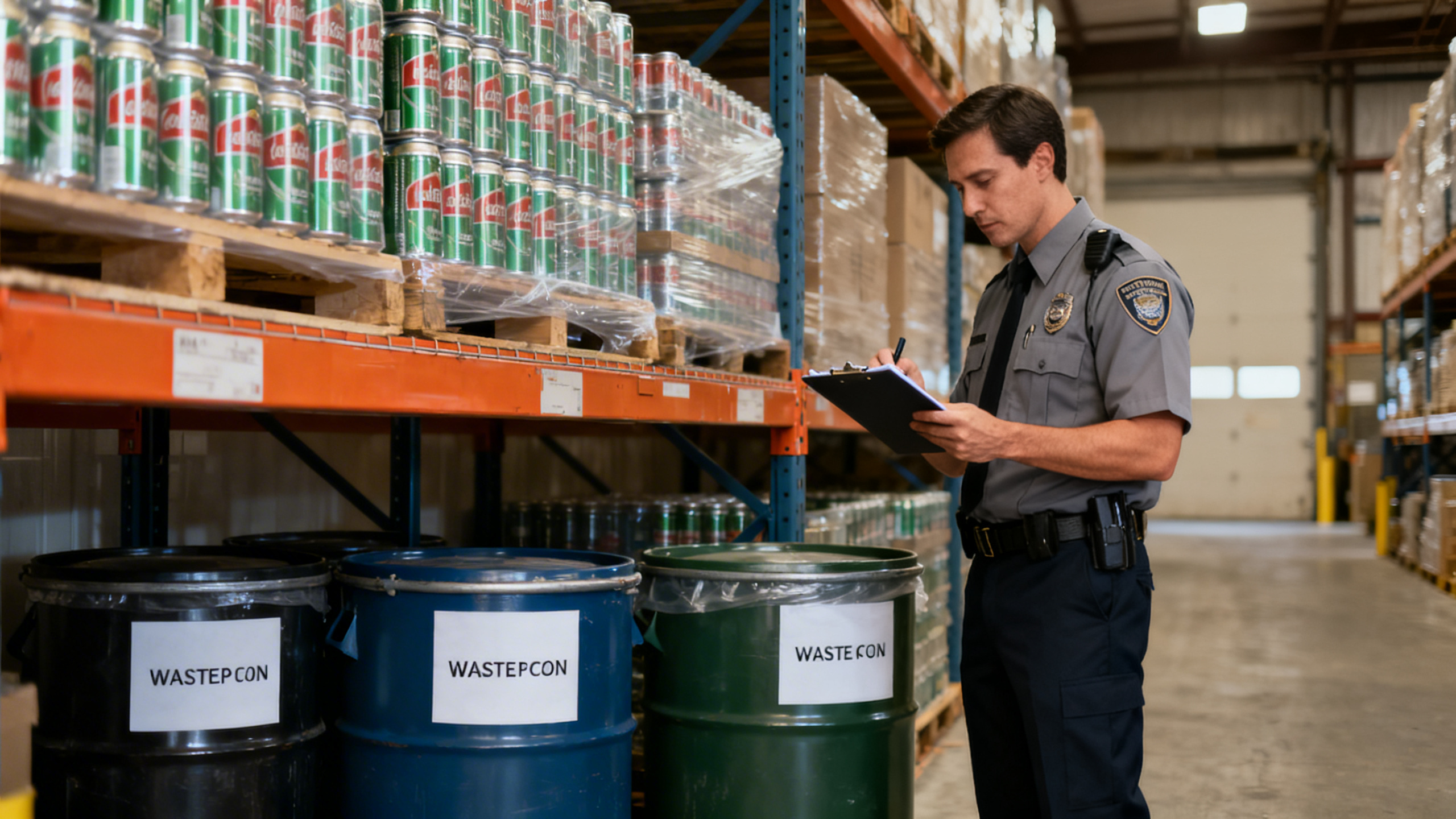
Expired drinkable THC products create a deceptively complex compliance problem in the U.S.: they look like “just beverages,” but disposal decisions can trigger RCRA hazardous waste determinations, Clean Water Act pretreatment violations, and reverse‑logistics chain‑of‑custody gaps that show up during audits.
This federal-focused guide explains why sewer disposal is a high-risk move, how to screen expired or failed‑test THC drinks for ignitability (D001), and how to structure practical options for return‑to‑vendor/recall, contracted waste handling, or approved on‑site destruction. It also outlines documentation practices that help businesses reconcile destruction back to inventory and defend decisions during regulator, insurer, or partner audits.
Informational only, not legal advice. You should confirm state, tribal, and local requirements (and your facility permits) before adopting any disposal method.
When expired beverages stack up, pouring product into a sink, mop basin, or floor drain can feel like the fastest way to clear quarantine space. It’s also one of the most common compliance pitfalls because it collides with federal pretreatment rules and local sewer ordinances.
Under EPA’s general pretreatment regulations, an industrial user may not introduce pollutants into a publicly owned treatment works (POTW) that cause pass through or interference with the treatment plant. The national prohibitions at 40 CFR §403.5 include a specific prohibition on discharges that create a fire or explosion hazard in the sewer system. Many local sewer use ordinances mirror this concept and often reference a closed-cup flash point of less than 140°F (60°C) as a bright-line trigger for “flammable” discharges.
Primary sources:
RCRA includes a concept commonly called the domestic sewage exclusion (40 CFR §261.4(a)(1)) that can exclude certain hazardous waste mixtures with domestic sewage in sewers from the definition of solid waste.
Two practical problems:
Reference (domestic sewage exclusion discussion): https://www.law.cornell.edu/cfr/text/40/261.4
EPA’s hazardous waste pharmaceutical rule created an explicit sewer ban for certain entities and materials (40 CFR §266.505). That rule is aimed at healthcare facilities and reverse distributors handling hazardous waste pharmaceuticals, not beverage operators.
Even so, it illustrates EPA’s direction of travel: sewering high‑risk consumer products is increasingly treated as an unacceptable disposal pathway. EPA and many POTWs strongly discourage sewer disposal of complex chemical mixtures.
Background on the sewer prohibition in the pharmaceutical context: https://www.ecfr.gov/current/title-40/chapter-I/subchapter-I/part-266/subpart-P/section-266.505
If you operate a licensed business handling THC beverages, you typically need a disposal SOP that starts with a waste determination. Under RCRA, once a product is discarded (expired, failed test, recalled, damaged, or otherwise designated for disposal), it becomes a candidate “solid waste,” and you must evaluate whether it is a hazardous waste.
At the federal level, a discarded THC beverage is not automatically a listed hazardous waste. The usual trigger is whether it exhibits a characteristic, especially ignitability.
The ignitability characteristic at 40 CFR §261.21 covers liquids with a flash point below 60°C (140°F), with an important exclusion for certain aqueous alcohol solutions.
Key details:
Primary sources:
Compliance takeaway: If you have beverages with appreciable ethanol or flammable flavor systems, build a screen into your SOP: either obtain a reliable flash point/ABV basis (SDS, formulation data, or testing) or treat the lot conservatively until evaluated.
If a beverage is determined to be hazardous (for example, ignitable), then the container it came in may or may not be exempt once “empty.” The federal standard for when a container is “RCRA empty” is at 40 CFR §261.7. If containers are not RCRA-empty, residues may have to be managed as hazardous waste.
Reference: https://www.law.cornell.edu/cfr/text/40/261.7
Practical pitfall: A common “quick fix” is to drain all product to make containers “empty.” If draining is done to a sink, floor drain, or sanitary sewer, you may create a pretreatment violation. If draining is done into an open bin, you may create an ignitable liquid accumulation and fire code/OSHA hazards.
Most operators end up using one (or a combination) of three pathways:
1) Return‑to‑vendor (RTV) / recall / supplier-managed destruction2) Contract waste handling (denaturing/solidification, transport, manifests)3) On‑site destruction approved by local authorities and aligned to internal controls
RTV is often the cleanest compliance story if the vendor has an established recall and destruction program, and if your contracts allow returns.
What “good” looks like:
Reverse logistics note (online returns): If you accept returns (where permitted), write a returns SOP that covers:
Even at the federal level, reverse logistics can trigger DOT/HazMat issues if the shipment is flammable (see the DOT discussion below). Your vendor may require you to ship using a specific carrier and packaging instruction.
When RTV isn’t available—or when you’re dealing with mixed lots from multiple brands—a contracted hazardous waste or industrial waste vendor can be the most defensible option.
Typical elements:
Recordkeeping: If shipments move under RCRA hazardous waste manifests, generators must retain required records. Federal generator recordkeeping requirements are addressed in 40 CFR Part 262 (record retention is commonly three years, with extensions during enforcement actions).
Reference (generator recordkeeping): https://www.ecfr.gov/current/title-40/chapter-I/subchapter-I/part-262/subpart-D
Some businesses seek on‑site destruction to avoid transport risk and to close inventory gaps quickly. On‑site destruction is highly variable because it depends on:
If you pursue on‑site destruction, the compliance story needs to be airtight:
Do not default to “dump and dilute.” Dilution to avoid a hazardous waste determination is not a compliant strategy, and dilution to make a discharge acceptable can still violate pretreatment rules.
POTWs focus on protecting sewer infrastructure, worker safety, treatment performance, and biosolids quality. Beverage disposal can trigger concerns even if the active ingredient is not the focus.
EPA notes that local limits are site-specific and enforceable when properly developed; your facility can be in compliance with federal categorical standards (if any apply) and still violate local limits or narrative prohibitions.
Reference: https://www.epa.gov/npdes/pretreatment-standards-and-requirements-local-limits
Operational takeaway: Even if you never discharge beverage product, your SOP should ensure staff understand that “sanitary sewer” is not a universal disposal pathway. Train for it like you train age-gating or security: simple rule, repeated often.
Expired beverages are frequently moved between licensed locations, vendors, or destruction sites. If the waste is ignitable or otherwise regulated as hazardous material, transportation obligations can change.
For ethanol solutions, DOT proper shipping names often reference UN1170 (Ethanol or Ethanol solution), depending on concentration and other factors. Classification and packaging requirements are fact-specific.
Useful starting reference for emergency response and UN/NA 1170: https://cameochemicals.noaa.gov/unna/1170
Compliance takeaway: Don’t assume reverse logistics shipments are “just returns.” Align your shipping program with hazmat training and carrier requirements when alcohol content or flash point triggers apply.
Expired THC drink disposal is as much a documentation problem as it is a waste-handling problem. Your SOP should make it difficult for teams to improvise.
At a minimum, align retention with:
When in doubt, many operators retain destruction packets at least 3–7 years, and longer if required by license conditions, lender covenants, or ongoing disputes.
Use this workflow to keep decisions consistent:
1) Identify the trigger: expired date, failed test, recall notice, damage, returned item.2) Quarantine immediately in secured hold area with tamper-evident controls.3) Perform waste determination:
Even when penalties aren’t immediate, the business consequences can be significant:
Federal rules set the floor, but disposal obligations for THC drinks are often driven by state cannabis regulations, local solid waste rules, fire code, and POTW permits. If you operate in multiple jurisdictions, a single “national SOP” usually needs site-specific addenda.
For continuously updated compliance guidance, disposal SOP templates, and regulatory monitoring across jurisdictions, use https://www.cannabisregulations.ai/ to support your cannabis compliance program and reduce waste-handling, pretreatment, and reverse‑logistics risk.