


Sign Up
Ready to replace complexity with clarity?
Answer your real world compliance questions (limited time) and save thousands in legal fees and avoided fines.
Automate Compliance Today

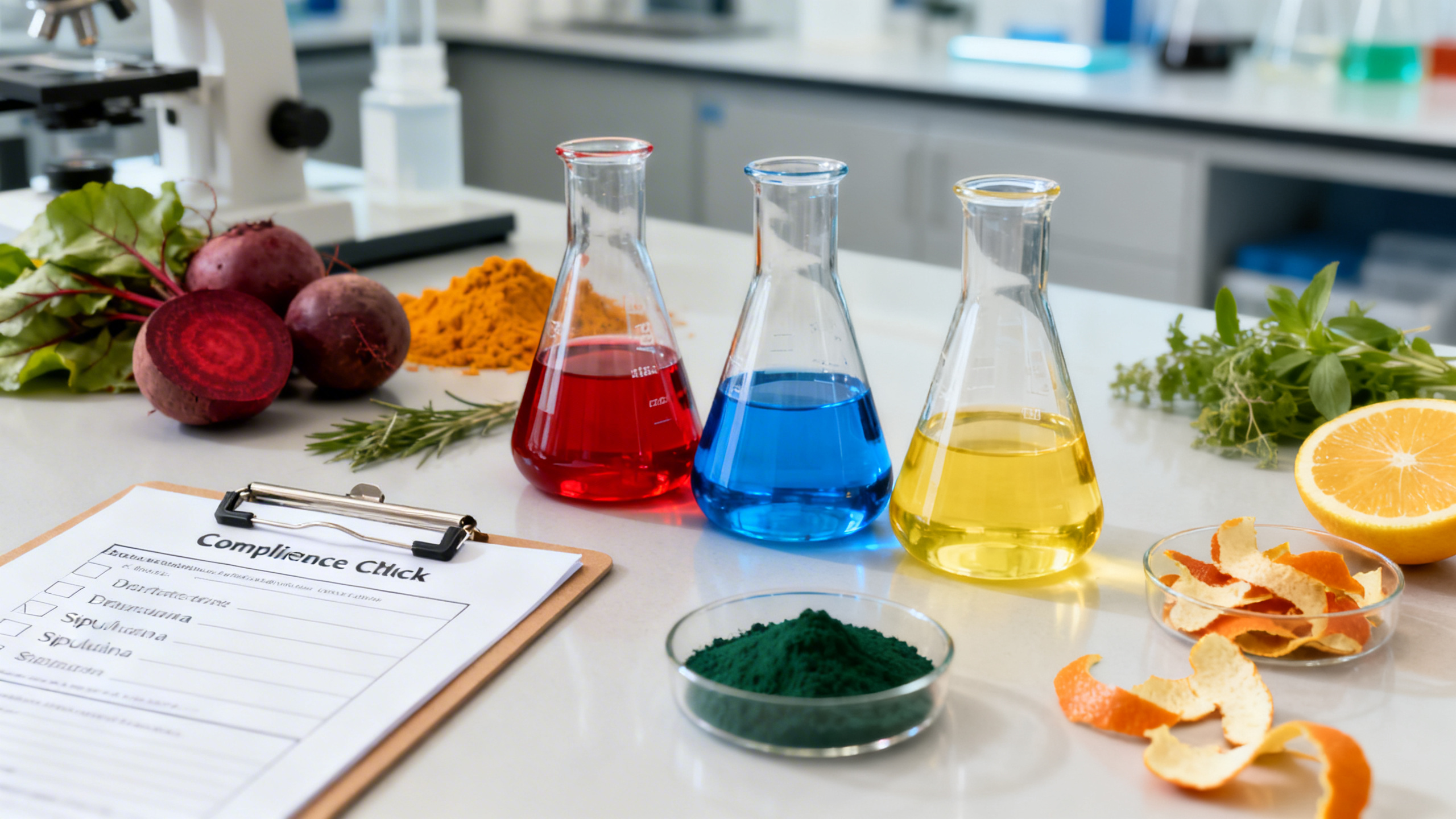
Non-alcoholic THC beverages—especially products sold outside state-licensed dispensary systems (e.g., in general retail or direct-to-consumer where state law allows)—are increasingly being formulated and marketed like conventional foods. That makes them collide head-on with federal food additive and color additive rules.
In 2025, FDA’s Human Foods Program (HFP) signaled that color additives derived from natural sources would be a priority area for new or updated guidance. The key compliance lesson for brands: calling a dye “natural” does not remove it from FDA’s color additive premarket approval framework.
This article (informational only, not legal advice) explains how FDA’s 2025 food colors agenda intersects with THC drinks, why “GRAS” is a common trap in color systems, and what to audit now to reduce adulteration and misbranding risk.
FDA’s Human Foods Program publicly posts a rolling list of Foods Program Guidance Under Development and, in 2025, included new work on food colors derived from natural sources—notably around the longstanding complexities of plant-based colorants like fruit and vegetable juice-derived colors.
The FDA’s constituent update announcing the 2025 guidance agenda is here: https://www.fda.gov/food/hfp-constituent-updates/fda-releases-2025-human-foods-program-guidance-agenda
And the underlying guidance development list is here: https://www.fda.gov/food/guidance-documents-regulatory-information-topic-food-and-dietary-supplements/foods-program-guidance-under-development
Even if your THC beverage is primarily regulated at the state level when sold through a licensed dispensary system, many hemp-derived THC beverage programs are intentionally designed to fit the “conventional food” channel. For these products, FDA’s food framework is not theoretical—it is the baseline federal standard that regulators, retailers, payment processors, insurers, and plaintiffs’ lawyers tend to benchmark.
FDA regulates all color additives—synthetic or from natural sources—through premarket listing/approval. FDA’s general color additive hub states the core rule clearly: color additives are required to be pre-approved and listed in FDA’s color additive regulations before use. See: https://www.fda.gov/industry/color-additives
In addition, FDA has recently highlighted the agency priority to expand options derived from natural sources (including via color additive petitions). One example: FDA announcements/approvals of new colors from natural sources emphasize that the FD&C Act requires FDA approval before use. See: https://www.fda.gov/news-events/press-announcements/fda-approves-three-food-colors-natural-sources
For THC drinks, that means:
FDA summarizes this distinction (food additive vs color additive) in its “Determining the Regulatory Status of a Food Ingredient” resource: https://www.fda.gov/food/food-ingredients-packaging/determining-regulatory-status-food-ingredient
Under the FD&C Act, color additives occupy a distinct lane. A substance can be “natural,” widely consumed, and even supported by safety data, but if the intended use is to color a food, FDA generally expects it to be authorized through the color additive framework.
In FDA’s system, color additives are typically grouped as:
The “exempt” category is where many “natural” colors sit, but “exempt from certification” does not mean exempt from regulation. It means the color is not batch-certified by FDA; it still must meet identity/specifications and be used only in permitted ways.
The actual regulations for exempt colors are in 21 CFR Part 73: https://www.ecfr.gov/current/title-21/chapter-I/subchapter-A/part-73
Many beverage brands assume that “juice-based color” is automatically permissible. FDA does list fruit juice and vegetable juice as color additives exempt from certification (see 21 CFR 73.250 and 21 CFR 73.260).
But the compliance risk is that commercial “natural color systems” are often not simply “juice.” They may be concentrates, extracts, reacted pigments, or blends manufactured with processing steps that push them outside the regulatory identity for “fruit juice” or “vegetable juice.”
FDA has historically tried to clarify this in guidance. For context, FDA issued a 2016 draft guidance on “Fruit Juice and Vegetable Juice as Color Additives in Food” and later withdrew it after technical concerns and reopened discussion. Even though that particular document was withdrawn, it shows the exact line FDA focuses on: whether a plant-derived material meets the identity/specifications for the listed color regulation versus needing a new color additive petition.
A recurring compliance failure in beverage formulation is assuming that a supplier’s GRAS position for an ingredient covers its use as a color.
FDA’s own “Determining the Regulatory Status of a Food Ingredient” page makes the key point:
That second bullet is where brands get trapped. GRAS is a food-additive concept; color additives are governed under their own premarket listing standard. Put differently:
THC drinks frequently use emulsions and “appearance systems” that include:
Common failure modes:
The takeaway: treat GRAS support as necessary for many ingredients, but do not assume it satisfies color additive authorization.
The color additive compliance story does not end with ingredient approval. Labeling is where misbranding claims proliferate.
FDA’s food labeling regulation for spices, flavorings, colorings and chemical preservatives is at 21 CFR 101.22: https://www.law.cornell.edu/cfr/text/21/101.22
Key concept: color additives generally must be declared in the ingredient statement by their name or an appropriate collective term permitted by regulation.
For THC beverage brands, this matters because:
If the ingredient statement is incomplete or misleading, that creates misbranding risk, and in the THC-adjacent category, enforcement scrutiny can stack (ingredient legality, safety, and label claims).
While the core of this article is the 2025 agenda, it’s important to note that FDA has continued evolving its posture on “no artificial colors” messaging. In early 2026, FDA announced it would exercise enforcement discretion for certain “no artificial colors” claims when petroleum-based certified colors are absent, even if naturally derived color additives are present.
Two compliance cautions for THC beverages:
THC beverages frequently sit in a complicated jurisdictional pocket:
If your product is sold through state-licensed channels, you may be required to use state-mandated warning language, THC symbols, potency per serving, and child-resistant packaging.
If your product is sold outside those channels (where state law permits), you may still choose to incorporate some state-style warnings for risk management, but you should coordinate that with:
The point is not to “mix regimes” haphazardly. It’s to build a label architecture that can survive both state inspections and federal-style scrutiny.
FDA has repeatedly used warning letters and public statements to emphasize that certain hemp-derived cannabinoids in conventional foods can trigger adulteration concerns (often framed as unsafe food additives), and that misleading labeling and drug claims add additional violations.
One example warning letter (July 15, 2024) explicitly asserts adulteration for delta-8 THC foods due to an unsafe food additive theory and references FDA’s concern about accidental ingestion: https://www.fda.gov/inspections-compliance-enforcement-and-criminal-investigations/warning-letters/earthly-hemps-674916-07152024
Why this matters for color additive compliance: once a product is already in a high-scrutiny category, secondary issues (like an unapproved “natural” color system or sloppy color labeling) can become the easiest enforcement hook.
If you sell THC beverages in any channel that resembles conventional food distribution, a proactive “colors and emulsions audit” is one of the highest ROI compliance projects you can do in 2026.
For each SKU and each flavor/variant, identify:
Document the rationale. Your internal memo should be written for an outside reviewer: “This is why we believe the primary technical effect is X.”
For each color additive:
If you can’t tie the ingredient directly to a listing regulation for the intended use, treat it as a red flag and escalate.
FDA has reminded manufacturers that authorized colors exempt from certification must still meet identity and purity specifications in their listing regulations and comply with other requirements; heavy metal contamination above specs can render the color (and the food) adulterated.
Ask suppliers for:
Many THC beverages rely on emulsions that include botanical extracts, carriers, and stabilizers. When those systems include color components, make sure you have:
If you are relying on a contract manufacturer, do not assume they have done this for you. Your brand is still on the hook for label accuracy and product compliance.
For each SKU:
Because “natural colors” are a fast-moving area—FDA is adding new options and revisiting policy—brands should plan for:
For background on petitioning, FDA’s color additive petition framework is in 21 CFR Part 71 and FDA’s petition guidance: https://www.ecfr.gov/current/title-21/chapter-I/subchapter-A/part-71 and https://www.fda.gov/regulatory-information/search-fda-guidance-documents/guidance-industry-color-additive-petitions-fda-recommendations-submission-chemical-and-technological
Some THC beverage strategies involve near-beer formats, “mocktails,” or products that sit close to alcohol categories. Where products fall under TTB jurisdiction (alcohol beverages), you can face an additional layer of constraints.
TTB has a resource on Color Additives in Alcohol Beverage Products explaining that a color additive approved for food generally may be used in alcohol beverages unless otherwise stated, but many color additive regulations only authorize specific food uses and may not include alcoholic beverages. See: https://www.ttb.gov/public-information/featured-stories/color-additives-alcohol-beverage-products
If your product strategy involves any alcoholic SKUs—or co-manufacturing in alcohol facilities—treat TTB/FDA crossover as a separate, high-risk workstream.
If you’re building or scaling THC beverage distribution—especially outside state-licensed dispensary systems—your formulations, supplier files, and label architecture should be reviewed with the same rigor as a conventional beverage company, plus the added complexity of cannabinoid-specific state rules.
Use https://www.cannabisregulations.ai/ to track federal and state regulatory updates, pressure-test ingredient and label decisions, and strengthen your end-to-end cannabis compliance posture as beverage enforcement expectations continue to evolve.