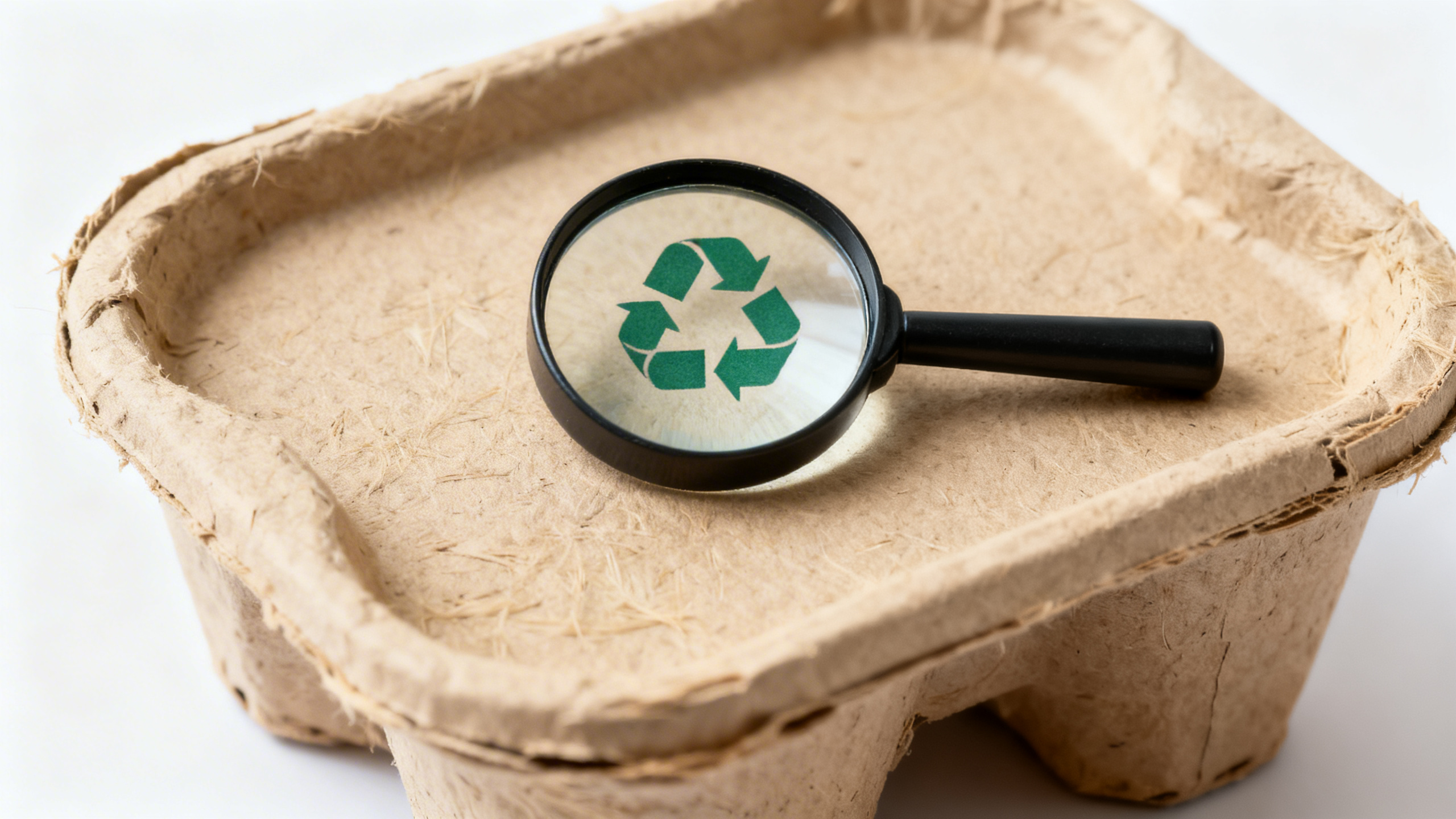

Analysis

“Hemp Plastic” and Compostable Claims Under Fire: California SB 343, ASTM D6400, and Proof You’ll Need for 2025–2026

California is raising the bar for hemp packaging sustainability claims. As SB 343, SB 54, ASTM compostability standards, and the FTC Green Guides reshape how brands can market recyclable, compostable, biodegradable, plastic-free, and bio-based packaging, cannabis and hemp operators need audit-ready substantiation before making environmental claims.
Compliance Carl
 Min Read
Published
June 2, 2026
Updated on:
June 2, 2026
Regulatory Topics
Regulation & Compliance Locations Covered in Post:
Cannabinoids & Compounds Covered in Post:
Relevant Readers:
explore all cannabis and hemp regulations

If your brand is moving toward hemp-fiber or hemp-blend packaging, the sustainability story can feel straightforward: plant-based input, fewer petrochemicals, and a cleaner end-of-life.

California regulators and federal advertising standards are making that story much harder to tell without receipts.

In 2025–2026, the risk isn’t only whether a package is “better.” The risk is whether your marketing and on-pack labeling (including symbols) imply an end-of-life outcome—recyclable, compostable, biodegradable, plastic-free, bio-based, or carbon-neutral—that you can’t substantiate in the real world.

This California-focused guide breaks down what SB 343 (Truth in Recycling), ASTM compostability standards (D6400/D6868), and the FTC’s ongoing Green Guides review mean for hemp packaging recyclability compostable claims—and the documentation you’ll need to defend them.

Important: This article is for informational purposes only and is not legal advice.

California SB 343: Why “recyclable” claims are getting re-litigated

California’s SB 343 (the “Truth in Recycling” law) targets one of the most common sources of greenwashing: packaging that looks recyclable (often via the chasing arrows symbol), but isn’t actually recycled at scale.

CalRecycle’s SB 343 program page and materials explain that the agency is required to publish data about material types/forms that routinely become feedstock used in new products/packaging, and that manufacturers must use that and other information to evaluate whether a product can be labeled “recyclable in California.”

External link: CalRecycle SB 343 Accurate Recycling Labels resources: https://calrecycle.ca.gov/wcs/recyclinglabels/

The big compliance trigger: CalRecycle’s 2025 Final Findings and the 18‑month clock

CalRecycle published the SB 343 Material Characterization Study Final Findings – 2023/2024 on April 4, 2025. After each new study, manufacturers have 18 months to ensure updated information supports use of the chasing arrows symbol on products.

Practical takeaway: for many companies, the key “manufactured after” compliance date coming out of the April 2025 publication is October 4, 2026 (18 months later). That date shows up repeatedly in compliance commentary because it is the point when packaging produced after that date must meet SB 343’s criteria to keep recyclability indicators.

External link (CalRecycle SB 343 page noting April 4, 2025 publication and 18 months): https://calrecycle.ca.gov/wcs/recyclinglabels/

SB 343’s statewide recyclability criteria (the “60%” concept)

CalRecycle’s SB 343 FAQ explains a central threshold concept: to be considered “recyclable,” a material type/form must be accepted for collection by jurisdiction recycling programs collectively serving at least 60% of the California population (and must also meet additional sortation/reprocessing criteria under the statute).

External link: CalRecycle SB 343 FAQ (Aug 2025): https://www2.calrecycle.ca.gov/Docs/Web/131148

Enforcement: who can come after your claims

Per CalRecycle’s SB 343 FAQ, SB 343 can be enforced by local jurisdictions and the California Attorney General, and penalties may apply.

External link: SB 343 FAQ enforcement note: https://www2.calrecycle.ca.gov/Docs/Web/131148

Why hemp packaging is uniquely exposed under SB 343

“Hemp packaging” isn’t one material. In the market, it can mean:

  • Molded fiber made with hemp hurd or fiber
  • Hemp paperboard cartons
  • Hemp-fiber composite trays
  • Hemp-blend flexible films
  • Hemp + bioplastic laminations
  • Hemp-labeled plastics where hemp is a small additive

SB 343 evaluates recyclability based on material type and form and whether it is routinely collected, sorted, and actually recycled into feedstock in California—not whether it contains a plant-based ingredient.

That means two packages can both be “hemp-based,” yet one may fit within widely recycled paper streams while the other is a multilayer composite that gets rejected at MRFs (materials recovery facilities) or can’t be pulped at paper mills.

“Looks like paper” is not a recycling strategy

Some hemp-fiber formats are sold as paper-like while containing:

  • Water-resistant coatings
  • Heat-seal layers
  • Barrier films
  • Adhesives and inks that disrupt repulping

If the structure behaves like a composite, your “recyclable” claim may fail in practice even if the fiber portion is technically recyclable.

Compostable claims: ASTM D6400 vs. ASTM D6868 (and why it matters for fiber packages)

A major compliance pitfall is mixing up:

  • “Plant-based” (a feedstock claim)
  • “Compostable” (an end-of-life claim)

ASTM provides two commonly referenced compostability specifications used in the U.S. market:

  • ASTM D6400: specification for plastics designed to be aerobically composted in municipal/industrial facilities
  • ASTM D6868: specification for end items that incorporate plastics/polymers as coatings/additives with paper/other substrates designed to be aerobically composted in municipal/industrial facilities

External link (ASTM overview of D6400 and D6868 as companion specifications): https://www.astm.org/news/case-study-standards-biodegradable-plastic-ma23

What this means for hemp-fiber packaging

If your “hemp” format is:

  • A plastic item (even if bio-based), D6400 is typically the relevant spec
  • A fiber item with a polymer coating (common in barrier cartons, lined pouches, coated wraps), D6868 is often the relevant spec

This distinction is not academic. Many sustainability claims fail because brands show a D6400 certificate for a resin but sell a finished, printed, coated structure where the standard that applies is different—or where the finished item was never tested/certified as sold.

“Meets ASTM” isn’t the same as “accepted in compost programs”

Even if a package meets D6400/D6868 in a controlled standard, it may still be:

  • Not accepted by local composters
  • Screened out as contamination
  • Disallowed by a retailer’s packaging policy

So you need both technical qualification and real-world access before using broad compostable claims.

FTC Green Guides: why 2025 is a “watch this space” year

The FTC’s Green Guides (Guides for the Use of Environmental Marketing Claims) are the federal playbook for when environmental marketing becomes deceptive under the FTC Act. The FTC’s Green Guides topic page continues to collect updates and FTC actions as part of its ongoing review.

External link: FTC Green Guides hub: https://www.ftc.gov/news-events/topics/truth-advertising/green-guides

What’s relevant for packaging teams right now

Even before any updated Guides are finalized, the current Green Guides framework already emphasizes:

  • Claims must be truthful and substantiated
  • “Recyclable” claims should be qualified if facilities aren’t available to a “substantial majority” of consumers or communities

You should assume the direction of travel is toward:

  • Higher substantiation standards
  • Less tolerance for vague “eco” language
  • More scrutiny of “biodegradable,” “compostable,” and “recyclable” when real-world infrastructure is limited

For a packaging format like hemp blends—where consumer perception often outpaces infrastructure—this is a high-risk mismatch.

Industry reporting continues to highlight the gap between state-level labeling mandates and pending federal updates.

External link (industry context): Packaging Dive on Green Guides updates pending while states lead: https://www.packagingdive.com/news/packaging-labeling-recyclable-compostable-green-guides/738514/

Substantiation: the proof you’ll need for 2025–2026 claims

For hemp packaging recyclability compostable claims, the winning approach is to build a claim file (a substantiation dossier) for every SKU/format. The file should cover both the technical basis and the availability basis.

A. Proof for “recyclable” in California (SB 343 readiness)

At minimum, maintain written records that support any recyclability representation, including symbols.

Your substantiation file should include:

  1. Material and structure specification
  • Bill of materials (BOM) with % by weight
  • Drawings showing layers (fiber, coatings, adhesives, inks)
  • Component breakdown (closure, label, window, liner)
  1. SB 343 evaluation memo
  • Identify the relevant “material type and form” category
  • Document how the package meets statewide recyclability criteria using CalRecycle-published information and any additional credible data you rely on
  1. Collection and sortation evidence
  • Evidence the format is accepted in recycling programs serving at least 60% of California population (as described in CalRecycle’s SB 343 FAQ)
  • Evidence it is sorted into a bale/stream and not routinely disposed
  1. End-market / feedstock evidence
  • Evidence that the sorted material routinely becomes feedstock used in new products/packaging (the core concept SB 343 is trying to measure)
  1. Artwork controls
  • Packaging artwork showing the exact claim language and any symbols
  • Version control, print dates, and manufacturing dates to manage the October 2026 trigger

External links:

B. Proof for “compostable” (ASTM + certification + access)

To support an unqualified “compostable” claim, treat it like a product performance claim.

Recommended documentation:

  1. Standard mapping
  • If it’s a plastic item: map to ASTM D6400
  • If it’s fiber with polymer coatings/additives: map to ASTM D6868
  1. Third-party certification
  • Keep the certificate for the finished item as sold (not only raw resin)
  • Keep test reports, scope statements, and any conditions/limitations
  1. Facility acceptance evidence
  • Written acceptance letters or published acceptance lists from composting facilities/haulers serving your sales geography
  • Evidence that the item is accepted in organics programs (and not treated as contamination)
  1. Claim qualification language
  • If only industrial composting is appropriate, be explicit (e.g., “commercially compostable where facilities exist”)

External link (ASTM overview of D6400/D6868): https://www.astm.org/news/case-study-standards-biodegradable-plastic-ma23

C. Proof for “biodegradable” (high-risk claim)

“Biodegradable” is one of the most enforcement-prone claims because it can imply:

  • A timeframe (how fast?)
  • An environment (soil? marine? landfill? compost?)
  • A completeness (does it fully break down or micro-fragment?)

If you must use it, you need:

  • A defined environment and timeframe
  • Test method alignment (and a strong basis for real-world conditions)
  • Clear qualifications to avoid a broad implied claim

In practice, many brands choose to avoid “biodegradable” entirely on packaging unless they have very strong substantiation.

The “plastic-free” and “bio-based” trap in hemp packaging

Hemp-based packaging is frequently marketed as plastic-free even when the package contains:

  • Heat-seal layers
  • Barrier coatings
  • Polymer windows
  • Adhesives and coatings that are plastics/polymers

How to reduce risk

  • Use precise composition claims (“made with X% plant fiber”) rather than absolute “plastic-free” unless you can prove it across all components
  • Define scope: does the claim include labels, closures, coatings, inks?
  • Avoid implying recyclability or compostability just because the input is bio-based

For bio-based claims, be careful not to imply the item is compostable or has lower impact overall. Keep separate claim files for:

  • Bio-based content (feedstock)
  • End-of-life outcomes (recycling/composting)
  • Carbon claims (footprint and offsets)

Carbon-neutral and climate claims: substantiation or silence

“Carbon-neutral” is increasingly treated like a quantified performance claim. Common failure modes include:

  • Using offsets without transparent boundaries
  • Claiming neutrality for a package when only a portion of emissions were measured
  • Not updating footprint calculations as materials and suppliers change

If you pursue carbon claims, maintain:

  • A current footprint study with defined system boundaries
  • Supplier emissions data and assumptions
  • Offset retirement documentation (if used)
  • Marketing language that matches the boundary (product vs. company vs. shipment)

Retailer packaging specs: why your claim file must satisfy buyers too

Even when a claim is legally defensible, it may fail a retailer’s sustainability screen.

Retailers increasingly expect:

  • Packaging to align with their recyclability definitions
  • Clear labeling that does not confuse consumers
  • Documentation they can audit

For example, Target describes programs and icons (like “Target Zero”) that mark items designed to be refillable, reusable or compostable, among other criteria—illustrating how retailers may apply their own frameworks and substantiation expectations.

External link: Target product & packaging design / circularity: https://corporate.target.com/sustainability-governance/circularity/product-packaging-design

Walmart has also published packaging guidance/playbooks and has recyclability and recycled-content goals (especially for private brands), which often flow down into supplier expectations.

External link (retailer guide summary): https://www.ecoenclose.com/resources/retailer-guide/walmart

Practical takeaway: If you can’t produce your documentation quickly, you may lose shelf access even before regulators get involved.

How SB 54 (California packaging EPR) changes the strategic calculus for hemp composites

California’s SB 54 (Plastic Pollution Prevention and Packaging Producer Responsibility Act) is the state’s packaging EPR regime. CalRecycle’s rulemaking page notes that permanent regulations were submitted to OAL on August 12, 2025 and published in the California Regulatory Notice Register on August 22, 2025, with an additional 15-day public comment period.

External link: CalRecycle SB 54 regulations page: https://calrecycle.ca.gov/laws/rulemaking/sb54regulations/

Why EPR matters for hemp blends

EPR doesn’t only care about what you say—it increasingly cares about what you put on the market:

  • Reporting by material category
  • Fees that can vary based on recyclability/compostability and other criteria
  • Pressure to eliminate hard-to-process composites

If your hemp packaging is effectively a fiber + plastic composite or multilayer structure, it may face:

  • Poor recyclability outcomes (SB 343 claim risk)
  • Limited compost acceptance (ASTM/acceptance risk)
  • Higher EPR costs or unfavorable categorization (SB 54 reporting/fee risk)

CalRecycle’s SB 54 packaging EPR hub includes guidance documents and covered material category resources used for producer reporting and determinations.

External link: CalRecycle SB 54 Packaging EPR hub: https://calrecycle.ca.gov/packaging/packaging-epr/

What hemp-based materials are most likely to work (and where brands get burned)

Because “hemp packaging” spans many constructions, it’s safer to think in end-of-life pathways.

Pathway 1: Paper recycling (best for many hemp fiber formats)

Most defensible when:

  • It is a mono-material fiber item (or functionally repulpable)
  • It is not heavily coated/laminated
  • Labels/adhesives are compatible with pulping

Where it fails:

  • Plastic windows
  • Heavy barrier layers
  • “Waterproof” coatings that behave like plastic laminations

Your proof burden under SB 343 will focus on collection/sortation and real recycling into feedstock.

Pathway 2: Commercial composting (possible, but only with the right construction)

Most defensible when:

  • The finished item is certified to the right ASTM spec (D6400 or D6868)
  • You have evidence of facility acceptance in relevant markets

Where it fails:

  • “Compostable” claims without access (“where facilities exist” isn’t optional if they don’t)
  • Items that technically compost but are not accepted by local composters due to contamination concerns

Pathway 3: Store drop-off / specialty programs (high friction)

If your package relies on a special collection program, your claim should be narrow and explicit.

  • Avoid broad “recyclable” language if only specialty recycling applies
  • Provide clear instructions and don’t imply curbside acceptance

2025–2026 compliance timeline (CA-focused)

Here’s the timing packaging teams should be designing to now:

  • April 4, 2025: CalRecycle publishes SB 343 Material Characterization Study Final Findings – 2023/2024 (triggers compliance update cycle)
  • 18 months after publication: manufacturers should ensure their packaging manufactured after that point has claims/symbols supported by the updated information (commonly tracked as October 4, 2026)
  • 2025–2026: FTC Green Guides review continues (expect heightened scrutiny; ensure claim files are audit-ready)
  • SB 54: regulations and guidance continue rolling forward; be ready for reporting/category decisions that penalize hard-to-recycle composites

External links:

Action checklist: how to ship hemp packaging without shipping legal risk

Use this as an internal sprint plan for packaging, marketing, and compliance.

1) Inventory every claim and symbol

  • On-pack: chasing arrows, “recyclable,” “compostable,” “biodegradable,” “plastic-free,” “eco,” “earth friendly,” etc.
  • Off-pack: website PDPs, sell sheets, retailer portals, investor decks

2) Split “material” claims from “end-of-life” claims

  • “Hemp fiber” is a composition claim
  • “Recyclable/compostable” is an end-of-life claim

Don’t let one imply the other.

3) Build a claim file per format/SKU

  • Material specs, suppliers, test reports
  • Applicable ASTM standard mapping (D6400 vs D6868)
  • Facility acceptance evidence for compostable items
  • SB 343 evaluation memo for recyclability in CA

4) Decide your safest label language

  • If you can’t prove statewide recyclability, avoid broad “recyclable” and chasing arrows in CA
  • If industrial composting only, say so clearly and prominently

5) Align with retailer requirements early

  • Ask buyers what proof they require
  • Provide certificates, scope statements, and acceptance evidence

6) Stress-test “plastic-free” and carbon claims

  • Audit every component for hidden polymers
  • Define carbon-neutral boundaries and keep documentation current

Bottom line

California is forcing a shift from “sustainability storytelling” to sustainability evidence. Hemp-based packaging can still be a strong strategy—but only when your end-of-life claims match:

  • What California systems actually collect and recycle (SB 343)
  • What composting systems actually accept (ASTM + access)
  • What regulators consider non-deceptive marketing (FTC Green Guides)

If your 2026 packaging still carries unsubstantiated “recyclable” or “compostable” messaging, you’re taking on avoidable enforcement and retailer-delisting risk.

Next step: operationalize your claim proof

CannabisRegulations.ai helps teams track changing state rules, document compliant packaging claims, and maintain audit-ready substantiation files across SKUs.

Use https://cannabisregulations.ai/ to centralize your cannabis compliance and packaging-claim workflows—so your next sustainability redesign holds up in California, in buyer reviews, and in enforcement scenarios.

Compliance Carl
Senior Compliance Editor
Compliance Carl is the senior editor desk at CannabisRegulations.ai. Carl writes about federal scheduling, state enforcement, carrier policy, and the operational compliance questions cannabis and hemp businesses actually face.

Locations Cannabis / Hemp Legal FAQ's:

Featured Compliance Insights

February 21, 2026

“Hemp Plastic” and Compostable Claims Under Fire: California SB 343, ASTM D6400, and Proof You’ll Need for 2025–2026

“Hemp Plastic” and Compostable Claims Under Fire: California SB 343, ASTM D6400, and Proof You’ll Need for 2025–2026

If your brand is moving toward hemp-fiber or hemp-blend packaging, the sustainability story can feel straightforward: plant-based input, fewer petrochemicals, and a cleaner end-of-life.

California regulators and federal advertising standards are making that story much harder to tell without receipts.

In 2025–2026, the risk isn’t only whether a package is “better.” The risk is whether your marketing and on-pack labeling (including symbols) imply an end-of-life outcome—recyclable, compostable, biodegradable, plastic-free, bio-based, or carbon-neutral—that you can’t substantiate in the real world.

This California-focused guide breaks down what SB 343 (Truth in Recycling), ASTM compostability standards (D6400/D6868), and the FTC’s ongoing Green Guides review mean for hemp packaging recyclability compostable claims—and the documentation you’ll need to defend them.

Important: This article is for informational purposes only and is not legal advice.

California SB 343: Why “recyclable” claims are getting re-litigated

California’s SB 343 (the “Truth in Recycling” law) targets one of the most common sources of greenwashing: packaging that looks recyclable (often via the chasing arrows symbol), but isn’t actually recycled at scale.

CalRecycle’s SB 343 program page and materials explain that the agency is required to publish data about material types/forms that routinely become feedstock used in new products/packaging, and that manufacturers must use that and other information to evaluate whether a product can be labeled “recyclable in California.”

External link: CalRecycle SB 343 Accurate Recycling Labels resources: https://calrecycle.ca.gov/wcs/recyclinglabels/

The big compliance trigger: CalRecycle’s 2025 Final Findings and the 18‑month clock

CalRecycle published the SB 343 Material Characterization Study Final Findings – 2023/2024 on April 4, 2025. After each new study, manufacturers have 18 months to ensure updated information supports use of the chasing arrows symbol on products.

Practical takeaway: for many companies, the key “manufactured after” compliance date coming out of the April 2025 publication is October 4, 2026 (18 months later). That date shows up repeatedly in compliance commentary because it is the point when packaging produced after that date must meet SB 343’s criteria to keep recyclability indicators.

External link (CalRecycle SB 343 page noting April 4, 2025 publication and 18 months): https://calrecycle.ca.gov/wcs/recyclinglabels/

SB 343’s statewide recyclability criteria (the “60%” concept)

CalRecycle’s SB 343 FAQ explains a central threshold concept: to be considered “recyclable,” a material type/form must be accepted for collection by jurisdiction recycling programs collectively serving at least 60% of the California population (and must also meet additional sortation/reprocessing criteria under the statute).

External link: CalRecycle SB 343 FAQ (Aug 2025): https://www2.calrecycle.ca.gov/Docs/Web/131148

Enforcement: who can come after your claims

Per CalRecycle’s SB 343 FAQ, SB 343 can be enforced by local jurisdictions and the California Attorney General, and penalties may apply.

External link: SB 343 FAQ enforcement note: https://www2.calrecycle.ca.gov/Docs/Web/131148

Why hemp packaging is uniquely exposed under SB 343

“Hemp packaging” isn’t one material. In the market, it can mean:

  • Molded fiber made with hemp hurd or fiber
  • Hemp paperboard cartons
  • Hemp-fiber composite trays
  • Hemp-blend flexible films
  • Hemp + bioplastic laminations
  • Hemp-labeled plastics where hemp is a small additive

SB 343 evaluates recyclability based on material type and form and whether it is routinely collected, sorted, and actually recycled into feedstock in California—not whether it contains a plant-based ingredient.

That means two packages can both be “hemp-based,” yet one may fit within widely recycled paper streams while the other is a multilayer composite that gets rejected at MRFs (materials recovery facilities) or can’t be pulped at paper mills.

“Looks like paper” is not a recycling strategy

Some hemp-fiber formats are sold as paper-like while containing:

  • Water-resistant coatings
  • Heat-seal layers
  • Barrier films
  • Adhesives and inks that disrupt repulping

If the structure behaves like a composite, your “recyclable” claim may fail in practice even if the fiber portion is technically recyclable.

Compostable claims: ASTM D6400 vs. ASTM D6868 (and why it matters for fiber packages)

A major compliance pitfall is mixing up:

  • “Plant-based” (a feedstock claim)
  • “Compostable” (an end-of-life claim)

ASTM provides two commonly referenced compostability specifications used in the U.S. market:

  • ASTM D6400: specification for plastics designed to be aerobically composted in municipal/industrial facilities
  • ASTM D6868: specification for end items that incorporate plastics/polymers as coatings/additives with paper/other substrates designed to be aerobically composted in municipal/industrial facilities

External link (ASTM overview of D6400 and D6868 as companion specifications): https://www.astm.org/news/case-study-standards-biodegradable-plastic-ma23

What this means for hemp-fiber packaging

If your “hemp” format is:

  • A plastic item (even if bio-based), D6400 is typically the relevant spec
  • A fiber item with a polymer coating (common in barrier cartons, lined pouches, coated wraps), D6868 is often the relevant spec

This distinction is not academic. Many sustainability claims fail because brands show a D6400 certificate for a resin but sell a finished, printed, coated structure where the standard that applies is different—or where the finished item was never tested/certified as sold.

“Meets ASTM” isn’t the same as “accepted in compost programs”

Even if a package meets D6400/D6868 in a controlled standard, it may still be:

  • Not accepted by local composters
  • Screened out as contamination
  • Disallowed by a retailer’s packaging policy

So you need both technical qualification and real-world access before using broad compostable claims.

FTC Green Guides: why 2025 is a “watch this space” year

The FTC’s Green Guides (Guides for the Use of Environmental Marketing Claims) are the federal playbook for when environmental marketing becomes deceptive under the FTC Act. The FTC’s Green Guides topic page continues to collect updates and FTC actions as part of its ongoing review.

External link: FTC Green Guides hub: https://www.ftc.gov/news-events/topics/truth-advertising/green-guides

What’s relevant for packaging teams right now

Even before any updated Guides are finalized, the current Green Guides framework already emphasizes:

  • Claims must be truthful and substantiated
  • “Recyclable” claims should be qualified if facilities aren’t available to a “substantial majority” of consumers or communities

You should assume the direction of travel is toward:

  • Higher substantiation standards
  • Less tolerance for vague “eco” language
  • More scrutiny of “biodegradable,” “compostable,” and “recyclable” when real-world infrastructure is limited

For a packaging format like hemp blends—where consumer perception often outpaces infrastructure—this is a high-risk mismatch.

Industry reporting continues to highlight the gap between state-level labeling mandates and pending federal updates.

External link (industry context): Packaging Dive on Green Guides updates pending while states lead: https://www.packagingdive.com/news/packaging-labeling-recyclable-compostable-green-guides/738514/

Substantiation: the proof you’ll need for 2025–2026 claims

For hemp packaging recyclability compostable claims, the winning approach is to build a claim file (a substantiation dossier) for every SKU/format. The file should cover both the technical basis and the availability basis.

A. Proof for “recyclable” in California (SB 343 readiness)

At minimum, maintain written records that support any recyclability representation, including symbols.

Your substantiation file should include:

  1. Material and structure specification
  • Bill of materials (BOM) with % by weight
  • Drawings showing layers (fiber, coatings, adhesives, inks)
  • Component breakdown (closure, label, window, liner)
  1. SB 343 evaluation memo
  • Identify the relevant “material type and form” category
  • Document how the package meets statewide recyclability criteria using CalRecycle-published information and any additional credible data you rely on
  1. Collection and sortation evidence
  • Evidence the format is accepted in recycling programs serving at least 60% of California population (as described in CalRecycle’s SB 343 FAQ)
  • Evidence it is sorted into a bale/stream and not routinely disposed
  1. End-market / feedstock evidence
  • Evidence that the sorted material routinely becomes feedstock used in new products/packaging (the core concept SB 343 is trying to measure)
  1. Artwork controls
  • Packaging artwork showing the exact claim language and any symbols
  • Version control, print dates, and manufacturing dates to manage the October 2026 trigger

External links:

B. Proof for “compostable” (ASTM + certification + access)

To support an unqualified “compostable” claim, treat it like a product performance claim.

Recommended documentation:

  1. Standard mapping
  • If it’s a plastic item: map to ASTM D6400
  • If it’s fiber with polymer coatings/additives: map to ASTM D6868
  1. Third-party certification
  • Keep the certificate for the finished item as sold (not only raw resin)
  • Keep test reports, scope statements, and any conditions/limitations
  1. Facility acceptance evidence
  • Written acceptance letters or published acceptance lists from composting facilities/haulers serving your sales geography
  • Evidence that the item is accepted in organics programs (and not treated as contamination)
  1. Claim qualification language
  • If only industrial composting is appropriate, be explicit (e.g., “commercially compostable where facilities exist”)

External link (ASTM overview of D6400/D6868): https://www.astm.org/news/case-study-standards-biodegradable-plastic-ma23

C. Proof for “biodegradable” (high-risk claim)

“Biodegradable” is one of the most enforcement-prone claims because it can imply:

  • A timeframe (how fast?)
  • An environment (soil? marine? landfill? compost?)
  • A completeness (does it fully break down or micro-fragment?)

If you must use it, you need:

  • A defined environment and timeframe
  • Test method alignment (and a strong basis for real-world conditions)
  • Clear qualifications to avoid a broad implied claim

In practice, many brands choose to avoid “biodegradable” entirely on packaging unless they have very strong substantiation.

The “plastic-free” and “bio-based” trap in hemp packaging

Hemp-based packaging is frequently marketed as plastic-free even when the package contains:

  • Heat-seal layers
  • Barrier coatings
  • Polymer windows
  • Adhesives and coatings that are plastics/polymers

How to reduce risk

  • Use precise composition claims (“made with X% plant fiber”) rather than absolute “plastic-free” unless you can prove it across all components
  • Define scope: does the claim include labels, closures, coatings, inks?
  • Avoid implying recyclability or compostability just because the input is bio-based

For bio-based claims, be careful not to imply the item is compostable or has lower impact overall. Keep separate claim files for:

  • Bio-based content (feedstock)
  • End-of-life outcomes (recycling/composting)
  • Carbon claims (footprint and offsets)

Carbon-neutral and climate claims: substantiation or silence

“Carbon-neutral” is increasingly treated like a quantified performance claim. Common failure modes include:

  • Using offsets without transparent boundaries
  • Claiming neutrality for a package when only a portion of emissions were measured
  • Not updating footprint calculations as materials and suppliers change

If you pursue carbon claims, maintain:

  • A current footprint study with defined system boundaries
  • Supplier emissions data and assumptions
  • Offset retirement documentation (if used)
  • Marketing language that matches the boundary (product vs. company vs. shipment)

Retailer packaging specs: why your claim file must satisfy buyers too

Even when a claim is legally defensible, it may fail a retailer’s sustainability screen.

Retailers increasingly expect:

  • Packaging to align with their recyclability definitions
  • Clear labeling that does not confuse consumers
  • Documentation they can audit

For example, Target describes programs and icons (like “Target Zero”) that mark items designed to be refillable, reusable or compostable, among other criteria—illustrating how retailers may apply their own frameworks and substantiation expectations.

External link: Target product & packaging design / circularity: https://corporate.target.com/sustainability-governance/circularity/product-packaging-design

Walmart has also published packaging guidance/playbooks and has recyclability and recycled-content goals (especially for private brands), which often flow down into supplier expectations.

External link (retailer guide summary): https://www.ecoenclose.com/resources/retailer-guide/walmart

Practical takeaway: If you can’t produce your documentation quickly, you may lose shelf access even before regulators get involved.

How SB 54 (California packaging EPR) changes the strategic calculus for hemp composites

California’s SB 54 (Plastic Pollution Prevention and Packaging Producer Responsibility Act) is the state’s packaging EPR regime. CalRecycle’s rulemaking page notes that permanent regulations were submitted to OAL on August 12, 2025 and published in the California Regulatory Notice Register on August 22, 2025, with an additional 15-day public comment period.

External link: CalRecycle SB 54 regulations page: https://calrecycle.ca.gov/laws/rulemaking/sb54regulations/

Why EPR matters for hemp blends

EPR doesn’t only care about what you say—it increasingly cares about what you put on the market:

  • Reporting by material category
  • Fees that can vary based on recyclability/compostability and other criteria
  • Pressure to eliminate hard-to-process composites

If your hemp packaging is effectively a fiber + plastic composite or multilayer structure, it may face:

  • Poor recyclability outcomes (SB 343 claim risk)
  • Limited compost acceptance (ASTM/acceptance risk)
  • Higher EPR costs or unfavorable categorization (SB 54 reporting/fee risk)

CalRecycle’s SB 54 packaging EPR hub includes guidance documents and covered material category resources used for producer reporting and determinations.

External link: CalRecycle SB 54 Packaging EPR hub: https://calrecycle.ca.gov/packaging/packaging-epr/

What hemp-based materials are most likely to work (and where brands get burned)

Because “hemp packaging” spans many constructions, it’s safer to think in end-of-life pathways.

Pathway 1: Paper recycling (best for many hemp fiber formats)

Most defensible when:

  • It is a mono-material fiber item (or functionally repulpable)
  • It is not heavily coated/laminated
  • Labels/adhesives are compatible with pulping

Where it fails:

  • Plastic windows
  • Heavy barrier layers
  • “Waterproof” coatings that behave like plastic laminations

Your proof burden under SB 343 will focus on collection/sortation and real recycling into feedstock.

Pathway 2: Commercial composting (possible, but only with the right construction)

Most defensible when:

  • The finished item is certified to the right ASTM spec (D6400 or D6868)
  • You have evidence of facility acceptance in relevant markets

Where it fails:

  • “Compostable” claims without access (“where facilities exist” isn’t optional if they don’t)
  • Items that technically compost but are not accepted by local composters due to contamination concerns

Pathway 3: Store drop-off / specialty programs (high friction)

If your package relies on a special collection program, your claim should be narrow and explicit.

  • Avoid broad “recyclable” language if only specialty recycling applies
  • Provide clear instructions and don’t imply curbside acceptance

2025–2026 compliance timeline (CA-focused)

Here’s the timing packaging teams should be designing to now:

  • April 4, 2025: CalRecycle publishes SB 343 Material Characterization Study Final Findings – 2023/2024 (triggers compliance update cycle)
  • 18 months after publication: manufacturers should ensure their packaging manufactured after that point has claims/symbols supported by the updated information (commonly tracked as October 4, 2026)
  • 2025–2026: FTC Green Guides review continues (expect heightened scrutiny; ensure claim files are audit-ready)
  • SB 54: regulations and guidance continue rolling forward; be ready for reporting/category decisions that penalize hard-to-recycle composites

External links:

Action checklist: how to ship hemp packaging without shipping legal risk

Use this as an internal sprint plan for packaging, marketing, and compliance.

1) Inventory every claim and symbol

  • On-pack: chasing arrows, “recyclable,” “compostable,” “biodegradable,” “plastic-free,” “eco,” “earth friendly,” etc.
  • Off-pack: website PDPs, sell sheets, retailer portals, investor decks

2) Split “material” claims from “end-of-life” claims

  • “Hemp fiber” is a composition claim
  • “Recyclable/compostable” is an end-of-life claim

Don’t let one imply the other.

3) Build a claim file per format/SKU

  • Material specs, suppliers, test reports
  • Applicable ASTM standard mapping (D6400 vs D6868)
  • Facility acceptance evidence for compostable items
  • SB 343 evaluation memo for recyclability in CA

4) Decide your safest label language

  • If you can’t prove statewide recyclability, avoid broad “recyclable” and chasing arrows in CA
  • If industrial composting only, say so clearly and prominently

5) Align with retailer requirements early

  • Ask buyers what proof they require
  • Provide certificates, scope statements, and acceptance evidence

6) Stress-test “plastic-free” and carbon claims

  • Audit every component for hidden polymers
  • Define carbon-neutral boundaries and keep documentation current

Bottom line

California is forcing a shift from “sustainability storytelling” to sustainability evidence. Hemp-based packaging can still be a strong strategy—but only when your end-of-life claims match:

  • What California systems actually collect and recycle (SB 343)
  • What composting systems actually accept (ASTM + access)
  • What regulators consider non-deceptive marketing (FTC Green Guides)

If your 2026 packaging still carries unsubstantiated “recyclable” or “compostable” messaging, you’re taking on avoidable enforcement and retailer-delisting risk.

Next step: operationalize your claim proof

CannabisRegulations.ai helps teams track changing state rules, document compliant packaging claims, and maintain audit-ready substantiation files across SKUs.

Use https://cannabisregulations.ai/ to centralize your cannabis compliance and packaging-claim workflows—so your next sustainability redesign holds up in California, in buyer reviews, and in enforcement scenarios.