July 8, 2026

Thank you! Your submission has been received!
Oops! Something went wrong while submitting the form.

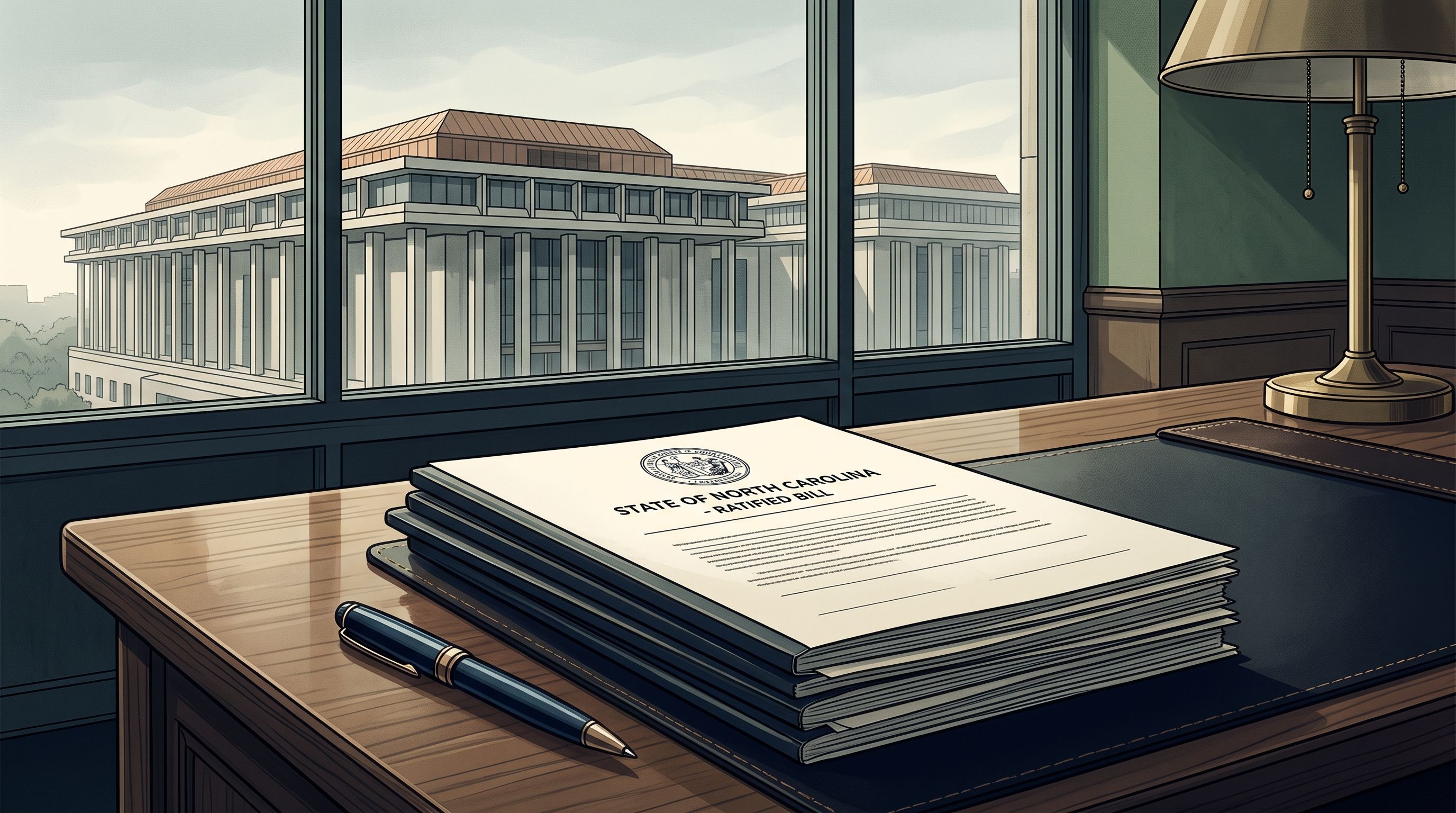
North Carolina's long-running standoff over hemp regulation ended abruptly last week. The House passed House Bill 328 by a 66–35 vote on July 1, and the Senate adopted the conference report 37–6 on July 2, sending the state's first comprehensive restriction of hemp-derived THC, kratom, and xylazine to the governor. For a state that has been one of the country's most permissive THCA flower markets, the compromise bill redraws the map.
The conference version resolves the chambers' earlier split — the House had favored age-gating, the Senate broader restrictions — and lands on both:
As NC Newsline reported, the Senate's posture was that "doing nothing was not an option" given the unregulated storefront market that has grown since 2022.
The total-THC shift is the consequential piece for North Carolina's THCA market. Under the delta-9-only test, high-THCA flower could be sold as legal hemp; under a total-THC standard that counts THCA, most of that product is reclassified out of the hemp category. Combined with the federal November 12 redefinition, THCA flower retail in North Carolina as it existed in 2024–2025 effectively ends once the new rules bind. Our earlier coverage of North Carolina's THCA laws and licensing rules and how NC regulated hemp THCA in 2025 traces how the market got here.
Bundling kratom into a hemp bill reflects a broader statehouse pattern: legislatures are regulating intoxicating consumables as a category rather than plant by plant. The federal government moved the same direction the same week — DEA announced temporary scheduling of 7-OH, the potent kratom derivative, citing public-safety concerns. North Carolina's synthetic-kratom ban now anticipates rather than lags the federal posture.
The bill sits with Gov. Josh Stein, who can sign it, veto it, or let it become law without his signature. As of publication he has not acted, and the margins in both chambers — 66–35 and 37–6 — are comfortably veto-proof if members hold. Operative dates then stagger: age restrictions and kratom provisions on their statutory schedule, the xylazine scheduling December 1, and the total-THC and container-cap alignment tracking the federal November 12 effective date. NC retailers holding THCA or delta-8 inventory should treat November 12 as the hard planning deadline and review sell-down options with counsel now.
House Bill 328 — a compromise restricting hemp-derived THC products via a total THC standard, banning synthetic kratom, age-gating hemp and kratom sales at 21, and scheduling xylazine. It passed both chambers the first week of July and went to the governor.
For now, under existing rules. But the bill's total-THC standard counts THCA toward the hemp threshold, and the federal 0.4 mg per-container standard takes effect November 12, 2026 — together ending most THCA flower retail as currently practiced. Watch the governor's action.
Dates stagger. Xylazine scheduling begins December 1, 2026; the total-THC and container-cap provisions align with the federal standard effective November 12, 2026; age restrictions follow the bill's own schedule once enacted.
Lawmakers bundled intoxicating consumables into one regulatory package — the same week DEA temporarily scheduled the kratom derivative 7-OH federally.
This article is for informational purposes only and is not legal advice. Consult your counsel before making compliance decisions.
North Carolina's long-running standoff over hemp regulation ended abruptly last week. The House passed House Bill 328 by a 66–35 vote on July 1, and the Senate adopted the conference report 37–6 on July 2, sending the state's first comprehensive restriction of hemp-derived THC, kratom, and xylazine to the governor. For a state that has been one of the country's most permissive THCA flower markets, the compromise bill redraws the map.
The conference version resolves the chambers' earlier split — the House had favored age-gating, the Senate broader restrictions — and lands on both:
As NC Newsline reported, the Senate's posture was that "doing nothing was not an option" given the unregulated storefront market that has grown since 2022.
The total-THC shift is the consequential piece for North Carolina's THCA market. Under the delta-9-only test, high-THCA flower could be sold as legal hemp; under a total-THC standard that counts THCA, most of that product is reclassified out of the hemp category. Combined with the federal November 12 redefinition, THCA flower retail in North Carolina as it existed in 2024–2025 effectively ends once the new rules bind. Our earlier coverage of North Carolina's THCA laws and licensing rules and how NC regulated hemp THCA in 2025 traces how the market got here.
Bundling kratom into a hemp bill reflects a broader statehouse pattern: legislatures are regulating intoxicating consumables as a category rather than plant by plant. The federal government moved the same direction the same week — DEA announced temporary scheduling of 7-OH, the potent kratom derivative, citing public-safety concerns. North Carolina's synthetic-kratom ban now anticipates rather than lags the federal posture.
The bill sits with Gov. Josh Stein, who can sign it, veto it, or let it become law without his signature. As of publication he has not acted, and the margins in both chambers — 66–35 and 37–6 — are comfortably veto-proof if members hold. Operative dates then stagger: age restrictions and kratom provisions on their statutory schedule, the xylazine scheduling December 1, and the total-THC and container-cap alignment tracking the federal November 12 effective date. NC retailers holding THCA or delta-8 inventory should treat November 12 as the hard planning deadline and review sell-down options with counsel now.
House Bill 328 — a compromise restricting hemp-derived THC products via a total THC standard, banning synthetic kratom, age-gating hemp and kratom sales at 21, and scheduling xylazine. It passed both chambers the first week of July and went to the governor.
For now, under existing rules. But the bill's total-THC standard counts THCA toward the hemp threshold, and the federal 0.4 mg per-container standard takes effect November 12, 2026 — together ending most THCA flower retail as currently practiced. Watch the governor's action.
Dates stagger. Xylazine scheduling begins December 1, 2026; the total-THC and container-cap provisions align with the federal standard effective November 12, 2026; age restrictions follow the bill's own schedule once enacted.
Lawmakers bundled intoxicating consumables into one regulatory package — the same week DEA temporarily scheduled the kratom derivative 7-OH federally.
This article is for informational purposes only and is not legal advice. Consult your counsel before making compliance decisions.