



June 29, 2026


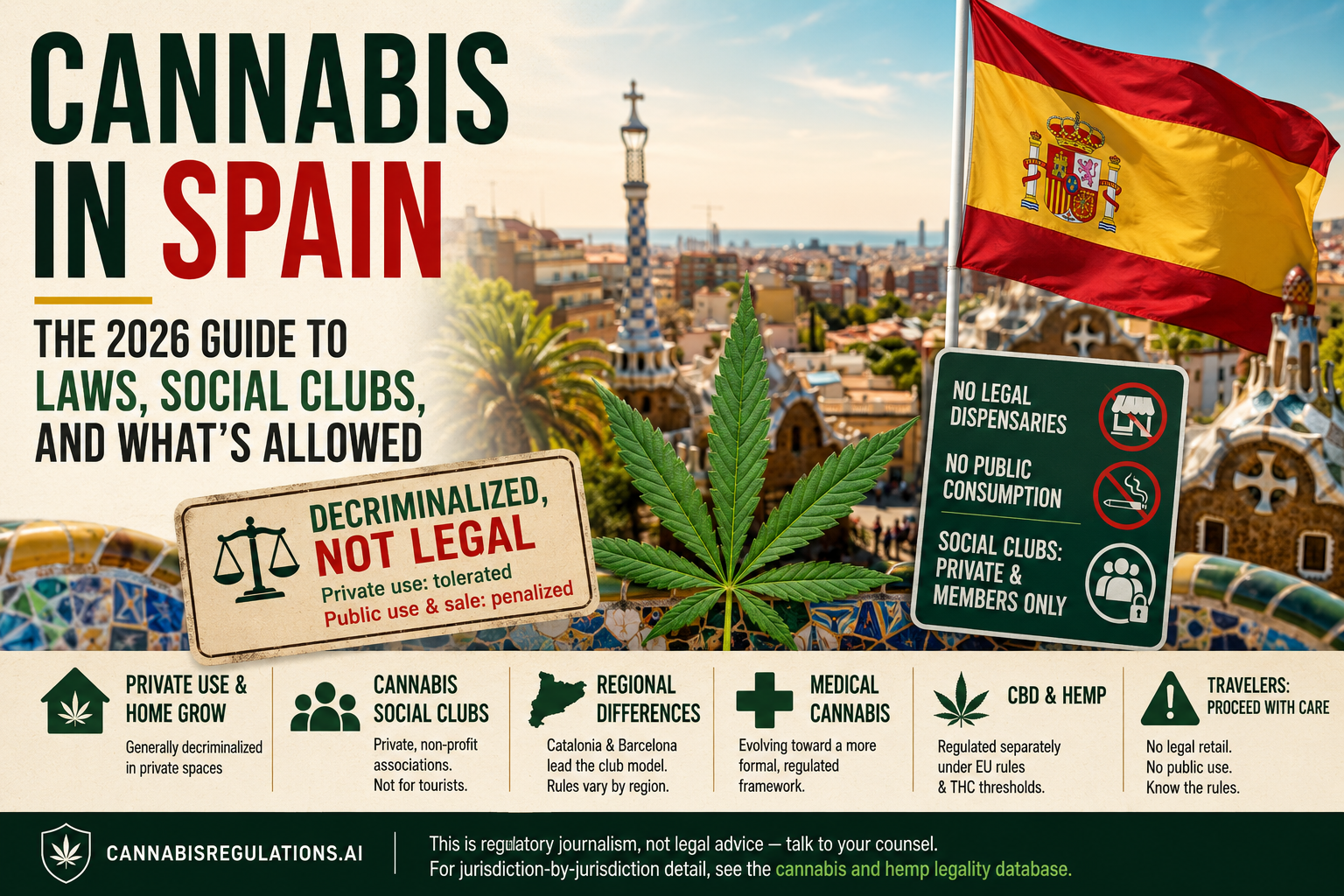
Short answer: as of 2026, weed is not fully legal in Spain, but it is not treated the way it is in countries with strict prohibition either. Spain sits in a middle zone that confuses many travelers and frustrates many operators. Private, personal use and cultivating a small amount of cannabis for yourself in a private space are generally tolerated or decriminalized. At the same time, public consumption, public possession, selling, and trafficking can draw administrative fines or, in more serious cases, criminal penalties. There is no legal commercial recreational retail market in Spain. The private, members-only cannabis social clubs you may have read about operate in a legally ambiguous gray zone, and they are not open to tourists who simply walk in off the street.
This guide explains how that middle zone actually works, what it means if you are visiting, and what operators thinking about Spain should understand before they make assumptions. Spanish cannabis policy combines a national legal framework with meaningful regional variation, and the medical side is still evolving. Treat everything here as general orientation, confirm the details locally, and read on for the nuance that the short answer cannot capture.
The single most important idea for understanding cannabis in Spain is the difference between decriminalization and legalization. They are not the same thing, and treating them as if they were is how travelers get into trouble.
Legalization, in the sense most people mean, implies a regulated commercial market: licensed shops, taxed products, age verification, and a clear legal path from cultivation to sale to the consumer. That is what exists in countries like Canada and in several U.S. states. Spain does not have this for recreational cannabis. There is no legal dispensary where a visitor can walk in, show identification, and buy a regulated product.
Decriminalization is narrower and more conditional. In broad terms, Spain does not generally treat private, personal cannabis use as a criminal matter. Growing a few plants for your own use inside a private home, or consuming in a genuinely private setting, is generally not prosecuted the way street dealing is. But the moment activity moves into public space, or involves supplying others, the legal picture changes quickly. Decriminalization in Spain is best understood as tolerance of private conduct, not permission to treat cannabis like a normal retail good.
This distinction matters because marketing language and travel chatter blur it constantly. People hear that Spain is relaxed about cannabis and assume that means they can buy and use it freely. The safer mental model is this: what you do privately is mostly your business, but anything public, commercial, or involving sale is where penalties live.
If there is one line that separates a quiet stay from a fine, it is the line between private and public.
In private spaces, Spanish practice generally tolerates personal use and small-scale personal cultivation. An adult growing a modest number of plants at home for personal consumption, with no intent to sell, sits in the decriminalized zone described above. This is why Spain is often described as permissive, and why so many people are surprised when they learn how strict the public side can be.
Public consumption and public possession are a different story. Spain penalizes cannabis use and possession in public places under public-safety rules, and these can carry administrative fines. Smoking in a park, on a beach, on a street, or in another public area is not the tolerated private conduct described above. It is the kind of behavior that draws enforcement, and tourists are not exempt simply because they did not know the rule.
For a visitor, the practical takeaway is blunt: there is no reliable, legal way to consume cannabis in public in Spain, and there is no legal storefront to buy it from. The private tolerance that locals may rely on is tied to private homes and private settings that a traveler usually does not have lawful access to.
Cannabis social clubs are the part of Spain that generates the most confusion, and the most risk for people who misunderstand them.
The basic concept is a private, non-commercial association of adult members who pool resources to cultivate and share cannabis among themselves. The theory is that this is collective private use rather than public sale, which is why the clubs have grown up in the same decriminalized space as personal cultivation. Members are supposed to be the people who collectively grow and consume the cannabis, not customers buying from a shop.
In practice, these clubs are not licensed retail businesses. They are not the Spanish equivalent of a regulated dispensary, and they do not have a clear, settled legal status nationwide. Their position is best described as tolerated but legally ambiguous. Enforcement and acceptance have varied over time and from place to place, and the clubs exist in tension with national rules that prohibit sale and trafficking.
Several features are widely understood to define how legitimate clubs try to operate, even though specific rules vary and should be confirmed locally:
Because the model rests on the idea of a closed, private group rather than a business serving the public, anything that looks like open retail, public marketing, or selling to walk-in tourists pushes a club out of the tolerated zone and toward the conduct Spain penalizes.
Spain is not a single uniform jurisdiction when it comes to cannabis. National law sets the framework, but regions and municipalities have their own approaches, and this regional layer is essential to understanding the picture on the ground.
Catalonia, and Barcelona in particular, is the region most associated with cannabis social clubs. The model became especially visible there, and the region has at times attempted to set out its own parameters for how such associations operate. This is why so much of the international conversation about Spanish cannabis clubs centers on Barcelona.
It is important not to over-read that visibility. The presence of clubs in a given city does not mean cannabis is legal there in a commercial sense, and it does not mean a tourist can simply join one on arrival and start buying. Regional rules vary, can change, and sit on top of national prohibitions on sale and trafficking. A practice that is tolerated in one place may be treated differently in another, and the fact that something appears common does not make it lawful retail.
For travelers and operators alike, the lesson is to resist the temptation to generalize from one city. Spain’s cannabis reality is regional, layered, and subject to change, so local confirmation always beats assumptions drawn from a headline about Barcelona.
If you are visiting Spain and wondering how cannabis fits into your trip, the honest summary is that the legal, low-risk options are narrow.
There are no legal recreational dispensaries open to the public. You cannot walk into a licensed shop and buy cannabis the way you might in some other countries. The cannabis social clubs that exist are private, members-only associations that are not aimed at tourists and are not designed to function as on-arrival retail. Treating a club as if it were a dispensary misreads both the model and the law.
Buying on the street is not a safe workaround. Street sale falls squarely within the conduct Spain treats as illegal, and it carries the risks you would expect, both legal and practical. Public use, meanwhile, can draw administrative fines under public-safety rules, so even casual consumption in a visible setting is a poor idea.
None of this is legal advice, and enforcement experiences vary. The point is simply that the gap between Spain’s relaxed reputation and its actual rules is wide, and tourists are the people most likely to fall into that gap.
Medical access in Spain has historically been more limited than in some other European countries, and it is an area in motion rather than a settled system.
For a long time, patients in Spain had narrower formal pathways to medical cannabis than the country’s permissive reputation might suggest. More recently, Spain has been moving toward a more formal medical framework, with the general direction pointing to clearer, regulated access through the health system rather than informal arrangements. The specifics of who qualifies, which products are available, and how access is administered are exactly the kind of evolving detail that should be confirmed through current, authoritative sources rather than assumed.
The broader point for both patients and operators is that medical cannabis in Spain should be understood as a developing regulated channel, separate from the recreational gray zone and separate again from the social-club model. Conflating these three things leads to bad conclusions. A formal medical framework, if and as it matures, follows its own rules and is not a backdoor to recreational supply.
CBD and hemp sit in yet another category, and they are governed in part by the wider European Union context rather than by cannabis rules alone.
In general terms, low-THC hemp and certain hemp-derived products occupy a different regulatory space from THC-rich cannabis. Across the EU, hemp cultivation and hemp-derived goods are subject to THC thresholds and product-specific rules, and Spain operates within that broader framework. This is why you may encounter CBD products in various forms while recreational cannabis remains off the legal retail menu.
The nuance is that the legal treatment of a given CBD or hemp product can depend heavily on its THC content, how it is marketed, and what category it falls into, including whether it is sold for consumption or for other uses. These distinctions are technical and they shift with EU and national developments, so the sensible approach is to treat CBD and hemp as their own regulated area and to confirm the status of any specific product rather than assuming that ‘CBD is legal’ settles the question.
For businesses eyeing Spain, the most valuable thing this article can offer is a warning against the most common misconception: that Spain is an open or near-open recreational market waiting to be entered.
It is not. The headline points are clear and worth restating. There is no licensed commercial recreational retail market. The cannabis social club model is not licensed retail and does not function as a regulated dispensary system; it is a tolerated but legally ambiguous private-association approach that exists in tension with national prohibitions on sale and trafficking. Building a business plan around the assumption that clubs are simply unlicensed shops waiting to be formalized misreads the legal foundation they stand on.
Operators should also internalize the regional and evolving nature of the system. National rules, regional approaches, and a developing medical framework interact, and they do not move in lockstep. What looks tolerated today, in one region, may be treated differently tomorrow or elsewhere. Regulatory uncertainty is not a temporary inconvenience here; it is a structural feature of the current landscape.
The practical posture for any serious operator is caution, local legal counsel, and a clear-eyed distinction between the recreational gray zone, the social-club model, the developing medical channel, and the separate hemp and CBD space. Treating these as one market is the fastest way to build on sand.
Where does this leave Spain heading further into 2026 and beyond? The most defensible expectation is continuity with gradual evolution rather than sudden transformation.
The decriminalized treatment of private personal use is well established and unlikely to vanish. The social-club model has shown staying power despite its ambiguity, and the regional conversation, especially in Catalonia, continues. The clearest direction of travel is on the medical side, where Spain has been moving toward a more formal framework. None of this adds up to an imminent, fully legal recreational retail market, and readers should be wary of confident predictions that one is around the corner.
For travelers, the near-term reality is the one described throughout this guide: relaxed in private, restricted in public, with no legal retail and no tourist-facing club access. For operators, the watchword remains uncertainty paired with patience. The smart move is to track developments through reliable, current sources rather than to act on assumptions.
No. As of 2026, there is no legal commercial recreational retail market in Spain. You cannot walk into a licensed dispensary and buy cannabis the way you can in some other countries.
Generally no. Clubs are private, members-only associations that are not aimed at tourists and typically involve a sign-up or referral process rather than instant walk-in access. They are not the equivalent of a dispensary open to the public.
No. Public consumption and possession can draw administrative fines under public-safety rules. There is no reliable legal way to consume cannabis in public.
Private, personal cultivation of a small amount for your own use in a private space is generally within the decriminalized zone. Growing for sale or supply is a different and prohibited matter. Confirm specifics locally, as regional practice and enforcement vary.
Their status is best described as tolerated but legally ambiguous. They are not licensed retail businesses, and they sit in tension with national rules against sale and trafficking. Acceptance and enforcement have varied over time and by region.
CBD and low-THC hemp occupy a different regulatory space, shaped by the broader EU framework and by THC thresholds and product rules. The legal treatment of a specific product can depend on its THC content and how it is categorized and marketed, so verify the status of any particular product.
Medical access has historically been limited, and Spain has been moving toward a more formal medical framework. The current specifics are evolving and should be confirmed through authoritative, up-to-date sources.
There is no basis here for predicting an imminent, fully legal recreational retail market. The clearest movement is on the medical side, while private use remains decriminalized and the social-club model remains ambiguous. Treat confident predictions with caution.
Assume there is no legal retail and no public consumption option, avoid street purchases entirely, do not treat clubs as walk-in shops, and confirm anything important with reliable local sources before relying on it.
This is regulatory journalism, not legal advice — talk to your counsel. For jurisdiction-by-jurisdiction detail, see the cannabis and hemp legality database.
Short answer: as of 2026, weed is not fully legal in Spain, but it is not treated the way it is in countries with strict prohibition either. Spain sits in a middle zone that confuses many travelers and frustrates many operators. Private, personal use and cultivating a small amount of cannabis for yourself in a private space are generally tolerated or decriminalized. At the same time, public consumption, public possession, selling, and trafficking can draw administrative fines or, in more serious cases, criminal penalties. There is no legal commercial recreational retail market in Spain. The private, members-only cannabis social clubs you may have read about operate in a legally ambiguous gray zone, and they are not open to tourists who simply walk in off the street.
This guide explains how that middle zone actually works, what it means if you are visiting, and what operators thinking about Spain should understand before they make assumptions. Spanish cannabis policy combines a national legal framework with meaningful regional variation, and the medical side is still evolving. Treat everything here as general orientation, confirm the details locally, and read on for the nuance that the short answer cannot capture.
The single most important idea for understanding cannabis in Spain is the difference between decriminalization and legalization. They are not the same thing, and treating them as if they were is how travelers get into trouble.
Legalization, in the sense most people mean, implies a regulated commercial market: licensed shops, taxed products, age verification, and a clear legal path from cultivation to sale to the consumer. That is what exists in countries like Canada and in several U.S. states. Spain does not have this for recreational cannabis. There is no legal dispensary where a visitor can walk in, show identification, and buy a regulated product.
Decriminalization is narrower and more conditional. In broad terms, Spain does not generally treat private, personal cannabis use as a criminal matter. Growing a few plants for your own use inside a private home, or consuming in a genuinely private setting, is generally not prosecuted the way street dealing is. But the moment activity moves into public space, or involves supplying others, the legal picture changes quickly. Decriminalization in Spain is best understood as tolerance of private conduct, not permission to treat cannabis like a normal retail good.
This distinction matters because marketing language and travel chatter blur it constantly. People hear that Spain is relaxed about cannabis and assume that means they can buy and use it freely. The safer mental model is this: what you do privately is mostly your business, but anything public, commercial, or involving sale is where penalties live.
If there is one line that separates a quiet stay from a fine, it is the line between private and public.
In private spaces, Spanish practice generally tolerates personal use and small-scale personal cultivation. An adult growing a modest number of plants at home for personal consumption, with no intent to sell, sits in the decriminalized zone described above. This is why Spain is often described as permissive, and why so many people are surprised when they learn how strict the public side can be.
Public consumption and public possession are a different story. Spain penalizes cannabis use and possession in public places under public-safety rules, and these can carry administrative fines. Smoking in a park, on a beach, on a street, or in another public area is not the tolerated private conduct described above. It is the kind of behavior that draws enforcement, and tourists are not exempt simply because they did not know the rule.
For a visitor, the practical takeaway is blunt: there is no reliable, legal way to consume cannabis in public in Spain, and there is no legal storefront to buy it from. The private tolerance that locals may rely on is tied to private homes and private settings that a traveler usually does not have lawful access to.
Cannabis social clubs are the part of Spain that generates the most confusion, and the most risk for people who misunderstand them.
The basic concept is a private, non-commercial association of adult members who pool resources to cultivate and share cannabis among themselves. The theory is that this is collective private use rather than public sale, which is why the clubs have grown up in the same decriminalized space as personal cultivation. Members are supposed to be the people who collectively grow and consume the cannabis, not customers buying from a shop.
In practice, these clubs are not licensed retail businesses. They are not the Spanish equivalent of a regulated dispensary, and they do not have a clear, settled legal status nationwide. Their position is best described as tolerated but legally ambiguous. Enforcement and acceptance have varied over time and from place to place, and the clubs exist in tension with national rules that prohibit sale and trafficking.
Several features are widely understood to define how legitimate clubs try to operate, even though specific rules vary and should be confirmed locally:
Because the model rests on the idea of a closed, private group rather than a business serving the public, anything that looks like open retail, public marketing, or selling to walk-in tourists pushes a club out of the tolerated zone and toward the conduct Spain penalizes.
Spain is not a single uniform jurisdiction when it comes to cannabis. National law sets the framework, but regions and municipalities have their own approaches, and this regional layer is essential to understanding the picture on the ground.
Catalonia, and Barcelona in particular, is the region most associated with cannabis social clubs. The model became especially visible there, and the region has at times attempted to set out its own parameters for how such associations operate. This is why so much of the international conversation about Spanish cannabis clubs centers on Barcelona.
It is important not to over-read that visibility. The presence of clubs in a given city does not mean cannabis is legal there in a commercial sense, and it does not mean a tourist can simply join one on arrival and start buying. Regional rules vary, can change, and sit on top of national prohibitions on sale and trafficking. A practice that is tolerated in one place may be treated differently in another, and the fact that something appears common does not make it lawful retail.
For travelers and operators alike, the lesson is to resist the temptation to generalize from one city. Spain’s cannabis reality is regional, layered, and subject to change, so local confirmation always beats assumptions drawn from a headline about Barcelona.
If you are visiting Spain and wondering how cannabis fits into your trip, the honest summary is that the legal, low-risk options are narrow.
There are no legal recreational dispensaries open to the public. You cannot walk into a licensed shop and buy cannabis the way you might in some other countries. The cannabis social clubs that exist are private, members-only associations that are not aimed at tourists and are not designed to function as on-arrival retail. Treating a club as if it were a dispensary misreads both the model and the law.
Buying on the street is not a safe workaround. Street sale falls squarely within the conduct Spain treats as illegal, and it carries the risks you would expect, both legal and practical. Public use, meanwhile, can draw administrative fines under public-safety rules, so even casual consumption in a visible setting is a poor idea.
None of this is legal advice, and enforcement experiences vary. The point is simply that the gap between Spain’s relaxed reputation and its actual rules is wide, and tourists are the people most likely to fall into that gap.
Medical access in Spain has historically been more limited than in some other European countries, and it is an area in motion rather than a settled system.
For a long time, patients in Spain had narrower formal pathways to medical cannabis than the country’s permissive reputation might suggest. More recently, Spain has been moving toward a more formal medical framework, with the general direction pointing to clearer, regulated access through the health system rather than informal arrangements. The specifics of who qualifies, which products are available, and how access is administered are exactly the kind of evolving detail that should be confirmed through current, authoritative sources rather than assumed.
The broader point for both patients and operators is that medical cannabis in Spain should be understood as a developing regulated channel, separate from the recreational gray zone and separate again from the social-club model. Conflating these three things leads to bad conclusions. A formal medical framework, if and as it matures, follows its own rules and is not a backdoor to recreational supply.
CBD and hemp sit in yet another category, and they are governed in part by the wider European Union context rather than by cannabis rules alone.
In general terms, low-THC hemp and certain hemp-derived products occupy a different regulatory space from THC-rich cannabis. Across the EU, hemp cultivation and hemp-derived goods are subject to THC thresholds and product-specific rules, and Spain operates within that broader framework. This is why you may encounter CBD products in various forms while recreational cannabis remains off the legal retail menu.
The nuance is that the legal treatment of a given CBD or hemp product can depend heavily on its THC content, how it is marketed, and what category it falls into, including whether it is sold for consumption or for other uses. These distinctions are technical and they shift with EU and national developments, so the sensible approach is to treat CBD and hemp as their own regulated area and to confirm the status of any specific product rather than assuming that ‘CBD is legal’ settles the question.
For businesses eyeing Spain, the most valuable thing this article can offer is a warning against the most common misconception: that Spain is an open or near-open recreational market waiting to be entered.
It is not. The headline points are clear and worth restating. There is no licensed commercial recreational retail market. The cannabis social club model is not licensed retail and does not function as a regulated dispensary system; it is a tolerated but legally ambiguous private-association approach that exists in tension with national prohibitions on sale and trafficking. Building a business plan around the assumption that clubs are simply unlicensed shops waiting to be formalized misreads the legal foundation they stand on.
Operators should also internalize the regional and evolving nature of the system. National rules, regional approaches, and a developing medical framework interact, and they do not move in lockstep. What looks tolerated today, in one region, may be treated differently tomorrow or elsewhere. Regulatory uncertainty is not a temporary inconvenience here; it is a structural feature of the current landscape.
The practical posture for any serious operator is caution, local legal counsel, and a clear-eyed distinction between the recreational gray zone, the social-club model, the developing medical channel, and the separate hemp and CBD space. Treating these as one market is the fastest way to build on sand.
Where does this leave Spain heading further into 2026 and beyond? The most defensible expectation is continuity with gradual evolution rather than sudden transformation.
The decriminalized treatment of private personal use is well established and unlikely to vanish. The social-club model has shown staying power despite its ambiguity, and the regional conversation, especially in Catalonia, continues. The clearest direction of travel is on the medical side, where Spain has been moving toward a more formal framework. None of this adds up to an imminent, fully legal recreational retail market, and readers should be wary of confident predictions that one is around the corner.
For travelers, the near-term reality is the one described throughout this guide: relaxed in private, restricted in public, with no legal retail and no tourist-facing club access. For operators, the watchword remains uncertainty paired with patience. The smart move is to track developments through reliable, current sources rather than to act on assumptions.
No. As of 2026, there is no legal commercial recreational retail market in Spain. You cannot walk into a licensed dispensary and buy cannabis the way you can in some other countries.
Generally no. Clubs are private, members-only associations that are not aimed at tourists and typically involve a sign-up or referral process rather than instant walk-in access. They are not the equivalent of a dispensary open to the public.
No. Public consumption and possession can draw administrative fines under public-safety rules. There is no reliable legal way to consume cannabis in public.
Private, personal cultivation of a small amount for your own use in a private space is generally within the decriminalized zone. Growing for sale or supply is a different and prohibited matter. Confirm specifics locally, as regional practice and enforcement vary.
Their status is best described as tolerated but legally ambiguous. They are not licensed retail businesses, and they sit in tension with national rules against sale and trafficking. Acceptance and enforcement have varied over time and by region.
CBD and low-THC hemp occupy a different regulatory space, shaped by the broader EU framework and by THC thresholds and product rules. The legal treatment of a specific product can depend on its THC content and how it is categorized and marketed, so verify the status of any particular product.
Medical access has historically been limited, and Spain has been moving toward a more formal medical framework. The current specifics are evolving and should be confirmed through authoritative, up-to-date sources.
There is no basis here for predicting an imminent, fully legal recreational retail market. The clearest movement is on the medical side, while private use remains decriminalized and the social-club model remains ambiguous. Treat confident predictions with caution.
Assume there is no legal retail and no public consumption option, avoid street purchases entirely, do not treat clubs as walk-in shops, and confirm anything important with reliable local sources before relying on it.
This is regulatory journalism, not legal advice — talk to your counsel. For jurisdiction-by-jurisdiction detail, see the cannabis and hemp legality database.
