
June 29, 2026


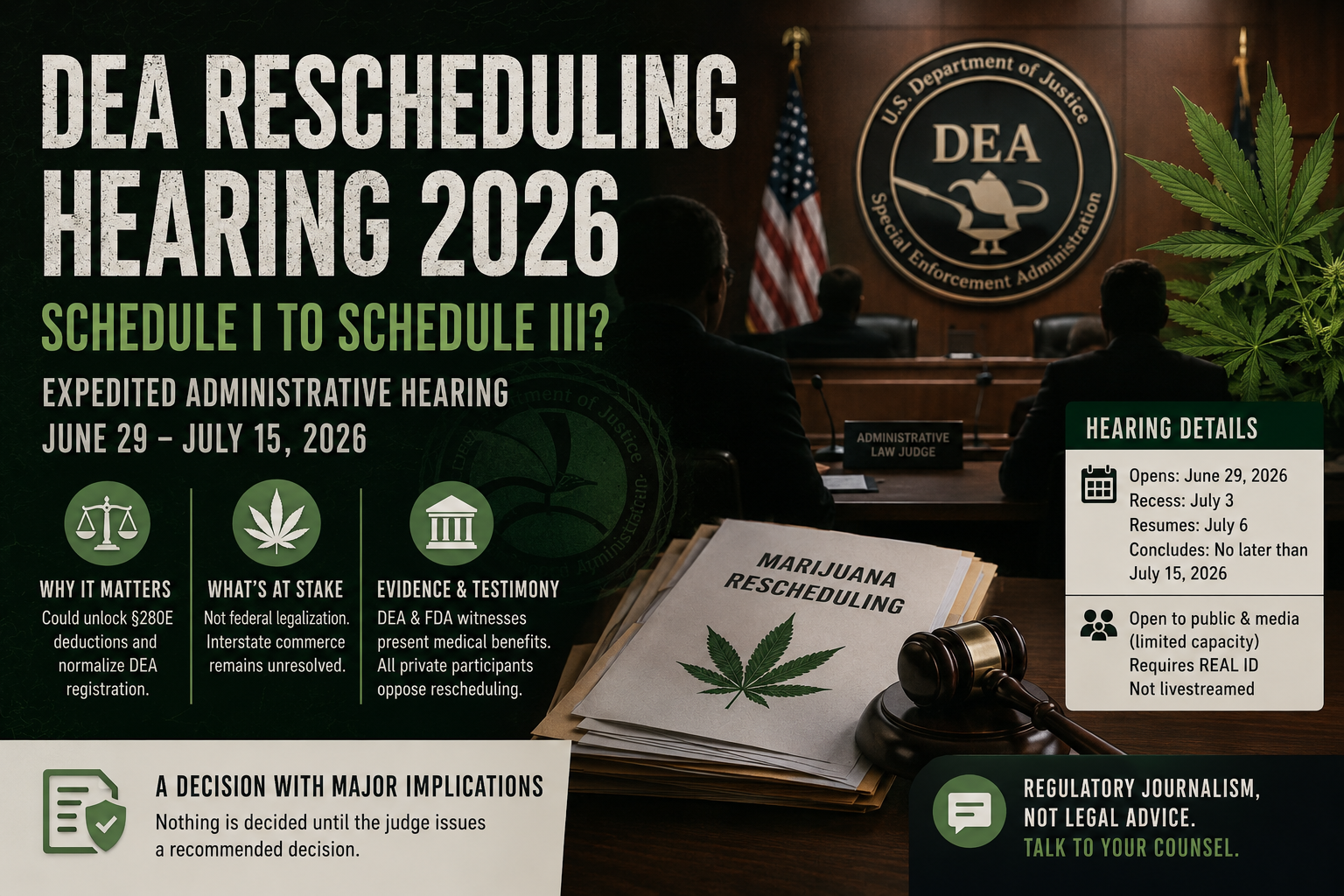
The U.S. Drug Enforcement Administration's expedited administrative hearing on whether to reschedule marijuana more comprehensively from Schedule I to Schedule III opened June 29, 2026 at the DEA hearing facility in Arlington, Virginia. The proceeding is scheduled to conclude no later than July 15, with a recess on July 3 and a reconvening on July 6. For the cannabis industry, the coming weeks rank among the most consequential of the long federal rescheduling saga, because the testimony that emerges and the administrative law judge's eventual recommendation could reshape the tax and regulatory environment that defines how state-licensed operators run their businesses.
This article explains what is actually at stake, what the hearing can and cannot decide, and how operators should think about the range of possible outcomes. It is reporting on a live regulatory process, not a prediction. A great deal of what happens inside an administrative hearing is procedural, and the path from testimony to a final rule is long, with several points at which the trajectory can change.
It is important to separate this proceeding from an earlier action. In April 2026, an order moved state-licensed medical marijuana and FDA-approved marijuana products to Schedule III. That order was narrow. It addressed specific categories of product rather than the plant and its derivatives across the board. The hearing that began June 29 concerns the broader question of comprehensive rescheduling, meaning a change that would reach beyond those defined categories.
The distinction matters because operators sometimes conflate the two. The April order is already in effect for the categories it named. The current hearing is the venue in which the wider question is being tested through evidence and cross-examination. Whatever the administrative law judge ultimately recommends on the broader question, the narrow April action stands on its own footing unless and until it is separately revisited.
We have tracked the procedural lead-up to this hearing in our earlier coverage of the notice-of-intent filings, and readers looking for the litigation context around the stay motions tied to the narrower medical action can review our reporting on the NDASA stay motion and its Section 280E implications.
The Controlled Substances Act sorts regulated drugs into five schedules. The schedule assigned to a substance is supposed to reflect three things: its potential for abuse, whether it has a currently accepted medical use in the United States, and its safety profile or risk of dependence. Schedule I is the most restrictive tier. By definition, a Schedule I substance is treated as having a high potential for abuse and no currently accepted medical use, and as lacking accepted safety for use under medical supervision. Marijuana has sat in Schedule I for decades, alongside substances such as heroin.
Schedule III is a materially different category. Substances in Schedule III are recognized as having a currently accepted medical use and a lower potential for abuse than Schedule I or II drugs. Many prescription medications occupy this tier. A move to Schedule III would amount to a federal acknowledgment that marijuana has accepted medical applications, which is a significant shift in posture even though it would not make marijuana freely available.
It is worth stressing what a Schedule III classification would not do. It would not legalize marijuana at the federal level. It would not authorize interstate commerce in state-licensed cannabis. It would not convert state medical or adult-use programs into federally sanctioned markets. Schedule III substances remain controlled and remain subject to federal oversight, including registration and recordkeeping requirements administered by the DEA.
For most cannabis businesses, the single most important practical consequence of marijuana's scheduling is tax treatment under Section 280E of the Internal Revenue Code. Section 280E denies ordinary business deductions and credits to any trade or business that traffics in controlled substances listed in Schedule I or Schedule II of the Controlled Substances Act. Because marijuana has been a Schedule I substance, state-licensed operators have been barred from deducting routine expenses such as rent, marketing, and most payroll, even though those expenses are entirely ordinary for any retail or manufacturing enterprise.
The result is an effective tax burden that can dwarf what a comparable non-cannabis business would pay. Operators can typically reduce taxable income only by the cost of goods sold, which is narrower than the full set of business expenses available to companies outside the Schedule I and II categories. This dynamic has constrained margins, complicated fundraising, and pushed many businesses to manage cash carefully through every tax year.
Here is the pivotal point for this hearing. Section 280E by its terms applies only to Schedule I and Schedule II substances. If marijuana were rescheduled to Schedule III, the statutory trigger for Section 280E would no longer apply to marijuana businesses in the same way. In principle, that would open the door to ordinary business deductions and meaningfully change the after-tax economics of the industry. That prospect is the financial engine behind much of the attention this proceeding has drawn. Operators should treat the timing and mechanics of any such change as uncertain until a final rule is in place, and should be cautious about restructuring on the assumption of an outcome that has not occurred.
Rescheduling a controlled substance is not a single decision made in a vacuum. It follows an administrative process that can include a formal hearing before an administrative law judge, often referred to as an ALJ. The hearing is the evidentiary stage. Witnesses present testimony, documents are entered into the record, and parties may cross-examine opposing witnesses. The judge presides over the proceeding and manages the record but does not issue the final, binding decision on scheduling.
Instead, the administrative law judge typically issues a recommended decision after the hearing concludes and the record is complete. That recommendation, along with the developed record, then moves to the agency for further action. The ultimate rescheduling decision rests with the agency through its rulemaking authority, and a final action generally takes the form of a published rule. In short, the hearing builds the factual foundation, the judge recommends, and the agency decides. Each of those stages takes time, and the recommendation is not self-executing.
This structure is why it is a mistake to read the start of a hearing as the start of a new legal regime. The hearing is an input. The schedule of testimony, including the recess on July 3 and the reconvening on July 6, reflects the practical work of getting witnesses and evidence into the record before the July 15 conclusion date.
According to filings, the DEA's two government witnesses are Dr. Corey Burchman, a pain-management physician, and Dominic Chiapperino, the director of the FDA's controlled-substance staff. Both are slated to present testimony on marijuana's medical benefits. That focus is notable. Testimony on accepted medical use speaks directly to one of the core statutory questions that distinguishes Schedule I from Schedule III, namely whether a substance has a currently accepted medical use in the United States.
At the same time, the selected private participants in the hearing oppose rescheduling. The presence of opposing participants is a feature of the adversarial structure of a formal hearing, where competing views are tested on the record. Readers should not assume that the alignment of witnesses signals a predetermined result. The judge weighs the full record, and the strength of evidence, cross-examination, and legal argument all factor into a recommended decision that has not yet been written.
We are reporting the witness roster and the stated focus of the testimony as described in the filings. We are not characterizing the substance of testimony that has not yet been delivered, and we are not predicting how the judge will weigh it.
The hearing is open to the public and the media in a limited capacity. Attendance is constrained by the facility and by security requirements, and a REAL ID is required to enter. The proceeding is not being livestreamed. That last point became a matter of public contention. Representative Steve Cohen and several news organizations pressed for the hearing to be streamed so that a broader audience could follow a proceeding with national implications. The administrative law judge declined those requests.
The absence of a livestream has practical consequences for how the public and the industry will learn what happens inside the room. Coverage will depend heavily on in-person attendance and on the documents that enter the record. For operators and counsel who cannot attend, that means primary-source filings and credible on-the-ground reporting will be the most reliable way to follow developments, rather than real-time video.
Because this is a live proceeding, the responsible way to think about outcomes is in terms of scenarios rather than forecasts. Several broad possibilities are worth holding in mind, each with different implications for operators.
One scenario is a comprehensive rescheduling to Schedule III that reaches well beyond the narrow categories addressed by the April order. This is the outcome with the largest potential effect on industry economics, principally through the Section 280E mechanism described above. Even in this scenario, federal legalization would not follow, interstate commerce would not be authorized, and DEA oversight would continue. The practical benefit would be concentrated in tax treatment and in the symbolic and regulatory recognition of accepted medical use.
A second scenario is a narrower result that confirms or refines the existing posture without extending Schedule III treatment across the board. In this case, the categories addressed by the April order would remain in their current position, while the broader market would not see the wholesale change some operators are anticipating. The economic effect would be far more limited and would leave much of the industry in a familiar position.
A third scenario is that the broader rescheduling does not advance, leaving marijuana in Schedule I for the categories not covered by the April action. Under this outcome, Section 280E would continue to apply to those businesses as it does today, and the operational and tax pressures that operators have managed for years would persist. The status-quo scenario is a reminder that the start of a hearing does not guarantee change.
We are not assigning probabilities to these scenarios. They are framed here so that operators can plan for a range of results rather than committing to a single expected outcome.
It is worth being precise about the boundaries of even the most favorable outcome. A move to Schedule III would not legalize marijuana federally. It would not create a lawful national market or permit cannabis to move across state lines outside of any federally authorized channel. It would not eliminate state licensing regimes or harmonize the patchwork of state rules. And it would not remove the substance from federal control.
What a Schedule III classification could change is the application of Section 280E to marijuana businesses, the federal characterization of marijuana as having an accepted medical use, and the regulatory framework that attaches to a Schedule III substance, including registration and recordkeeping expectations. Operators should understand the difference between tax relief and legalization. The two are often conflated in public discussion, and the gap between them is where a great deal of compliance risk lives.
Schedule III substances sit within the DEA's registration and oversight system. Businesses that handle controlled substances in that tier are generally subject to registration requirements, recordkeeping obligations, and the possibility of on-site inspections by the DEA. For state-licensed cannabis operators accustomed to dealing primarily with state regulators, an expanded federal touchpoint could introduce new compliance expectations even in a scenario that improves tax treatment.
This is why the operational backdrop matters as much as the headline question of scheduling. A change that reduces the Section 280E burden could arrive alongside new federal registration and inspection considerations. Operators who treat any favorable outcome as purely a tax windfall, without preparing for the regulatory obligations that accompany federal controlled-substance status, may find themselves unprepared for the administrative side of the transition. None of this is settled, and the precise contours of any registration or inspection regime for rescheduled marijuana would depend on the final rule and any implementing guidance.
The right posture during a live proceeding is preparation without premature action. The following steps are oriented toward readiness rather than reaction.
The compressed schedule, from the June 29 opening through the July 15 conclusion, with a recess on July 3 and a reconvening on July 6, signals an effort to develop the record efficiently. That efficiency does not shorten the larger process. After the hearing closes, the administrative law judge still needs to weigh the record and issue a recommended decision, and the agency still needs to act through rulemaking before anything becomes binding. The hearing is the moment when the evidence is laid down, but it is not the moment when the question is answered.
For the industry, the value of close attention now is that the record being built will shape the recommendation, and the recommendation will shape the agency's options. Operators who follow the proceeding carefully will be better positioned to interpret the recommended decision when it arrives and to act on a final rule when one is published. That is a meaningful advantage in an environment where timing and preparation often separate businesses that adapt smoothly from those that scramble.
No. The hearing is the evidentiary stage. The administrative law judge presides over testimony and the record and later issues a recommended decision. The binding scheduling decision is made by the agency through rulemaking, which follows the hearing.
The April 2026 order moved state-licensed medical marijuana and FDA-approved marijuana products to Schedule III. It was narrow and addressed specific categories. This hearing concerns the broader question of comprehensive rescheduling beyond those categories.
No. Schedule III substances remain controlled. A move to Schedule III would recognize an accepted medical use and change the application of Section 280E, but it would not legalize marijuana federally, authorize interstate commerce, or replace state programs.
Section 280E denies ordinary business deductions to businesses trafficking in Schedule I or Schedule II controlled substances. Because it applies only to those tiers, a move to Schedule III would change how the provision affects marijuana businesses, with significant potential tax consequences.
According to filings, the DEA's two government witnesses are Dr. Corey Burchman, a pain-management physician, and Dominic Chiapperino, director of the FDA's controlled-substance staff, both slated to testify on marijuana's medical benefits. The selected private participants oppose rescheduling.
The hearing is open to the public and media in a limited capacity, and a REAL ID is required to attend. It is not being livestreamed. Representative Steve Cohen and news organizations pressed for streaming, and the administrative law judge declined.
There is no fixed public date for a final rule. After the hearing concludes by July 15, the judge issues a recommended decision, and the agency then proceeds through rulemaking. The full process can take time, and the timing of any final action is uncertain.
Maintain Section 280E reserves, keep thorough documentation, prepare for possible DEA registration and inspection requirements, and follow primary-source filings rather than acting on predicted outcomes. Coordinate tax and legal planning so you can adjust deliberately if a final rule changes your exposure.
Sources: DEA press release; Marijuana Moment; Vicente LLP. Regulatory journalism, not legal advice — talk to your counsel.
The U.S. Drug Enforcement Administration's expedited administrative hearing on whether to reschedule marijuana more comprehensively from Schedule I to Schedule III opened June 29, 2026 at the DEA hearing facility in Arlington, Virginia. The proceeding is scheduled to conclude no later than July 15, with a recess on July 3 and a reconvening on July 6. For the cannabis industry, the coming weeks rank among the most consequential of the long federal rescheduling saga, because the testimony that emerges and the administrative law judge's eventual recommendation could reshape the tax and regulatory environment that defines how state-licensed operators run their businesses.
This article explains what is actually at stake, what the hearing can and cannot decide, and how operators should think about the range of possible outcomes. It is reporting on a live regulatory process, not a prediction. A great deal of what happens inside an administrative hearing is procedural, and the path from testimony to a final rule is long, with several points at which the trajectory can change.
It is important to separate this proceeding from an earlier action. In April 2026, an order moved state-licensed medical marijuana and FDA-approved marijuana products to Schedule III. That order was narrow. It addressed specific categories of product rather than the plant and its derivatives across the board. The hearing that began June 29 concerns the broader question of comprehensive rescheduling, meaning a change that would reach beyond those defined categories.
The distinction matters because operators sometimes conflate the two. The April order is already in effect for the categories it named. The current hearing is the venue in which the wider question is being tested through evidence and cross-examination. Whatever the administrative law judge ultimately recommends on the broader question, the narrow April action stands on its own footing unless and until it is separately revisited.
We have tracked the procedural lead-up to this hearing in our earlier coverage of the notice-of-intent filings, and readers looking for the litigation context around the stay motions tied to the narrower medical action can review our reporting on the NDASA stay motion and its Section 280E implications.
The Controlled Substances Act sorts regulated drugs into five schedules. The schedule assigned to a substance is supposed to reflect three things: its potential for abuse, whether it has a currently accepted medical use in the United States, and its safety profile or risk of dependence. Schedule I is the most restrictive tier. By definition, a Schedule I substance is treated as having a high potential for abuse and no currently accepted medical use, and as lacking accepted safety for use under medical supervision. Marijuana has sat in Schedule I for decades, alongside substances such as heroin.
Schedule III is a materially different category. Substances in Schedule III are recognized as having a currently accepted medical use and a lower potential for abuse than Schedule I or II drugs. Many prescription medications occupy this tier. A move to Schedule III would amount to a federal acknowledgment that marijuana has accepted medical applications, which is a significant shift in posture even though it would not make marijuana freely available.
It is worth stressing what a Schedule III classification would not do. It would not legalize marijuana at the federal level. It would not authorize interstate commerce in state-licensed cannabis. It would not convert state medical or adult-use programs into federally sanctioned markets. Schedule III substances remain controlled and remain subject to federal oversight, including registration and recordkeeping requirements administered by the DEA.
For most cannabis businesses, the single most important practical consequence of marijuana's scheduling is tax treatment under Section 280E of the Internal Revenue Code. Section 280E denies ordinary business deductions and credits to any trade or business that traffics in controlled substances listed in Schedule I or Schedule II of the Controlled Substances Act. Because marijuana has been a Schedule I substance, state-licensed operators have been barred from deducting routine expenses such as rent, marketing, and most payroll, even though those expenses are entirely ordinary for any retail or manufacturing enterprise.
The result is an effective tax burden that can dwarf what a comparable non-cannabis business would pay. Operators can typically reduce taxable income only by the cost of goods sold, which is narrower than the full set of business expenses available to companies outside the Schedule I and II categories. This dynamic has constrained margins, complicated fundraising, and pushed many businesses to manage cash carefully through every tax year.
Here is the pivotal point for this hearing. Section 280E by its terms applies only to Schedule I and Schedule II substances. If marijuana were rescheduled to Schedule III, the statutory trigger for Section 280E would no longer apply to marijuana businesses in the same way. In principle, that would open the door to ordinary business deductions and meaningfully change the after-tax economics of the industry. That prospect is the financial engine behind much of the attention this proceeding has drawn. Operators should treat the timing and mechanics of any such change as uncertain until a final rule is in place, and should be cautious about restructuring on the assumption of an outcome that has not occurred.
Rescheduling a controlled substance is not a single decision made in a vacuum. It follows an administrative process that can include a formal hearing before an administrative law judge, often referred to as an ALJ. The hearing is the evidentiary stage. Witnesses present testimony, documents are entered into the record, and parties may cross-examine opposing witnesses. The judge presides over the proceeding and manages the record but does not issue the final, binding decision on scheduling.
Instead, the administrative law judge typically issues a recommended decision after the hearing concludes and the record is complete. That recommendation, along with the developed record, then moves to the agency for further action. The ultimate rescheduling decision rests with the agency through its rulemaking authority, and a final action generally takes the form of a published rule. In short, the hearing builds the factual foundation, the judge recommends, and the agency decides. Each of those stages takes time, and the recommendation is not self-executing.
This structure is why it is a mistake to read the start of a hearing as the start of a new legal regime. The hearing is an input. The schedule of testimony, including the recess on July 3 and the reconvening on July 6, reflects the practical work of getting witnesses and evidence into the record before the July 15 conclusion date.
According to filings, the DEA's two government witnesses are Dr. Corey Burchman, a pain-management physician, and Dominic Chiapperino, the director of the FDA's controlled-substance staff. Both are slated to present testimony on marijuana's medical benefits. That focus is notable. Testimony on accepted medical use speaks directly to one of the core statutory questions that distinguishes Schedule I from Schedule III, namely whether a substance has a currently accepted medical use in the United States.
At the same time, the selected private participants in the hearing oppose rescheduling. The presence of opposing participants is a feature of the adversarial structure of a formal hearing, where competing views are tested on the record. Readers should not assume that the alignment of witnesses signals a predetermined result. The judge weighs the full record, and the strength of evidence, cross-examination, and legal argument all factor into a recommended decision that has not yet been written.
We are reporting the witness roster and the stated focus of the testimony as described in the filings. We are not characterizing the substance of testimony that has not yet been delivered, and we are not predicting how the judge will weigh it.
The hearing is open to the public and the media in a limited capacity. Attendance is constrained by the facility and by security requirements, and a REAL ID is required to enter. The proceeding is not being livestreamed. That last point became a matter of public contention. Representative Steve Cohen and several news organizations pressed for the hearing to be streamed so that a broader audience could follow a proceeding with national implications. The administrative law judge declined those requests.
The absence of a livestream has practical consequences for how the public and the industry will learn what happens inside the room. Coverage will depend heavily on in-person attendance and on the documents that enter the record. For operators and counsel who cannot attend, that means primary-source filings and credible on-the-ground reporting will be the most reliable way to follow developments, rather than real-time video.
Because this is a live proceeding, the responsible way to think about outcomes is in terms of scenarios rather than forecasts. Several broad possibilities are worth holding in mind, each with different implications for operators.
One scenario is a comprehensive rescheduling to Schedule III that reaches well beyond the narrow categories addressed by the April order. This is the outcome with the largest potential effect on industry economics, principally through the Section 280E mechanism described above. Even in this scenario, federal legalization would not follow, interstate commerce would not be authorized, and DEA oversight would continue. The practical benefit would be concentrated in tax treatment and in the symbolic and regulatory recognition of accepted medical use.
A second scenario is a narrower result that confirms or refines the existing posture without extending Schedule III treatment across the board. In this case, the categories addressed by the April order would remain in their current position, while the broader market would not see the wholesale change some operators are anticipating. The economic effect would be far more limited and would leave much of the industry in a familiar position.
A third scenario is that the broader rescheduling does not advance, leaving marijuana in Schedule I for the categories not covered by the April action. Under this outcome, Section 280E would continue to apply to those businesses as it does today, and the operational and tax pressures that operators have managed for years would persist. The status-quo scenario is a reminder that the start of a hearing does not guarantee change.
We are not assigning probabilities to these scenarios. They are framed here so that operators can plan for a range of results rather than committing to a single expected outcome.
It is worth being precise about the boundaries of even the most favorable outcome. A move to Schedule III would not legalize marijuana federally. It would not create a lawful national market or permit cannabis to move across state lines outside of any federally authorized channel. It would not eliminate state licensing regimes or harmonize the patchwork of state rules. And it would not remove the substance from federal control.
What a Schedule III classification could change is the application of Section 280E to marijuana businesses, the federal characterization of marijuana as having an accepted medical use, and the regulatory framework that attaches to a Schedule III substance, including registration and recordkeeping expectations. Operators should understand the difference between tax relief and legalization. The two are often conflated in public discussion, and the gap between them is where a great deal of compliance risk lives.
Schedule III substances sit within the DEA's registration and oversight system. Businesses that handle controlled substances in that tier are generally subject to registration requirements, recordkeeping obligations, and the possibility of on-site inspections by the DEA. For state-licensed cannabis operators accustomed to dealing primarily with state regulators, an expanded federal touchpoint could introduce new compliance expectations even in a scenario that improves tax treatment.
This is why the operational backdrop matters as much as the headline question of scheduling. A change that reduces the Section 280E burden could arrive alongside new federal registration and inspection considerations. Operators who treat any favorable outcome as purely a tax windfall, without preparing for the regulatory obligations that accompany federal controlled-substance status, may find themselves unprepared for the administrative side of the transition. None of this is settled, and the precise contours of any registration or inspection regime for rescheduled marijuana would depend on the final rule and any implementing guidance.
The right posture during a live proceeding is preparation without premature action. The following steps are oriented toward readiness rather than reaction.
The compressed schedule, from the June 29 opening through the July 15 conclusion, with a recess on July 3 and a reconvening on July 6, signals an effort to develop the record efficiently. That efficiency does not shorten the larger process. After the hearing closes, the administrative law judge still needs to weigh the record and issue a recommended decision, and the agency still needs to act through rulemaking before anything becomes binding. The hearing is the moment when the evidence is laid down, but it is not the moment when the question is answered.
For the industry, the value of close attention now is that the record being built will shape the recommendation, and the recommendation will shape the agency's options. Operators who follow the proceeding carefully will be better positioned to interpret the recommended decision when it arrives and to act on a final rule when one is published. That is a meaningful advantage in an environment where timing and preparation often separate businesses that adapt smoothly from those that scramble.
No. The hearing is the evidentiary stage. The administrative law judge presides over testimony and the record and later issues a recommended decision. The binding scheduling decision is made by the agency through rulemaking, which follows the hearing.
The April 2026 order moved state-licensed medical marijuana and FDA-approved marijuana products to Schedule III. It was narrow and addressed specific categories. This hearing concerns the broader question of comprehensive rescheduling beyond those categories.
No. Schedule III substances remain controlled. A move to Schedule III would recognize an accepted medical use and change the application of Section 280E, but it would not legalize marijuana federally, authorize interstate commerce, or replace state programs.
Section 280E denies ordinary business deductions to businesses trafficking in Schedule I or Schedule II controlled substances. Because it applies only to those tiers, a move to Schedule III would change how the provision affects marijuana businesses, with significant potential tax consequences.
According to filings, the DEA's two government witnesses are Dr. Corey Burchman, a pain-management physician, and Dominic Chiapperino, director of the FDA's controlled-substance staff, both slated to testify on marijuana's medical benefits. The selected private participants oppose rescheduling.
The hearing is open to the public and media in a limited capacity, and a REAL ID is required to attend. It is not being livestreamed. Representative Steve Cohen and news organizations pressed for streaming, and the administrative law judge declined.
There is no fixed public date for a final rule. After the hearing concludes by July 15, the judge issues a recommended decision, and the agency then proceeds through rulemaking. The full process can take time, and the timing of any final action is uncertain.
Maintain Section 280E reserves, keep thorough documentation, prepare for possible DEA registration and inspection requirements, and follow primary-source filings rather than acting on predicted outcomes. Coordinate tax and legal planning so you can adjust deliberately if a final rule changes your exposure.
Sources: DEA press release; Marijuana Moment; Vicente LLP. Regulatory journalism, not legal advice — talk to your counsel.
