


Sign Up
Ready to replace complexity with clarity?
Answer your real world compliance questions (limited time) and save thousands in legal fees and avoided fines.
Automate Compliance Today

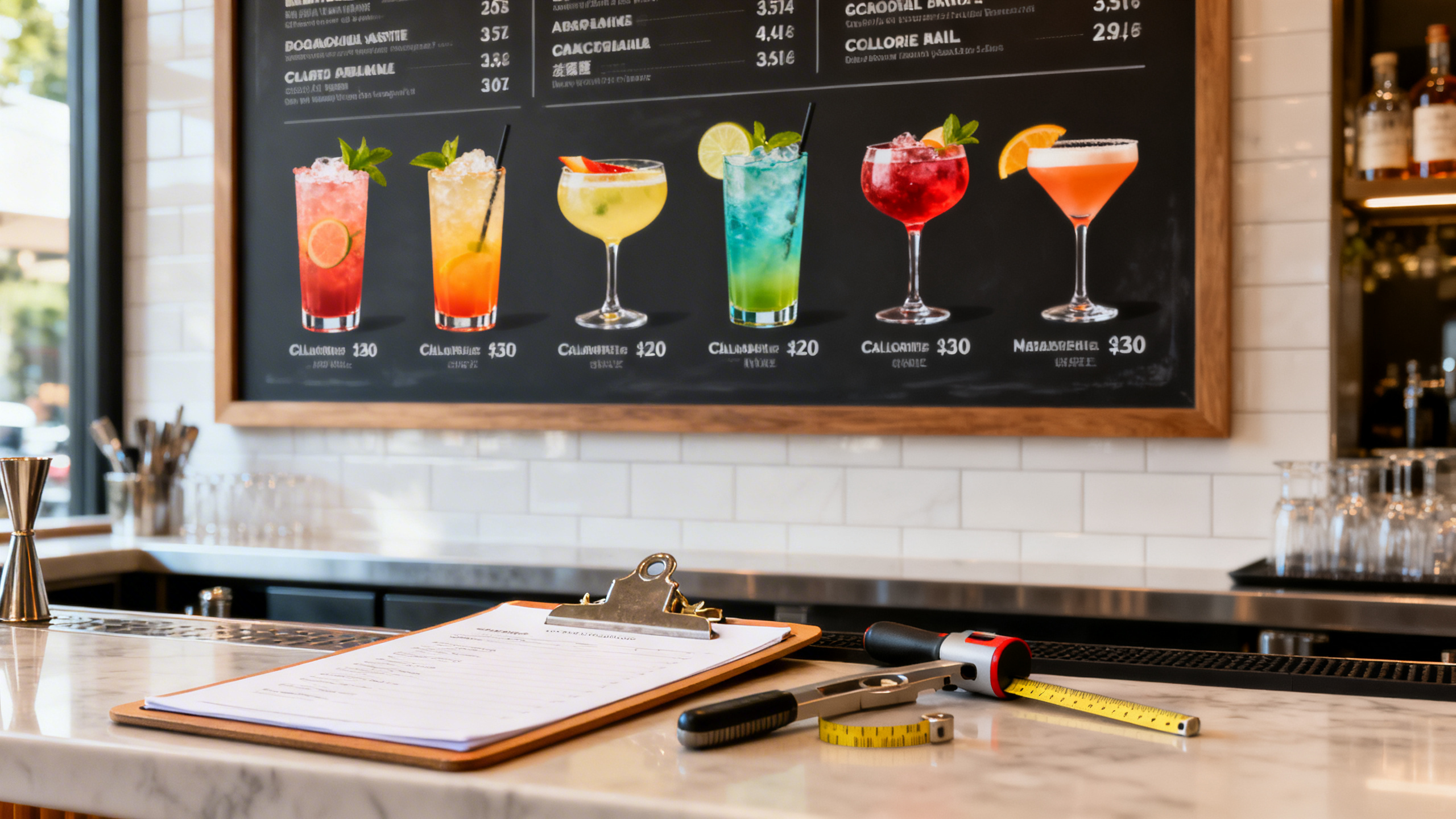
When national and regional chains test “mocktail” programs that include THC‑infused, non‑alcoholic drinks, compliance teams quickly discover a collision of regulatory regimes: FDA’s chain menu labeling requirements, federal allergen rules, state‑by‑state intoxicant warnings, and on‑premise service controls that look a lot like alcohol service—without the benefit of a uniform federal framework for THC beverages.
This article is informational only (not legal advice). It focuses on the federal layer—especially 21 CFR 101.11—and then explains how to build a practical “spec packet + change control” system so your posted calories, allergens, and milligrams per serving don’t drift out of compliance.
The FDA’s menu labeling rule applies to covered establishments—restaurants and similar retail food establishments that are part of a chain with 20 or more locations doing business under the same name and offering for sale substantially the same menu items. The FDA summarizes the rule and core obligations on its menu labeling page: https://www.fda.gov/food/nutrition-food-labeling-and-critical-foods/menu-labeling-requirements
As chains move from “limited‑time novelty” to a consistent mocktail section, a THC mocktail can become a standard menu item, triggering calorie declarations and written nutrition information requirements under 21 CFR 101.11. The full regulation is available in the eCFR: https://www.ecfr.gov/current/title-21/chapter-I/subchapter-B/part-101/subpart-A/section-101.11
In general, you are covered if you operate 20+ locations under the same name and offer substantially the same menu items. If you are covered, the obligation is not optional.
A key practical point for beverage rollouts: a chain can easily drift into coverage even if a mocktail is not sold everywhere. If the item is “routinely” listed (or otherwise meets the definition of a standard menu item), you should plan as if menu labeling will apply.
For standard menu items, FDA’s rule requires calories to be disclosed on menus and menu boards.
Two required statements also matter for mocktails:
These statements need to be presented clearly and conspicuously in the formats described by the rule.
Covered establishments must have the required additional written nutrition information available for consumers upon request. FDA’s “Menu Labeling Rule: General Information” fact sheet highlights this requirement: https://www.fda.gov/media/116000/download
Under 21 CFR 101.11, the written nutrition information generally includes:
FDA has also issued supplemental guidance addressing implementation questions, reasonable basis, and enforcement discretion around certain nutrient declarations (e.g., “calories from fat”): https://www.fda.gov/regulatory-information/search-fda-guidance-documents/guidance-industry-menu-labeling-supplemental-guidance
Menu labeling is not only “post a number.” Covered establishments must have a reasonable basis for nutrient declarations and must maintain supporting records that can be provided to FDA upon request. The regulation allows nutrient values to be determined using nutrient databases, cookbooks, laboratory analyses, or other reasonable means (see 21 CFR 101.11).
In practice, THC mocktails create a documentation challenge because:
If your chain posts calories but cannot show a reproducible recipe basis, you have a preventable compliance gap.
Many mocktails are marketed as “clean” or “light,” but calories can come from:
Even if the THC ingredient itself contributes minimal calories, the carrier often does not.
If customers can swap mixers or choose from multiple flavors under one menu line, you can drift into a variable menu item scenario under 21 CFR 101.11. Variable items can require calorie ranges and additional presentation logic.
Operational takeaway: if you want to avoid ranges, reduce variability. Standardize:
The rule’s definitions include electronic menus and menu boards, and FDA training materials have long emphasized applicability to electronic formats. If you display the mocktail for selection in an app or online ordering flow, plan for the calorie disclosure to follow the item into that interface.
As ordering migrates to third‑party platforms, operators have faced scrutiny and research attention over missing calorie disclosures. FDA has also updated menu labeling guidance questions addressing voluntary use on third‑party platforms (see the menu labeling supplemental guidance page above).
Federal allergen law focuses on packaged foods regulated by FDA, but chain operators often provide ingredient/allergen information voluntarily (or to meet state/local expectations and customer needs).
Under the FD&C Act’s major allergen framework (as amended by FALCPA and the FASTER Act), the major allergens include milk, egg, fish, Crustacean shellfish, tree nuts, peanuts, wheat, soybeans, and sesame. FDA provides consumer and industry resources here:
Even when not mandated the way packaged labeling is, chains that sell THC mocktails should treat allergen transparency as a brand‑level safety obligation. Best practice is to align your in‑restaurant allergen approach with FDA’s major allergen concepts:
In packaged foods, advisory statements like “may contain” are generally voluntary. Restaurants face a different reality: shared shakers, blenders, garnish stations, and glassware washing processes can create cross‑contact risk.
If you choose to use advisory language on a menu, keep it disciplined:
A mocktail can be non‑alcoholic and still intoxicate.
From a consumer‑protection standpoint, the menu should not allow customers to infer “safe to drive” or “no impairment” from the term “non‑alcoholic.” For chains, this is both a regulatory and liability issue.
A practical disclosure strategy is to add a clear qualifier where the drink name appears:
Your exact wording will depend on state rules where you operate, but the compliance design principle is federal‑agnostic: do not let ‘non‑alcoholic’ do all the consumer communication work.
Even though the drink is not alcohol, regulators and enforcement bodies often borrow alcohol control concepts when evaluating on‑premise intoxicant service:
Also, if you sell true non‑alcohol beer/wine alternatives, note that the Alcohol and Tobacco Tax and Trade Bureau (TTB) regulates certain labeling terms for malt beverages. For example, TTB explains restrictions on “non‑alcoholic” for malt beverages and the “contains less than 0.5% alcohol by volume” adjacency requirement: https://www.ttb.gov/regulated-commodities/beverage-alcohol/beer/labeling/malt-beverage-alcohol-content
That TTB page is not “THC mocktail” law—but it’s a useful compliance parallel: words like “non‑alcoholic” are regulated terms in related categories, and sloppy usage can create enforcement and consumer‑deception risk.
A menu labeling program doesn’t “bless” the underlying ingredient legality.
FDA has continued enforcement against certain cannabinoid food products (especially where child appeal, copycat packaging, or unsafe additive issues arise). For example, FDA warning letters have stated that delta‑8 THC added to conventional foods is an unsafe food additive absent authorization, and that introducing adulterated food into interstate commerce is prohibited.
Example FDA warning letter page (illustrative enforcement posture): https://www.fda.gov/inspections-compliance-enforcement-and-criminal-investigations/warning-letters/stnr-creations-llc-698700-07162025
For restaurant chains, the risk takeaway is simple: build your menu and disclosure program as if it will be read by FDA, state health departments, and plaintiff’s attorneys—because it might.
Your best defense against silent drift is a spec packet per beverage SKU that ties together:
Include:
Document:
FDA’s menu labeling supplemental guidance emphasizes the need for a reasonable basis and flexibility to account for natural variation: https://www.fda.gov/files/food/published/Menu-Labeling-Supplemental-Guidance-for-Industry-PDF.pdf
Maintain:
Even though 21 CFR 101.11 is about nutrition, your mocktail program will be judged on whether the THC mg per serving is accurate and consistently delivered.
Your packet should include:
Include:
Most menu labeling failures are not intentional—they happen when culinary teams improve a recipe and nobody recalculates calories or mg.
Implement a formal change control that triggers review for:
Your approval gate should include at least:
If your mocktail intoxicates, your service controls should mirror alcohol controls:
Many states impose serving limits for THC beverages; even where not explicit, chains can reduce incident risk by establishing internal controls:
To reduce implied co‑mingling:
Use this as a starting point for internal QA (not as legal advice):
If you’re building or scaling a THC mocktail program, you’ll need a system that connects menu labeling, allergen management, mg/serving accuracy, and store‑level training—and keeps it all current when recipes change.
Use https://cannabisregulations.ai/ to track fast‑moving regulatory changes, centralize your spec packets and SOPs, and strengthen your cannabis compliance posture across labeling, licensing, and enforcement risk management.