


Sign Up
Ready to replace complexity with clarity?
Answer your real world compliance questions (limited time) and save thousands in legal fees and avoided fines.
Automate Compliance Today

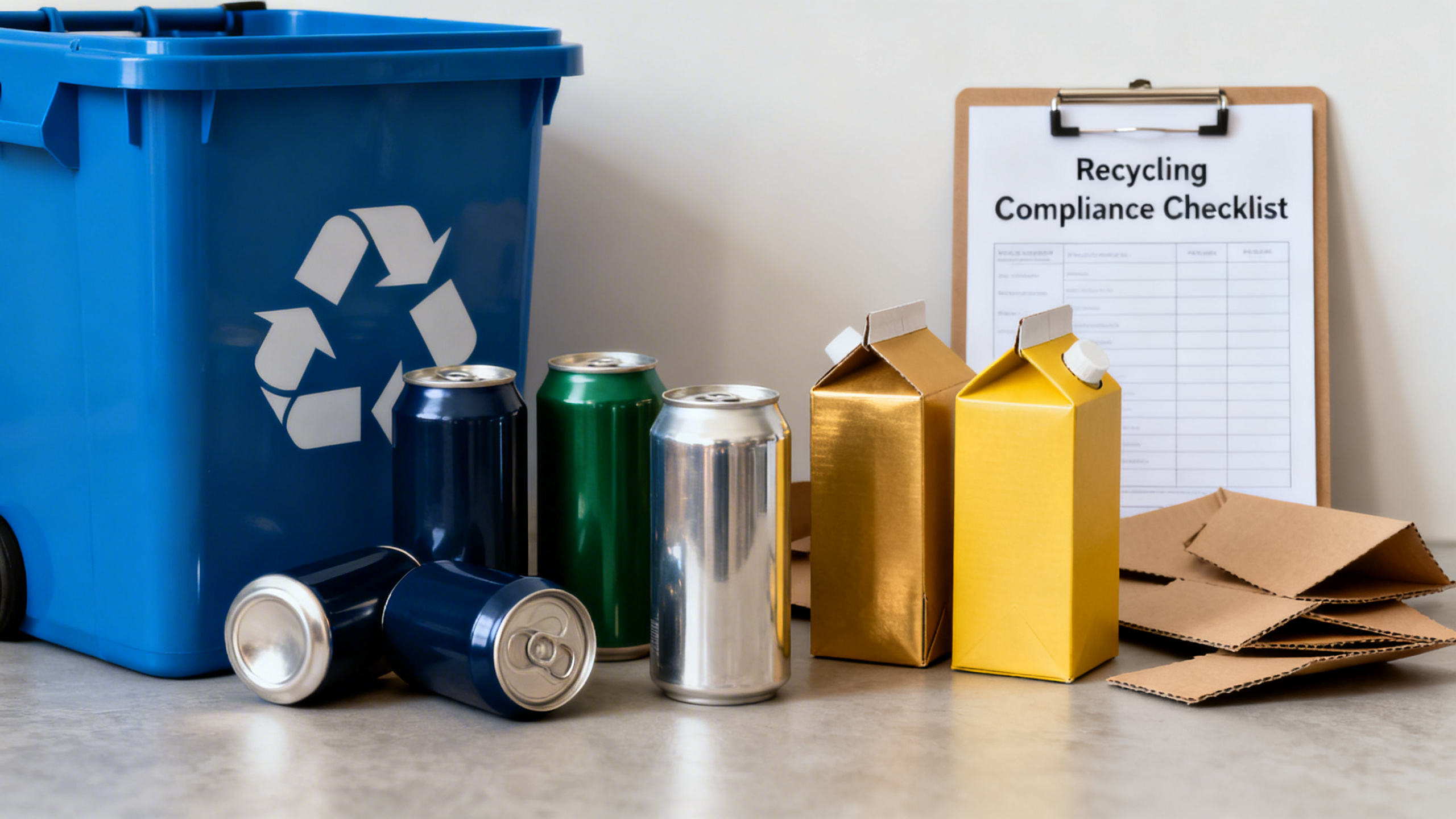
Ontario’s move to full Extended Producer Responsibility (EPR) for Blue Box materials has shifted from a “future planning” issue to a budgeting, data, and packaging-design issue that hits beverage brands immediately. For THC- and CBD-infused beverage producers selling into Ontario, the Blue Box transition adds a second compliance layer on top of federal packaging and labelling rules: you now have to prove what packaging you supplied, pay for its end-of-life management through the EPR system, and ensure your on-pack recyclability messaging can survive increasing scrutiny.
This article breaks down what changed in Ontario’s Blue Box framework, why 2025 cost pressures triggered proposed and finalized regulatory tweaks, and what beverage brands should do now to reduce fee surprises and avoid label/“green claims” risk. It’s informational only, not legal advice.
Ontario’s Blue Box system is governed by the Resource Recovery and Circular Economy Act, 2016 (RRCEA) and the Blue Box Regulation (O. Reg. 391/21). The regulation makes “producers” financially and operationally responsible for end-of-life management of designated Blue Box materials (paper, packaging, and packaging‑like products supplied to consumers).
The key business takeaway: EPR is not just a fee line item. It is a data-and-contract regime with registration, reporting, recordkeeping, and (in later years) verification requirements that depend on precise bill-of-materials information.
Primary references:
The Blue Box Regulation uses a hierarchy to assign responsibility. In many cases, the brand holder is the obligated producer; if there is no resident brand holder, responsibility can shift to an importer (resident in Ontario), and if neither applies it can fall to the retailer supplying to the consumer. The specific hierarchy and deeming rules are set out in O. Reg. 391/21.
For THC beverage businesses, this matters because:
Start with the regulation itself (https://www.ontario.ca/laws/regulation/210391) and validate producer status early—misidentifying the producer is one of the fastest ways to end up with compliance orders or retroactive corrections.
Ontario’s EPR transition for Blue Box materials began in July 2023 and culminated in full producer responsibility at the end of 2025. RPRA summarizes this transition and the end of the legacy program here: https://rpra.ca/programs/blue-box/.
By 2025, multiple stakeholders raised concerns that Blue Box system costs were higher than expected and that implementation details needed tightening. Ontario posted proposed amendments to the Blue Box Regulation in 2025 through the Environmental Registry of Ontario (ERO), explicitly framing the changes as intended to curb cost increases while maintaining service levels and improving transparency.
Key ERO notice (proposed amendments): https://ero.ontario.ca/notice/025-0009
Even if you’re not tracking the politics, the direction of travel is clear:
The proposal package (PDF) posted on ERO includes items such as changes related to planned service expansion and other technical clarifications: https://ero.ontario.ca/public/2025-06/Proposed%20Amendments%20to%20the%20Blue%20Box%20Regulation.pdf.
For planning purposes, it’s important to note that Ontario’s transition reached full producer responsibility at the start of 2026. RPRA announced that as of January 1, 2026, the legacy program ended and the province completed the move to a producer-run Blue Box system: https://rpra.ca/2026/01/ontario-completes-transition-to-producer-run-blue-box-program/.
For beverage brands, that means 2025 is the year you should have been locking down data quality and contractual coverage—because 2026 is where the operational model fully runs through producer/PRO arrangements.
Ontario’s Blue Box regime relies heavily on producer-supplied data. RPRA has provided transition-period support, but it has not reduced the obligation to report accurately.
A critical update for compliance planning: RPRA stated that Blue Box producers will not be required to submit verification reports when submitting annual supply data in 2025 and 2026. However, RPRA also clarified that producers must continue to report accurate and complete data, maintain records, and can be subject to inspection requests.
RPRA further indicated that the first supply data verification report would start in 2027 to verify 2026 supply data.
Many beverage businesses interpret “no verification report required” as “lower risk.” In reality:
For infused beverages, packaging is typically a multi-material “system,” not a single component:
Ontario’s Blue Box EPR obligations and fees are driven by the quantities and categories of Blue Box material supplied. That makes packaging specifications a compliance input, not just a marketing decision.
Aluminum beverage cans are widely recycled in Canada, but beverage producers still need to map every component accurately for reporting:
Even small changes—like switching to a different closure or adding a full-body sleeve—can move your packaging into different material categories and affect fee outcomes.
Your label choices may create two parallel risks:
Canada’s Competition Bureau has elevated the profile of greenwashing enforcement and published guidance on environmental claims.
Competition Bureau hub: https://competition-bureau.canada.ca/en/how-we-foster-competition/education-and-outreach/environmental-claims-and-greenwashing
Competition Bureau news release on final guidelines (June 2025): https://www.canada.ca/en/competition-bureau/news/2025/06/competition-bureau-issues-final-guidelines-regarding-environmental-claims.html
For beverage brands, the safest approach is to align on-pack claims with:
Ontario’s Blue Box EPR affects packaging economics and recyclability messaging, but the core product packaging and labelling requirements for THC beverages are still federal under the Cannabis Act and Cannabis Regulations, administered by Health Canada.
Health Canada’s official packaging and labelling guide is the best starting point because it consolidates what must appear on labels and how packaging must function (child-resistant, warnings, standardized symbol, cannabinoid content, etc.):
Beverage brands often have limited label real estate due to mandatory federal elements (warnings, symbol, THC/CBD quantities, etc.). EPR adds pressure because teams want to add:
The collision point is that these extra statements must be:
In other words, EPR doesn’t change federal label rules, but it changes the risk calculus of what you choose to say on pack.
Ontario’s EPR regulator, RPRA, has compliance and enforcement tools including compliance orders and administrative monetary penalties, and enforcement actions can be publicly disclosed.
Example: RPRA’s announcement of its first administrative penalty to a Blue Box producer: https://rpra.ca/2024/07/registrars-statement-rpra-issues-first-administrative-penalty-to-blue-box-producer/.
The reputational angle matters for regulated beverage brands because compliance issues can:
The following actions align with the research notes you provided and reflect how Ontario’s producer-responsibility model actually operates.
Do this before negotiating PRO contracts or deciding which entity in a corporate group will report:
Start with the regulation text: https://www.ontario.ca/laws/regulation/210391 and RPRA program guidance: https://rpra.ca/programs/blue-box/regulation/.
For THC/CBD beverages, BOM discipline should extend beyond the primary can:
Then implement change control: when packaging specs change, your supply-data logic must update.
Ontario’s system is pushing toward consistent collection, but in practice, processing outcomes depend on design choices.
Operationally, brands should pressure-test:
This is not just sustainability optimization; it can become fee optimization and risk management under EPR.
Many producers use a producer responsibility organization (PRO) to perform obligations. Your contract should clearly address:
RPRA’s overview of the producer-run framework is a useful reference point when setting expectations with service providers: https://rpra.ca/programs/blue-box/regulation/.
If your beverage label includes recyclability claims, build a substantiation file:
Competition Bureau environmental claims guidance hub: https://competition-bureau.canada.ca/en/how-we-foster-competition/education-and-outreach/environmental-claims-and-greenwashing
Even though verification reports were not required for 2025 and 2026 submissions, RPRA has clearly telegraphed that verification begins later.
Action items:
RPRA’s notice is explicit on timing: https://rpra.ca/2024/11/blue-box-producers-will-not-be-required-to-submit-verification-reports-when-submitting-supply-reports-in-2025-and-2026/.
Many beverage brands sell nationally, and that turns packaging EPR into a multi-jurisdiction reporting exercise. Ontario’s reporting categories, definitions, and timing will not perfectly match other provinces.
Two practical examples to keep on your radar:
The compliance risk in a national rollout is under- or double-reporting the same material flows across jurisdictions, especially where supply chains and distributors differ by province.
If you’re feeling the squeeze between EPR fees, supply-data reporting, and tightly controlled label space, the best move is to operationalize the work: define producer responsibility, standardize BOM capture, and implement claim review gates.
For ongoing regulatory monitoring, reporting checklists, and packaging/label compliance support, use CannabisRegulations.ai to stay audit-ready and reduce surprises as Ontario’s Blue Box EPR continues to evolve.