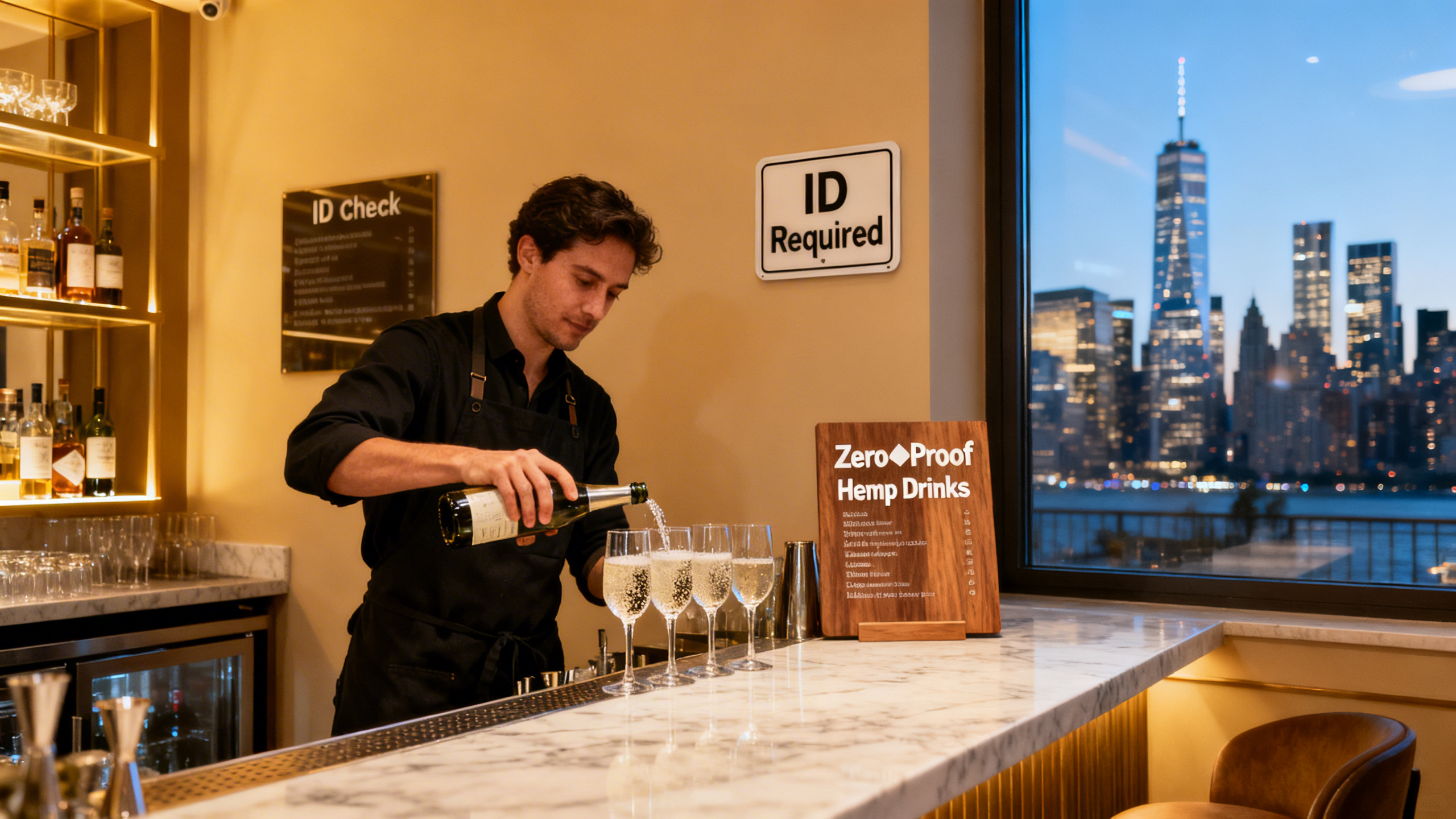
In 2025, the “sober bar” movement isn’t just about zero-proof spirits and adaptogen sodas. Increasingly, menus feature hemp-derived THC drinks—sparkling waters, “social tonics,” and mocktails dosed in single‑digit milligrams.
For operators, though, the hard part isn’t mixology. It’s cannabis compliance—specifically, whether your state (and your alcohol regulator) will treat on‑premise hemp THC beverage service as a lawful new category, an outright ban, or a gray area that can jeopardize your liquor license.
This multi‑state survey focuses on the focus keyword: On‑premise hemp THC drinks 2025. It categorizes states into allow / ban / unclear buckets for bars and restaurants, and it flags the practical compliance hurdles sober bars must solve: 21+ age controls, serving-size caps, labeling/warnings, no-alcohol co‑infusion, and insurance/over‑service policies.
Important: This article is informational only and not legal advice. Rules change quickly, and local ordinances and health departments can be stricter than state law.
The baseline problem: “Hemp” legality isn’t the same as “on‑premise service” legality
Many hemp THC beverages are formulated to fit the federal hemp definition (≤0.3% delta‑9 THC by dry weight). But on‑premise service triggers additional layers:
- Alcohol regulator rules (ABC/OLCC/TABC equivalents) that control what can be sold on a licensed premises
- Food safety rules (state DOH/food code) about additives, labeling, and permitted product forms
- Hemp product statutes that often regulate potency, packaging, testing, and age gating
- Local licensing and zoning that can prohibit or restrict these products even if the state allows them
Also, federal law complicates the background. The U.S. FDA has repeatedly stated that certain THC-related additives in foods can be treated as unlawful/“adulterated” under the Federal Food, Drug, and Cosmetic Act in many circumstances, and it has issued warning letters tied to edible products containing intoxicating cannabinoids (including delta‑8 THC) and similar items. See FDA warning letter examples like Earthly Hemps (July 15, 2024) for how FDA frames “unsafe food additive” risks: https://www.fda.gov/inspections-compliance-enforcement-and-criminal-investigations/warning-letters/earthly-hemps-674916-07152024
States respond by building their own frameworks (often stricter than federal ambiguity), or by prohibiting products entirely.
2025 legal map for bars and restaurants: Allow / Ban / Unclear (selected highlights)
This is not a 50‑state licensing guide. Instead, it’s a practical compliance map for whether a bar/restaurant/sober bar can sell and serve non‑alcoholic hemp THC drinks for on‑site consumption under state‑level rules and regulator posture.
“Allowed” (clear pathways for on‑premise service)
These states have explicit statutory endorsements or published regulator guidance that, in practice, supports lawful on‑premise service—usually with tight potency, labeling, and licensing conditions.
Minnesota (Allowed with an on‑site consumption endorsement)
Minnesota is one of the clearest “yes, but tightly controlled” states for on‑premise hemp THC beverages.
Under Minnesota Statutes, the Office of Cannabis Management (OCM) issues an on-site consumption endorsement to a lower-potency hemp edible (LPHE) retailer that also holds an on-sale alcohol license (chapter 340A). The statute language is direct: the office “shall issue” the endorsement to a qualifying retailer. See MN Revisor, section 342.46: https://www.revisor.mn.gov/statutes/cite/342.46
Practical takeaways for operators:
- Build your program as a retail LPHE compliance system, not as a “cocktail special.”
- Expect regulators to focus on testing compliance, product sourcing, and age controls.
- Train staff on “no sales to visibly intoxicated” policies (many state frameworks borrow this standard).
If you’re launching in Minnesota, also monitor OCM bulletins about LPHE licensing transition timelines and guidance memos: https://content.govdelivery.com/accounts/MNOCM/bulletins/400bfc3
Oregon (Allowed under OLCC guidance—non-alcoholic only, hemp vendor license, registry coming)
Oregon’s approach is notable because the Oregon Liquor and Cannabis Commission (OLCC) has published Hemp‑Derived Beverage Guidance that speaks directly to alcohol licensees.
Key points from OLCC:
- Only non-alcoholic hemp-derived beverages may be sold in Oregon.
- Beverages must comply with Oregon law.
- Alcohol licensees and liquor agents must hold a hemp vendor license from the Oregon Department of Agriculture (ODA) to sell hemp-derived beverages.
- Beginning January 1, 2026, hemp-derived beverages containing THC or CBD must be registered with OLCC in Oregon’s Hemp Registry and comply with Oregon labeling requirements.
Source: https://www.oregon.gov/olcc/marijuana/Pages/Hemp-Beverage-Guidance.aspx
Practical takeaways:
- Oregon is an “allow” state for on‑premise—but compliance is license‑stacking: your alcohol license does not replace hemp vendor licensing.
- Design your SOPs around non‑alcoholic service only and avoid any “mixing” practices that could create an alcohol+THC combination.
Louisiana (Allowed for some, but permit access and emergency limits reshape on‑premise programs)
Louisiana changed the calculus in 2025 with emergency regulation affecting consumable hemp beverages.
The Louisiana Division of Administration emergency rule (effective May 2, 2025) includes beverage constraints such as:
- A serving must be 12 fluid ounces or greater
- A serving must not include more than 5 mg THC (per the emergency rule text)
Source PDF: https://www.doa.la.gov/media/ykyjhbuu/2505emr031.pdf
Operational implications:
- Your menu engineering may have to change: many “mini can” formats or concentrated mixers don’t fit a 12‑oz minimum serving requirement.
- If permits are limited (and some industry reporting suggests not all venues can newly obtain permissions), expansion planning should confirm whether your location can be permitted before committing to build‑out.
“Banned” (on‑premise hemp THC drinks are treated as unlawful or noncompliant)
In these states, the regulator posture is effectively: “If it’s an intoxicating hemp beverage, it does not belong on an alcohol-licensed premises,” or the state bans detectable THC in hemp foods/beverages entirely.
California (Banned—ABC enforces CDPH’s prohibition on detectable THC in hemp foods/beverages)
California is one of the clearest “no” states for on‑premise hemp THC drinks.
The California Department of Alcoholic Beverage Control (ABC) is enforcing California Department of Public Health (CDPH) regulations adopted and published September 24, 2024, which prohibit the marketing or sale of industrial hemp products intended for human use—including food and beverages—that contain a detectable level of total THC or other intoxicating cannabinoids.
California ABC’s enforcement page (and ongoing enforcement messaging) is explicit that ABC licensees may not carry, market, or sell noncompliant hemp products: https://www.abc.ca.gov/enforcement/illegal-hemp-enforcement/
CDPH announcement: https://www.cdph.ca.gov/Programs/OPA/pages/nr24-26.aspx
Practical takeaways:
- A sober bar in California should assume “THC mocktails made from hemp beverages” are not allowed if detectable THC is present.
- Even if a product is sold elsewhere online, ABC enforcement risk is the key operational constraint for bars/restaurants.
Georgia’s SB 494 (effective October 1, 2024) created a new hemp product regime, but the Georgia Department of Revenue Alcohol and Tobacco Division (ATD) has issued policy bulletins that are restrictive for alcohol-licensed businesses.
ATD Policy Bulletin 2025‑01 states:
- The Georgia Hemp Farming Act, as amended, specifically prohibits the sale/distribution of alcoholic beverages that contain consumable hemp products
- It also references prohibitions on food products that contain consumable hemp products
- For retail package liquor stores, the bulletin’s headline takeaway is that only hemp vapor products can legally be sold on those premises
Source (PDF): https://dor.georgia.gov/document/document/atd-policy-bulletin-2025-01-overview-restriction-hemp-products-retail-package/download
Why this matters for sober bars:
- If your business model relies on an alcohol license type that is treated like “package” retail (or is otherwise under ATD restrictions), hemp beverages may be a nonstarter.
- Even where non‑alcoholic hemp beverages may exist elsewhere in commerce, alcohol regulators can restrict what sits on the licensed premises.
“Unclear / high-risk gray area” (possible in theory, but enforcement or licensing posture is unstable)
Many states fall into this bucket: the hemp statute might permit certain products, but the on‑premise question is unresolved, or alcohol regulators/health departments have not issued clear direction.
Texas (Rapidly evolving; alcohol regulator increasingly involved)
Texas illustrates a common trend: alcohol regulators stepping into hemp product enforcement for license holders.
Reporting indicates the Texas Alcoholic Beverage Commission (TABC) approved rules affecting retailers (including restaurants) that sell consumable hemp products, with a strong emphasis on 21+ controls and enforcement coordination with DSHS. See coverage describing finalized rules and TABC’s enforcement posture: https://www.texastribune.org/2026/01/20/texas-tabc-hemp-rules-finalized/
Practical takeaways:
- Texas may be feasible for on‑premise hemp drinks in some contexts, but operators should treat it as high compliance scrutiny and confirm whether their specific license privileges allow sales/service.
- Expect ID checks, product documentation (COAs), and strict “no co‑mingling with alcohol” practices.
New York (Hemp products regulated, but on‑premise service depends on license class and local enforcement)
New York’s Office of Cannabis Management (OCM) runs a Cannabinoid Hemp Program and publishes guidance on permitted/prohibited product forms.
Start here for official program info: https://cannabis.ny.gov/cannabinoid-hemp
And see OCM’s “Permitted and Prohibited Cannabinoid Hemp Product Forms” guidance (revised 10/7/2024): https://cannabis.ny.gov/system/files/documents/2024/10/permitted-and-prohibited-product-forms-guidance-document-nys-cannabinoid-hemp-program_v4.pdf
What makes New York “unclear” for sober bars:
- The state’s hemp program is real and active, but the question “can a bar/restaurant serve by the glass” is often a function of liquor authority policy, local health department posture, and the venue’s license configuration.
Common compliance hurdles for on‑premise hemp THC mocktails (even where “allowed”)
Even in “allow” states, success depends on operationalizing rules the way regulators expect.
1) Age 21+ gating must be as strict as alcohol (or stricter)
Most modern intoxicating hemp frameworks converge on 21+. Your SOP should treat hemp THC drinks like spirits:
- ID every guest who appears under 30 (or use a card-everyone policy)
- Use POS prompts requiring date of birth entry
- Train staff on refusal scripts and fake ID escalation
2) Serving-size and mg-per-serving caps drive menu design
Examples from “allow” states:
- Louisiana’s emergency rule includes a 5 mg per serving cap and a 12‑oz minimum serving size requirement (see PDF above).
- Minnesota’s LPHE structure is built around “lower‑potency” products and a retailer endorsement model (see MN statute above).
Your menu should be designed around:
- Single‑serve cans/bottles sold in original packaging (minimize “bartender dosing” risk)
- Clear “per container” potency disclosure on the menu
- Standard “one at a time” pacing rules
3) No alcohol co‑infusion (and avoid anything that looks like co‑service)
Even where non‑alcoholic hemp beverages are allowed, many alcohol regulators treat any combination of alcohol + THC (or “intoxicating hemp”) as prohibited or as a license risk.
Best practice:
- Do not mix hemp THC beverages into alcoholic cocktails
- Do not offer “floats,” “shots,” or add-ons
- Keep a distinct “hemp beverage” menu section that is explicitly non‑alcoholic
4) Product documentation: COAs, sourcing, and packaging integrity
Regulators and insurers increasingly expect:
- Certificates of analysis (COAs) from accredited labs
- Chain-of-custody and supplier agreements
- Batch/lot traceability
- Products kept in original sealed packaging for service whenever possible
If your staff is opening cans and pouring into glassware, you may need extra controls (and in some jurisdictions, it can create compliance risk).
5) “Non-alcoholic intoxicant” warnings and consumer messaging
Even when not explicitly mandated, sober bars should adopt prominent warnings:
- “Contains intoxicating hemp-derived THC. Do not drive.”
- “Effects may be delayed 30–120 minutes.”
- “Do not combine with alcohol or other intoxicants.”
- “Not for pregnant or breastfeeding individuals.”
Use plain language and make it visible on menus and receipts.
6) Dram-shop analog risk and insurance
Even if your state’s dram-shop statute is alcohol-specific, plaintiff theories and insurer concerns may treat “intoxicating hemp beverages” similarly.
Operational steps:
- Talk to your broker about endorsements that cover service of intoxicating non‑alcoholic products
- Add incident logging (refusals, cut-offs, guest complaints)
- Use security camera retention policies consistent with alcohol operations
These are practical controls designed to “read like compliance” to inspectors.
House Policy A: Product handling
- We only sell manufacturer-sealed non‑alcoholic hemp THC beverages sourced from approved suppliers.
- We maintain COAs and invoices for each SKU and lot/batch.
- We do not alter potency, combine products, or add concentrate.
House Policy B: Responsible service & cut-offs
- Maximum of one hemp THC beverage served per guest at a time.
- Minimum 30-minute pacing between beverages.
- Staff may refuse service for visible impairment, mixed-intoxicant concerns, or safety reasons.
- Complimentary water and food options are offered with service.
House Policy C: No-alcohol separation
- No hemp THC products are served or consumed with alcohol on premises.
- If the venue also holds an alcohol license, hemp THC beverages are stored and merchandised in a separate section.
House Policy D: Customer disclosures
- Menus and receipts disclose per‑serving potency and key warnings.
- Staff provide a short verbal safety script: onset time, no driving, do not mix.
Business strategy: how to choose “launch states” for on‑premise hemp THC mocktails
For multi‑state operators, the simplest way to reduce risk is to prioritize:
- States with explicit on‑site authorization (like Minnesota’s endorsement model)
- States with published alcohol regulator guidance allowing non‑alcoholic hemp beverages (like Oregon)
- States where the health department has created a stable product framework and enforcement posture is predictable
Avoid building your flagship concept in states where:
- The alcohol regulator is actively removing products from shelves (California)
- The alcohol regulator’s policy bulletins narrow what can be sold on licensed premises (Georgia package context)
- Enforcement authority is shifting between agencies and rules are in active overhaul (many “unclear” states)
What to watch next (late 2025 through 2026)
The on‑premise question will continue to move because:
- More states are adopting ABC-style oversight for intoxicating hemp products (permits, inspections, age‑21 rules)
- Potency caps are converging around 5 mg per serving in several jurisdictions
- Registries and track/trace style requirements are expanding (Oregon’s 2026 registry is a good example)
- Federal policy and enforcement signals continue to influence state regulators’ risk tolerance
Action steps checklist (operators)
- Confirm whether your state is allow / ban / unclear for on‑premise hemp THC beverages—and whether your specific license type changes the answer.
- Adopt alcohol-grade age verification and responsible service controls.
- Use sealed, labeled products; keep COAs and invoices on-site.
- Separate hemp THC beverage service from alcohol service.
- Update insurance and incident documentation practices.
If you want to operationalize these rules across multiple jurisdictions, use https://cannabisregulations.ai/ to track evolving state requirements, build SOPs that match regulator expectations, and keep your on‑premise program aligned with the latest licensing and enforcement updates.