


Sign Up
Ready to replace complexity with clarity?
Answer your real world compliance questions (limited time) and save thousands in legal fees and avoided fines.
Automate Compliance Today

As of 20 February 2026, Great Britain’s market for ingestible CBD products remains in a transitional “tolerated” phase rather than a fully authorised one. But the UK’s food regulators took a major step toward a fully regulated market when the Food Standards Agency (FSA) launched a consultation on the first proposed product-specific CBD novel food authorisations in Great Britain.
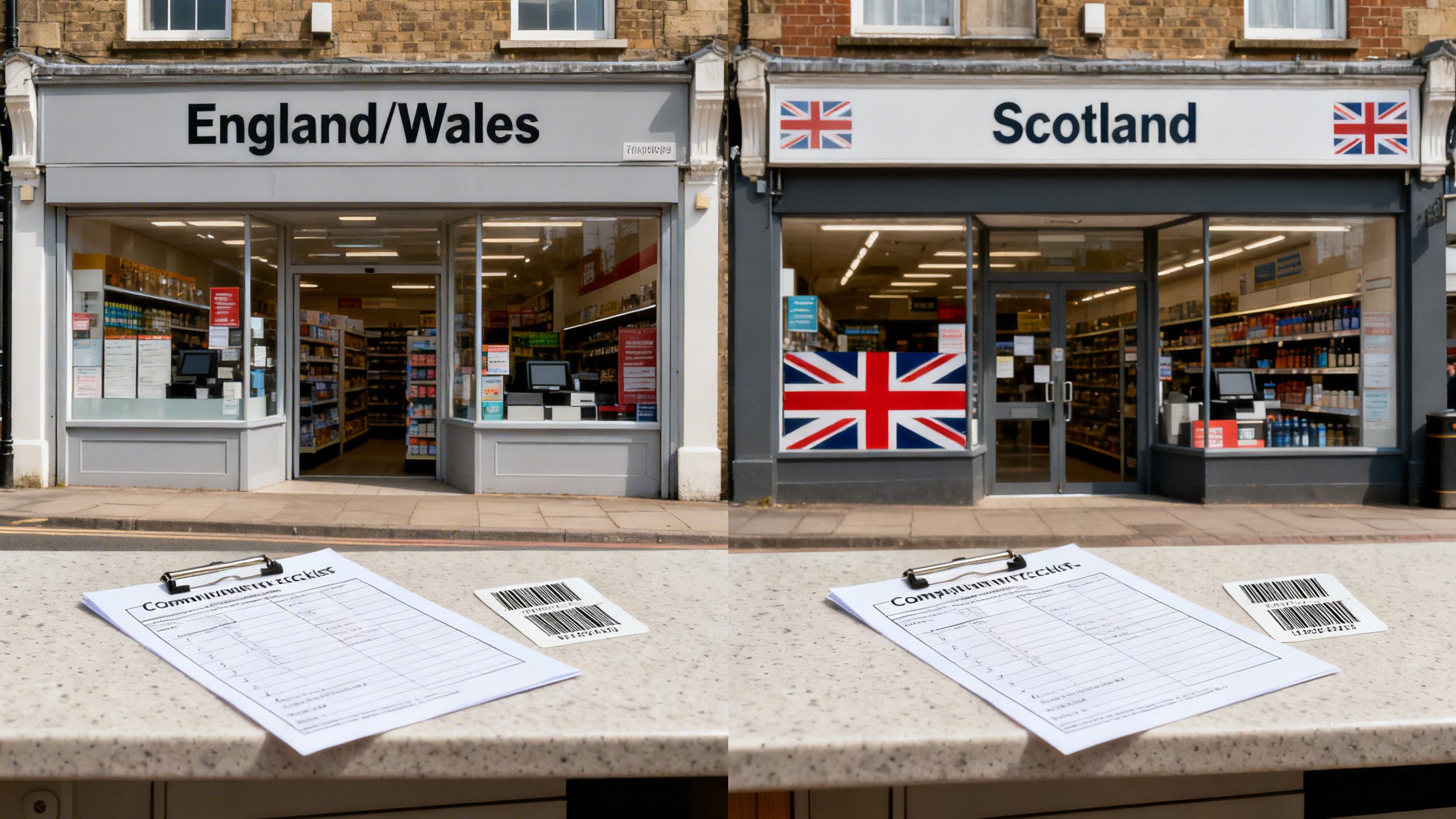
The compliance catch for operators is devolution: final decisions for England and Wales are taken by Ministers advised by the FSA, while Scotland has its own regulator, Food Standards Scotland (FSS), and Scottish Ministers may align—or diverge—on timing, scope, and conditions of authorisation. That divergence could create a “two-speed” retail market inside Great Britain—especially for national chains, online sellers, and wholesalers servicing multiple nations.
This article summarises what the FSA consulted on in 2025, how devolved decision-making could split retail compliance, and a practical 2026 go‑live readiness plan covering supplier assurances, stock segregation, e‑commerce geo-targeting, and recall/withdrawal SOPs.
Informational only: This is not legal advice. Always confirm requirements with your regulatory counsel and the relevant competent authority.
In late summer 2025, the FSA announced it had launched a public consultation on draft risk management recommendations to authorise the first CBD food products as novel foods in Great Britain, subject to conditions (including labelling requirements). The FSA stated that, if approved, these would be the first CBD food products to become fully regulated on the UK market under the novel foods regime.
Key points businesses should anchor to:
Primary sources:
The novel foods regime in Great Britain is rooted in retained Regulation (EU) 2015/2283, but risk management decisions (authorisations and conditions) flow through national governance.
For products within scope of the 2025 consultation, the FSA’s draft recommendations were directed to Ministers in England and Wales. If those Ministers approve, the authorisation becomes the basis for lawful placing on the market in those nations—subject to the authorisation’s specifications and conditions.
Scotland’s regulator, Food Standards Scotland, publishes separate business guidance and consumer information on novel foods, including CBD. FSS has been clear that CBD foods require authorisation before they can be sold legally, and it directs businesses to the GB regulated products application process.
Authoritative FSS resources:
The practical upshot: even if the science and underlying safety assessment is jointly developed or aligned, go‑live timing and enforcement posture can still vary by nation.
Until product-specific authorisations are granted, the market has largely operated under an interim enforcement approach.
The FSA maintains a list of CBD products linked to novel food applications that it proposes may remain on the market in England and Wales while applications progress (provided certain criteria are met). The list is also the backbone of retail due diligence: major retailers commonly require proof of listing status.
FSA guidance and the list:
FSS’s CBD business guidance emphasises that CBD foods require authorisation and that products on the market are otherwise in contravention—an important reminder that “tolerated” is not the same as “authorised”, and that Scotland can take a different stance on what is acceptable pending authorisations.
If England/Wales Ministers approve the first authorisations in 2026 while Scotland does not (or does so later, or with different conditions), businesses operating GB-wide should plan for at least three plausible divergence patterns.
This is the most operationally disruptive scenario because it creates a product class that is:
Even if Scotland authorises at roughly the same time, Scotland could set different risk-management conditions, for example:
Operationally, even small differences can force separate SKUs.
Even with formal alignment, enforcement can differ (local authority focus, transition time allowances, prioritisation). Retailers still need defensible compliance documentation and training.
For multi-nation operators, divergence becomes less a policy question and more a systems problem.
If a product is authorised in England/Wales but not in Scotland, you may need to:
This becomes even more complex if you run:
The FSA’s consultation messaging placed heavy emphasis on clear labelling for safe use. If authorisations require specific statements (for example, limits on daily intake and population restrictions), Scotland could:
Even if the authorisation does not literally mandate printing an “authorisation number” on-pack, retailers may adopt an internal control: e.g., SKU-to-authorisation mapping in product information management systems, and on-pack or on-shelf “compliance references” to support audits.
Practical takeaway: assume you may need separate artwork for Scotland vs. England/Wales, even if the product formulation is identical.
When conditions differ by nation, planograms must become nation-aware:
FSA/FSS safety advice has included recommending healthy adults do not exceed 10 mg/day and advising certain groups avoid use. Retailers should anticipate:
Consumer advice source:
Below is a practical implementation plan designed for national retailers, brands, and distributors that must be ready for authorisations to land in England/Wales first, while Scotland potentially takes a different path.
In your PIM/ERP, create explicit fields for:
Then tie those fields to:
Update supplier quality agreements to require:
Also require suppliers to maintain alignment with the FSA “CBD products linked to novel food applications” list for any non-authorised products sold in England/Wales pending final outcomes.
If there is any risk Scotland will lag or vary conditions, assume you may need:
Critical controls:
Online retail is where devolution splits can create inadvertent breaches.
Minimum viable controls for 2026:
Document these controls as part of your cannabis compliance programme (in this context: ingestible CBD food compliance), because enforcement agencies often ask not only “what did you intend?” but “what controls did you implement?”
Policies alone fail under operational pressure. Implement:
For businesses with border-area stores (e.g., Northumberland / Scottish Borders), tighten controls around:
You should treat a Scotland non-authorisation (or delayed authorisation) as a foreseeable “regulatory withdrawal” trigger.
Your SOP should define:
Even if no “safety defect” exists, withdrawal logistics can mirror a recall: speed matters, and audit trails matter.
Build nation-specific training modules that cover:
Also implement escalation paths for:
In the GB novel foods context, “ready” means you can prove, quickly and consistently, that:
This is where a modern cannabis compliance stack (product master data + nation rules + audit trails) becomes more than a legal function—it becomes a retail systems capability.
If you sell ingestible CBD products across Great Britain, 2026 is the year to move from “policy awareness” to go-live operational controls: nation-aware product data, supplier assurance packs tied to authorisation references, e‑commerce gating, and documented withdrawal playbooks.
Use https://cannabisregulations.ai/ to track regulatory updates, build internal compliance checklists, and maintain evidence-ready documentation across licensing, labelling, and retail rollout requirements.