


Sign Up
Ready to replace complexity with clarity?
Answer your real world compliance questions (limited time) and save thousands in legal fees and avoided fines.
Automate Compliance Today

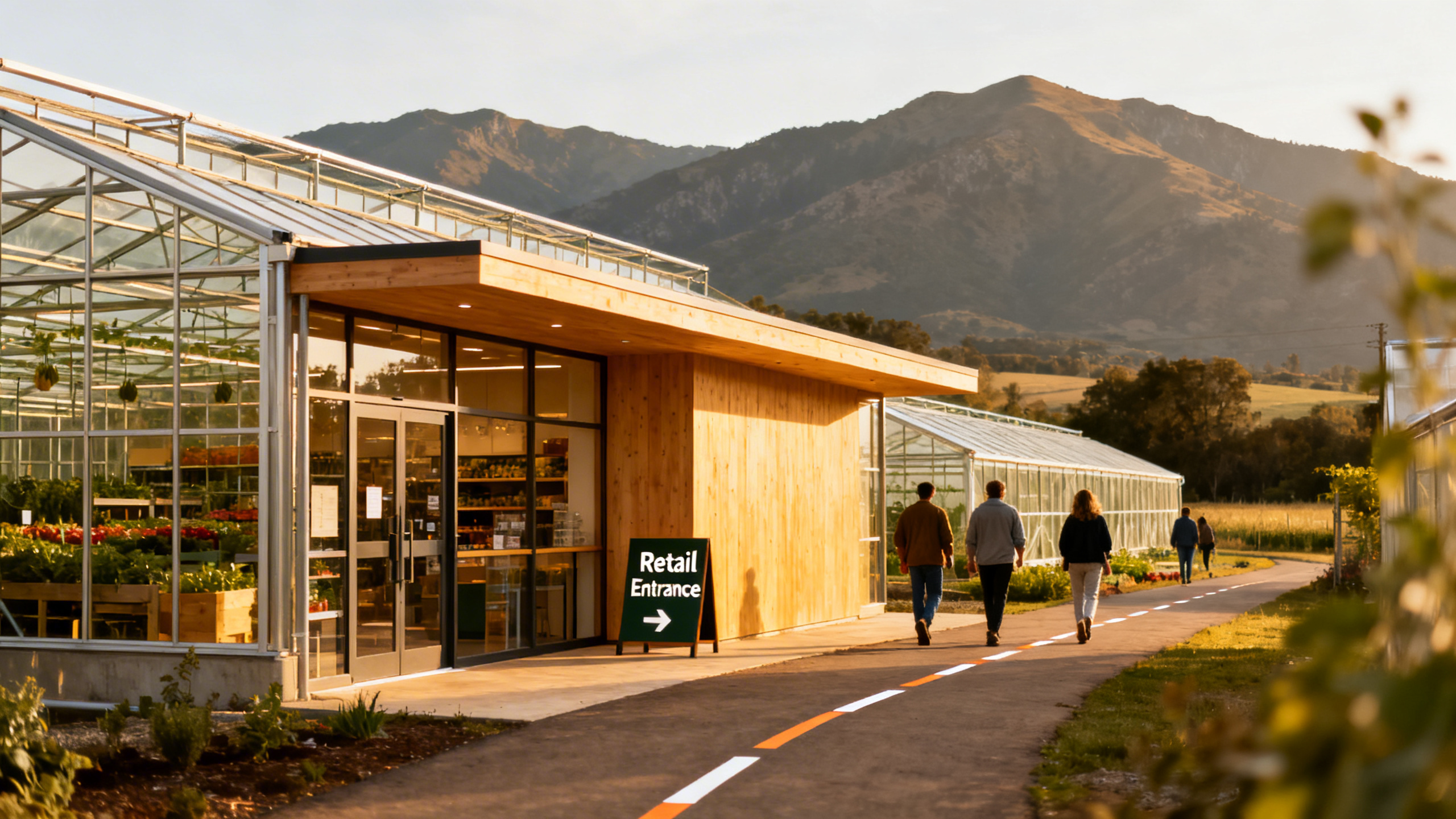
In British Columbia, the Producer Retail Store (PRS) licence—often called “farmgate”—is one of the most strategically important retail pathways for federally licensed producers. It allows qualifying producers to sell their own products directly to adults from a store located at (or connected to) the production site, while still operating inside B.C.’s tightly controlled distribution and compliance framework.
What makes PRS especially interesting going into 2025 isn’t just the business model—it’s the data. The Liquor and Cannabis Regulation Branch (LCRB) publishes weekly application statistics, and those weekly snapshots provide a rare, near-real-time signal of market sentiment: how many businesses are still pushing into direct sales, and how much “pipeline” activity is sitting in regulatory review.
This article breaks down what the BC producer retail store 2025 story looks like, what the LCRB’s weekly stats can (and can’t) tell you, and the operational hurdles that consistently slow PRS projects—especially local government approvals, security design, and inventory controls.
Informational only: This post is for general compliance education and does not constitute legal advice. Always confirm requirements with the LCRB, your local government, and qualified counsel.
The PRS model is straightforward in concept: a federally licensed producer in B.C. can operate a retail storefront on the production site and sell to the public—subject to provincial licensing and local government support.
In practice, PRS matters because it can:
The province’s policy intent is also visible in how PRS is positioned on the official application guidance: it is a defined licence type with application requirements, and it is explicitly tied to local government and Indigenous Nation involvement.
External resources:
Unlike many jurisdictions where licensing activity is opaque or published quarterly, B.C. provides a rolling view of paid applications in progress.
The LCRB’s Application Statistics page includes a section indicating it publishes PRS application counts and updates them weekly (the page itself displays a “last updated” date). This is important because it suggests licensing demand is not a one-time surge—it can be monitored as a trend line.
External resource:
The LCRB’s statistics focus on paid applications in progress. That means the data is capturing applications that have been submitted and paid for, but are not yet finalized.
For operators, that metric is useful in three ways:
Your research notes reference September 2025 as a period showing “ongoing uptake” in PRS applications. The key operational takeaway is: PRS demand appears persistent—not limited to the initial program launch.
If you’re building a PRS roadmap for 2025, you should treat the weekly LCRB publication as a planning input:
PRS is not a “quick add-on.” It’s a retail licence that sits at the intersection of:
The LCRB’s PRS application guidance emphasizes that applicants must check requirements and fees and be prepared to demonstrate readiness in several areas—especially local government items like development permits, business licensing, and zoning.
External resource:
A central feature of B.C.’s retail licensing framework is that the LCRB cannot issue certain licences without local support. The application statistics page explicitly references the concept that provincial issuance is constrained by local recommendations (for store licensing pathways).
Separate from that, the Province provides guidance on the role of local governments and First Nations in the licensing process, including how responses are recorded through the portal and how zoning confirmation may be required.
External resource:
The PRS value proposition is strong—but the compliance hurdles are real. In 2025, three themes repeatedly drive timelines and costs: zoning/community consultation, security standards, and inventory control that aligns with provincial distribution frameworks.
Even when a producer has a compliant production site, adding on-site retail introduces new land use questions:
Strategy for 2025:
PRS sites combine production operations and retail operations. That can increase security complexity because you must control access between:
B.C. publishes cannabis licence terms and conditions through handbooks (including for PRS). These handbooks are where operators will find the detailed expectations around secure storage, restricted areas, and surveillance.
External resource:
Operational best practices:
Direct-to-consumer does not mean “outside the system.” PRS operators still need disciplined inventory control and reporting.
The LCRB application page for PRS highlights that stores must submit monthly sales reports that are submitted onward for federal tracking purposes.
External resource:
Strategy for 2025:
For beverage makers and experiential brands, PRS can anchor tourism—but sampling and “experience design” must stay within provincial policy and licence terms.
B.C. has issued policy directives and bulletins touching on sampling and related activities. For example, the LCRB has published a sampling policy (#16-10) and bulletins that update guided tours and sampling at a manufacturer site.
External resources:
Practical design guidance:
Even though this article focuses on licensing, the consumer rules drive frontline compliance.
In B.C., access to retail stores is restricted to adults. Retail operations should be built around consistent ID checks and staff training.
A particularly helpful official program reference is the Province’s Minors as Agents Program, which reinforces the importance of ID verification and compliance checks.
External resource:
If your PRS model includes online presence (menus, click-and-collect concepts where allowed, or accessory sales), B.C. has issued direction indicating age verification tools are required in certain online contexts.
External resource:
PRS locations can be highly visible: they are destinations, they attract new customers, and they often operate next to high-value production infrastructure. That visibility increases the importance of inspection readiness.
B.C. explains the enforcement process and penalties under the Cannabis Control and Licensing Act framework, including inspections, seizure authority in certain contexts, and administrative monetary penalties.
External resource:
Practical takeaway: treat your PRS compliance program like a “retail + manufacturing” hybrid. That means:
If you want a PRS to be operational in 2025 (or to be positioned competitively for 2026), plan around what slows projects down.
A PRS licence is only as real as the local government pathway.
Show your work:
Design should do compliance “for free.” The best PRS stores use layout to reduce staff burden:
Most non-compliance risk appears in edge cases, not normal sales:
Tie SOPs back to staff training and document control so you can prove consistency during inspections.
If weekly LCRB statistics continue to show a steady PRS application pipeline, that signals:
If you’re evaluating a BC producer retail store 2025 application, treat the project like a regulated rollout with parallel workstreams:
For ongoing updates, always monitor:
Use https://cannabisregulations.ai/ to track B.C. regulatory changes, build SOP sets for PRS operations, and stay inspection-ready with practical compliance workflows.