

June 16, 2026


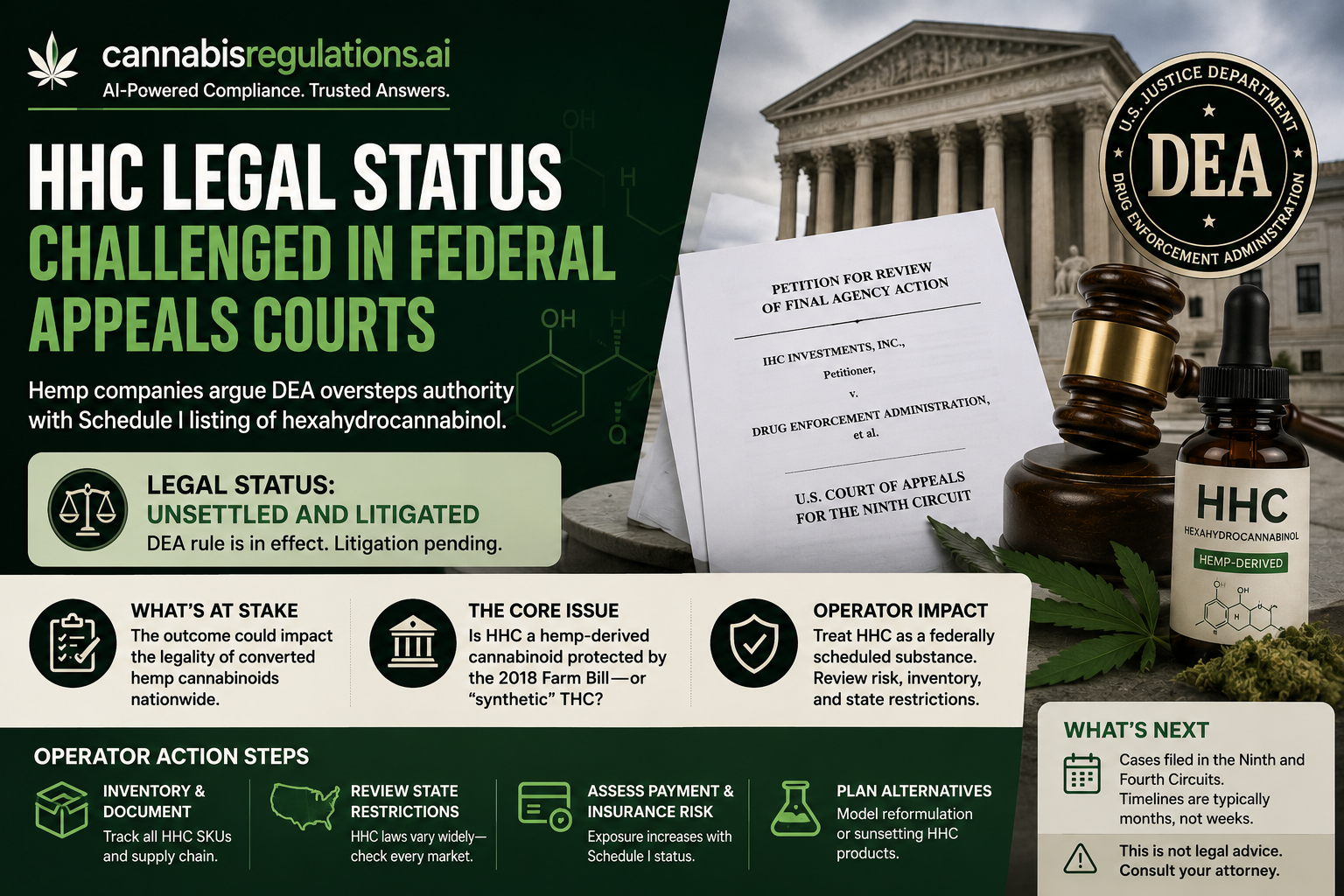
Two hemp companies have asked federal appeals courts to overturn the Drug Enforcement Administration's decision to treat hexahydrocannabinol (HHC) as a Schedule I controlled substance. The petitions, filed in early June 2026, set up a direct test of whether a hydrogenated, hemp-derived cannabinoid is shielded by the 2018 Farm Bill or banned as "synthetic" THC. For operators asking whether HHC is legal, the honest answer is now: unsettled, and litigated.
The lawsuits target a DEA final rule published May 4, 2026, titled "Specific Listing for Hexahydrocannabinol," which placed HHC explicitly in Schedule I of the Controlled Substances Act. IHC Investments, Inc. and Bluestar Operations, LLC each filed separate petitions for review of final agency action, naming the DEA, DEA Administrator Terrance C. Cole, and the acting U.S. Attorney General. The cases were filed in the U.S. Court of Appeals for the Ninth Circuit and the Fourth Circuit, respectively.
The petitioners argue the agency exceeded its statutory authority. Their core claim is that the 2018 Farm Bill removed hemp and its "derivatives, extracts, cannabinoids, and isomers" from the Controlled Substances Act so long as the material contains no more than 0.3% delta-9 THC by dry weight. On that reading, a cannabinoid produced from legal hemp remains lawful regardless of the processing involved.
The DEA's position rests on the idea that commercially produced HHC is effectively synthetic THC, and that synthetic tetrahydrocannabinols sit outside the Farm Bill's hemp carve-out. The companies counter that hemp processing routinely involves extraction, refinement, conversion, hydrogenation, and distillation, and that calling the resulting molecule "synthetic" misreads both the chemistry and the statute. That single word, synthetic, is doing most of the legal work here. How the courts define it will reach well beyond HHC to the broader universe of converted cannabinoids.
For businesses selling HHC, the filing changes the risk calculus but not the legal status. The DEA rule is in effect now; a petition for review does not automatically pause enforcement. Operators should treat HHC as federally scheduled until a court says otherwise.
Concrete steps worth taking with counsel: inventory and document every HHC SKU and its supply chain; review distribution into states that independently restrict HHC or semi-synthetic cannabinoids; reassess payment-processing and insurance exposure tied to a Schedule I product; and model the cost of reformulating or sunsetting HHC lines if the rule stands. Operators that also sell into the broader hemp market should fold this into planning for the federal total-THC cutover scheduled for later this year, which independently threatens many intoxicating hemp products.
The HHC fight does not stand alone. It runs parallel to the rescheduling litigation moving through the D.C. Circuit and to the looming federal hemp-THC definition change, both of which are reshaping cannabinoid markets in 2026. State posture varies widely: some states have already restricted or banned HHC and other semi-synthetic cannabinoids, while others remain silent and default to federal treatment. An operator's exposure therefore depends on both the outcome of these petitions and the specific states it ships into.
The petitions for review will proceed in the Ninth and Fourth Circuits. There is no published merits hearing date yet, and circuit timelines for agency-action challenges typically run months, not weeks. Watch for any motion to stay the rule pending review, for possible consolidation or transfer given the parallel filings, and for whether other hemp companies join. Until a court rules, the DEA's Schedule I listing governs.
This is not legal advice. Operators with HHC exposure should talk to their counsel about their specific products and markets.
Is HHC federally legal right now? No. As of the DEA's May 4, 2026 final rule, HHC is listed in Schedule I. The lawsuits seek to overturn that listing but do not suspend it.
Who is suing the DEA over HHC? IHC Investments, Inc. and Bluestar Operations, LLC filed separate petitions for review in the Ninth and Fourth Circuits.
What is the companies' main argument? That HHC is a hemp-derived cannabinoid protected by the 2018 Farm Bill, and that the DEA wrongly classified it as synthetic THC.
Does the lawsuit make HHC legal again? No. Unless a court stays or vacates the rule, the Schedule I listing remains in force during the litigation.
Two hemp companies have asked federal appeals courts to overturn the Drug Enforcement Administration's decision to treat hexahydrocannabinol (HHC) as a Schedule I controlled substance. The petitions, filed in early June 2026, set up a direct test of whether a hydrogenated, hemp-derived cannabinoid is shielded by the 2018 Farm Bill or banned as "synthetic" THC. For operators asking whether HHC is legal, the honest answer is now: unsettled, and litigated.
The lawsuits target a DEA final rule published May 4, 2026, titled "Specific Listing for Hexahydrocannabinol," which placed HHC explicitly in Schedule I of the Controlled Substances Act. IHC Investments, Inc. and Bluestar Operations, LLC each filed separate petitions for review of final agency action, naming the DEA, DEA Administrator Terrance C. Cole, and the acting U.S. Attorney General. The cases were filed in the U.S. Court of Appeals for the Ninth Circuit and the Fourth Circuit, respectively.
The petitioners argue the agency exceeded its statutory authority. Their core claim is that the 2018 Farm Bill removed hemp and its "derivatives, extracts, cannabinoids, and isomers" from the Controlled Substances Act so long as the material contains no more than 0.3% delta-9 THC by dry weight. On that reading, a cannabinoid produced from legal hemp remains lawful regardless of the processing involved.
The DEA's position rests on the idea that commercially produced HHC is effectively synthetic THC, and that synthetic tetrahydrocannabinols sit outside the Farm Bill's hemp carve-out. The companies counter that hemp processing routinely involves extraction, refinement, conversion, hydrogenation, and distillation, and that calling the resulting molecule "synthetic" misreads both the chemistry and the statute. That single word, synthetic, is doing most of the legal work here. How the courts define it will reach well beyond HHC to the broader universe of converted cannabinoids.
For businesses selling HHC, the filing changes the risk calculus but not the legal status. The DEA rule is in effect now; a petition for review does not automatically pause enforcement. Operators should treat HHC as federally scheduled until a court says otherwise.
Concrete steps worth taking with counsel: inventory and document every HHC SKU and its supply chain; review distribution into states that independently restrict HHC or semi-synthetic cannabinoids; reassess payment-processing and insurance exposure tied to a Schedule I product; and model the cost of reformulating or sunsetting HHC lines if the rule stands. Operators that also sell into the broader hemp market should fold this into planning for the federal total-THC cutover scheduled for later this year, which independently threatens many intoxicating hemp products.
The HHC fight does not stand alone. It runs parallel to the rescheduling litigation moving through the D.C. Circuit and to the looming federal hemp-THC definition change, both of which are reshaping cannabinoid markets in 2026. State posture varies widely: some states have already restricted or banned HHC and other semi-synthetic cannabinoids, while others remain silent and default to federal treatment. An operator's exposure therefore depends on both the outcome of these petitions and the specific states it ships into.
The petitions for review will proceed in the Ninth and Fourth Circuits. There is no published merits hearing date yet, and circuit timelines for agency-action challenges typically run months, not weeks. Watch for any motion to stay the rule pending review, for possible consolidation or transfer given the parallel filings, and for whether other hemp companies join. Until a court rules, the DEA's Schedule I listing governs.
This is not legal advice. Operators with HHC exposure should talk to their counsel about their specific products and markets.
Is HHC federally legal right now? No. As of the DEA's May 4, 2026 final rule, HHC is listed in Schedule I. The lawsuits seek to overturn that listing but do not suspend it.
Who is suing the DEA over HHC? IHC Investments, Inc. and Bluestar Operations, LLC filed separate petitions for review in the Ninth and Fourth Circuits.
What is the companies' main argument? That HHC is a hemp-derived cannabinoid protected by the 2018 Farm Bill, and that the DEA wrongly classified it as synthetic THC.
Does the lawsuit make HHC legal again? No. Unless a court stays or vacates the rule, the Schedule I listing remains in force during the litigation.
