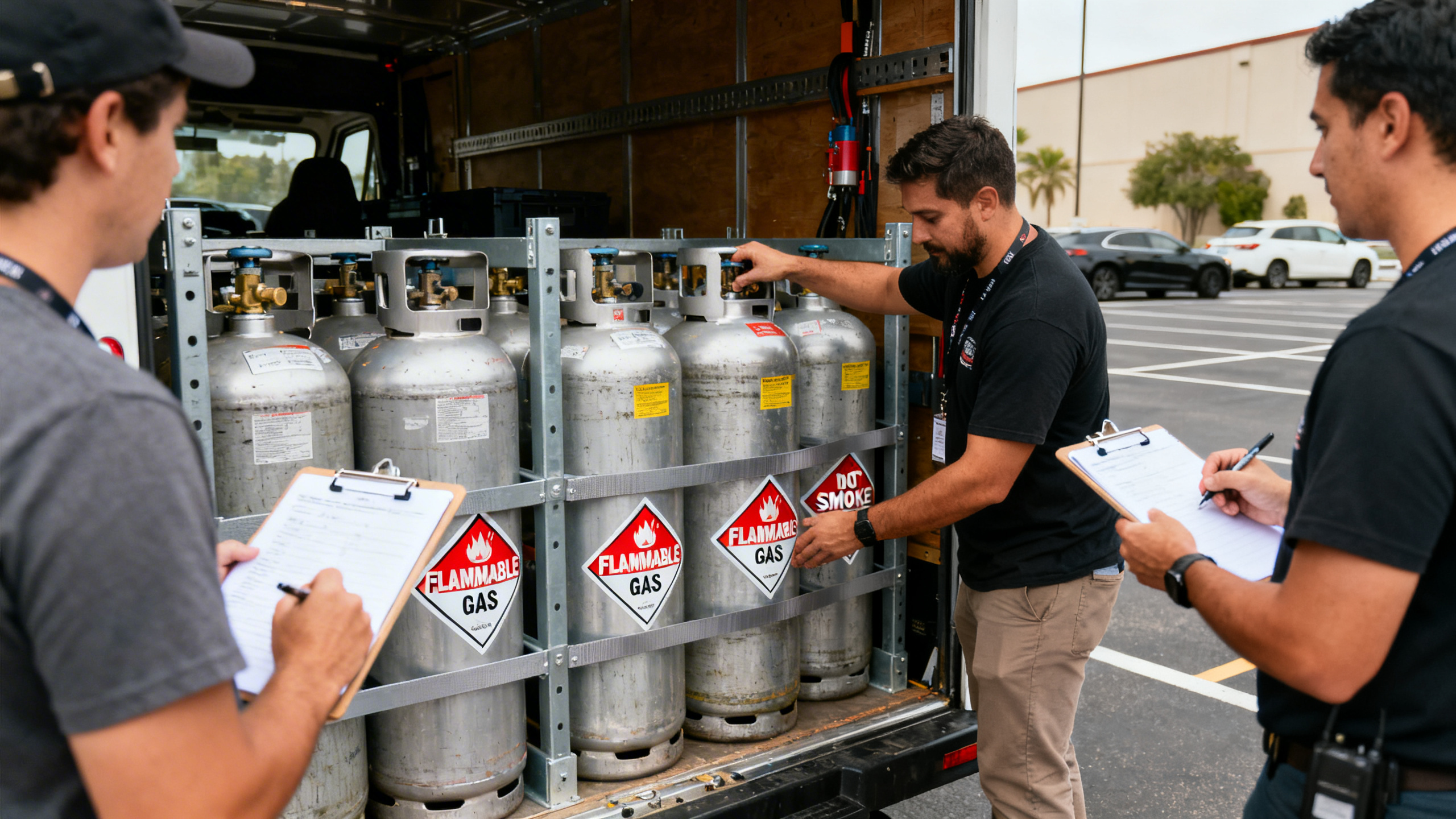
Pop-up tastings and on‑premise THC‑drink service often use compressed carbon dioxide for carbonation, keg pushing, or draft-style dispensing. That operational detail becomes a transportation and event-compliance issue the moment a cylinder is offered for transport, loaded, unloaded, or moved between venues as part of your activation.
In the United States, once CO2 cylinders enter commerce, the U.S. Department of Transportation’s Hazardous Materials Regulations (HMR) (49 CFR Parts 171–180) can apply—separately from facility safety obligations under OSHA and fire code requirements under the International Fire Code (IFC) or NFPA 55. Event teams frequently focus on the beverage service and overlook “back-of-house” logistics: cylinder qualification dates, shipping papers, carrier acceptance rules, and who needs hazmat training.
This guide is informational only (not legal advice). It’s designed as a 2025–2026 playbook for U.S. beverage activations using UN1013 carbon dioxide cylinders.
When DOT/HMR applies to CO2 cylinders at beverage events
If you control or influence any step of transportation—packing a cylinder into a van, handing it to a courier, or signing a delivery receipt—you may be acting as an offeror and/or a hazmat employer under DOT rules.
Common activation scenarios that trigger DOT compliance include:
- A brand team transports full cylinders to a venue in a company vehicle.
- A third‑party event production vendor picks up cylinders from a gas supplier and delivers them to a pop‑up.
- A venue requires you to bring your own draft system, including CO2 cylinders and regulators.
- You ship cylinders across state lines to a multi-city tour.
Under the HMR, carbon dioxide is typically regulated as UN1013, Carbon dioxide, a Division 2.2 (non‑flammable, non‑toxic gas). The key point: “non‑flammable” does not mean “unregulated.”
External reference: the official DOT/PHMSA eCFR portal for the HMR is here: https://www.ecfr.gov/current/title-49/subtitle-B/chapter-I/subchapter-C.
Classification basics: UN1013 and Division 2.2
For event draft systems, the relevant shipping description is usually:
- UN1013, Carbon dioxide, 2.2
Classification drives everything else: packaging/cylinder type, markings/labels, shipping papers, emergency response information, and (in certain cases) placarding.
For official text on Class 2 and cylinder shipment requirements, see 49 CFR Part 173 Subpart G, including §173.301: https://www.ecfr.gov/current/title-49/subtitle-B/chapter-I/subchapter-C/part-173/subpart-G/section-173.301.
Cylinder compliance: specification, condition, and requalification dates
For mobile beverage activations, the most common compliance failure is not “bad paperwork”—it’s an out-of-date or improperly marked cylinder.
What DOT expects on cylinders used in commerce
At a high level, when a cylinder is offered for transportation, it must be an authorized cylinder type and maintained per DOT requirements. The HMR has detailed rules in Parts 173 and 178, with ongoing maintenance/requalification rules in Part 180.
Event teams should verify:
- The cylinder bears an appropriate DOT specification marking (or UN pressure receptacle marking, if applicable).
- The cylinder shows a current requalification (hydrostatic test/inspection) marking.
- The valve is protected against damage during transport (caps/guards as required).
- No obvious defects: deep gouges, bulges, severe rust, illegible markings, damaged threads, or compromised valve protection.
Requalification intervals: plan for a 5-year rhythm unless you confirm otherwise
A widely encountered requirement for common aluminum cylinders (often marked DOT‑3AL) is hydrostatic re-test on a periodic cycle. 49 CFR §180.205 sets general requalification requirements, with requalification intervals and marking requirements managed in Part 180.
Official reference:
Practical takeaway for pop-ups:
- If you’re renting cylinders from a reputable gas supplier, they typically manage requalification. If you’re using “owned” cylinders, build a control: no cylinder goes on the truck unless the requal date is valid and legible.
Marking and labeling: what must be visible during transport
DOT has separate concepts:
- Marking (e.g., identification number, proper shipping name on packages)
- Labeling (hazard labels like “Non‑Flammable Gas”)
- Placarding (vehicle-level hazard signs)
For cylinders, the cylinder itself often carries required specification markings, and the hazard communication may also be carried via labels/marks on an outer package or overpack if one is used.
Non‑Flammable Gas (2.2) label expectations
Hazard labels are governed by 49 CFR Part 172 Subpart E.
Official reference:
Practical takeaway:
- If you are transporting cylinders as standalone items (not in an outer box), confirm with your gas supplier how the cylinder is labeled/marked for transport and whether additional marking is required for your mode (ground vs air).
“Limited quantity” is not your escape hatch for standard cylinders
Many teams assume “it’s small” means “it’s excepted.” But the HMR’s limited quantity relief for gases is targeted at aerosols and small receptacles—not typical beverage CO2 cylinders.
Official reference:
If you’re moving standard cylinders (5 lb, 20 lb, 50 lb, etc.), do not rely on limited-quantity assumptions without a formal determination.
Shipping papers: when you need them and what they must include
Shipping papers are governed by 49 CFR Part 172 Subpart C.
Official reference:
Baseline rule
Unless an exception applies, each person who offers a hazardous material for transportation must describe it on a shipping paper in the required format.
For many event moves, the biggest “gotcha” is that you may be both:
- the offeror (your team arranged transport and loaded the cylinders), and
- the carrier (you used your own van/truck and driver).
In those cases, you can’t assume the gas supplier’s invoice is “good enough.” You need a document that meets DOT shipping paper content rules.
What to include on the shipping paper for UN1013
A compliant shipping paper entry generally includes the basic description (in a required sequence) plus quantity and other required elements.
At minimum, plan for:
- UN1013
- Proper shipping name: Carbon dioxide
- Hazard class/division: 2.2
- Total quantity (number of cylinders and description/size)
- Emergency response telephone number when required
- Shipper/offeror certification when required
Because shipping paper details can vary based on packaging, mode, and whether any exceptions apply, many teams standardize a “CO2 cylinder transport form” that mirrors 49 CFR requirements and is reviewed by trained staff.
49 CFR Part 172 Subpart G requires emergency response information to be immediately available during transportation, and often ties that obligation to shipments requiring shipping papers.
Official reference:
Practical event takeaway:
- Keep ERI and the 24‑hour number accessible to the driver (paper or electronic, consistent with DOT expectations), and make sure it matches the material actually on board.
Hazmat training is governed by 49 CFR Part 172 Subpart H.
Official reference:
The key definition: “hazmat employee” is broader than “truck driver”
If a person’s job directly affects hazardous materials transportation safety, they may be a hazmat employee.
At beverage pop-ups, that can include:
- The operations lead who decides how cylinders will be transported.
- Staff who load/unload cylinders into vehicles.
- Anyone who prepares shipping papers or signs certifications.
- Drivers transporting cylinders as part of business operations.
Training components you should document
A compliant training program typically includes:
- General awareness/familiarization
- Function-specific training (what they actually do: load, secure, prepare papers)
- Safety training (hazards, incident response, PPE basics)
- Security awareness
- In-depth security training if a security plan is required for your operation
Also:
- Training must be documented and repeated at least every three years, and earlier if regulations change affecting their job function.
Securement in vehicles: blocking, bracing, and “don’t let it roll” rules
A cylinder rolling in a cargo van is both a safety hazard and a DOT compliance issue.
49 CFR §177.834 requires hazardous materials packages to be secured against shifting during transportation.
Official reference:
Practical securement standards for event vehicles:
- Use a purpose-built cylinder rack or a fixed, rated strap system.
- Keep protective caps/guards in place as required.
- Don’t transport with regulators attached unless your supplier’s guidance and your SOP explicitly allows it and it is protected.
- Separate cylinders from heavy objects that could impact valves.
- Keep the driver compartment protected from cylinder movement.
Many pop-up moves won’t hit placarding thresholds, but you need a process to confirm—not guess.
Placarding requirements are in 49 CFR Part 172 Subpart F. Table 2 materials (which include Division 2.2) generally require placards when the aggregate gross weight is 1,001 pounds or more, with important exceptions.
Official reference (threshold concept):
Practical takeaway:
- A single 50‑lb CO2 cylinder does not trigger placards. A box truck carrying many cylinders for a multi-stop activation might. Build a sign-off step in your dispatch SOP.
The “Materials of Trade” (MOT) exception: helpful, but not automatic
Many activation teams move cylinders in their own vehicles “for use at the job site.” That fact pattern may align with the Materials of Trade exception at 49 CFR §173.6.
Official reference:
MOT is nuanced. For Division 2.2 gases, the regulation includes conditions such as:
- the cylinder must conform to required packaging/qualification/maintenance rules, and
- quantity limits apply (e.g., a cylinder with gross weight not over 100 kg (220 lb) is referenced in §173.6).
Practical takeaway:
- MOT can reduce paperwork and some requirements for small, job-site related carriage, but it does not mean “no rules.” If you plan to use MOT, document your determination and train staff on exactly what it covers.
Carrier and venue reality: policies can be stricter than DOT
Even when DOT allows a shipment, carriers and venues can impose stricter terms.
Carrier acceptance rules (ground couriers, LTL, event freight)
Major carriers often require:
- pre-approval for hazardous materials shipping,
- use of trained shippers,
- specific packaging standards,
- correct documentation, and
- prohibited/limited items lists.
Start with carrier hazmat pages (examples):
For pop-ups, the safest approach is: assume you will not be able to “last minute” ship cylinders using standard parcel services unless you have an established hazmat program and carrier approval.
Venues and fire marshals (IFC/NFPA) may require permits and safety systems
DOT rules govern transportation; fire code governs on-site storage/use.
Many jurisdictions adopt IFC provisions for CO2 beverage dispensing systems. A commonly cited fire-code trigger is an operational permit for beverage dispensing systems using more than 100 pounds of CO2.
Illustrative code and guidance references:
NFPA reference:
Practical venue takeaway:
- Your venue may require ventilation, gas detection/alarm, signage, and a permit depending on CO2 quantity and whether cylinders are stored in enclosed/low-lying spaces.
2025–2026 playbook: contract clauses and SOP building blocks
Operationally, the strongest compliance programs treat CO2 logistics like a mini “hazmat lane” with standard controls.
Vendor contracting controls (what to put in your CO2 and event vendor agreements)
Add contract language requiring:
- Supplier provides in-date, DOT-authorized cylinders and maintains requalification.
- Vendor provides delivery paperwork sufficient for DOT shipping paper needs, or clearly allocates who prepares shipping papers.
- Vendor confirms whether transport will be under Materials of Trade, standard HMR shipping, or a specialty freight model.
- Vendor maintains training records for employees performing hazmat functions.
- Vendor carries appropriate insurance and indemnifies for hazmat transportation violations tied to their acts/omissions.
Transport SOP (minimum elements)
Build a one-page SOP your teams can follow in the field:
- Cylinder acceptance inspection checklist (markings legible, requal date valid, valve protection intact)
- Load plan (upright/horizontal allowed by your rack system; no rolling)
- Securement method (racks/straps; no loose cylinders)
- Driver instructions (no unattended cylinders in extreme heat; keep papers accessible)
- Shipping paper/ERI packet location
- Incident procedure (leak, suspected valve damage, vehicle crash)
Documentation packet you can standardize
Many teams create a “CO2 transport binder” (physical or digital) containing:
- Shipping paper template for UN1013
- Emergency response information and 24‑hour phone procedure
- Training certificates for relevant staff
- Vendor contact list (gas supplier, emergency service, venue contact)
- Proof of cylinder rental/ownership chain (helps at inspections)
Use this as a pre-tour and per-event checklist. Tailor it to your operations.
Pre-tour (30–60 days before first event)
- Confirm your cylinder sourcing model: rental swap, direct delivery, or owned cylinders.
- Decide whether you will rely on Materials of Trade or full shipping papers for your internal moves; document the decision.
- Implement 49 CFR 172 Subpart H training for anyone who loads/unloads, prepares papers, or drives.
- Build your shipping paper + ERI templates and have them reviewed internally.
- Confirm carrier acceptance rules if any shipment will be tendered to a third-party carrier.
- Confirm each venue’s fire code process and whether an operational permit, ventilation, or detection/alarm is required (especially if total CO2 on site may exceed common thresholds such as 100 lb).
Load-out day (each event)
- Verify each cylinder is in-date and markings are legible.
- Confirm valve protection and no regulator damage.
- Secure cylinders in racks/straps consistent with §177.834.
- Complete shipping papers if required; ensure driver has ERI accessible.
- Confirm how many cylinders and total weight are on the vehicle; check placarding threshold logic.
On-site (venue arrival and setup)
- Coordinate with the venue’s safety lead/fire marshal contact.
- Store spare cylinders upright and protected from impact; keep away from egress routes.
- If indoors or in confined spaces, confirm ventilation/detection expectations under local code.
- Post required signage if the venue/AHJ requires it.
Post-event (return, swaps, and storage)
- Apply the same transport controls on the return leg.
- Document any cylinder damage and quarantine suspect cylinders.
- Retain shipping papers and training records per your retention policy.
Enforcement and “what goes wrong in real life” at activations
Pop-ups get flagged for a few predictable reasons:
- No trained hazmat employees even though staff are loading/unloading cylinders.
- Cylinders rolling loose in vans (securement failure).
- Confusion over whether the move was “private” (it usually isn’t if it’s business-related).
- Missing or incomplete shipping papers when required.
- Venue fire marshal stops service due to permit or quantity threshold issues.
The cost isn’t just citations. It’s lost event days, product spoilage, reputational damage with venues, and insurance complications after an incident.
Key takeaways
- UN1013 CO2 cylinders are commonly regulated under DOT as Division 2.2.
- Training under 49 CFR 172 Subpart H can apply to event staff—not just drivers.
- Shipping papers are required unless a specific exception applies; do not assume “small quantity” rules cover standard cylinders.
- Securement is a DOT requirement; treat racks/straps as mandatory.
- Fire code is separate from DOT: venues may require permits, ventilation, and gas detection depending on quantity and layout.
Next step: turn this into an auditable compliance program
If your 2025–2026 calendar includes multi-city beverage activations, don’t run CO2 logistics on tribal knowledge. Build a repeatable program with training, SOPs, vendor controls, and documentation.
For practical tools to operationalize cannabis compliance, event risk controls, and licensing/regulatory monitoring across jurisdictions, use https://cannabisregulations.ai/ to centralize requirements and maintain an inspection-ready posture.