


Sign Up
Ready to replace complexity with clarity?
Answer your real world compliance questions (limited time) and save thousands in legal fees and avoided fines.
Automate Compliance Today

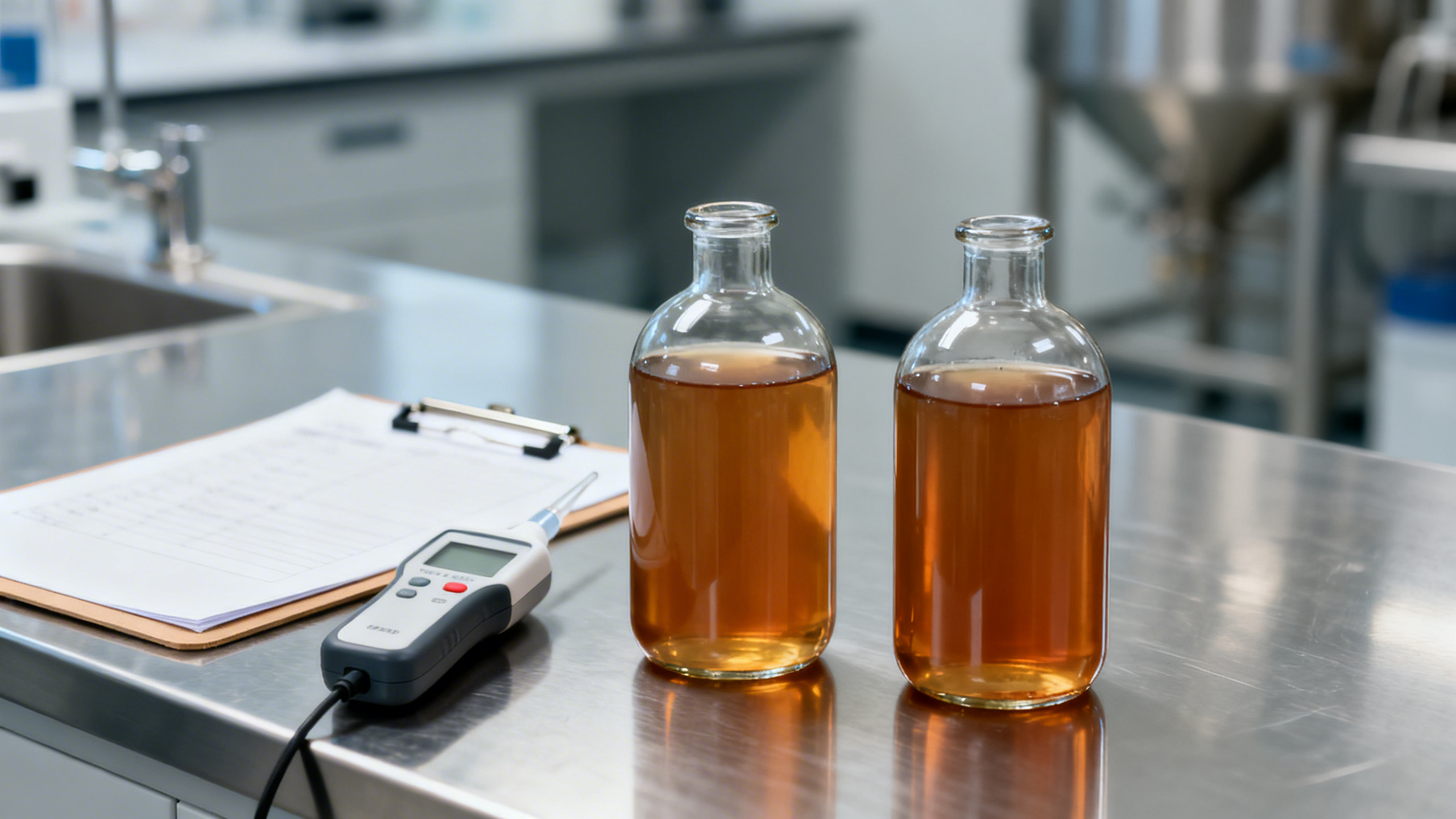
Kombucha is often positioned as a “better-for-you” sparkling beverage, and hemp-derived ingredients are frequently marketed as functional add-ons. Put them together and you get a compliance stress test.
In 2025, kombucha hemp regulation 2025 questions keep coming up for one reason: fermented drinks can drift above the federal 0.5% ABV line that triggers alcohol regulation, while hemp-derived cannabinoids can trigger state intoxicant rules, retail age gates, and even bans inside alcohol-licensed venues. The result is a product category where the same can may be treated like a food in one moment, an alcohol beverage in another, and a restricted adult product at the point of sale.
This article is informational only, not legal advice.
Most compliance teams treat “non-alcoholic” kombucha and “hemp beverage” compliance as separate tracks. In practice, they stack.
Under federal law, TTB jurisdiction turns on whether the kombucha is at or above 0.5% alcohol by volume (ABV) at any time—during production, when bottled, or at any time after bottling. TTB states plainly that if kombucha is 0.5% ABV or more at any time, it is an alcohol beverage subject to TTB regulations; if it is never at or above 0.5% ABV during production, at bottling, or after bottling, then TTB regulations do not apply and the product must comply with FDA requirements instead.
External link: https://www.ttb.gov/regulated-commodities/beverage-alcohol/kombucha
This is where kombucha is different from many other “NA” categories: refermentation risk in-package and in distribution can raise ABV after it leaves your facility, and TTB explicitly notes that scenario.
Even if a kombucha stays below 0.5% ABV, adding hemp-derived CBD or hemp-derived THC (or other cannabinoids) can:
At the federal level, the FDA continues to say that CBD and THC cannot be added to food or beverages in interstate commerce under the FD&C Act (with narrow exceptions for certain hemp seed ingredients). That doesn’t stop states from building their own in-state frameworks, but it does create enforcement and distribution risk.
External link: https://www.fda.gov/news-events/public-health-focus/fda-regulation-cannabis-and-cannabis-derived-products-including-cannabidiol-cbd
For a kombucha + hemp product, you should model ABV compliance as a lifecycle problem, not a single lab result.
A practical compliance map looks like this:
TTB resource hub: https://www.ttb.gov/regulated-commodities/beverage-alcohol/kombucha
Once you cross into TTB territory, you should expect additional layers such as:
TTB kombucha labeling FAQ: https://www.ttb.gov/kombucha/labeling
TTB explicitly warns that if kombucha is bottled under 0.5% ABV but later increases to 0.5% ABV or more due to continued fermentation in the container, TTB rules still apply.
External link (TTB kombucha general resources): https://www.ttb.gov/regulated-commodities/beverage-alcohol/kombucha/kombucha-general
For hemp-infused kombucha brands, that risk becomes more consequential because:
If your business model relies on staying below 0.5% ABV, your QA program should be built to defend that claim.
Regulators care about what happens after bottling. Consider controls such as:
TTB also provides a page on testing methods for kombucha alcohol content:https://www.ttb.gov/regulated-commodities/beverage-alcohol/kombucha/testing-methods
If your can says “non-alcoholic” (or similar language), but you don’t control cold chain and ABV drift, you’re creating a mismatch between:
That mismatch is where enforcement, retailer delistings, and insurance disputes tend to cluster.
Even when kombucha is legally a food, hemp-derived cannabinoids often push products into 21+ merchandising for three reasons:
Many hemp beverage brands also stumble on claims. FDA warning letters repeatedly focus on products that are:
Example FDA update on warning letters for CBD foods/beverages: https://www.fda.gov/food/hfp-constituent-updates/fda-warns-companies-illegally-selling-food-and-beverage-products-contain-cbd
For compliance teams, the takeaway is simple: formulation, labeling, and marketing have to be coordinated.
When a kombucha operation makes both:
…you can’t treat it as a single uniform beverage plant from a compliance perspective.
Many brands end up needing:
Some businesses explore “alternating premises” concepts when different regulated activities occur in the same physical space at different times. Federal regulations include record concepts for alternating premises in certain contexts.
Reference (federal regulation text): https://www.law.cornell.edu/cfr/text/27/19.627
Because eligibility and implementation depend heavily on facts and permits, this is an area where operators should plan early and document workflows rigorously.
A true 50-state analysis would be lengthy, and states change fast. Below is a high-signal snapshot of major states with clear agency statements or formal programs that affect whether alcohol-licensed businesses can stock hemp beverages—and how “intoxicating” definitions reshape formulation decisions.
California’s Department of Alcoholic Beverage Control has been enforcing CDPH emergency regulations that prohibit the sale of industrial hemp food and beverage products with a detectable level of total THC or other intoxicating cannabinoids at ABC-licensed locations.
External links:
Business takeaway: If you sell through bars, restaurants, or liquor stores in California, “detectable THC” is a bright line risk. “Hemp-derived” on the label does not solve that.
Massachusetts agencies issued a joint notice (DPH/MDAR) that it remains unlawful to manufacture or sell food/beverages with hemp-derived CBD or THC, and the ABCC advised that this also applies to alcoholic beverages on licensed premises.
External link (ABCC advisory PDF download page): https://www.mass.gov/doc/abcc-advisory-regarding-food-and-beverages-containing-hemp-derived-cbd-andor-thc-on-licensed-premises/download
Business takeaway: If you are distributing into Massachusetts alcohol channels, assume high enforcement sensitivity.
Oregon’s OLCC guidance indicates that only non-alcoholic hemp-derived beverages may be sold, and that alcohol licensees and liquor agents generally can sell compliant hemp-derived beverages if they have the required hemp vendor license from the Oregon Department of Agriculture (ODA). OLCC also notes a Hemp Registry requirement beginning January 1, 2026 for certain THC/CBD beverages.
External link: https://www.oregon.gov/olcc/marijuana/Pages/Hemp-Beverage-Guidance.aspx
Business takeaway: Oregon is an example of a state trying to keep a controlled pathway open—expect paperwork (vendor licensing + registry checks) and tighter labeling standards.
Washington’s WSLCB explains that outside of licensed retail stores, CBD cannot be added to orally ingestible products like foods or beverages.
External link: https://lcb.wa.gov/hemp/what_to_know
Business takeaway: General retail (including alcohol-licensed premises) should treat ingestible CBD/hemp beverages as high risk in Washington.
Connecticut DCP guidance states that THC-infused, hemp, or hemp-derived beverages are permitted only in licensed cannabis retail establishments and package stores with an endorsement, with key potency/container rules.
External link: https://portal.ct.gov/dcp/liquor-control-division/january-2024-hemp-thc-guidelines
Business takeaway: If you’re selling through alcohol channels in Connecticut, your partner may need a specific endorsement and your SKU may need to meet mg-per-container and minimum volume thresholds.
Minnesota’s Office of Cannabis Management (OCM) describes lower-potency hemp edible products (including beverages) with limits of 5 mg THC per serving and 50 mg per package, and notes an October 2025 license application window for businesses to continue selling.
External link: https://mn.gov/ocm/consumers/lphe-products/index.jsp
Business takeaway: Formulation teams must design to mg limits, while commercial teams must confirm retailer licensing status and ongoing eligibility.
Iowa HHS published compliance materials describing 4 mg THC per serving and 10 mg THC per container limits (using a calculation that includes THCa via the 0.877 factor) and prohibitions on certain synthetic cannabinoids.
External link (HF 2605 FAQ PDF): https://hhs.iowa.gov/media/13506/download?inline
Business takeaway: For beverages, your label claim and formulation must match Iowa’s THC calculation method; a COA alone is not enough if it’s calculated differently.
Virginia law restricts retail sales of substances for human consumption that exceed 0.3% total THC and/or exceed 2 mg total THC per package unless the product meets a 25:1 CBD-to-THC ratio condition, and requires a regulated hemp product retail facility registration.
External links:
Business takeaway: Virginia is a state where “intoxicating” is addressed through total THC and mg caps, not just delta-9 dry-weight logic.
Texas has moved through TABC rulemaking affecting how TABC license holders handle consumable hemp products, including age restrictions and verification requirements.
Background reporting (for context): https://www.texastribune.org/2026/01/20/texas-tabc-hemp-rules-finalized/
Business takeaway: In Texas, your hemp beverage retail pathway may depend heavily on whether the store also holds an alcohol permit—and how the state enforces age checks.
Georgia’s Department of Revenue Alcohol & Tobacco Division issued a policy bulletin stating that only hemp vapor products can legally be sold in retail package liquor stores, referencing statutory changes.
External link (GA DOR policy bulletin PDF): https://dor.georgia.gov/document/document/atd-policy-bulletin-2025-01-overview-restriction-hemp-products-retail-package/download
Business takeaway: Even if general retail can sell certain consumable hemp products, liquor store channels may be separately restricted.
If you distribute nationally, your product strategy usually needs at least two (and sometimes three) distinct compliance profiles:
The operational mistake brands make most often: trying to sell one SKU everywhere and “let the retailer decide.” That approach increases recalls, delistings, and enforcement risk.
For kombucha + hemp, conduct a pre-launch audit covering both ABV and hemp disclosures.
Across states, enforcement patterns are converging around a few themes:
If you’re launching (or already distributing) fermented “non-alcoholic” beverages with hemp-derived ingredients, you need a compliance system that can track ABV risk controls, state-by-state channel rules, labeling, and testing documentation—and update as states change.
Use https://www.cannabisregulations.ai/ to monitor regulatory updates, build state launch checklists, and pressure-test your kombucha + hemp rollout for compliance before a distributor or regulator does it for you.