


Sign Up
Ready to replace complexity with clarity?
Answer your real world compliance questions (limited time) and save thousands in legal fees and avoided fines.
Automate Compliance Today

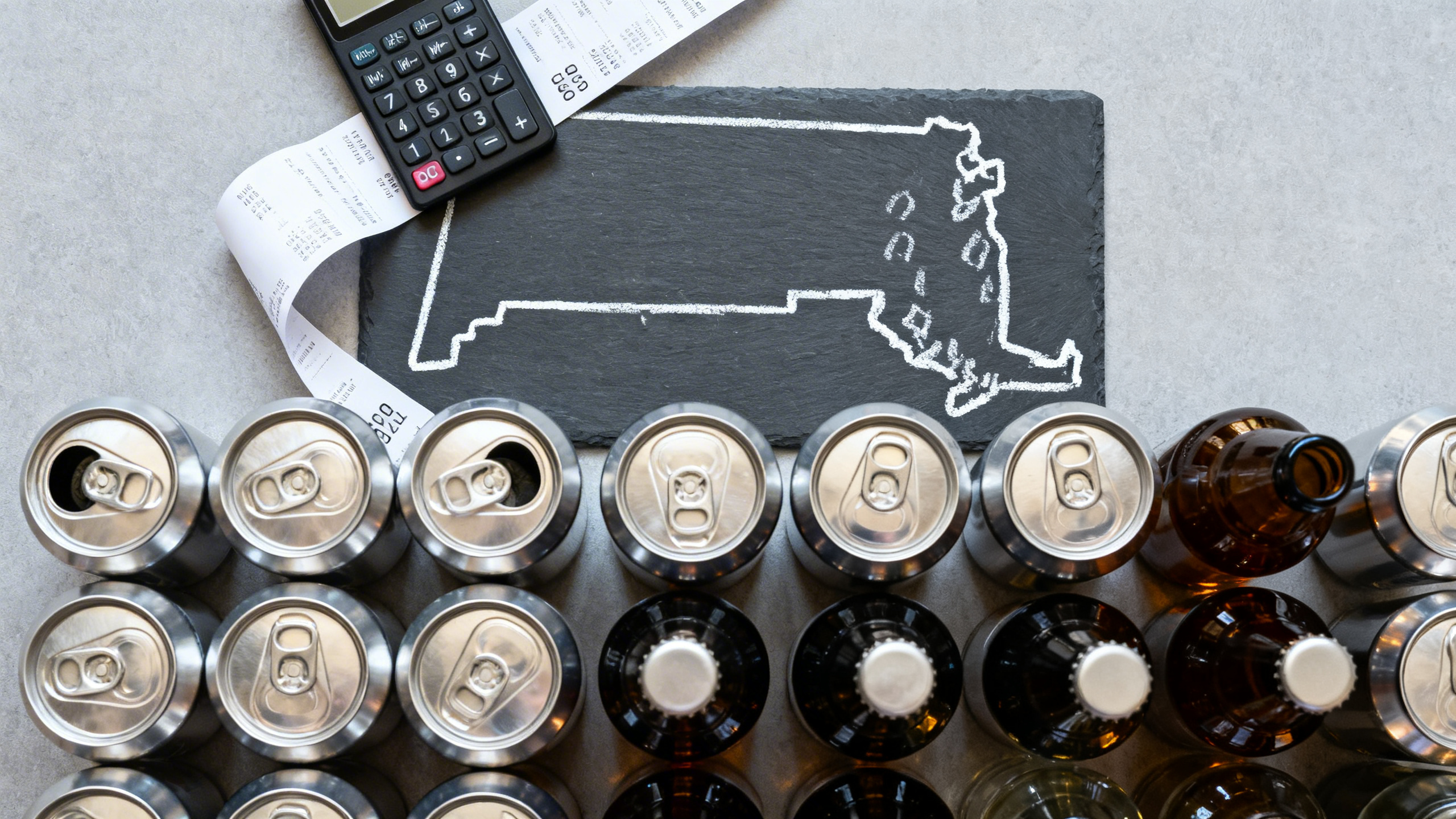
If you sell, distribute, or manufacture hemp-derived beverages in Massachusetts, a pending Beacon Hill reform package could reshape your 2026 pricing and compliance playbook. Among the most closely watched proposals: shifting oversight of intoxicating hemp-derived products to the Massachusetts Cannabis Control Commission (CCC) and adding a $4.05 per-gallon excise tax on hemp beverages—paired with tighter retail controls, including 21+ sales, retail registration, and enhanced labeling expectations.
This article models what a $4.05/gallon excise could do to common package sizes and typical retail price points, then translates those dollars into practical pass-through scenarios for off-premise and on-premise operators. It also highlights point-of-sale (POS) and back-office documentation changes that businesses should plan for—plus competitive pressures from nearby states.
Important: This post is informational only and not legal or tax advice. Always confirm applicability and implementation details in the final statute, regulations, and Department of Revenue guidance.
Massachusetts lawmakers have been debating multiple bills aimed at bringing intoxicating hemp-derived consumables under a clearer regulatory umbrella. Coverage of the 2025 legislative activity indicates that one approach would:
Industry reporting has pointed to the $4.05 per-gallon number as a deliberate policy signal: it mirrors a prominent Massachusetts alcohol excise rate category—making it easy for policymakers and regulators to communicate, and easy for tax systems to implement.
For reference, Massachusetts publicly lists alcohol excise tax rates on Mass.gov (including a category at $4.05 per gallon). See the Massachusetts DOR rate page: https://www.mass.gov/info-details/massachusetts-tax-rates and DOR’s alcohol excise overview: https://www.mass.gov/info-details/dor-alcoholic-beverage-excise-tax
Meanwhile, legislators and press coverage have emphasized public health and enforcement concerns, including products sold in general retail settings without consistent age gates or standardized labeling. Background reporting on the policy debate is summarized by Rhode Island Current (which closely covers Massachusetts policy, too): https://rhodeislandcurrent.com/2025/05/08/mass-legislators-push-for-more-forceful-action-on-intoxicating-hemp-derived-products/
A per-gallon excise is mechanically straightforward: tax = gallons × $4.05. The operational complexity comes from (1) converting package sizes into gallons and (2) deciding where and how the tax is embedded (wholesale vs. retail line item), which will determine margin effects and POS configuration.
Below are the math conversions you can use for rapid scenario planning:
Key takeaway for operators: A $4.05/gallon excise is “small” in rate terms but not small at the unit level. On a 12 oz can, ~$0.38 is enough to materially affect price-point strategy, especially in the $4.99–$7.99 range.
In Massachusetts, many businesses already understand alcohol excise taxes in practical terms: beer and wine excise rates are generally far lower per gallon than distilled-spirits-adjacent categories.
What makes the proposed hemp beverage excise noteworthy is its order-of-magnitude difference relative to beer and wine excises. A tax around $4.05/gallon is closer to certain higher-tax alcohol categories than to beer.
Why that matters:
For Massachusetts alcohol excise reference, use DOR’s pages: https://www.mass.gov/info-details/dor-alcoholic-beverage-excise-tax and https://www.mass.gov/info-details/massachusetts-tax-rates
Your unit economics depend on where the excise is imposed and who remits it (manufacturer, distributor, or retailer). Because legislative language can change, the safest way to plan is to test multiple pass-through scenarios.
Below are practical “what happens to the shelf price” examples for a 12 oz can with a modeled excise of $0.38.
Assumptions for illustration:
Result: You protect price-point, but margins compress sharply. This is usually unsustainable unless the product is a traffic driver or your wholesale cost drops.
Result: Less sticker shock, but you still give up margin or ask the brand/distributor to share the burden.
Result: Cleanest accounting, margin protected, but you risk a demand dip at sensitive thresholds.
Some retailers will treat the excise as part of “landed cost,” then apply normal markup, effectively passing through more than 100%.
Result: Improves margin stability but increases price gap versus neighboring states and other beverage alternatives.
To make this actionable, focus on threshold prices consumers recognize:
With a $0.38 excise on a 12 oz can, the risk zone is crossing from $4.99 → $5.49 or from $6.99 → $7.49. These are meaningful jumps (roughly 10% and 7%, respectively). If you’re trying to keep velocity, the pricing ladder strategy may matter more than the raw math.
Recommendation: Run 3 internal price decks now (0.5x, 1.0x, 1.25x pass-through) so your teams can react quickly if a bill advances.
Because the excise is linear with liquid volume, it doesn’t inherently favor one format. But markets aren’t purely mathematical—shopping behavior matters.
Pros:
Challenges:
Pros:
Challenges:
Practical insight: If the market becomes more price sensitive, multi-serve may become the primary way to keep perceived value strong, while single-serve becomes a sampling channel.
If Massachusetts implements a dedicated excise for hemp beverages, the compliance lift will likely show up first at the register and in receiving.
You should be ready for at least two implementation patterns:
1) Tax embedded in wholesale cost (like many excises): retailer sees higher cost, charges normal sales tax at checkout.2) Tax applied at retail (line-item excise): POS must calculate excise by volume per SKU.
If you have multiple can sizes and multi-packs, SKU-level configuration becomes critical. You’ll want:
Even if the retailer isn’t the remitter, expect increased documentation expectations. Prepare to store:
A major compliance risk in mixed-format retail is miscategorization. If the excise is only meant for intoxicating hemp beverages (as suggested by the policy intent), retailers will need defensible categorization rules to avoid:
Operational controls to consider:
Because Massachusetts enforcement priorities and definitions have been actively debated, you should assume definitions could be precise and enforcement could be complaint-driven. Track legislative updates via official sources like the Massachusetts Legislature’s bill portal: https://malegislature.gov/
Reporting on the reform discussions indicates policymakers are focused on:
Those controls will affect:
If oversight shifts to the CCC, businesses should watch for new CCC guidance and rulemaking notices at: https://masscannabiscontrol.com/ and the Commonwealth’s regulatory postings once promulgated.
Massachusetts operators near the border already plan around cross-border differences in product availability and pricing. A new per-gallon excise could widen the gap further.
Rhode Island regulators have been actively reviewing restrictions on hemp-derived THC drinks, with public discussion about where such beverages can be sold/served and what limits apply. See Rhode Island Current coverage (Feb 2026): https://rhodeislandcurrent.com/2026/02/02/cannabis-regulators-review-draft-restrictions-on-hemp-derived-thc-drinks/
What it means for MA retailers: If Rhode Island maintains easier access or lower total tax burden, MA border retailers may see customer leakage. If Rhode Island tightens rules, MA operators might gain demand—but only if MA pricing remains competitive.
New Hampshire’s broader approach to intoxicating hemp beverages is less uniform and can change with federal and state actions. Even absent a dedicated beverage excise, consumers may still seek lower “all-in” pricing across borders.
Arbitrage pressure points for 2026:
Mitigation strategies:
Once an excise exists, audit logic follows. Even if the remitter is upstream, your business may still be asked to demonstrate:
If you already operate in regulated excise categories (alcohol, tobacco, nicotine), reuse your best practices:
Until the proposal is finalized, the goal is readiness without over-committing.
A $4.05 per-gallon excise sounds abstract, but it equates to roughly $0.38 on a 12 oz can and $0.51 on a 16 oz can—large enough to shift shelf pricing, consumer demand, and cross-border competitiveness in 2026. The winners won’t be the businesses that guess the political outcome perfectly; they’ll be the ones that build flexible pricing ladders, clean product categorization, and audit-ready documentation.
To keep tracking the Massachusetts hemp beverage tax debate, licensing/registration requirements, labeling expectations, and compliance workflow updates, use https://cannabisregulations.ai/ for ongoing monitoring and compliance support.