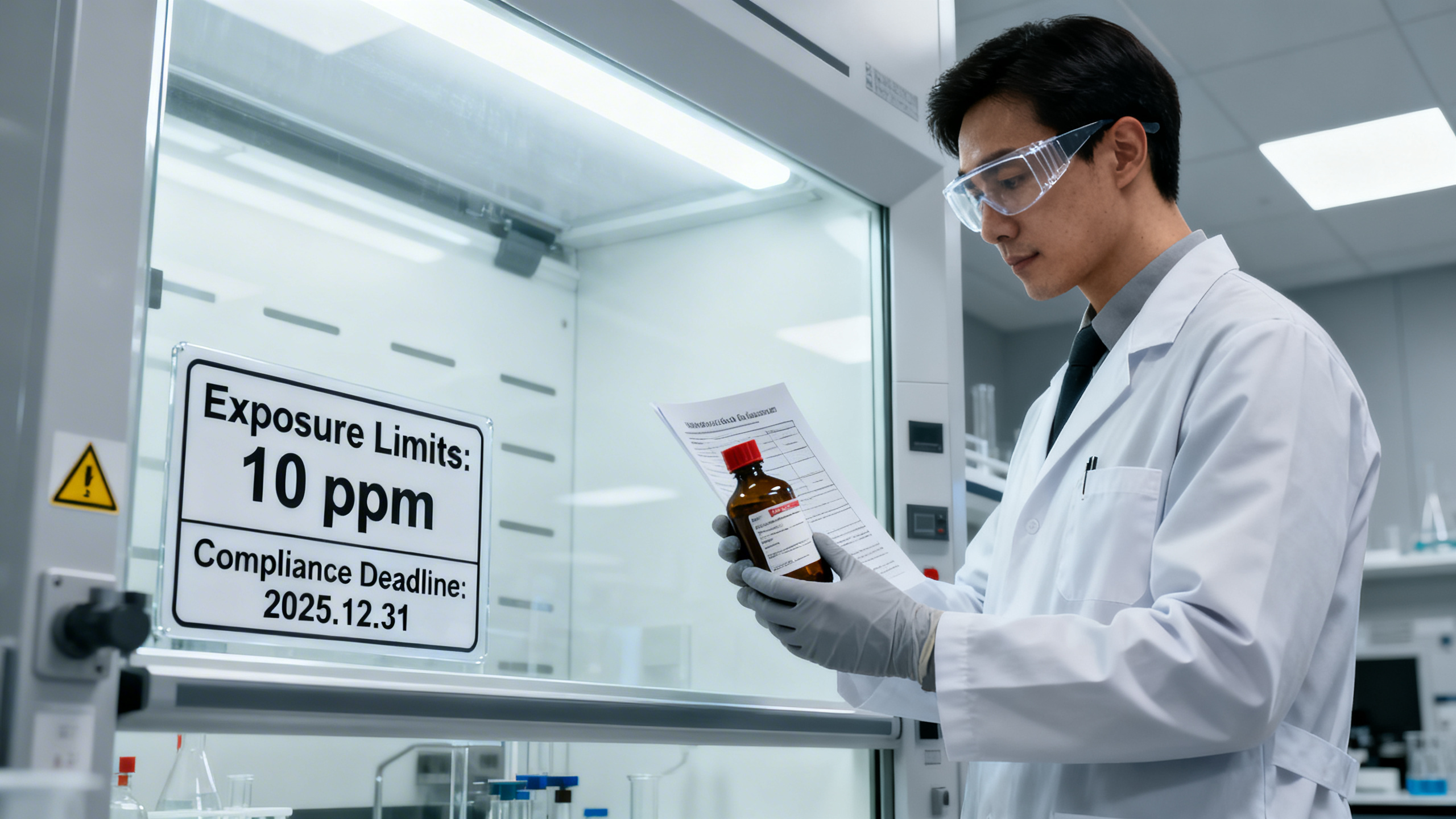
In 2024, the U.S. Environmental Protection Agency (EPA) finalized a major TSCA risk management rule for methylene chloride (also called dichloromethane or DCM). The rule largely removes methylene chloride from consumer markets and prohibits most industrial/commercial uses—while allowing only a narrow set of “conditions of use” to continue under a new, prescriptive Workplace Chemical Protection Program (WCPP).
For cannabis businesses, this matters even if you never buy drums of DCM for production. Many licensed operators interact with DCM indirectly through:
- Third-party testing labs that may use DCM in specific analytical methods, sample preparation, or instrument maintenance
- Extraction or post-processing facilities that historically used chlorinated solvents (or inherited legacy SOPs/equipment)
- Facilities and maintenance teams using DCM-containing cleaners, adhesive removers, or degreasers
The compliance picture is also shifting. In May 2025, EPA proposed to extend certain laboratory compliance dates into 2026–2027. Later updates (including EPA’s extension decision for non-federal labs) aligned lab timelines with federal laboratories and contractors.
This article explains what changed, which deadlines matter, what uses may still be allowed, and how labs/extractors should build solvent-alternative and method-validation plans for potency and contaminant testing.
Informational only, not legal advice.
What the EPA’s 2024 TSCA methylene chloride rule does (and why it hits labs first)
EPA’s TSCA Section 6(a) final rule addresses what EPA found to be unreasonable risk from methylene chloride across many “conditions of use.” In practical terms, the rule does two big things:
- Bans/phase-outs for all consumer uses and most industrial/commercial uses
- Creates a WCPP compliance pathway for a limited number of continued uses, including industrial and commercial use as a laboratory chemical
EPA also set a de minimis threshold—products/mixtures with methylene chloride below 0.1% by weight generally fall outside certain prohibitions.
Authoritative references:
Key deadlines: what changed from 2024 final rule to the 2025 proposal and 2025 extension
Cannabis operators should treat the timeline as two tracks:
- Supply chain / distribution prohibitions (these hit quickly and affect availability)
- Laboratory WCPP implementation (these are phased and, for non-federal laboratories, were extended)
Supply chain & market phase-outs (affect procurement and vendors)
These dates matter even if you only buy small bottles through lab supply catalogs.
- February 3, 2025: After this date, distribution in commerce to retailers is prohibited for any use (unless an allowed WCPP condition of use applies). Industry compliance summaries and university compliance bulletins commonly cite this date.
- May 5, 2025: After this date, retailers are prohibited from distributing methylene chloride (and methylene chloride-containing products) for any use.
- January 28, 2026: After this date, distribution in commerce is prohibited except for uses that continue under the WCPP.
- April 28, 2026: After this date, industrial/commercial use is prohibited except for those continuing under WCPP or other specified delayed prohibitions/exemptions.
These dates are widely summarized by reputable EHS and industry compliance sources, and they track to EPA’s final rule structure and EPA educational materials.
Laboratory WCPP deadlines (why 2026–2027 is the real crunch for testing)
Under the 2024 final rule, non-federal laboratories faced near-term WCPP deadlines in 2025. EPA later proposed and finalized an 18-month extension for the laboratory chemical condition of use.
EPA’s May 2025 proposal:
EPA’s 2025 extension update page (non-federal labs):
The extension (as described by EPA and summarized in the Federal Register extension notice) moves non-federal lab WCPP milestones to:
- Initial exposure monitoring by November 9, 2026 (for existing operations)
- Regulated areas and compliance with the exposure limits by February 8, 2027
- Exposure control plan implemented by May 10, 2027
Why this matters for cannabis testing contracts: if your lab vendor still uses DCM for any part of method workflow, they must build the monitoring/controls/recordkeeping program—meaning cost, scheduling, and potentially turnaround-time impacts.
What uses are still allowed—and where labs/extractors can get tripped up
A common misconception is that methylene chloride is simply “banned.” The actual compliance reality is more nuanced:
- Most industrial/commercial uses are prohibited on the phase-out timeline
- A limited list of conditions of use may continue only if the facility complies with WCPP requirements
- Some niche uses have delayed prohibitions or time-limited exemptions
The “laboratory chemical” pathway
EPA allows industrial and commercial use as a laboratory chemical to continue under WCPP. That includes many analytical and research uses, but it is not a free pass.
If a cannabis testing lab uses DCM for:
- sample extraction for certain analytes
- preparation steps tied to specific reference methods
- instrument cleaning/maintenance activities where DCM is used as a solvent
…then the lab must comply with WCPP obligations described below.
WCPP exposure limits are far lower than OSHA’s PEL
One reason labs are scrambling is that EPA’s WCPP sets an Existing Chemical Exposure Limit (ECEL) far below OSHA’s methylene chloride standard.
- EPA ECEL: 2 ppm (8-hour TWA)
- EPA STEL: 16 ppm (15-minute)
EPA’s ECEL list page (official): https://www.epa.gov/assessing-and-managing-chemicals-under-tsca/list-final-and-proposed-existing-chemical-exposure
OSHA’s methylene chloride standard for comparison: https://www.ecfr.gov/current/title-29/subtitle-B/chapter-XVII/part-1910/section-1910.1052
Even if a lab is compliant with OSHA’s PEL (25 ppm TWA), it may still be out of compliance with EPA’s WCPP.
Other delayed or exempted uses (watch for supply chain confusion)
The final rule includes delayed prohibitions for certain specialized uses (EPA presentations and the Federal Register discussion cite examples like specific aircraft/space/turbine adhesives/sealants and certain furniture refinishing categories) and a time-limited exemption connected to NASA emergency needs.
Cannabis businesses are unlikely to qualify for these, but they can still affect upstream supply chains and distributor behavior (i.e., suppliers changing catalogs, limiting shipments, or requiring certifications).
What cannabis labs must change: a practical TSCA compliance checklist
If you operate an in-house lab, manage QA/QC, or contract with third-party labs, here is the compliance work plan to run now.
1) Inventory DCM across the full facility—not just the lab bench
Start with an inventory that captures:
- pure methylene chloride bottles and ampoules
- mixtures and products that may contain DCM (cleaners, degreasers, adhesive removers)
- archived reagents and legacy SOP kits
- any DCM-containing standards or reference materials
Because the rule’s applicability often uses the 0.1% w/w threshold, you need concentration data—not just product names.
2) Map every DCM use case to a TSCA “condition of use”
Write down each task where DCM appears:
- analytical sample prep
- extraction steps (if any)
- cleaning glassware
- cleaning instrument components
- spot cleaning in production rooms
Then classify whether the use is:
- prohibited/being phased out
- allowed only under WCPP
If you can’t confidently map the use, that’s a red flag to escalate to EHS/compliance.
3) Update SDS libraries and HazCom training to reflect new restrictions
Even if DCM remains in your inventory temporarily, you should:
- ensure SDS versions match current supplier distributions
- update internal chemical hygiene plans and SOPs
- retrain personnel on revised handling, ventilation expectations, and disposal pathways
4) If DCM remains: build a WCPP program that can survive an audit
EPA’s compliance guide describes the WCPP elements in detail. At a high level, your program must include:
- an exposure monitoring strategy (personal breathing zone monitoring where applicable)
- determination of when a regulated area is required
- controls to meet ECEL/STEL (engineering controls first)
- respiratory/dermal protection decisions tied to monitoring and risk
- training and documentation
- recordkeeping and downstream notification requirements
Start with EPA’s compliance guide: https://www.epa.gov/system/files/documents/2024-07/mecl-compliance-guide.pdf
5) Vendor management: audit your third-party lab for TSCA methylene chloride compliance
If you contract testing, treat DCM like any other critical compliance risk.
Add these questions to your lab qualification packet:
- Do you use methylene chloride anywhere in analytical workflows, cleaning, or maintenance?
- If yes, which methods and matrices? What is the justification?
- Do you have a written WCPP for the laboratory chemical condition of use?
- What is your timeline to meet the extended milestones (Nov 9, 2026; Feb 8, 2027; May 10, 2027)?
- How are you meeting the 2 ppm ECEL and 16 ppm STEL requirements?
- What engineering controls are used (e.g., certified fume hoods, enclosures, closed systems)?
- How do you ensure cartridges/respiratory approaches are appropriate for DCM exposures (many programs require supplied-air depending on conditions)?
Document the answers and keep them with your vendor files. If a lab cannot provide a credible plan, assume there will be disruption before 2027.
Most modern regulated extraction operations do not rely on DCM as a primary process solvent. However, extractors can still be exposed to compliance risk through:
- legacy R&D SOPs
- solvent cleaning steps
- contract R&D labs
- maintenance products purchased by facilities teams
- Ban new procurement of DCM-containing products unless EHS approval is documented
- Review maintenance and sanitation chemical lists for DCM content
- Confirm waste handling procedures (DCM waste is typically hazardous waste; confirm your RCRA generator status and accumulation practices)
- If any DCM is used, prepare either to eliminate it or implement WCPP controls
Safer solvent alternatives: what to use instead (and how to avoid a “regrettable substitution”)
Replacing DCM isn’t as simple as swapping to the nearest solvent on a shelf. DCM is popular because it:
- is a strong solvent for many organics
- has a low boiling point
- is less flammable than many alternatives
But its health risks drive this TSCA action—and replacements must be evaluated for both analytical performance and worker safety.
Common alternative solvent families for labs
Depending on the method and analytes, labs often evaluate:
- Ethyl acetate (often used in extractions and chromatography solvent systems)
- Heptane/hexane blends (nonpolar; note flammability and worker exposure considerations)
- MTBE or 2-MeTHF (method dependent; requires compatibility and safety review)
- Ethanol, methanol, acetonitrile (common in LC-based workflows; each carries different hazards)
For general DCM replacement thinking and green-chemistry resources:
Important: “safer” depends on your context. Some alternatives increase fire risk, peroxide formation risk, or waste classification complexity. Substitute thoughtfully.
Validation plans for potency and contaminant testing when solvents change
Changing a solvent in sample prep can change recovery, selectivity, matrix effects, and instrument response. For regulated testing labs, that means you need a structured validation/verification plan.
When is a solvent change a “significant method modification”?
If you’re accredited (often ISO/IEC 17025) or follow state-mandated methods, swapping DCM for another solvent may be considered a significant modification requiring verification or validation.
Practical approach:
- If you use an established method and only change solvent: treat as at least a method verification
- If the solvent change alters extraction mechanics, cleanup, or detection: treat as a method validation
AOAC guidance on verification (useful for ISO 17025 contexts): https://www.aoac.org/wp-content/uploads/2019/09/ALACC-method-verification.pdf
Potency testing: ensure extraction efficiency and stability
For cannabinoid potency methods (typically LC-UV or LC-DAD / LC-MS variants), confirm:
- recovery across representative matrices (flower, concentrate, edible matrices as applicable)
- linearity/range
- precision (repeatability)
- accuracy (bias)
- robustness (small variations in time, temperature, agitation)
If a third-party lab is switching solvent to remove DCM, ask for:
- side-by-side comparison data (old vs new)
- matrix spike recoveries
- uncertainty estimate impacts
Contaminant workflows: watch for solvent-specific artifacts
For pesticide panels, residual solvents, and other contaminants:
- Ensure replacement solvents do not introduce co-elutions
- Confirm limits of quantitation remain fit for state action limits
- Re-check cleanup steps (SPE, dSPE/QuEChERS variations, etc.)
Residual solvent testing itself usually uses headspace GC methods and does not require DCM, but sample preparation steps or calibration workflows might.
Enforcement and business risk: what happens if you ignore TSCA methylene chloride compliance?
Even though cannabis is state-licensed, the methylene chloride rule is federal chemical regulation under TSCA. Noncompliance can create layered consequences:
- EPA enforcement exposure for regulated entities
- supply chain interruptions (vendors stop shipping)
- accreditation findings for labs (if safety and documentation controls are inadequate)
- business-to-business contract disputes (missed TATs, invalidated methods)
The biggest near-term risk for most operators is not an EPA inspector at the door—it’s losing a key lab vendor’s capacity during the 2026–2027 WCPP implementation period.
Action plan (2026 readiness checklist)
To stay ahead of the 2025–2027 window, set a structured internal program:
- Q1–Q2 2026: complete inventory + vendor attestation; identify any DCM dependencies in your testing menu
- Q2–Q3 2026: if DCM remains, schedule exposure monitoring and evaluate engineering controls before Nov 9, 2026
- Late 2026: finalize method changes and verification packages for any solvent substitutions
- Early 2027: ensure regulated areas/PPE decisions and ECEL/STEL compliance by Feb 8, 2027
- By May 10, 2027: ensure exposure control plans are implemented and fully documented
Takeaways
- The TSCA methylene chloride cannabis extraction compliance issue is real even when DCM is only used “in the lab.”
- Supply chain prohibitions begin in 2025 and tighten through January 28, 2026 and April 28, 2026.
- Non-federal lab WCPP deadlines were extended; key milestones now land on Nov 9, 2026, Feb 8, 2027, and May 10, 2027.
- EPA’s WCPP exposure limits (2 ppm TWA, 16 ppm STEL) are significantly more stringent than OSHA’s PEL—driving real operational changes.
- If you change solvents in analytical methods, plan for verification/validation and document comparability.
Next step: operationalize compliance tracking
If you manage a lab, extraction facility, or a multi-state operator’s QA program, you need a single place to track chemical restrictions, vendor compliance evidence, and method-change documentation.
Use https://cannabisregulations.ai/ to monitor regulatory updates, build compliance checklists, and standardize vendor qualification workflows across your organization.