

Sign Up
Ready to replace complexity with clarity?
Answer your real world compliance questions (limited time) and save thousands in legal fees and avoided fines.
Automate Compliance Today

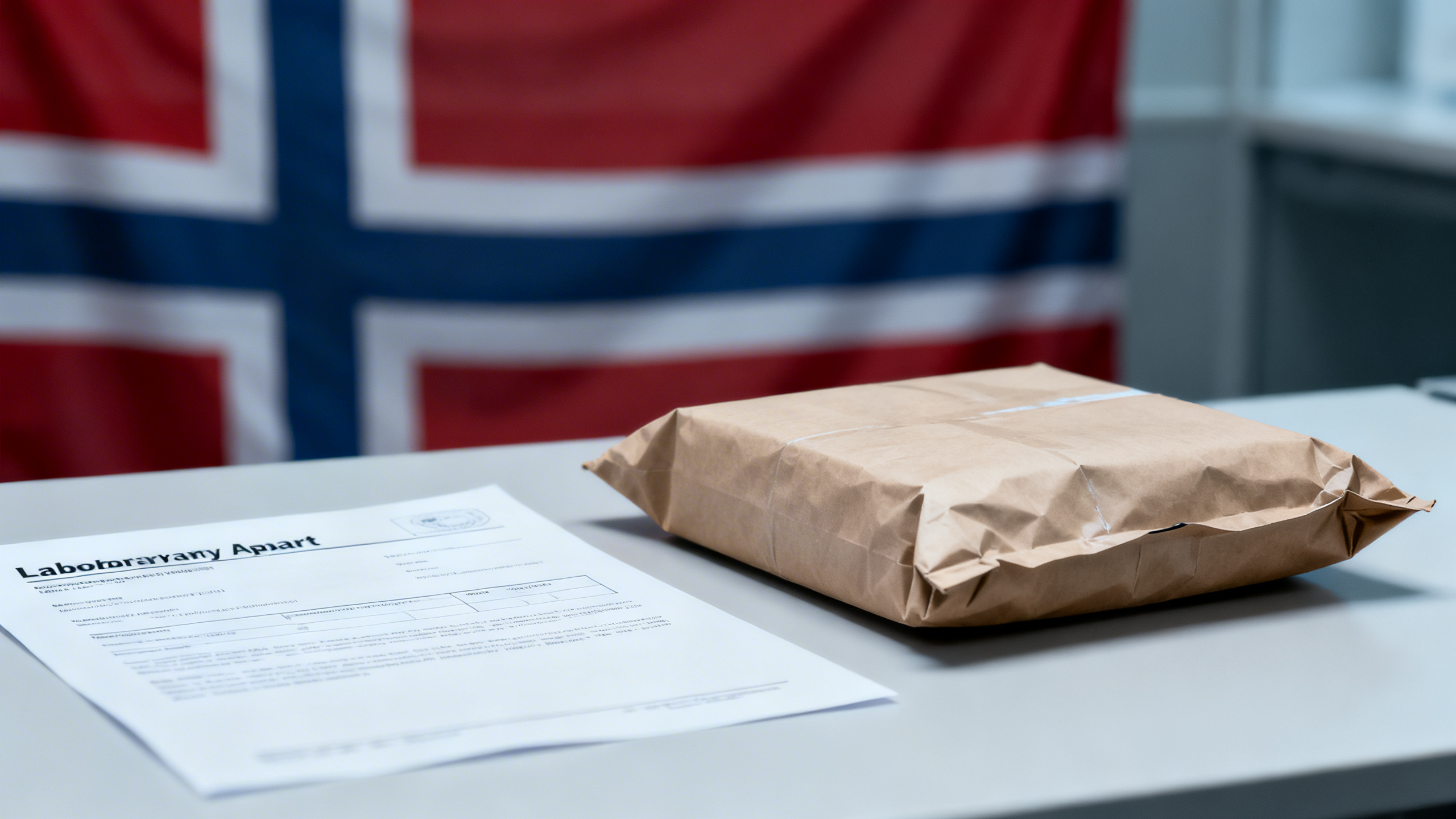
For companies trying to place CBD products into Norway in 2025, the practical rule is blunt: if a product shows THC (even trace), expect detention/seizure risk; and if it’s intended for ingestion, Novel Food and medicines classification hurdles can be determinative.
Norway is part of the EEA (so many EU food and consumer rules flow through), but it has maintained one of the region’s most restrictive positions on consumer CBD. As your research notes highlight, enforcement pressure remained high into September 2025, with continued detentions of online shipments where labs report any THC or where paperwork does not withstand scrutiny.
This article is informational only—not legal advice.
Norway does not have a single “CBD regulator.” Import outcomes depend on product category, intended use, and marketing claims.
If you are shipping into Norway, your first practical gatekeeper is Norwegian Customs (Tolletaten). Their public guidance on restricted goods is clear that medicines and supplements are sensitive categories and may require permits and compliance documentation.
External link: https://www.toll.no/en/goods/medicines-and-supplements/medicines-and-supplements
External link: https://www.toll.no/en/goods/medicines-and-supplements/importation-of-medicines-and-herbs
Even when a product is not explicitly marketed as a medicine, a shipment can be detained if:
If your product is a food or food supplement (e.g., oils, gummies, capsules, beverages), Mattilsynet is the competent authority for food compliance and import requirements.
Mattilsynet also confirms that the EEA health-claim framework applies in Norway through Regulation (EC) No 1924/2006; so unauthorized health claims are a compliance risk even where the ingredient itself is allowed.
External link: https://www.mattilsynet.no/en/food-and-beverages/regulations-on-food-supplements
External link: https://www.mattilsynet.no/en/food-and-beverages/nutrition-and-health-claims-in-the-eea
Importers of foodstuffs must understand importer obligations, including that the importer/first consignee is responsible for ensuring the consignment complies with Norwegian food rules, and that non-compliant goods can be refused.
External link: https://www.mattilsynet.no/en/food-and-beverages/commercial-import-of-foodstuff-to-norway
In 2025, the Norwegian Medicines Agency functions are under the Directorate of Medical Products (Direktoratet for medisinske produkter, DMP). DMP guidance for travelers makes clear that narcotic-containing medicines can be brought into Norway only under defined conditions and quantities with documentation.
DMP also publishes information about products frequently asked about under special permit/named patient, including that Epidyolex is an approved CBD medicinal product on the Norwegian market.
Even if you clear customs and product rules, advertising can still trigger enforcement. Norway’s Consumer Authority supervises compliance with consumer protection laws and marketing standards.
External link: https://www.forbrukertilsynet.no/english
For regulated products, conservative marketing is not optional—especially in influencer-led campaigns.
Across Europe, many markets use numerical THC allowances (e.g., 0.2% or 0.3% in certain contexts). Norway’s consumer CBD posture has been widely understood as a zero-tolerance approach in practice.
The operational issue for importers is that “0.00%” is not a chemical reality; it’s a measurement and enforcement reality:
So when Norway expects THC non-detect, the only defensible strategy is to treat “0.00% THC” as:
Norway implements the EU Novel Food framework (Regulation (EU) 2015/2283) through national rules referenced by Mattilsynet. In practice, this means that ingredients without a significant history of consumption before 15 May 1997 often require authorization prior to lawful marketing.
Mattilsynet explicitly references the Novel Food regulation framework in its food supplements guidance.
External link: https://www.mattilsynet.no/en/food-and-beverages/regulations-on-food-supplements
At the EU level, the European Commission’s Novel Food Catalogue is often cited as the reference point for how cannabinoids are treated as novel foods.
External link: https://ec.europa.eu/food/food-feed-portal/screen/novel-food-catalogue/search
Even outside Norway, the Novel Food pathway has been slowed by EFSA safety concerns and data gaps. In September 2025, EFSA published an updated safety statement and proposed an extremely low provisional safe intake level (widely reported as around 2 mg/day for a 70 kg adult equivalent), while noting persistent data gaps.
External link: https://www.efsa.europa.eu/en/news/provisional-safe-level-cannabidiol-novel-food
Practical takeaway: if your go-to-market plan assumes “Novel Food approval is imminent,” you should model timelines conservatively.
If your product is positioned as therapeutic (explicitly or implicitly), Norwegian authorities may treat it as a medicinal product. In that situation, the relevant pathway is not food law at all.
For physicians and importers looking at authorized medicine options, DMP notes Epidyolex as an approved CBD medicinal product in Norway.
For travelers, DMP guidance covers bringing certain controlled medicines into Norway with documentation and quantity limits.
Business takeaway: for most consumer brands, trying to market an ingestible CBD product in Norway without a credible Novel Food/medicines strategy is where seizures and enforcement exposure concentrate.
Norway import compliance is less about one magic document and more about a repeatable evidence system. If your focus keyword is Norway CBD 0.00% THC import 2025, this is the section that decides whether your shipments move.
At minimum, your batch COA package should:
Why it matters: if customs or another authority challenges your claim, the question becomes “ND at what LOQ?” not “did your label say 0.00%?”
Shipment holds often expose sloppy batch controls. Tighten:
If you are importing finished products, you still need upstream clarity. Maintain:
For Norway, many brands pivot to CBD isolate strategies to minimize contamination risk—but that does not automatically solve Novel Food or medicines classification.
Prepare a one-page technical spec that a border officer can understand:
For each shipment, have a digital pack ready:
This is the highest risk category because it intersects:
If you proceed here, expect heightened scrutiny and plan for detentions unless your Novel Food/medical pathway is robust.
Topicals may be more feasible than ingestibles, but they are not “unregulated.” Mattilsynet supervises cosmetics in Norway and publishes importer guidance.
External link: https://www.mattilsynet.no/en/cosmetics-and-body-care-products/importing-cosmetics-to-norway
Cosmetics must comply with EU/EEA cosmetics rules (including safety assessment and responsible person obligations). Also, marketing claims for cosmetics must remain cosmetic—avoid therapeutic language.
Norway’s nicotine/e-cigarette framework has been evolving, but CBD vapes raise additional regulatory questions (product safety, chemical classification, and potentially medicines/consumer protection issues). Unless you have a clear regulatory basis and specialist counsel, this is typically not the best first entry lane.
In strict jurisdictions, claims create the product. Even if your ingredient compliance is strong, claims can trigger medicines rules or consumer enforcement.
Steer clear of:
Mattilsynet summarizes that Norway applies Regulation (EC) No 1924/2006. If you cannot use an authorized claim, do not imply it.
External link: https://www.mattilsynet.no/en/food-and-beverages/nutrition-and-health-claims-in-the-eea
Your enforcement exposure increases when:
The Consumer Authority explains its role and the Marketing Control Act enforcement approach.
External link: https://www.forbrukertilsynet.no/english
Business takeaway: create a written claims matrix and influencer contract clauses that prohibit health/medical claims and require pre-approval.
When shipments are detained, outcomes may include:
For broader illegality involving controlled substances, Norway’s Penal Code includes serious sanctions for unlawful import/handling of narcotics (general reference).
External reference: https://www.unodc.org/cld/es/legislation/nor/penal_code/part_ii_-_chapter_23/sections_231232/sections_231232.html
Separately, food law violations can carry administrative and criminal consequences. Norway’s Food Act (administered by Mattilsynet) provides for penalties for violations.
External reference (English translation PDF): https://bwcimplementation.org/sites/default/files/resource/NO_Food%20Act%20-%202003_EN.pdf
1) Decide your category: cosmetic/topical is often lower-risk than ingestible.2) Implement a THC ND release spec and require COAs with LOD/LOQ.3) Build a detention-ready documentation pack for every shipment.4) Audit labels and websites for medical/health claims and remove risky language.5) Prepare for enforcement: written SOPs for customs queries, sample retention, and corrective actions.
1) Assume parcels may be inspected; do not rely on “small shipment” invisibility.2) Tighten product pages: avoid claims, avoid “pharma-like” dosing language.3) Use conservative packaging and clear batch IDs.4) If you cannot demonstrate 0.00% THC (ND) with credible lab limits, do not ship.
Tolletaten provides general guidance on medicines and supplements for private individuals.
External link: https://www.toll.no/en/goods/medicines-and-supplements/medicines-and-supplements
Norway’s rules and enforcement priorities evolve, and outcomes often hinge on small documentation and testing details. For ongoing guidance on cannabis compliance, import documentation workflows, labeling reviews, and licensing/regulatory monitoring across Europe, use https://www.cannabisregulations.ai/ to build a defensible compliance program before your next shipment.