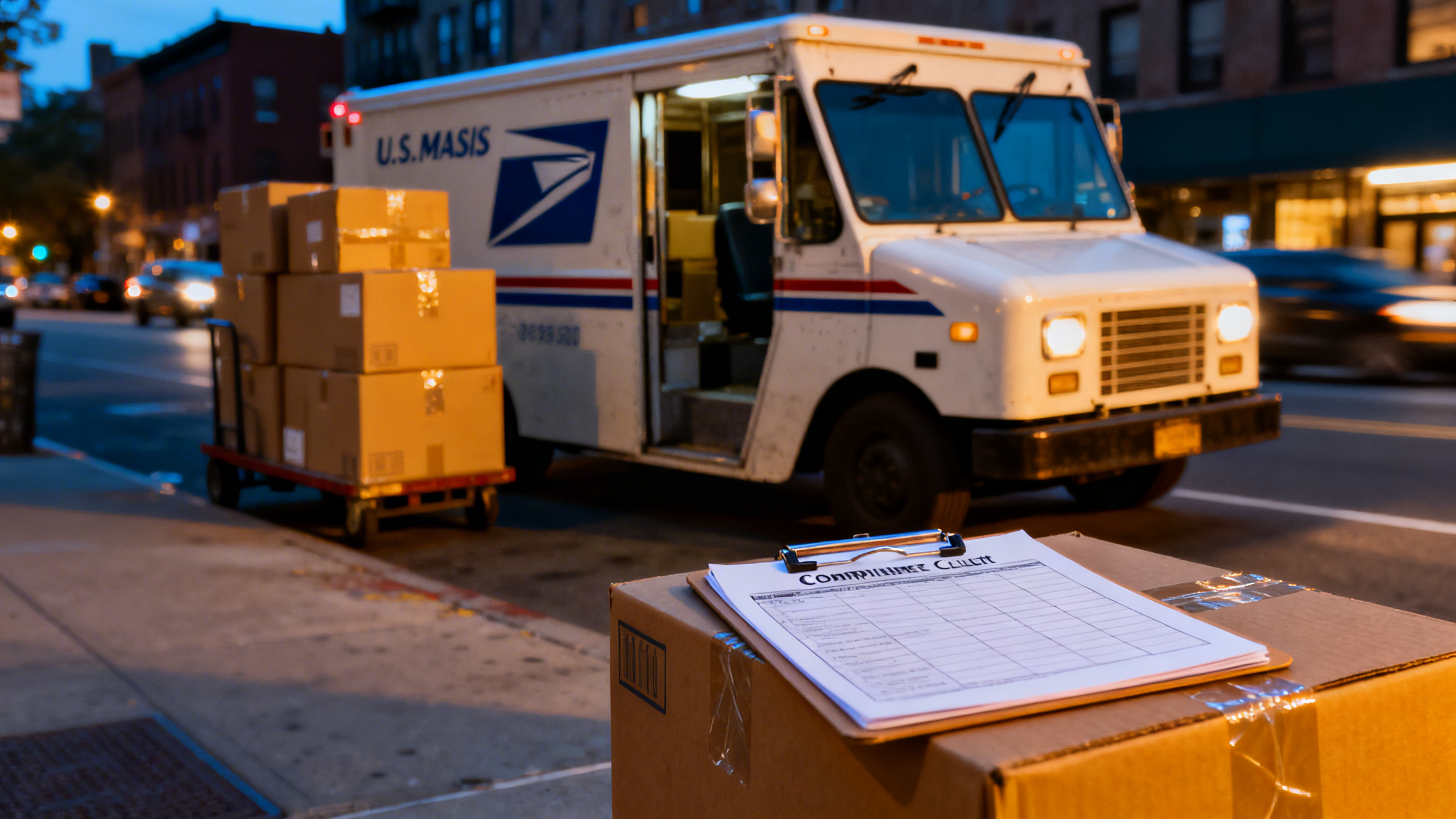
If Congress ever authorizes the U.S. Postal Service to carry state-legal cannabis, it would be one of the biggest operational shifts in modern cannabis commerce—potentially opening a nationwide “last‑mile” network that currently sits off-limits.
But even with a statutory carve-out, USPS cannabis shipping 2025 compliance would not be as simple as “put it in a box and drop it at the post office.” Operators would still have to navigate overlapping federal constraints (the Controlled Substances Act, the PACT Act mail rules for vaping products), plus a patchwork of state licensing, delivery, and track‑and‑trace requirements.
This article breaks down what a 2025 Senate proposal could change, what would remain illegal or highly restricted, and a practical decision tree and readiness checklist for brands planning e‑commerce or wholesale fulfillment—if federal law ever permits USPS carriage.
Informational only, not legal advice.
What the law says today: USPS generally cannot mail marijuana
Under current USPS standards, mailing marijuana is prohibited. USPS mailing standards (Publication 52) treat marijuana as a nonmailable controlled substance under federal law, and USPS employees and mailers are expected to comply with federal statutes governing controlled substances.
Key point for compliance teams: even state-legal cannabis is still “marijuana” under federal law unless and until federal scheduling changes or Congress creates a narrow postal exception.
External reference: USPS mailing standards are maintained by USPS and incorporated by reference in postal regulations (see USPS Publication 52 at https://about.usps.com/publications/pub52/).
The 2025 Senate concept: a USPS carve-out for state-legal cannabis
According to widely reported policy discussions in 2025, a Senate proposal would authorize USPS to transport cannabis that is legal under state, tribal, or territorial law. The core idea is a targeted federal permission for the postal service—without necessarily changing the Controlled Substances Act broadly.
If introduced and enacted, a bill like this would likely require USPS to develop:
- Eligibility rules (who can mail: licensed operators only vs. consumers)
- Permitted product categories
- Package acceptance and verification procedures
- Adult-signature delivery standards
- Audit trails and documentation
However, a USPS authorization does not automatically legalize:
- Interstate commerce in marijuana (CSA issues)
- Direct-to-consumer shipping (state law and federal rules may still restrict)
- Vape shipments (PACT Act constraints)
Practical takeaway: Treat “USPS may carry it” as a carrier permission layer, not a full legalization layer.
The big federal constraints that would still shape USPS shipping
Even with a postal carve-out, several federal frameworks would remain relevant.
Controlled Substances Act (CSA): scheduling and interstate commerce risk
The CSA still classifies marijuana as a Schedule I controlled substance (as of this writing). A USPS exception could be drafted narrowly (e.g., “USPS may accept and transport in compliance with state law”), but that raises immediate design questions:
- Does the exception apply only to intrastate shipments?
- Does it apply to licensed-to-licensed shipments only?
- Does it preempt or coexist with other federal enforcement provisions?
If the bill does not explicitly address interstate commerce, operators should assume that shipping across state lines remains the highest-risk scenario, particularly where the destination state’s licensing regime does not authorize receipt.
Federal reference: CSA framework is codified at https://uscode.house.gov/ (21 U.S.C. § 801 et seq.).
The PACT Act and ENDS: why vape products are the hardest category
Many stakeholders overlook that the postal system is already constrained by federal law for vaping products. The PACT Act, as amended in 2021, expanded rules governing “ENDS” (electronic nicotine delivery systems) to cover a broad set of vaping products and components.
For compliance planning, this is the key operational reality:
- USPS generally cannot ship vaping products to consumers.
- The law includes strict requirements around age verification, adult signature, and registration/reporting for covered shipments, and USPS implemented a broad prohibition with limited exceptions.
So even if USPS were authorized to carry state-legal cannabis, a separate fix might be required to permit vape cartridges, disposable vapes, and certain components through USPS.
Federal reference: PACT Act statute and amendments are available through Congress resources and the U.S. Code (15 U.S.C. § 375 et seq.) at https://uscode.house.gov/.
Why USPS could be uniquely useful vs. private carriers
Today, most major private carriers maintain policies that prohibit shipping marijuana products, even between licensed entities, because of federal illegality and internal risk controls.
In practice, this produces a bottleneck:
- Many operators rely on licensed in-state couriers or vertically integrated transport.
- Multistate operators typically move product only within each state’s regulated system.
If USPS were explicitly authorized, it could offer:
- Broad geographic reach (including rural routes)
- Standardized tracking and delivery confirmation
- Potentially lower-cost options for business-to-business logistics where state law allows
But: USPS would also likely impose strict acceptance standards—and could require account-based mailing, approved packaging, adult-signature services, and audit-ready documentation.
A practical compliance map: how to think about “allowed” shipping scenarios
If a USPS authorization passed, you would still need to evaluate every shipment through a layered compliance lens.
Layer 1: Is the shipment intrastate or interstate?
Intrastate (within the same state)
Intrastate shipping is the most plausible “first wave” use case because it can be aligned with:
- State licensing rules
- State delivery/transport permissions
- State track-and-trace reporting (where required)
Even then, states may restrict who can deliver and how transfers occur. Some states require that deliveries be conducted by a state-licensed delivery or transport licensee, and may not recognize USPS as an authorized delivery agent without regulatory updates.
Interstate (across state lines)
Interstate shipping is the most legally complex. A postal carve-out would need to be unusually explicit to make interstate shipments viable.
Minimum conditions that would likely be necessary:
- Destination state clearly authorizes receipt and sale
- Origin state authorizes export to out-of-state licensees
- USPS rules permit interstate routing for this category
- Clear federal safe harbor language
Compliance takeaway: Until federal law clearly allows interstate commerce, treat interstate USPS shipping as presumptively prohibited.
Layer 2: Who is shipping to whom?
Licensed business-to-business (B2B)
This is the most defensible scenario for an initial USPS program:
- Dispensary-to-dispensary (where allowed)
- Manufacturer-to-dispensary
- Distributor-to-retailer
Operationally, B2B also aligns better with:
- Controlled receiving docks
- Document retention
- Standard operating procedures (SOPs)
Direct-to-consumer (DTC)
DTC shipping raises additional issues:
- State prohibitions on mailing or common-carrier delivery
- Requirements for age-21 verification at purchase and at delivery
- Limitations on possession and purchase quantities
- Local jurisdiction “dry” rules or municipal opt-outs
Even if USPS were allowed federally, many states would still need to affirmatively authorize DTC delivery by mail.
Layer 3: What product type is it?
A USPS authorization, if enacted, could treat product categories differently.
Flower and pre-rolls
Possible, but likely subject to:
- Odor control and tamper evidence
- Quantity limits tied to state law
- Packaging that prevents exposure and leakage
Edibles and beverages
Likely to trigger:
- Food safety handling expectations
- Heat sensitivity controls and “melt risk” packaging
- Clear labeling and child-resistant standards (state-driven)
Concentrates and topicals
Often workable from a packaging standpoint, but high-potency products may face state-specific restrictions on serving size, potency, or SKU types.
Vapes
The hardest category because of the PACT Act/ENDS overlay. Expect either:
- A continued USPS ban for vapes, or
- A narrowly defined exception with strict registration, reporting, and adult-signature requirements
The shipping decision tree (operator-ready)
Use this decision tree to build SOPs and automation logic.
Step 1: Confirm legal eligibility
- Is the origin party a licensed entity authorized to transfer the product?
- Is the destination party licensed/eligible to receive (for B2B) or legally eligible (for DTC)?
- Does the state allow delivery by common carrier or mail?
If any answer is “no,” stop.
Step 2: Determine route legality
- Is this intrastate?
- If yes, proceed to Step 3.
- Is this interstate?
- If yes, proceed only if federal law explicitly permits and both states’ regulations clearly allow export/import.
Step 3: Screen product category restrictions
- If the shipment includes vape products or components, evaluate PACT Act/ENDS rules and USPS-specific prohibitions.
- Confirm product form and potency are legal in the destination jurisdiction.
Step 4: Select the required service level
Assume USPS will require something like:
- Adult Signature Required (21+)
- No parcel forwarding or restricted forwarding
- Trackable services and standardized barcode usage
USPS may also require account-based mailing with approved shippers and periodic audits.
Step 5: Build labeling and disclosure rules
Expect a tension between:
- Not making the package attractive to theft
- Providing enough information for USPS acceptance and audit
A likely approach is “neutral exterior” packaging with:
- Required shipper/recipient identifiers
- Internal documentation (packing slip / manifest)
- Any required regulatory disclosures inside the package (state-specific)
Never rely on “stealth shipping” to hide regulated goods. If USPS authorizes carriage, it will likely require truthful declarations under specified procedures.
Step 6: Recordkeeping and reconciliation
At minimum, build retention for:
- Order records and invoices
- License verification logs (B2B)
- Age verification logs (DTC)
- Chain-of-custody / handoff documentation
- Tracking numbers and delivery confirmation
- Exception handling (returns, refusals, seizures, losses)
Compliance expectations: age controls, ID checks, and delivery integrity
If USPS carriage were permitted, Congress and USPS would likely impose robust delivery safeguards.
Age-21 delivery controls
To reduce diversion risk, expect:
- Age gate at checkout for DTC
- ID verification (document + database verification)
- Adult signature at delivery
- Policies for failed delivery attempts (hold at Post Office, return to sender, no neighbor delivery)
Address and jurisdiction verification
Your systems should flag:
- Restricted ZIP codes (local bans, municipal opt-outs)
- PO boxes (may be disallowed depending on rule design)
- Campuses, federal property, or other restricted delivery points
Returns, forwarding, and undeliverable packages
USPS policies often allow forwarding of mail, but a regulated program could require:
- No forwarding
- Strict return-to-sender routing
- Controlled disposal procedures for non-recoverable parcels
Readiness checklist for e‑commerce brands and operators
If you are an operator or brand building toward compliant shipping, this checklist is a practical starting point.
Operational readiness
- Written SOPs for packing, handoff, and exception handling
- Employee training for fulfillment staff and compliance teams
- Secure storage and staged pick/pack controls
- Incident response plan for loss, theft, damaged parcels, or enforcement contact
Identity and age verification (KYC)
- Identity verification at account creation (risk-based)
- Age verification at checkout and again at delivery
- Fraud screening (velocity checks, device fingerprinting, payment risk)
Address verification and restricted-jurisdiction logic
- Address standardization (USPS address validation APIs)
- Restricted ZIP / jurisdiction rules engine
- Handling for military addresses, federal enclaves, and other special cases
Product compliance controls
- SKU-level mapping of product form (flower/edible/vape)
- State-by-state legality rules for potency, serving size, and packaging
- Batch/lot tracking and testing COA association
Packaging and labeling controls
- Tamper-evident packaging
- Child-resistant packaging where state law requires
- Climate considerations (heat packs/cold packs where permissible)
- Neutral exterior packaging if required
Tracking, audit trail, and documentation
- Unique shipment IDs tied to order IDs
- Carrier scanning events captured and retained
- Delivery confirmation and signature capture
- Retention schedule aligned to state requirements
Insurance and financial controls
- Shipping insurance or declared value strategy
- Claims SOPs and reconciliation
- Segregated inventory accounting for shipped goods
How this could interact with state track-and-trace systems
Even if USPS is federally authorized, many states require regulated inventory movement reporting in track-and-trace systems (e.g., METRC or BioTrack).
If USPS became a permitted carrier, states might require:
- A “transport manifest” equivalent tied to USPS tracking
- Reporting of departure/receipt times
- Verification that only authorized licensees ship/receive
If your state requires a manifest today, assume USPS shipments would need a manifest-to-tracking-number crosswalk to keep audits clean.
Enforcement risk: what could still go wrong
A USPS authorization would not eliminate compliance exposure. Common failure modes to plan for:
- Shipping into a jurisdiction where it is illegal or restricted
- Shipping product types excluded by the program (especially vapes)
- Inadequate age verification or signature compliance
- Incorrect or missing documentation
- Inventory reconciliation gaps (what left vs. what was delivered)
- Theft/diversion patterns that trigger carrier or regulator scrutiny
Build monitoring and escalation:
- Exception dashboards (lost, delayed, refused)
- Threshold alerts for repeat delivery failures
- Audit-ready logs and rapid response playbooks
Near-term strategy: plan for “phased permission,” not an overnight switch
If Congress advances USPS authorization, expect a phased rollout:
- Likely starting with licensed-to-licensed intrastate shipments
- Potential pilots, shipper registration, and compliance audits
- Gradual expansion (if any) to DTC or additional product categories
For operators, the competitive advantage will go to teams that already have:
- E‑commerce compliance infrastructure
- State-by-state rules engines
- Documented SOPs and training
Key takeaways
- A USPS authorization could be a major unlock, but USPS cannabis shipping 2025 compliance would still depend on CSA boundaries, state law, and PACT Act vape restrictions.
- The most realistic early use cases are intrastate, licensed B2B shipments with strict documentation and adult-signature delivery controls.
- DTC and vape shipping are likely to remain heavily constrained without additional federal and state changes.
- Invest now in verification, restricted-jurisdiction logic, audit trails, and incident response so you can adapt quickly if federal rules change.
Stay ready with CannabisRegulations.ai
USPS policy shifts, federal bills, and state delivery rules can change quickly—and the operational details (service levels, documentation, age verification, recordkeeping) are where compliance programs succeed or fail.
Use https://cannabisregulations.ai/ to track federal and state updates, build compliant SOPs, and stress-test your shipping workflows against evolving regulations and enforcement priorities.