June 29, 2026


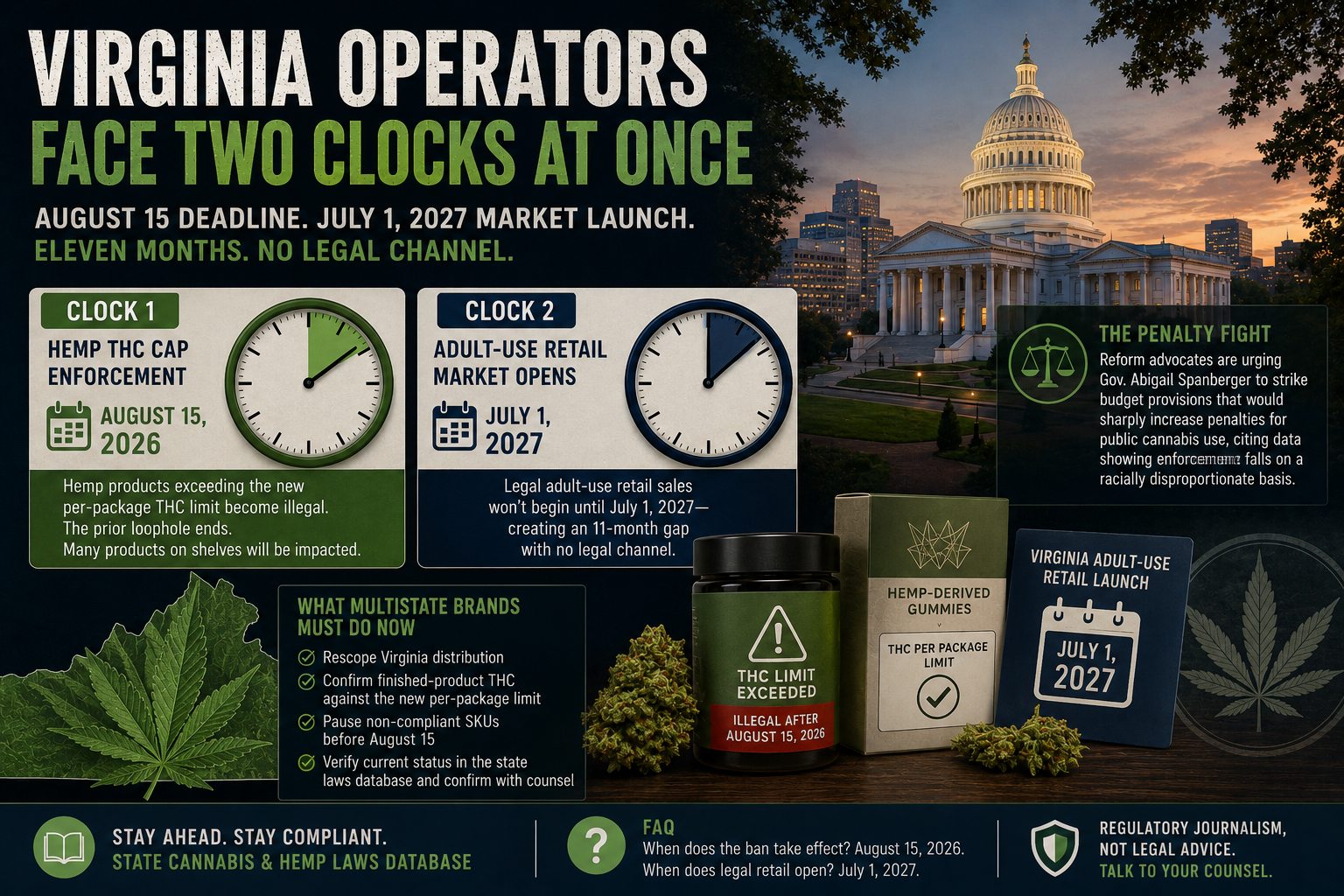
Virginia is heading toward a date that should worry every hemp operator selling into the state. On August 15, 2026, most hemp products that exceed the state's per-package THC cap are expected to become illegal. That is roughly eleven months before Virginia's adult-use retail framework allows legal cannabis sales to begin, which the state has set for July 1, 2027. The gap between those two dates is the heart of what operators are now calling Virginia's hemp cliff. For nearly a year, a large share of products that are legal today would have no legal channel in the state, and no licensed dispensary system ready to absorb them.
Reform advocates and many in the hemp industry argue the math is brutal. Critics say the per-package cap, as written, would render roughly 80 percent of currently legal hemp products illegal once it takes effect. At the same time, advocates are pressing Governor Abigail Spanberger to strike budget provisions that would sharply increase penalties for public cannabis use, pointing to data they say shows enforcement falls disproportionately on people of color. For businesses, the result is a compressed compliance window with two moving parts: a product cliff and a penalty fight, both converging on the same summer.
This article walks through what is established, what is still in flux, and what operators and multistate brands should be doing now. It is written for compliance officers, founders, distributors, and counsel who need to plan around a hard date without overreading the specifics. We hedge where the details are unsettled, and we point you to the places to verify current status before you act.
To understand the cliff, it helps to understand the road behind it. Virginia legalized simple possession of cannabis for adults in 2021, becoming the first Southern state to do so. But legalization of possession and the creation of a legal retail market are two very different things. For years, Virginia had the former without the latter. Adults could possess and, within limits, grow cannabis at home, yet there was no licensed store where they could legally buy it.
That stalled middle ground created a vacuum, and the hemp market rushed in to fill it. Products derived from hemp, often sold as containing only trace amounts of delta-9 THC on a dry-weight basis, proliferated in convenience stores, vape shops, and online. Many of these products are intoxicating in practice, even when they technically meet a federal hemp definition by weight. The result was a retail landscape where consumers could buy intoxicating hemp products almost anywhere, while a regulated adult-use cannabis market still did not exist.
Lawmakers have repeatedly tried to close that loop. The new framework heading toward 2027 retail sales is the latest attempt to build the licensed market Virginia has lacked since 2021. But sequencing matters. Tightening the hemp rules in 2026, well before licensed stores open in 2027, is what produces the interim gap that operators now have to navigate.
The core change is a per-package THC cap. Rather than relying solely on a dry-weight percentage, Virginia's approach centers on limiting the total amount of THC allowed in a single package. Products that exceed that per-package threshold are expected to lose their legal status in the state on August 15, 2026.
We are deliberately not citing an exact milligram figure or a specific bill number here, because the precise terms can shift through budget negotiations, technical amendments, and the governor's action. What is well established is the shape of the policy: a per-package cap, an effective date of August 15, 2026, and a market impact that critics estimate touches a large majority of currently legal products. If a product's total THC per package sits above the cap, the working assumption should be that it cannot be legally sold in Virginia once the rule takes effect.
That distinction between a percentage-based limit and a per-package milligram limit is the part many operators underestimate. A product can comply with a dry-weight percentage standard and still blow past a per-package cap, simply because the package is large or the serving count is high. The shift in measurement is what reshapes the shelf.
Behind the cliff is a national argument over so-called intoxicating hemp. The 2018 federal Farm Bill defined hemp by delta-9 THC content on a dry-weight basis. That definition, written before the current product landscape existed, did not anticipate concentrated edibles, beverages, and novel cannabinoids that can be intoxicating even at low dry-weight percentages.
States have responded in different ways. Some have effectively folded intoxicating hemp into their cannabis regulatory systems. Others have banned specific cannabinoids. Virginia's chosen lever is the per-package cap, which targets the total dose in a container rather than only the concentration. Supporters argue this closes a loophole that let intoxicating products reach shelves without the controls applied to licensed cannabis. Opponents argue it wipes out a legal, tax-paying industry overnight and leaves consumers with no regulated alternative until 2027.
For compliance planning, the policy rationale matters less than the mechanism. A per-package cap reshapes product design, packaging, distribution, and inventory math all at once. It is not a labeling tweak. It is a structural change to what a sellable unit looks like in the state.
Virginia's cliff does not exist in isolation. A separate federal pressure is building for late 2026. A federal hemp redefinition is associated with a roughly 0.4 milligram total-THC-per-container standard expected to take effect in November 2026. If that federal change lands as described, it would compress the national hemp market on a similar timeline, just months after Virginia's state-level cliff.
For multistate operators, the two deadlines stack. A product reformulated to survive Virginia's August cap could still be exposed to a far tighter federal per-container standard in November. Planning around only one of these dates risks solving for August while ignoring a more sweeping change weeks later. We cover the federal side in more depth in our analysis of the hemp regulatory cliff and the November 2026 deadline, and operators should read the two timelines together rather than separately.
The practical takeaway is to model both scenarios. If your roadmap assumes only Virginia changes, you may rebuild a product line twice. If you plan for the stricter of the two standards where feasible, you reduce the odds of a second scramble in the fall.
Running alongside the product cliff is a fight over penalties. Reform advocates are urging Governor Spanberger to strike budget provisions that would sharply increase penalties for public cannabis use. Their central argument is that enforcement of public-use rules has been racially disproportionate, and that ramping up penalties would deepen that disparity rather than address it.
This matters to operators for two reasons. First, the tone of enforcement shapes the environment in which a business operates, even a business that never touches public-use scenarios directly. Second, heightened penalties raise the stakes for any compliance misstep across the broader cannabis and hemp landscape in the state. A jurisdiction signaling tougher enforcement is a jurisdiction where ambiguity is more expensive.
Whether the provisions survive depends on the governor's action and the final budget. We are not predicting an outcome. The point for planning is that Virginia is simultaneously tightening product rules and debating tougher penalties, and both threads should inform how conservatively a business approaches the state in 2026.
Once the per-package cap takes effect, continuing to sell non-compliant products in Virginia is not a gray area. Products above the cap would be treated as illegal, and the exposure runs across the supply chain. Retailers holding non-compliant inventory, distributors moving it, and brands supplying it can all face risk depending on how the rules and enforcement priorities are framed.
The harder problem is the interim gap. Because licensed adult-use retail is not scheduled to open until July 1, 2027, there is no legal channel inside Virginia to absorb capped-out products during the roughly eleven-month window. That means operators cannot simply route inventory into a licensed dispensary system, because that system does not yet exist for these products. The realistic options are to rescope distribution out of the state, sell through before the deadline where lawful, or reformulate to fit under the cap.
Shipping is its own minefield. Moving hemp or THC products across state lines implicates carrier policies and a patchwork of state laws, and it is not a clean workaround. We walk through the carrier landscape in our guide to shipping hemp and THC products via UPS, FedEx, and USPS in 2026. Treat any plan to ship product out of Virginia as a compliance project in its own right, not a logistics afterthought.
For a multistate brand, the Virginia cliff is a portfolio question, not a single-SKU question. The first task is to identify which products in the catalog exceed the per-package cap as written, then map where those products are sold and how much inventory sits in or is bound for Virginia.
From there, the work splits into a few tracks. Distribution rescoping means deciding which products to pull from Virginia and where, if anywhere, they can lawfully go instead. Sell-through planning means calculating how much product can realistically clear shelves before August 15, 2026, without overshooting and stranding inventory. Reformulation means redesigning packages or dosing to fit under the cap, ideally with the stricter federal standard in mind so the work is not undone in November.
Documentation underpins all of it. Certificates of analysis, often called COAs, need to reflect total THC per package, not just concentration, so that compliance against a per-package cap can actually be demonstrated. Packaging and labeling must match the new measurement basis. Inventory systems should be able to flag which lots are compliant under which standard and in which state. None of this happens overnight, which is why the calendar pressure is real.
The following checklist is a planning aid, not legal advice. Adapt it to your own footprint and confirm every step against current Virginia rules and your counsel's guidance.
Because the specifics can move, treat published summaries, including this one, as a starting point rather than the final word. The most reliable approach is to confirm the operative statute and effective date directly, check whether the governor has signed, amended, or vetoed the relevant provisions, and review any guidance issued by the responsible Virginia agency. Where a milligram figure or bill number matters to a decision, pull it from the primary source rather than a secondary description.
Our state cannabis and hemp law database is built to help you track status across jurisdictions, but for a decision with this much exposure, primary sources and your own counsel should be the final check before you act.
Most hemp products that exceed the state's per-package THC cap are expected to become illegal to sell in Virginia on that date. Critics estimate the cap would affect roughly 80 percent of currently legal hemp products.
Virginia's framework sets adult-use retail sales to begin July 1, 2027. That is roughly eleven months after the hemp cap is expected to take effect, which is why operators describe the gap as a cliff.
The hemp rules tighten in 2026 while the licensed retail market is not scheduled to open until 2027. During that interim window there is no licensed dispensary channel inside Virginia to absorb products that exceed the cap.
A per-package cap limits the total amount of THC allowed in one package, rather than only the concentration by dry weight. A product can meet a percentage standard yet still exceed a per-package cap if the package is large or contains many servings.
A separate federal hemp redefinition is associated with a roughly 0.4 milligram total-THC-per-container standard expected in November 2026. For multistate operators, it stacks on top of Virginia's August cap, so planning should account for both deadlines.
Reform advocates are urging Governor Spanberger to strike budget provisions that would sharply increase penalties for public cannabis use, citing data they say shows enforcement is racially disproportionate. The outcome depends on the governor's action and the final budget.
Shipping hemp or THC products across state lines implicates carrier policies and varying state laws and is not a simple workaround. Any out-of-state shipping plan should be treated as its own compliance project and verified before use.
Check the operative statute and effective date directly, confirm the governor's action on the relevant provisions, and review any agency guidance. For high-exposure decisions, rely on primary sources and your counsel rather than summaries.
Sources: Marijuana Moment, June 26, 2026; Marijuana Moment, June 23, 2026.
This is regulatory journalism, not legal advice — talk to your counsel. Track current status in our state cannabis and hemp law database.
Virginia is heading toward a date that should worry every hemp operator selling into the state. On August 15, 2026, most hemp products that exceed the state's per-package THC cap are expected to become illegal. That is roughly eleven months before Virginia's adult-use retail framework allows legal cannabis sales to begin, which the state has set for July 1, 2027. The gap between those two dates is the heart of what operators are now calling Virginia's hemp cliff. For nearly a year, a large share of products that are legal today would have no legal channel in the state, and no licensed dispensary system ready to absorb them.
Reform advocates and many in the hemp industry argue the math is brutal. Critics say the per-package cap, as written, would render roughly 80 percent of currently legal hemp products illegal once it takes effect. At the same time, advocates are pressing Governor Abigail Spanberger to strike budget provisions that would sharply increase penalties for public cannabis use, pointing to data they say shows enforcement falls disproportionately on people of color. For businesses, the result is a compressed compliance window with two moving parts: a product cliff and a penalty fight, both converging on the same summer.
This article walks through what is established, what is still in flux, and what operators and multistate brands should be doing now. It is written for compliance officers, founders, distributors, and counsel who need to plan around a hard date without overreading the specifics. We hedge where the details are unsettled, and we point you to the places to verify current status before you act.
To understand the cliff, it helps to understand the road behind it. Virginia legalized simple possession of cannabis for adults in 2021, becoming the first Southern state to do so. But legalization of possession and the creation of a legal retail market are two very different things. For years, Virginia had the former without the latter. Adults could possess and, within limits, grow cannabis at home, yet there was no licensed store where they could legally buy it.
That stalled middle ground created a vacuum, and the hemp market rushed in to fill it. Products derived from hemp, often sold as containing only trace amounts of delta-9 THC on a dry-weight basis, proliferated in convenience stores, vape shops, and online. Many of these products are intoxicating in practice, even when they technically meet a federal hemp definition by weight. The result was a retail landscape where consumers could buy intoxicating hemp products almost anywhere, while a regulated adult-use cannabis market still did not exist.
Lawmakers have repeatedly tried to close that loop. The new framework heading toward 2027 retail sales is the latest attempt to build the licensed market Virginia has lacked since 2021. But sequencing matters. Tightening the hemp rules in 2026, well before licensed stores open in 2027, is what produces the interim gap that operators now have to navigate.
The core change is a per-package THC cap. Rather than relying solely on a dry-weight percentage, Virginia's approach centers on limiting the total amount of THC allowed in a single package. Products that exceed that per-package threshold are expected to lose their legal status in the state on August 15, 2026.
We are deliberately not citing an exact milligram figure or a specific bill number here, because the precise terms can shift through budget negotiations, technical amendments, and the governor's action. What is well established is the shape of the policy: a per-package cap, an effective date of August 15, 2026, and a market impact that critics estimate touches a large majority of currently legal products. If a product's total THC per package sits above the cap, the working assumption should be that it cannot be legally sold in Virginia once the rule takes effect.
That distinction between a percentage-based limit and a per-package milligram limit is the part many operators underestimate. A product can comply with a dry-weight percentage standard and still blow past a per-package cap, simply because the package is large or the serving count is high. The shift in measurement is what reshapes the shelf.
Behind the cliff is a national argument over so-called intoxicating hemp. The 2018 federal Farm Bill defined hemp by delta-9 THC content on a dry-weight basis. That definition, written before the current product landscape existed, did not anticipate concentrated edibles, beverages, and novel cannabinoids that can be intoxicating even at low dry-weight percentages.
States have responded in different ways. Some have effectively folded intoxicating hemp into their cannabis regulatory systems. Others have banned specific cannabinoids. Virginia's chosen lever is the per-package cap, which targets the total dose in a container rather than only the concentration. Supporters argue this closes a loophole that let intoxicating products reach shelves without the controls applied to licensed cannabis. Opponents argue it wipes out a legal, tax-paying industry overnight and leaves consumers with no regulated alternative until 2027.
For compliance planning, the policy rationale matters less than the mechanism. A per-package cap reshapes product design, packaging, distribution, and inventory math all at once. It is not a labeling tweak. It is a structural change to what a sellable unit looks like in the state.
Virginia's cliff does not exist in isolation. A separate federal pressure is building for late 2026. A federal hemp redefinition is associated with a roughly 0.4 milligram total-THC-per-container standard expected to take effect in November 2026. If that federal change lands as described, it would compress the national hemp market on a similar timeline, just months after Virginia's state-level cliff.
For multistate operators, the two deadlines stack. A product reformulated to survive Virginia's August cap could still be exposed to a far tighter federal per-container standard in November. Planning around only one of these dates risks solving for August while ignoring a more sweeping change weeks later. We cover the federal side in more depth in our analysis of the hemp regulatory cliff and the November 2026 deadline, and operators should read the two timelines together rather than separately.
The practical takeaway is to model both scenarios. If your roadmap assumes only Virginia changes, you may rebuild a product line twice. If you plan for the stricter of the two standards where feasible, you reduce the odds of a second scramble in the fall.
Running alongside the product cliff is a fight over penalties. Reform advocates are urging Governor Spanberger to strike budget provisions that would sharply increase penalties for public cannabis use. Their central argument is that enforcement of public-use rules has been racially disproportionate, and that ramping up penalties would deepen that disparity rather than address it.
This matters to operators for two reasons. First, the tone of enforcement shapes the environment in which a business operates, even a business that never touches public-use scenarios directly. Second, heightened penalties raise the stakes for any compliance misstep across the broader cannabis and hemp landscape in the state. A jurisdiction signaling tougher enforcement is a jurisdiction where ambiguity is more expensive.
Whether the provisions survive depends on the governor's action and the final budget. We are not predicting an outcome. The point for planning is that Virginia is simultaneously tightening product rules and debating tougher penalties, and both threads should inform how conservatively a business approaches the state in 2026.
Once the per-package cap takes effect, continuing to sell non-compliant products in Virginia is not a gray area. Products above the cap would be treated as illegal, and the exposure runs across the supply chain. Retailers holding non-compliant inventory, distributors moving it, and brands supplying it can all face risk depending on how the rules and enforcement priorities are framed.
The harder problem is the interim gap. Because licensed adult-use retail is not scheduled to open until July 1, 2027, there is no legal channel inside Virginia to absorb capped-out products during the roughly eleven-month window. That means operators cannot simply route inventory into a licensed dispensary system, because that system does not yet exist for these products. The realistic options are to rescope distribution out of the state, sell through before the deadline where lawful, or reformulate to fit under the cap.
Shipping is its own minefield. Moving hemp or THC products across state lines implicates carrier policies and a patchwork of state laws, and it is not a clean workaround. We walk through the carrier landscape in our guide to shipping hemp and THC products via UPS, FedEx, and USPS in 2026. Treat any plan to ship product out of Virginia as a compliance project in its own right, not a logistics afterthought.
For a multistate brand, the Virginia cliff is a portfolio question, not a single-SKU question. The first task is to identify which products in the catalog exceed the per-package cap as written, then map where those products are sold and how much inventory sits in or is bound for Virginia.
From there, the work splits into a few tracks. Distribution rescoping means deciding which products to pull from Virginia and where, if anywhere, they can lawfully go instead. Sell-through planning means calculating how much product can realistically clear shelves before August 15, 2026, without overshooting and stranding inventory. Reformulation means redesigning packages or dosing to fit under the cap, ideally with the stricter federal standard in mind so the work is not undone in November.
Documentation underpins all of it. Certificates of analysis, often called COAs, need to reflect total THC per package, not just concentration, so that compliance against a per-package cap can actually be demonstrated. Packaging and labeling must match the new measurement basis. Inventory systems should be able to flag which lots are compliant under which standard and in which state. None of this happens overnight, which is why the calendar pressure is real.
The following checklist is a planning aid, not legal advice. Adapt it to your own footprint and confirm every step against current Virginia rules and your counsel's guidance.
Because the specifics can move, treat published summaries, including this one, as a starting point rather than the final word. The most reliable approach is to confirm the operative statute and effective date directly, check whether the governor has signed, amended, or vetoed the relevant provisions, and review any guidance issued by the responsible Virginia agency. Where a milligram figure or bill number matters to a decision, pull it from the primary source rather than a secondary description.
Our state cannabis and hemp law database is built to help you track status across jurisdictions, but for a decision with this much exposure, primary sources and your own counsel should be the final check before you act.
Most hemp products that exceed the state's per-package THC cap are expected to become illegal to sell in Virginia on that date. Critics estimate the cap would affect roughly 80 percent of currently legal hemp products.
Virginia's framework sets adult-use retail sales to begin July 1, 2027. That is roughly eleven months after the hemp cap is expected to take effect, which is why operators describe the gap as a cliff.
The hemp rules tighten in 2026 while the licensed retail market is not scheduled to open until 2027. During that interim window there is no licensed dispensary channel inside Virginia to absorb products that exceed the cap.
A per-package cap limits the total amount of THC allowed in one package, rather than only the concentration by dry weight. A product can meet a percentage standard yet still exceed a per-package cap if the package is large or contains many servings.
A separate federal hemp redefinition is associated with a roughly 0.4 milligram total-THC-per-container standard expected in November 2026. For multistate operators, it stacks on top of Virginia's August cap, so planning should account for both deadlines.
Reform advocates are urging Governor Spanberger to strike budget provisions that would sharply increase penalties for public cannabis use, citing data they say shows enforcement is racially disproportionate. The outcome depends on the governor's action and the final budget.
Shipping hemp or THC products across state lines implicates carrier policies and varying state laws and is not a simple workaround. Any out-of-state shipping plan should be treated as its own compliance project and verified before use.
Check the operative statute and effective date directly, confirm the governor's action on the relevant provisions, and review any agency guidance. For high-exposure decisions, rely on primary sources and your counsel rather than summaries.
Sources: Marijuana Moment, June 26, 2026; Marijuana Moment, June 23, 2026.
This is regulatory journalism, not legal advice — talk to your counsel. Track current status in our state cannabis and hemp law database.
