

June 17, 2026


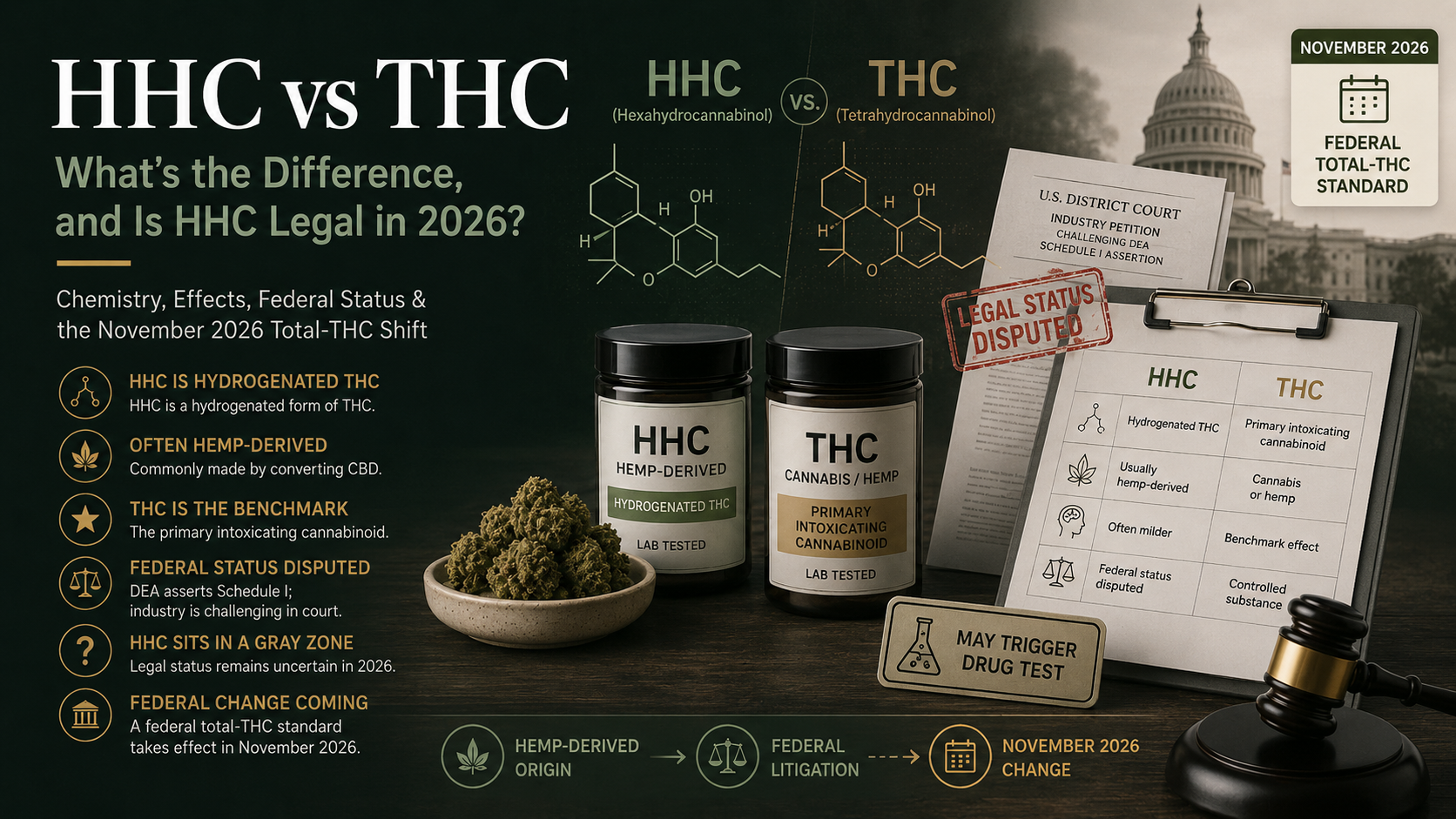
HHC vs THC is one of the most common questions shoppers and retailers ask about hemp-derived cannabinoids, and the answer in 2026 is more about law than chemistry. HHC is closely related to THC, sold widely as a hemp product, and now caught in a federal legal dispute that could change its status. This guide explains what HHC is, how it compares with THC, and where its legality stands.
| HHC | THC (delta-9) | |
|---|---|---|
| What it is | Hydrogenated form of THC | The primary intoxicating compound in cannabis |
| Typical source | Hemp-derived, often converted from CBD | Cannabis or hemp |
| Effect | Intoxicating, often described as milder | Intoxicating, the benchmark |
| Federal status | Disputed — DEA asserts Schedule I; industry is challenging that in court | Schedule I, except where rescheduling now applies to FDA-approved and state-licensed medical products |
| Drug test | May trigger a positive THC-metabolite result | Triggers a positive result |
The short version: chemically they are cousins, but the legal treatment is where operators get into trouble.
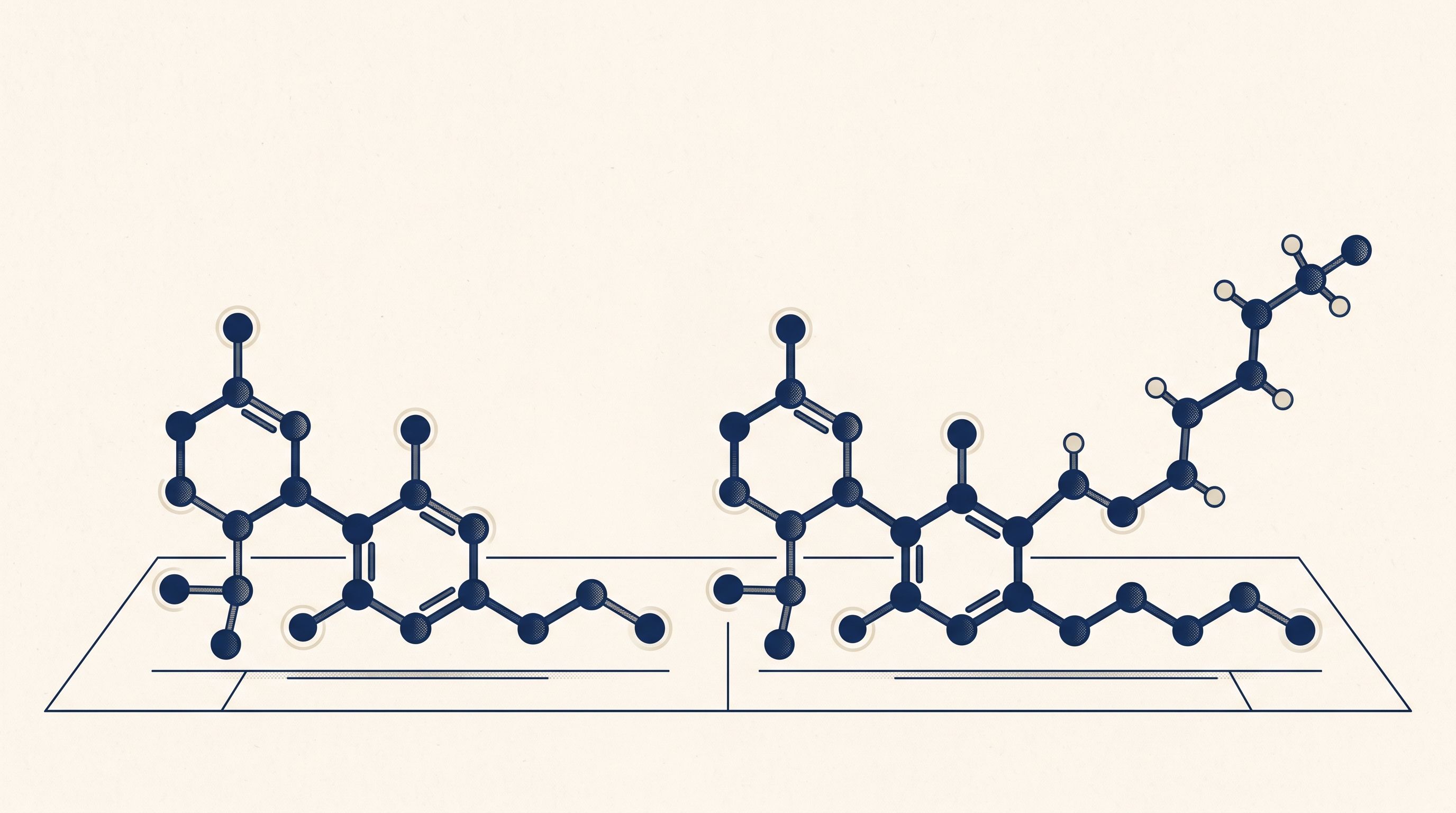
HHC, or hexahydrocannabinol, is a hydrogenated form of THC. Adding hydrogen to the THC molecule changes its structure and stability and produces a compound that is intoxicating but is often reported to be somewhat milder than delta-9 THC. Most HHC on the market is hemp-derived, manufactured by converting CBD extracted from hemp.
That manufacturing route is central to the legal fight. Producers have argued HHC is a legal hemp derivative under the 2018 Farm Bill, which legalized hemp and its derivatives below 0.3% delta-9 THC. Regulators counter that a cannabinoid produced through chemical synthesis is a different matter.
This is where HHC vs THC stops being a chemistry question. Hemp companies have sued the DEA, challenging the agency's position that HHC is a federally banned Schedule I substance because it is synthetically produced. The lawsuit reflects the broader unresolved question of whether "synthesized" hemp cannabinoids fall inside or outside the Farm Bill's protection.
Two forces are converging. The first is that litigation, which could clarify HHC's federal status one way or the other. The second is a federal total-THC standard set to take effect in November 2026, which would change how THC content is measured across hemp products and could pull many intoxicating hemp cannabinoids, HHC among the candidates, into tighter restriction. Until both resolve, HHC sits in a gray zone: marketed as hemp, asserted by the DEA to be controlled, and facing a measurement change that could reset the field.
State law adds another layer. Some states have explicitly banned HHC and other converted cannabinoids; others regulate them like other hemp products; and a few are silent. For a current view of where individual jurisdictions stand, check our state database, and for the picture abroad see HHC legality in the UK and Europe.
Retailers and brands should not treat HHC as settled. Confirm the regulatory status in every state where you sell, since a product that is tolerated in one state may be banned in a neighbor. Keep certificates of analysis that document cannabinoid content and sourcing, because the "synthetic versus natural" distinction is exactly what the DEA dispute turns on. And build for the November 2026 total-THC standard now, rather than waiting, so a measurement change does not strand inventory. Because the federal status is contested, talk to your counsel before launching or expanding an HHC line.
Is HHC legal? It is disputed at the federal level. Producers treat it as a legal hemp derivative, while the DEA has asserted it is a Schedule I controlled substance, and that question is now in litigation. State law varies, and some states ban it outright.
Is HHC stronger than THC? Generally no. HHC is intoxicating but is often described as milder than delta-9 THC, though potency depends on the product and dose.
HHC vs delta-8 — what's the difference? Both are hemp-derived intoxicating cannabinoids typically made by converting CBD. They differ in molecular structure and reported effects, but they share the same legal uncertainty around synthesized cannabinoids.
HHC vs THCA — are they the same? No. THCA is the natural acidic precursor to THC found in the plant, while HHC is a hydrogenated, usually converted compound. Their legal treatment differs, and the November 2026 total-THC standard is especially relevant to THCA.
Will HHC make me fail a drug test? It can. HHC use may produce a positive result on standard THC-metabolite drug tests.
This article is for general information and is not legal advice. Consult qualified counsel about your specific situation.
HHC vs THC is one of the most common questions shoppers and retailers ask about hemp-derived cannabinoids, and the answer in 2026 is more about law than chemistry. HHC is closely related to THC, sold widely as a hemp product, and now caught in a federal legal dispute that could change its status. This guide explains what HHC is, how it compares with THC, and where its legality stands.
| HHC | THC (delta-9) | |
|---|---|---|
| What it is | Hydrogenated form of THC | The primary intoxicating compound in cannabis |
| Typical source | Hemp-derived, often converted from CBD | Cannabis or hemp |
| Effect | Intoxicating, often described as milder | Intoxicating, the benchmark |
| Federal status | Disputed — DEA asserts Schedule I; industry is challenging that in court | Schedule I, except where rescheduling now applies to FDA-approved and state-licensed medical products |
| Drug test | May trigger a positive THC-metabolite result | Triggers a positive result |
The short version: chemically they are cousins, but the legal treatment is where operators get into trouble.
HHC, or hexahydrocannabinol, is a hydrogenated form of THC. Adding hydrogen to the THC molecule changes its structure and stability and produces a compound that is intoxicating but is often reported to be somewhat milder than delta-9 THC. Most HHC on the market is hemp-derived, manufactured by converting CBD extracted from hemp.
That manufacturing route is central to the legal fight. Producers have argued HHC is a legal hemp derivative under the 2018 Farm Bill, which legalized hemp and its derivatives below 0.3% delta-9 THC. Regulators counter that a cannabinoid produced through chemical synthesis is a different matter.
This is where HHC vs THC stops being a chemistry question. Hemp companies have sued the DEA, challenging the agency's position that HHC is a federally banned Schedule I substance because it is synthetically produced. The lawsuit reflects the broader unresolved question of whether "synthesized" hemp cannabinoids fall inside or outside the Farm Bill's protection.
Two forces are converging. The first is that litigation, which could clarify HHC's federal status one way or the other. The second is a federal total-THC standard set to take effect in November 2026, which would change how THC content is measured across hemp products and could pull many intoxicating hemp cannabinoids, HHC among the candidates, into tighter restriction. Until both resolve, HHC sits in a gray zone: marketed as hemp, asserted by the DEA to be controlled, and facing a measurement change that could reset the field.
State law adds another layer. Some states have explicitly banned HHC and other converted cannabinoids; others regulate them like other hemp products; and a few are silent. For a current view of where individual jurisdictions stand, check our state database, and for the picture abroad see HHC legality in the UK and Europe.
Retailers and brands should not treat HHC as settled. Confirm the regulatory status in every state where you sell, since a product that is tolerated in one state may be banned in a neighbor. Keep certificates of analysis that document cannabinoid content and sourcing, because the "synthetic versus natural" distinction is exactly what the DEA dispute turns on. And build for the November 2026 total-THC standard now, rather than waiting, so a measurement change does not strand inventory. Because the federal status is contested, talk to your counsel before launching or expanding an HHC line.
Is HHC legal? It is disputed at the federal level. Producers treat it as a legal hemp derivative, while the DEA has asserted it is a Schedule I controlled substance, and that question is now in litigation. State law varies, and some states ban it outright.
Is HHC stronger than THC? Generally no. HHC is intoxicating but is often described as milder than delta-9 THC, though potency depends on the product and dose.
HHC vs delta-8 — what's the difference? Both are hemp-derived intoxicating cannabinoids typically made by converting CBD. They differ in molecular structure and reported effects, but they share the same legal uncertainty around synthesized cannabinoids.
HHC vs THCA — are they the same? No. THCA is the natural acidic precursor to THC found in the plant, while HHC is a hydrogenated, usually converted compound. Their legal treatment differs, and the November 2026 total-THC standard is especially relevant to THCA.
Will HHC make me fail a drug test? It can. HHC use may produce a positive result on standard THC-metabolite drug tests.
This article is for general information and is not legal advice. Consult qualified counsel about your specific situation.
