
September 23, 2026


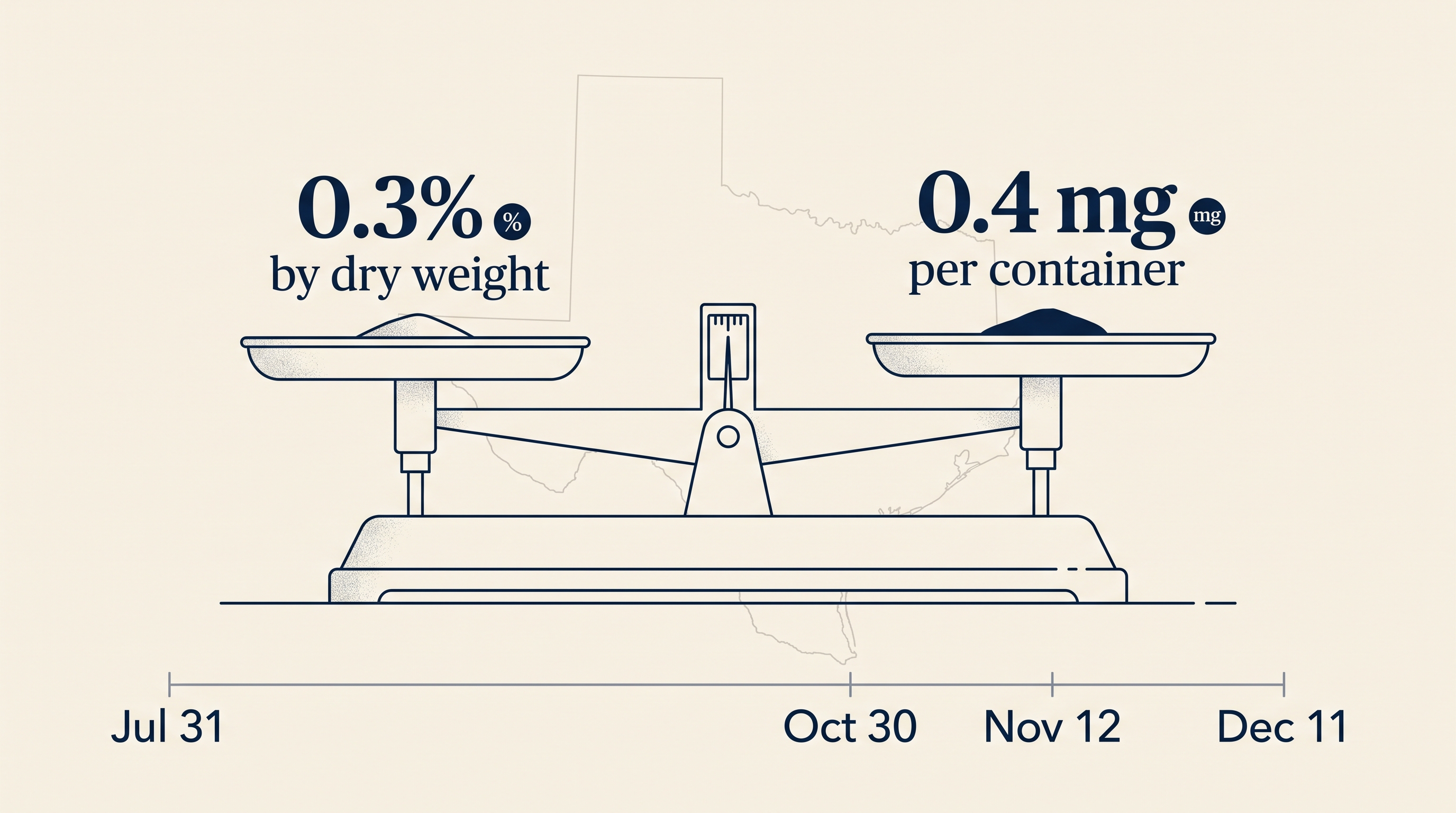
Are THC gummies legal in Texas? Hemp-derived delta-9 gummies at or below 0.3 percent delta-9 THC by dry weight are legal for sale to adults 21 and over by a retailer registered with the Department of State Health Services (DSHS) under Health and Safety Code chapter 443 (House Bill 1325, 2019). Delta-8 gummies are not: since DSHS's July 31, 2026 scheduling action, anything above "trace amounts" of non-delta-9 THC is controlled, a Travis County judge declined on September 4 to stop enforcement, and an injunction hearing is set for October 30. On December 11 the federal hemp definition switches to total THC with a 0.4 milligram per-container cap, a test a standard 10 mg gummy fails 25 times over.
Which rulebook applies depends on the cannabinoid. The matrix is the operative part of this page; for the other 49 states, start with our state-by-state guide to edibles legality.
| Gummy type | Texas statute and DSHS Chapter 300 rules | Texas enforcement since July 31, 2026 (today) | Federal hemp definition from Dec. 11, 2026 | What the COA must show |
|---|---|---|---|---|
| Hemp delta-9 gummy, no more than 0.3% delta-9 by dry weight | Legal. DSHS-licensed manufacturer, DSHS-registered retailer, 21+ with ID, child-resistant package, COA link on label | Legal. Not touched by the July 31 schedule | Outside "hemp" if the container holds more than 0.4 mg total THC. One 10 mg gummy is 25 times the cap | Total delta-9 (delta-9 plus 0.877 x THCA) at or below 0.3% with measurement of uncertainty; milligrams of total THC per container |
| Delta-8 gummy | Not a lawful consumable hemp product unless the delta-8 is a trace amount naturally produced by the source hemp | Controlled substance. Products labeled as delta-8 or testing above trace may be detained and referred to law enforcement | Excluded as a cannabinoid synthesized outside the plant (this exclusion was delayed to Dec. 11) | Delta-8 at or near non-detect; synthesis route |
| THCA gummy | THCA counts toward total delta-9 at 0.877 under 25 TAC 300.101 since March 31, 2026; a THCA-forward gummy fails the 0.3% test | Contested. Whether the July 31 schedule reaches naturally occurring THCA is the central claim in SS Distro v. DSHS; police agencies disagree on possession | Total THC includes THCA under section 781; same 0.4 mg cap | THCA on the panel and the converted total |
| CBD gummy (isolate or broad-spectrum) | Legal. Same license, registration, 21+ and packaging rules | Legal. Unaffected | Hemp only if total THC per container is at or below 0.4 mg; full-spectrum gummies may not clear it | Total THC in milligrams per container, not only a percentage |
| Delta-10, HHC, THC-P or THC-O gummy | Not a lawful consumable hemp product | Controlled substances since July 31 | Excluded: cannabinoids not naturally producible from Nov. 12; those synthesized outside the plant from Dec. 11 | Do not stock |
| Marijuana gummy (Compassionate Use Program low-THC cannabis) | Lawful only by prescription through a DPS-licensed dispensing organization: no more than 10 mg THC per dose and 1 g THC per package under HB 46 (eff. Sept. 1, 2025). Otherwise marijuana | Unchanged by July 31 | Marijuana under the Controlled Substances Act on any date | Not a hemp COA; dispensing-organization records |
Texas statute and DSHS rules. Chapter 443 takes its hemp definition from Agriculture Code section 121.001: delta-9 THC of not more than 0.3 percent on a dry-weight basis. DSHS's Chapter 300 rules, effective March 31, 2026, set fees at $10,000 per manufacturing location and $5,000 per retail location a year, define the acceptable level as total delta-9 (delta-9 plus 0.877 times THCA), and require child-resistant packaging and a COA link on the label. The 21-and-over rule is a DSHS rule, not a statute: Senate Bill 3 was vetoed on June 22, 2025, Senate Bill 6 passed the Senate in the second special session and was never heard in a House committee, and DSHS's October 2, 2025 emergency rules under Executive Order GA-56 are now permanent at 25 TAC 300.701-.702. Our Texas hemp delta-9 status page tracks the statute; TABC's hemp rules and the HB 46 medical expansion cover the other agencies.
The July 31 schedule. After DSHS v. Sky Marketing Corp., in which the Texas Supreme Court held that delta-8 is a controlled substance, DSHS reinstated its 2021 definitions effective July 31, 2026: only trace amounts of delta-8 naturally produced by the source hemp are permissible, and products labeled as delta-8 or testing above trace may be detained and referred to law enforcement. No rule defines "trace." The July 31 recriminalization covers what came off shelves; whether THCA is legal in Texas is the question no court has answered.
The federal definition. Section 781 of P.L. 119-37 redefines hemp by total THC, including THCA, and excludes final products above 0.4 mg of total THC per container and cannabinoids synthesized outside the plant. Section 2019 of P.L. 119-103, signed September 2, 2026, applies those amendments before December 11 only to cannabinoids "not capable of being naturally produced," which still start November 12. How the December 11 delay works and the 0.4 mg per-container cap, explained have the detail.
Texas measures a percentage of dry weight. A 4 gram gummy at exactly 0.3 percent carries 12 mg of delta-9 THC and is lawful hemp; a standard 10 mg gummy in the same matrix tests at 0.25 percent. Federal law from December 11 measures milligrams per "container," the innermost package sold to the consumer: a 20-count jar of 10 mg gummies holds 200 mg, 500 times the cap; one 10 mg gummy is 25 times it; the 12 mg gummy, 30 times. No formulation satisfies both a 10 mg serving and a 0.4 mg container.
Texas does not import the federal cap automatically. Section 443.001(5) points to Agriculture Code section 121.001, a freestanding 2019 definition with no cross-reference to 7 U.S.C. 1639o. DSHS's rules carry a narrower hook: 25 TAC 300.302(b) bars cannabis material other than hemp "produced in compliance with" the federal hemp subchapter, and section 300.403 requires out-of-state products to comply with federal regulations. That reaches how the plant was grown, not the milligrams in the jar, and DSHS has not said it reads the rule any wider. The milligram limit binds anyway: from December 11 a 12 mg gummy is lawful consumable hemp in Austin and marijuana to a federal prosecutor, a carrier, a bank and a payment processor, and for the roughly 14,000 registered Texas retailers buying from out-of-state manufacturers it becomes marijuana the moment it crosses the state line. Whether you can mail hemp edibles covers the carrier side.
In SS Distro USA LLC v. DSHS, Cause No. D-1-GN-26-007113 (Travis County), four hemp businesses challenge the undefined "trace amount" standard and the fees. Judge Maya Guerra Gamble denied a temporary restraining order on September 4; the injunction hearing is set for 9 a.m. on October 30 before Judge Maria Cantu Hexsel of the 53rd District Court, as reported by The Marijuana Herald from plaintiffs' counsel. In Texas Hemp Business Council v. DSHS, No. 15-26-00099-CV, the Fifteenth Court of Appeals lifted the injunction against the Chapter 300 rules on June 5; THBC says the State's reply brief was due September 17. The federal case, Monti v. Garcia, No. 3:26-cv-00254 (S.D. Tex.), lost its emergency motion on August 10; the three Texas hemp cases and what each can fix sorts them out. For THCA-labeled gummies the open question is possession: KUT reported on September 15 that DSHS refers it to police, Austin police will not seize product at or below 0.3 percent delta-9, and other agencies differ. As of September 23, no ruling, briefing schedule change or new filing has moved the October 30 injunction hearing date.
Texas has no state milligram cap of its own. Virginia has had one since August 15, 2026: 2 mg of total THC per package, per the Virginia Department of Agriculture and Consumer Services, and Virginia's 2 mg cap took effect as written. Illinois wrote the federal 0.4 mg figure into its Hemp Act with a fixed November 12 start, and Missouri's HB 2641 reclassifies hemp products above 0.4 mg as marijuana the same day; neither moved with the federal delay, as the state deadlines that did not move maps. Ohio's SB 56 applies the same test, and a federal judge has blocked enforcement only against the companies that sued, as reported by The Marijuana Herald, leaving a split Ohio market. A 10 mg Texas gummy is therefore a multistate brand's most permissive SKU and its least portable: unlawful in Virginia now, in Illinois and Missouri on November 12, and outside federal hemp everywhere on December 11. For full-spectrum CBD gummies, which face the same arithmetic, see our guide to CBD's status in Texas.
Yes. CBD gummies from hemp with no more than 0.3 percent delta-9 THC by dry weight are consumable hemp products under Health and Safety Code chapter 443, sold by DSHS-registered retailers to adults 21 and over. From December 11, 2026 federal law also caps total THC at 0.4 mg per container.
No. Since DSHS's July 31, 2026 scheduling action, delta-8 THC is a controlled substance in Texas except for trace amounts naturally produced by the source hemp, and delta-8-labeled products may be detained. A Travis County judge denied a restraining order on September 4; an injunction hearing is set for October 30, 2026.
For hemp products, 0.3 percent delta-9 THC by dry weight under Agriculture Code section 121.001, with DSHS counting THCA at a 0.877 conversion. For Compassionate Use Program patients, up to 10 mg THC per dose and one gram per package. From December 11, 2026 the federal hemp definition adds a 0.4 mg per-container cap.
Marijuana gummies are illegal outside the Compassionate Use Program. Hemp delta-9 gummies at or below 0.3 percent delta-9 THC by dry weight are legal. Delta-8 and other non-delta-9 isomer gummies have been treated as controlled substances since July 31, 2026; DSHS's treatment of THCA is in litigation.
Hemp-derived delta-9 gummies at or below 0.3 percent remain legal in Texas as of September 2026. The next dates that could change that are the October 30, 2026 Travis County injunction hearing and December 11, 2026, when the federal hemp definition adds a 0.4 mg per-container cap.
Gummies made from hemp with no more than 0.3 percent total delta-9 THC by dry weight, produced by a DSHS-licensed manufacturer and sold by a DSHS-registered retailer to adults 21 and over, in child-resistant packaging with a COA link on the label. Delta-8, delta-10, HHC and THC-P gummies do not qualify.
This is regulatory journalism, not legal advice — talk to your counsel.
Are THC gummies legal in Texas? Hemp-derived delta-9 gummies at or below 0.3 percent delta-9 THC by dry weight are legal for sale to adults 21 and over by a retailer registered with the Department of State Health Services (DSHS) under Health and Safety Code chapter 443 (House Bill 1325, 2019). Delta-8 gummies are not: since DSHS's July 31, 2026 scheduling action, anything above "trace amounts" of non-delta-9 THC is controlled, a Travis County judge declined on September 4 to stop enforcement, and an injunction hearing is set for October 30. On December 11 the federal hemp definition switches to total THC with a 0.4 milligram per-container cap, a test a standard 10 mg gummy fails 25 times over.
Which rulebook applies depends on the cannabinoid. The matrix is the operative part of this page; for the other 49 states, start with our state-by-state guide to edibles legality.
| Gummy type | Texas statute and DSHS Chapter 300 rules | Texas enforcement since July 31, 2026 (today) | Federal hemp definition from Dec. 11, 2026 | What the COA must show |
|---|---|---|---|---|
| Hemp delta-9 gummy, no more than 0.3% delta-9 by dry weight | Legal. DSHS-licensed manufacturer, DSHS-registered retailer, 21+ with ID, child-resistant package, COA link on label | Legal. Not touched by the July 31 schedule | Outside "hemp" if the container holds more than 0.4 mg total THC. One 10 mg gummy is 25 times the cap | Total delta-9 (delta-9 plus 0.877 x THCA) at or below 0.3% with measurement of uncertainty; milligrams of total THC per container |
| Delta-8 gummy | Not a lawful consumable hemp product unless the delta-8 is a trace amount naturally produced by the source hemp | Controlled substance. Products labeled as delta-8 or testing above trace may be detained and referred to law enforcement | Excluded as a cannabinoid synthesized outside the plant (this exclusion was delayed to Dec. 11) | Delta-8 at or near non-detect; synthesis route |
| THCA gummy | THCA counts toward total delta-9 at 0.877 under 25 TAC 300.101 since March 31, 2026; a THCA-forward gummy fails the 0.3% test | Contested. Whether the July 31 schedule reaches naturally occurring THCA is the central claim in SS Distro v. DSHS; police agencies disagree on possession | Total THC includes THCA under section 781; same 0.4 mg cap | THCA on the panel and the converted total |
| CBD gummy (isolate or broad-spectrum) | Legal. Same license, registration, 21+ and packaging rules | Legal. Unaffected | Hemp only if total THC per container is at or below 0.4 mg; full-spectrum gummies may not clear it | Total THC in milligrams per container, not only a percentage |
| Delta-10, HHC, THC-P or THC-O gummy | Not a lawful consumable hemp product | Controlled substances since July 31 | Excluded: cannabinoids not naturally producible from Nov. 12; those synthesized outside the plant from Dec. 11 | Do not stock |
| Marijuana gummy (Compassionate Use Program low-THC cannabis) | Lawful only by prescription through a DPS-licensed dispensing organization: no more than 10 mg THC per dose and 1 g THC per package under HB 46 (eff. Sept. 1, 2025). Otherwise marijuana | Unchanged by July 31 | Marijuana under the Controlled Substances Act on any date | Not a hemp COA; dispensing-organization records |
Texas statute and DSHS rules. Chapter 443 takes its hemp definition from Agriculture Code section 121.001: delta-9 THC of not more than 0.3 percent on a dry-weight basis. DSHS's Chapter 300 rules, effective March 31, 2026, set fees at $10,000 per manufacturing location and $5,000 per retail location a year, define the acceptable level as total delta-9 (delta-9 plus 0.877 times THCA), and require child-resistant packaging and a COA link on the label. The 21-and-over rule is a DSHS rule, not a statute: Senate Bill 3 was vetoed on June 22, 2025, Senate Bill 6 passed the Senate in the second special session and was never heard in a House committee, and DSHS's October 2, 2025 emergency rules under Executive Order GA-56 are now permanent at 25 TAC 300.701-.702. Our Texas hemp delta-9 status page tracks the statute; TABC's hemp rules and the HB 46 medical expansion cover the other agencies.
The July 31 schedule. After DSHS v. Sky Marketing Corp., in which the Texas Supreme Court held that delta-8 is a controlled substance, DSHS reinstated its 2021 definitions effective July 31, 2026: only trace amounts of delta-8 naturally produced by the source hemp are permissible, and products labeled as delta-8 or testing above trace may be detained and referred to law enforcement. No rule defines "trace." The July 31 recriminalization covers what came off shelves; whether THCA is legal in Texas is the question no court has answered.
The federal definition. Section 781 of P.L. 119-37 redefines hemp by total THC, including THCA, and excludes final products above 0.4 mg of total THC per container and cannabinoids synthesized outside the plant. Section 2019 of P.L. 119-103, signed September 2, 2026, applies those amendments before December 11 only to cannabinoids "not capable of being naturally produced," which still start November 12. How the December 11 delay works and the 0.4 mg per-container cap, explained have the detail.
Texas measures a percentage of dry weight. A 4 gram gummy at exactly 0.3 percent carries 12 mg of delta-9 THC and is lawful hemp; a standard 10 mg gummy in the same matrix tests at 0.25 percent. Federal law from December 11 measures milligrams per "container," the innermost package sold to the consumer: a 20-count jar of 10 mg gummies holds 200 mg, 500 times the cap; one 10 mg gummy is 25 times it; the 12 mg gummy, 30 times. No formulation satisfies both a 10 mg serving and a 0.4 mg container.
Texas does not import the federal cap automatically. Section 443.001(5) points to Agriculture Code section 121.001, a freestanding 2019 definition with no cross-reference to 7 U.S.C. 1639o. DSHS's rules carry a narrower hook: 25 TAC 300.302(b) bars cannabis material other than hemp "produced in compliance with" the federal hemp subchapter, and section 300.403 requires out-of-state products to comply with federal regulations. That reaches how the plant was grown, not the milligrams in the jar, and DSHS has not said it reads the rule any wider. The milligram limit binds anyway: from December 11 a 12 mg gummy is lawful consumable hemp in Austin and marijuana to a federal prosecutor, a carrier, a bank and a payment processor, and for the roughly 14,000 registered Texas retailers buying from out-of-state manufacturers it becomes marijuana the moment it crosses the state line. Whether you can mail hemp edibles covers the carrier side.
In SS Distro USA LLC v. DSHS, Cause No. D-1-GN-26-007113 (Travis County), four hemp businesses challenge the undefined "trace amount" standard and the fees. Judge Maya Guerra Gamble denied a temporary restraining order on September 4; the injunction hearing is set for 9 a.m. on October 30 before Judge Maria Cantu Hexsel of the 53rd District Court, as reported by The Marijuana Herald from plaintiffs' counsel. In Texas Hemp Business Council v. DSHS, No. 15-26-00099-CV, the Fifteenth Court of Appeals lifted the injunction against the Chapter 300 rules on June 5; THBC says the State's reply brief was due September 17. The federal case, Monti v. Garcia, No. 3:26-cv-00254 (S.D. Tex.), lost its emergency motion on August 10; the three Texas hemp cases and what each can fix sorts them out. For THCA-labeled gummies the open question is possession: KUT reported on September 15 that DSHS refers it to police, Austin police will not seize product at or below 0.3 percent delta-9, and other agencies differ. As of September 23, no ruling, briefing schedule change or new filing has moved the October 30 injunction hearing date.
Texas has no state milligram cap of its own. Virginia has had one since August 15, 2026: 2 mg of total THC per package, per the Virginia Department of Agriculture and Consumer Services, and Virginia's 2 mg cap took effect as written. Illinois wrote the federal 0.4 mg figure into its Hemp Act with a fixed November 12 start, and Missouri's HB 2641 reclassifies hemp products above 0.4 mg as marijuana the same day; neither moved with the federal delay, as the state deadlines that did not move maps. Ohio's SB 56 applies the same test, and a federal judge has blocked enforcement only against the companies that sued, as reported by The Marijuana Herald, leaving a split Ohio market. A 10 mg Texas gummy is therefore a multistate brand's most permissive SKU and its least portable: unlawful in Virginia now, in Illinois and Missouri on November 12, and outside federal hemp everywhere on December 11. For full-spectrum CBD gummies, which face the same arithmetic, see our guide to CBD's status in Texas.
Yes. CBD gummies from hemp with no more than 0.3 percent delta-9 THC by dry weight are consumable hemp products under Health and Safety Code chapter 443, sold by DSHS-registered retailers to adults 21 and over. From December 11, 2026 federal law also caps total THC at 0.4 mg per container.
No. Since DSHS's July 31, 2026 scheduling action, delta-8 THC is a controlled substance in Texas except for trace amounts naturally produced by the source hemp, and delta-8-labeled products may be detained. A Travis County judge denied a restraining order on September 4; an injunction hearing is set for October 30, 2026.
For hemp products, 0.3 percent delta-9 THC by dry weight under Agriculture Code section 121.001, with DSHS counting THCA at a 0.877 conversion. For Compassionate Use Program patients, up to 10 mg THC per dose and one gram per package. From December 11, 2026 the federal hemp definition adds a 0.4 mg per-container cap.
Marijuana gummies are illegal outside the Compassionate Use Program. Hemp delta-9 gummies at or below 0.3 percent delta-9 THC by dry weight are legal. Delta-8 and other non-delta-9 isomer gummies have been treated as controlled substances since July 31, 2026; DSHS's treatment of THCA is in litigation.
Hemp-derived delta-9 gummies at or below 0.3 percent remain legal in Texas as of September 2026. The next dates that could change that are the October 30, 2026 Travis County injunction hearing and December 11, 2026, when the federal hemp definition adds a 0.4 mg per-container cap.
Gummies made from hemp with no more than 0.3 percent total delta-9 THC by dry weight, produced by a DSHS-licensed manufacturer and sold by a DSHS-registered retailer to adults 21 and over, in child-resistant packaging with a COA link on the label. Delta-8, delta-10, HHC and THC-P gummies do not qualify.
This is regulatory journalism, not legal advice — talk to your counsel.
