
August 26, 2026

Thank you! Your submission has been received!
Oops! Something went wrong while submitting the form.

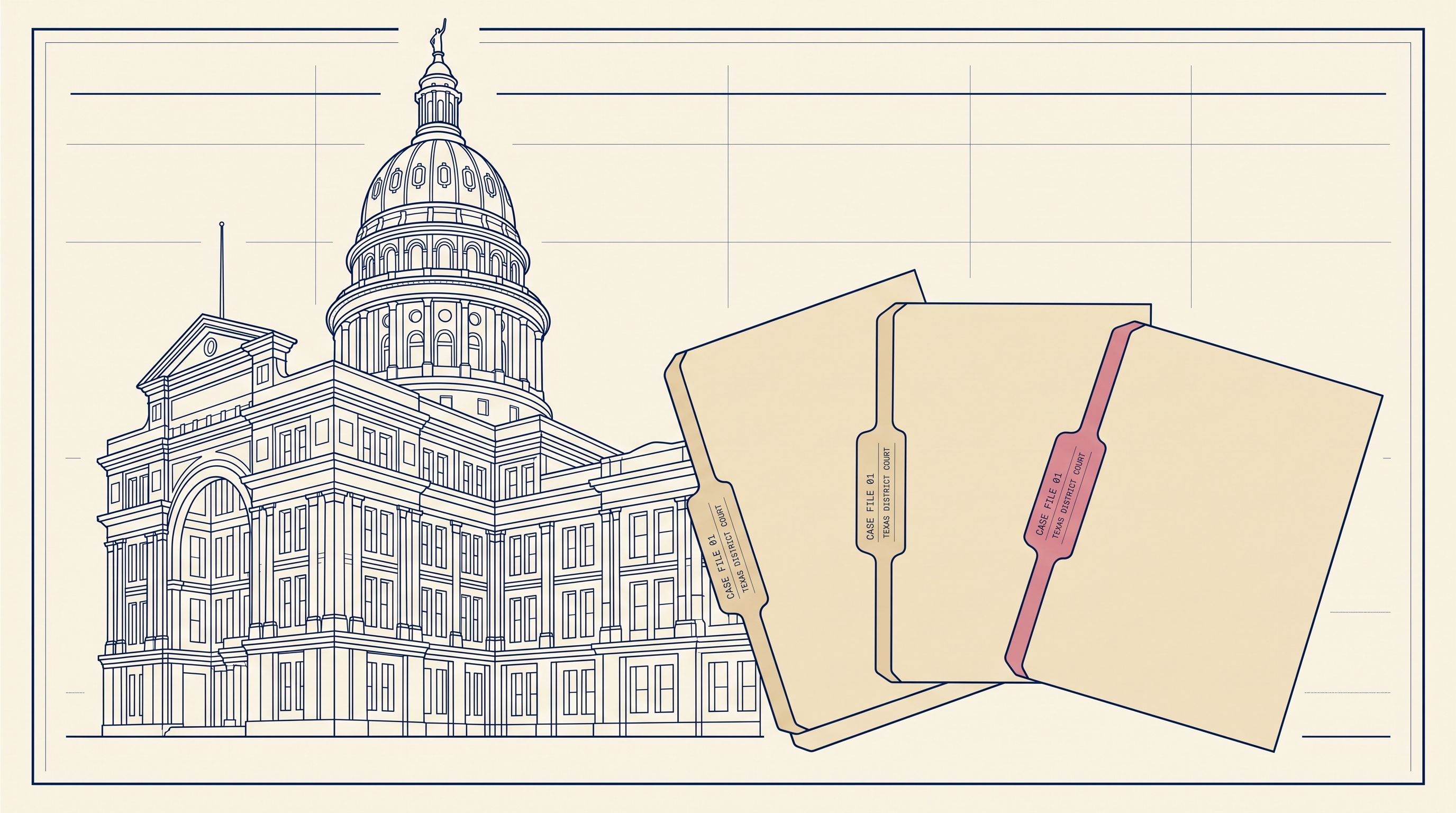
Four Texas hemp businesses sued the Department of State Health Services on August 20, 2026 in the 459th Judicial District Court of Travis County, challenging how the agency is enforcing the state's new hemp restrictions rather than the restrictions themselves. Attorney David K. Sergi filed on behalf of SS Distro USA LLC, Topps Distro LLC doing business as KingPin Kush, Jason Moreno doing business as My City Hemp, and Trevor Kocaoglan, naming DSHS, Interim Commissioner Imelda Garcia and Division Director Glenn Hargett. It is the third active case against the agency, and the only one aimed squarely at enforcement practice.
At the center of the complaint is what the plaintiffs call DSHS's "Post-July Implementation and Enforcement Standard." Under it, the suit alleges, the agency is detaining product and referring businesses to law enforcement when products contain more than trace amounts of naturally occurring tetrahydrocannabinolic acid. The plaintiffs argue that reaches further than the Texas Supreme Court's decision in DSHS v. Sky Marketing Corp. supports, because that case concerned manufactured delta-8 THC, not naturally occurring THCA. No court has resolved the distinction.
The second claim is about money. DSHS set a $10,000 annual manufacturer fee and a $5,000 annual retailer fee. The complaint argues the legislature never authorized fees at those levels.
The third is a Texas Constitution anti-monopoly claim, alleging the restrictions operate to favor the limited set of licensees inside the Texas Compassionate Use Program. The plaintiffs seek a temporary restraining order and a temporary injunction, and cite Whitney Economics figures putting the Texas hemp market at $5.1 billion and roughly 48,900 jobs, with $3.85 billion and more than 36,000 jobs at risk. For what the underlying restrictions actually prohibit, the July 31 recriminalization and what it banned is the starting point.
Wire coverage tends to blur these together. They are not interchangeable, and an operator watching the wrong one will misjudge the timeline.
| Case | Court | Filed | What it challenges / status |
|---|---|---|---|
| SS Distro USA LLC et al. v. DSHS | 459th Judicial District Court, Travis County | Aug. 20, 2026 | Enforcement practice, the $10,000/$5,000 fees, and an anti-monopoly claim. TRO requested; no ruling. |
| Texas Hemp Business Council v. DSHS, Cause No. D-1-GN-26-002511 | Trial court in Travis County; now Fifteenth Court of Appeals, No. 15-26-00099-CV | Apr. 7, 2026 | The rules themselves. The trial court's temporary injunction is not currently in effect while the interlocutory appeal proceeds. Briefing continues; no oral argument scheduled. |
| Federal challenge | U.S. District Court, Southern District of Texas (Galveston) | 2026 | Federal preemption and constitutional theories. Judge Jeffrey Brown denied an emergency TRO in early August. |
The appeal at the Fifteenth Court of Appeals has the broadest reach and the longest runway. A Travis County temporary restraining order, if granted, would constrain how DSHS enforces — it would not strike the underlying statute. The federal case, having already lost its emergency posture, is now on an ordinary schedule. Nothing here produces a fast answer. The Texas Hemp Business Council's own case tracker describes the appellate timeline in terms of months, not weeks.
The THCA-detention argument is getting the coverage. The fee argument is the one that could survive a loss on everything else. An agency can be entirely correct about which cannabinoids the statute reaches and still lack authority to charge $10,000 a year for the privilege of complying. Those are separate questions decided under separate standards.
And the fee question interacts with the calendar in a way no wire story has spelled out. An operator deciding whether to renew is choosing between paying a fee that a court may later void and letting a registration lapse that may be required when the narrower federal hemp definition takes effect on November 12. The state fee dispute and the federal cutover are unrelated proceedings that land on the same balance sheet in the same quarter. That interaction is what actually binds.
None of this is legal advice, and the fee decision in particular is entity-specific. Talk to your counsel.
Texas sits at the enforcement end of a spectrum. Virginia sits at the statutory end. In Virginia, a federal court declined to pause a hemp cap, and the 2 mg per-package limit took effect on August 15, 2026 as written — the question of whether a court would slow a short-runway restriction was answered no. In North Carolina, the HB 328 hemp and kratom crackdown has not cleared the House, and the market is still open.
The operational read: Texas operators are litigating about how a rule is being applied, Virginia operators have run out of room to litigate at all, and North Carolina operators still have a legislature to lobby. Same product category, three completely different compliance postures — which is why the state-by-state THCA guide is worth re-reading before any multistate shipment. Whether a given product is sellable in Texas today is a narrower question, addressed in whether THCA is legal in Texas right now and, for the separate delta-9 rules, Texas delta-9 thresholds.
The rules being enforced did not appear from nowhere. DSHS's hemp rule overhaul set the framework, and the fight over who controls Texas hemp policy explains why an agency, rather than the legislature, ended up holding the pen. Federally, meanwhile, DEA has asked its own judge to move marijuana to Schedule III — a proceeding that changes nothing about what DSHS may detain.
Is THCA legal in Texas in 2026?
Texas recriminalized delta-8 and THCA products effective July 31, 2026, and DSHS is enforcing against products containing them. Multiple lawsuits are challenging the rules and the enforcement practice, but none has produced an injunction in effect as of late August.
How many lawsuits are pending against Texas DSHS over hemp?
Three distinct ones: the August 20 Travis County suit over enforcement practice and fees, Texas Hemp Business Council v. DSHS on interlocutory appeal at the Fifteenth Court of Appeals, and a federal suit in the Southern District of Texas where an emergency TRO was denied in early August.
What are the Texas hemp licensing fees?
DSHS set a $10,000 annual manufacturer fee and a $5,000 annual retailer fee. The August 20 lawsuit argues the legislature never authorized fees at those levels.
Can DSHS detain my hemp product over trace THCA?
DSHS has been detaining product and making law-enforcement referrals over naturally occurring THCA, which the new complaint argues exceeds the Texas Supreme Court's Sky Marketing ruling on manufactured delta-8. Document any detention carefully and speak with your counsel.
Does the Texas Supreme Court's Sky Marketing decision cover THCA?
The plaintiffs argue it does not — that the case concerned manufactured delta-8 THC, not naturally occurring THCA, and that DSHS is applying it more broadly than the ruling supports. No court has resolved that question.
This is regulatory journalism, not legal advice — talk to your counsel.
Four Texas hemp businesses sued the Department of State Health Services on August 20, 2026 in the 459th Judicial District Court of Travis County, challenging how the agency is enforcing the state's new hemp restrictions rather than the restrictions themselves. Attorney David K. Sergi filed on behalf of SS Distro USA LLC, Topps Distro LLC doing business as KingPin Kush, Jason Moreno doing business as My City Hemp, and Trevor Kocaoglan, naming DSHS, Interim Commissioner Imelda Garcia and Division Director Glenn Hargett. It is the third active case against the agency, and the only one aimed squarely at enforcement practice.
At the center of the complaint is what the plaintiffs call DSHS's "Post-July Implementation and Enforcement Standard." Under it, the suit alleges, the agency is detaining product and referring businesses to law enforcement when products contain more than trace amounts of naturally occurring tetrahydrocannabinolic acid. The plaintiffs argue that reaches further than the Texas Supreme Court's decision in DSHS v. Sky Marketing Corp. supports, because that case concerned manufactured delta-8 THC, not naturally occurring THCA. No court has resolved the distinction.
The second claim is about money. DSHS set a $10,000 annual manufacturer fee and a $5,000 annual retailer fee. The complaint argues the legislature never authorized fees at those levels.
The third is a Texas Constitution anti-monopoly claim, alleging the restrictions operate to favor the limited set of licensees inside the Texas Compassionate Use Program. The plaintiffs seek a temporary restraining order and a temporary injunction, and cite Whitney Economics figures putting the Texas hemp market at $5.1 billion and roughly 48,900 jobs, with $3.85 billion and more than 36,000 jobs at risk. For what the underlying restrictions actually prohibit, the July 31 recriminalization and what it banned is the starting point.
Wire coverage tends to blur these together. They are not interchangeable, and an operator watching the wrong one will misjudge the timeline.
| Case | Court | Filed | What it challenges / status |
|---|---|---|---|
| SS Distro USA LLC et al. v. DSHS | 459th Judicial District Court, Travis County | Aug. 20, 2026 | Enforcement practice, the $10,000/$5,000 fees, and an anti-monopoly claim. TRO requested; no ruling. |
| Texas Hemp Business Council v. DSHS, Cause No. D-1-GN-26-002511 | Trial court in Travis County; now Fifteenth Court of Appeals, No. 15-26-00099-CV | Apr. 7, 2026 | The rules themselves. The trial court's temporary injunction is not currently in effect while the interlocutory appeal proceeds. Briefing continues; no oral argument scheduled. |
| Federal challenge | U.S. District Court, Southern District of Texas (Galveston) | 2026 | Federal preemption and constitutional theories. Judge Jeffrey Brown denied an emergency TRO in early August. |
The appeal at the Fifteenth Court of Appeals has the broadest reach and the longest runway. A Travis County temporary restraining order, if granted, would constrain how DSHS enforces — it would not strike the underlying statute. The federal case, having already lost its emergency posture, is now on an ordinary schedule. Nothing here produces a fast answer. The Texas Hemp Business Council's own case tracker describes the appellate timeline in terms of months, not weeks.
The THCA-detention argument is getting the coverage. The fee argument is the one that could survive a loss on everything else. An agency can be entirely correct about which cannabinoids the statute reaches and still lack authority to charge $10,000 a year for the privilege of complying. Those are separate questions decided under separate standards.
And the fee question interacts with the calendar in a way no wire story has spelled out. An operator deciding whether to renew is choosing between paying a fee that a court may later void and letting a registration lapse that may be required when the narrower federal hemp definition takes effect on November 12. The state fee dispute and the federal cutover are unrelated proceedings that land on the same balance sheet in the same quarter. That interaction is what actually binds.
None of this is legal advice, and the fee decision in particular is entity-specific. Talk to your counsel.
Texas sits at the enforcement end of a spectrum. Virginia sits at the statutory end. In Virginia, a federal court declined to pause a hemp cap, and the 2 mg per-package limit took effect on August 15, 2026 as written — the question of whether a court would slow a short-runway restriction was answered no. In North Carolina, the HB 328 hemp and kratom crackdown has not cleared the House, and the market is still open.
The operational read: Texas operators are litigating about how a rule is being applied, Virginia operators have run out of room to litigate at all, and North Carolina operators still have a legislature to lobby. Same product category, three completely different compliance postures — which is why the state-by-state THCA guide is worth re-reading before any multistate shipment. Whether a given product is sellable in Texas today is a narrower question, addressed in whether THCA is legal in Texas right now and, for the separate delta-9 rules, Texas delta-9 thresholds.
The rules being enforced did not appear from nowhere. DSHS's hemp rule overhaul set the framework, and the fight over who controls Texas hemp policy explains why an agency, rather than the legislature, ended up holding the pen. Federally, meanwhile, DEA has asked its own judge to move marijuana to Schedule III — a proceeding that changes nothing about what DSHS may detain.
Is THCA legal in Texas in 2026?
Texas recriminalized delta-8 and THCA products effective July 31, 2026, and DSHS is enforcing against products containing them. Multiple lawsuits are challenging the rules and the enforcement practice, but none has produced an injunction in effect as of late August.
How many lawsuits are pending against Texas DSHS over hemp?
Three distinct ones: the August 20 Travis County suit over enforcement practice and fees, Texas Hemp Business Council v. DSHS on interlocutory appeal at the Fifteenth Court of Appeals, and a federal suit in the Southern District of Texas where an emergency TRO was denied in early August.
What are the Texas hemp licensing fees?
DSHS set a $10,000 annual manufacturer fee and a $5,000 annual retailer fee. The August 20 lawsuit argues the legislature never authorized fees at those levels.
Can DSHS detain my hemp product over trace THCA?
DSHS has been detaining product and making law-enforcement referrals over naturally occurring THCA, which the new complaint argues exceeds the Texas Supreme Court's Sky Marketing ruling on manufactured delta-8. Document any detention carefully and speak with your counsel.
Does the Texas Supreme Court's Sky Marketing decision cover THCA?
The plaintiffs argue it does not — that the case concerned manufactured delta-8 THC, not naturally occurring THCA, and that DSHS is applying it more broadly than the ruling supports. No court has resolved that question.
This is regulatory journalism, not legal advice — talk to your counsel.