

September 9, 2026


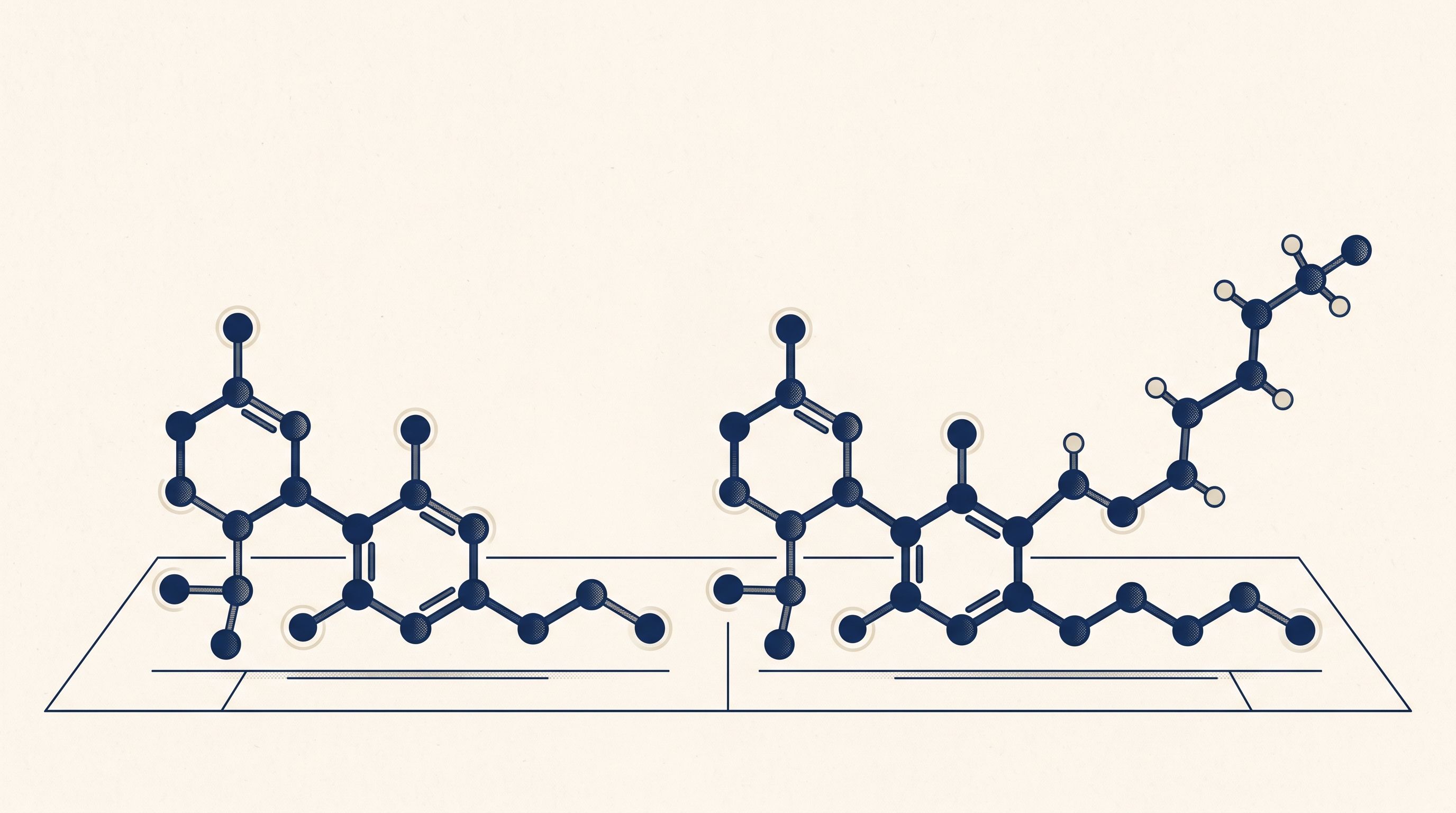
THC-P vs THC comes down to two carbon atoms. Delta-9 THC carries a five-carbon alkyl side chain; tetrahydrocannabiphorol (THC-P) carries seven. An Italian team led by Cinzia Citti identified THC-P in a cannabis sample in 2019 and published the finding in Scientific Reports, which means the plant can make it. That single fact — natural occurrence — is what decides which federal deadline applies to THC-P products in 2026, and it points to a date most sellers are not expecting.
The 2019 paper reported that THC-P binds the CB1 receptor with roughly 33-fold higher affinity than delta-9 THC (a Ki of about 1.2 nM against about 40 nM) and produced cannabimimetic effects in mice at lower doses. Binding affinity is not a dose multiplier. It says how tightly a molecule attaches to a receptor in a lab assay, not how a 5 mg gummy will feel or how long it will last. No controlled human potency or safety study of THC-P has been published. A label that says "33 times stronger than THC" is converting a receptor measurement into an effect claim, and that is the sentence most likely to be quoted back in a consumer complaint or an enforcement letter.
Commercial THC-P is not extracted from the plant. Natural THC-P occurs in trace amounts; the product on the shelf is synthesized from hemp-derived CBD. Trace natural occurrence plus synthetic commercial supply is the whole legal story, and it cuts in opposite directions at the state and federal levels.
Under the 2018 Farm Bill, hemp was defined by delta-9 THC alone, at or below 0.3 percent on a dry-weight basis. THC-P is not delta-9, so the test never measured it. Section 781 of P.L. 119-37 replaced that definition with a total-THC test and a 0.4 mg total-THC cap per container, and it carved two categories out of "hemp" by name: cannabinoids "not capable of being naturally produced by a Cannabis sativa L. plant," and cannabinoids the plant can produce that were "synthesized or manufactured outside the plant."
Then Congress split the dates. P.L. 119-103, signed September 2, 2026, keeps November 12 only for the first category and moves everything else in Section 781 to December 11. Because THC-P is a cannabinoid the plant is capable of producing, commercial THC-P made from CBD falls in the second paragraph — synthesized outside the plant — and gets the December 11 federal date, not the November 12 date most coverage assigns to "synthetics." That is the reading the statute's text supports. Whether a specific compound is "capable of being naturally produced" is a factual question the law does not answer molecule by molecule, and nothing in the delay makes THC-P a hemp product after December 11. Separately, the Federal Analogue Act, 21 U.S.C. §813, treats a substance with a chemical structure and effect "substantially similar" to a Schedule I or II controlled substance as if it were controlled when intended for human consumption; that exposure does not depend on any hemp date and is a reason to keep marketing language free of pharmacological claims.
Tennessee bans it by name. Under Public Chapter 526 (2025), which moved hemp-derived cannabinoid products under the Alcoholic Beverage Commission on January 1, 2026, the TABC's guidance states that products are prohibited if they "contain any amount of THCp." Texas reaches it by definition. DSHS's July 31, 2026 schedule, reinstated after the Texas Supreme Court's Sky Marketing decision, controls tetrahydrocannabinols "naturally contained in a plant of the genus Cannabis" except for delta-9 in hemp at or below 0.3 percent, "as well as synthetic equivalents … and/or synthetic substances, derivatives, and their isomers with similar chemical structure and pharmacological activity." THC-P is a homolog rather than an isomer, but the text does not stop at isomers; both naturally occurring THC-P and a CBD-derived version sit inside that language. The July 31 action is the same one behind the delta-8 and THCA recriminalization. Georgia does not name THC-P. SB 494 (2024) works through a total-THC compliance ceiling, a retail flower ban and serving caps, and Georgia has not listed THC-P on its controlled-substances schedule; a compliant THC-P edible is regulated like any other consumable hemp product there, and the federal December 11 date is what changes that. Florida has no statute naming THC-P — the Legislature's 2024 attempt (SB 1698) was vetoed and the 2026 session ended without a hemp bill — but FDACS's amended Rule 5K-4.034 bars synthetic cannabinoids in hemp extract, which is where CBD-derived THC-P lands. The full map is in the state analog-ban tracker, with current status on the THC-P legality page.
Most state-mandated potency panels quantify delta-9, THCA and a short list of majors. THC-P is often not on the analyte list, so a certificate of analysis can report "total THC" without ever measuring the compound the product is named for. Under a delta-9-only method that is invisible; under Section 781's total-THC test it depends on whether the lab's method includes THC-P at all. The practical gap to close is with your lab, not your lawyer: ask whether THC-P is quantified, at what limit of detection, and whether it is rolled into total THC on the report. Drug-test detectability is unstudied; do not promise customers either answer.
Three legal tests, one molecule. Tennessee names the compound; Texas defines a class broad enough to catch it; the federal government sorts it by origin and assigns a date. A state that reasons by cannabinoid identity will always extend to THC-P quickly. A state that reasons by total milligrams, such as Virginia with its 2 mg per-package cap, never needed to name it. The comparison pieces in this cluster show the same pattern from other angles: delta-8 versus delta-9 under federal law is the anchor, how THC-P compares with THCA covers the flower-composition question, and THCA versus THC, HHC versus THC and the three-way delta comparison cover the rest of the shelf.
| Question | THC-P | Delta-9 THC | THCA |
|---|---|---|---|
| Alkyl side chain | Seven carbons | Five carbons | Five carbons (acid form of delta-9) |
| Natural occurrence | Trace amounts (identified 2019) | Yes, principal intoxicant | Yes, precursor in raw flower |
| Commercial source | Synthesized from hemp CBD | Extracted or naturally present | Naturally present in flower |
| Intoxicating as sold | Yes | Yes | No — converts on heating |
| Federal status before Dec. 11, 2026 | Not measured by the delta-9-only test | Hemp if ≤0.3% dry weight | Not counted under the delta-9-only test |
| Federal status from Dec. 11, 2026 | Synthesized-outside-the-plant exclusion; counted toward the 0.4 mg cap | Counted toward total THC and the 0.4 mg cap | Counted toward total THC at 0.877 conversion |
| November 12 bucket? | No — the plant can produce it | No | No |
| Typical state treatment | Named (TN), class-defined (TX), regulated as hemp (GA), synthetic rule (FL) | Governed by state cannabis or hemp delta-9 rules | Total-THC states count it; delta-9-only states do not |
| On standard potency panels? | Often not listed | Yes | Yes |
Is THC-P legal?
Federally, hemp-derived THC-P has fallen under the 2018 Farm Bill's delta-9-only definition until Section 781's total-THC rules apply — December 11, 2026 for synthesized plant-producible cannabinoids under P.L. 119-103. Several states ban it by name or under synthetic-cannabinoid rules. Talk to your counsel.
Is THC-P legal in Georgia?
Georgia's SB 494 does not name THC-P and has not scheduled it; compliant consumable hemp products are regulated through total-THC limits, serving caps and licensing. The federal definition changes on December 11, 2026.
Is THC-P legal in Florida?
No Florida statute names THC-P, but FDACS's hemp extract rule bars synthetic cannabinoids, which is how commercial THC-P is made. Verify against the current rule before selling.
Is THC-P legal in Texas?
DSHS's July 31, 2026 schedule controls tetrahydrocannabinols naturally contained in cannabis (other than compliant delta-9) and their synthetic equivalents and derivatives. THC-P falls within that text. Check with counsel.
Is THC-P dangerous?
No controlled human potency or safety studies exist. The 2019 discovery paper reported much higher CB1 binding affinity than delta-9, which is not the same as a dose multiplier. Treat products as unstudied.
Why is THC-P legal at all?
Because it occurs naturally in the cannabis plant and, when derived from hemp, has fallen under the 2018 Farm Bill's delta-9-only definition — a definition Section 781 replaces with a total-THC test and an exclusion for cannabinoids synthesized outside the plant.
This is regulatory journalism, not legal advice — talk to your counsel.
THC-P vs THC comes down to two carbon atoms. Delta-9 THC carries a five-carbon alkyl side chain; tetrahydrocannabiphorol (THC-P) carries seven. An Italian team led by Cinzia Citti identified THC-P in a cannabis sample in 2019 and published the finding in Scientific Reports, which means the plant can make it. That single fact — natural occurrence — is what decides which federal deadline applies to THC-P products in 2026, and it points to a date most sellers are not expecting.
The 2019 paper reported that THC-P binds the CB1 receptor with roughly 33-fold higher affinity than delta-9 THC (a Ki of about 1.2 nM against about 40 nM) and produced cannabimimetic effects in mice at lower doses. Binding affinity is not a dose multiplier. It says how tightly a molecule attaches to a receptor in a lab assay, not how a 5 mg gummy will feel or how long it will last. No controlled human potency or safety study of THC-P has been published. A label that says "33 times stronger than THC" is converting a receptor measurement into an effect claim, and that is the sentence most likely to be quoted back in a consumer complaint or an enforcement letter.
Commercial THC-P is not extracted from the plant. Natural THC-P occurs in trace amounts; the product on the shelf is synthesized from hemp-derived CBD. Trace natural occurrence plus synthetic commercial supply is the whole legal story, and it cuts in opposite directions at the state and federal levels.
Under the 2018 Farm Bill, hemp was defined by delta-9 THC alone, at or below 0.3 percent on a dry-weight basis. THC-P is not delta-9, so the test never measured it. Section 781 of P.L. 119-37 replaced that definition with a total-THC test and a 0.4 mg total-THC cap per container, and it carved two categories out of "hemp" by name: cannabinoids "not capable of being naturally produced by a Cannabis sativa L. plant," and cannabinoids the plant can produce that were "synthesized or manufactured outside the plant."
Then Congress split the dates. P.L. 119-103, signed September 2, 2026, keeps November 12 only for the first category and moves everything else in Section 781 to December 11. Because THC-P is a cannabinoid the plant is capable of producing, commercial THC-P made from CBD falls in the second paragraph — synthesized outside the plant — and gets the December 11 federal date, not the November 12 date most coverage assigns to "synthetics." That is the reading the statute's text supports. Whether a specific compound is "capable of being naturally produced" is a factual question the law does not answer molecule by molecule, and nothing in the delay makes THC-P a hemp product after December 11. Separately, the Federal Analogue Act, 21 U.S.C. §813, treats a substance with a chemical structure and effect "substantially similar" to a Schedule I or II controlled substance as if it were controlled when intended for human consumption; that exposure does not depend on any hemp date and is a reason to keep marketing language free of pharmacological claims.
Tennessee bans it by name. Under Public Chapter 526 (2025), which moved hemp-derived cannabinoid products under the Alcoholic Beverage Commission on January 1, 2026, the TABC's guidance states that products are prohibited if they "contain any amount of THCp." Texas reaches it by definition. DSHS's July 31, 2026 schedule, reinstated after the Texas Supreme Court's Sky Marketing decision, controls tetrahydrocannabinols "naturally contained in a plant of the genus Cannabis" except for delta-9 in hemp at or below 0.3 percent, "as well as synthetic equivalents … and/or synthetic substances, derivatives, and their isomers with similar chemical structure and pharmacological activity." THC-P is a homolog rather than an isomer, but the text does not stop at isomers; both naturally occurring THC-P and a CBD-derived version sit inside that language. The July 31 action is the same one behind the delta-8 and THCA recriminalization. Georgia does not name THC-P. SB 494 (2024) works through a total-THC compliance ceiling, a retail flower ban and serving caps, and Georgia has not listed THC-P on its controlled-substances schedule; a compliant THC-P edible is regulated like any other consumable hemp product there, and the federal December 11 date is what changes that. Florida has no statute naming THC-P — the Legislature's 2024 attempt (SB 1698) was vetoed and the 2026 session ended without a hemp bill — but FDACS's amended Rule 5K-4.034 bars synthetic cannabinoids in hemp extract, which is where CBD-derived THC-P lands. The full map is in the state analog-ban tracker, with current status on the THC-P legality page.
Most state-mandated potency panels quantify delta-9, THCA and a short list of majors. THC-P is often not on the analyte list, so a certificate of analysis can report "total THC" without ever measuring the compound the product is named for. Under a delta-9-only method that is invisible; under Section 781's total-THC test it depends on whether the lab's method includes THC-P at all. The practical gap to close is with your lab, not your lawyer: ask whether THC-P is quantified, at what limit of detection, and whether it is rolled into total THC on the report. Drug-test detectability is unstudied; do not promise customers either answer.
Three legal tests, one molecule. Tennessee names the compound; Texas defines a class broad enough to catch it; the federal government sorts it by origin and assigns a date. A state that reasons by cannabinoid identity will always extend to THC-P quickly. A state that reasons by total milligrams, such as Virginia with its 2 mg per-package cap, never needed to name it. The comparison pieces in this cluster show the same pattern from other angles: delta-8 versus delta-9 under federal law is the anchor, how THC-P compares with THCA covers the flower-composition question, and THCA versus THC, HHC versus THC and the three-way delta comparison cover the rest of the shelf.
| Question | THC-P | Delta-9 THC | THCA |
|---|---|---|---|
| Alkyl side chain | Seven carbons | Five carbons | Five carbons (acid form of delta-9) |
| Natural occurrence | Trace amounts (identified 2019) | Yes, principal intoxicant | Yes, precursor in raw flower |
| Commercial source | Synthesized from hemp CBD | Extracted or naturally present | Naturally present in flower |
| Intoxicating as sold | Yes | Yes | No — converts on heating |
| Federal status before Dec. 11, 2026 | Not measured by the delta-9-only test | Hemp if ≤0.3% dry weight | Not counted under the delta-9-only test |
| Federal status from Dec. 11, 2026 | Synthesized-outside-the-plant exclusion; counted toward the 0.4 mg cap | Counted toward total THC and the 0.4 mg cap | Counted toward total THC at 0.877 conversion |
| November 12 bucket? | No — the plant can produce it | No | No |
| Typical state treatment | Named (TN), class-defined (TX), regulated as hemp (GA), synthetic rule (FL) | Governed by state cannabis or hemp delta-9 rules | Total-THC states count it; delta-9-only states do not |
| On standard potency panels? | Often not listed | Yes | Yes |
Is THC-P legal?
Federally, hemp-derived THC-P has fallen under the 2018 Farm Bill's delta-9-only definition until Section 781's total-THC rules apply — December 11, 2026 for synthesized plant-producible cannabinoids under P.L. 119-103. Several states ban it by name or under synthetic-cannabinoid rules. Talk to your counsel.
Is THC-P legal in Georgia?
Georgia's SB 494 does not name THC-P and has not scheduled it; compliant consumable hemp products are regulated through total-THC limits, serving caps and licensing. The federal definition changes on December 11, 2026.
Is THC-P legal in Florida?
No Florida statute names THC-P, but FDACS's hemp extract rule bars synthetic cannabinoids, which is how commercial THC-P is made. Verify against the current rule before selling.
Is THC-P legal in Texas?
DSHS's July 31, 2026 schedule controls tetrahydrocannabinols naturally contained in cannabis (other than compliant delta-9) and their synthetic equivalents and derivatives. THC-P falls within that text. Check with counsel.
Is THC-P dangerous?
No controlled human potency or safety studies exist. The 2019 discovery paper reported much higher CB1 binding affinity than delta-9, which is not the same as a dose multiplier. Treat products as unstudied.
Why is THC-P legal at all?
Because it occurs naturally in the cannabis plant and, when derived from hemp, has fallen under the 2018 Farm Bill's delta-9-only definition — a definition Section 781 replaces with a total-THC test and an exclusion for cannabinoids synthesized outside the plant.
This is regulatory journalism, not legal advice — talk to your counsel.
