
August 26, 2026

Thank you! Your submission has been received!
Oops! Something went wrong while submitting the form.

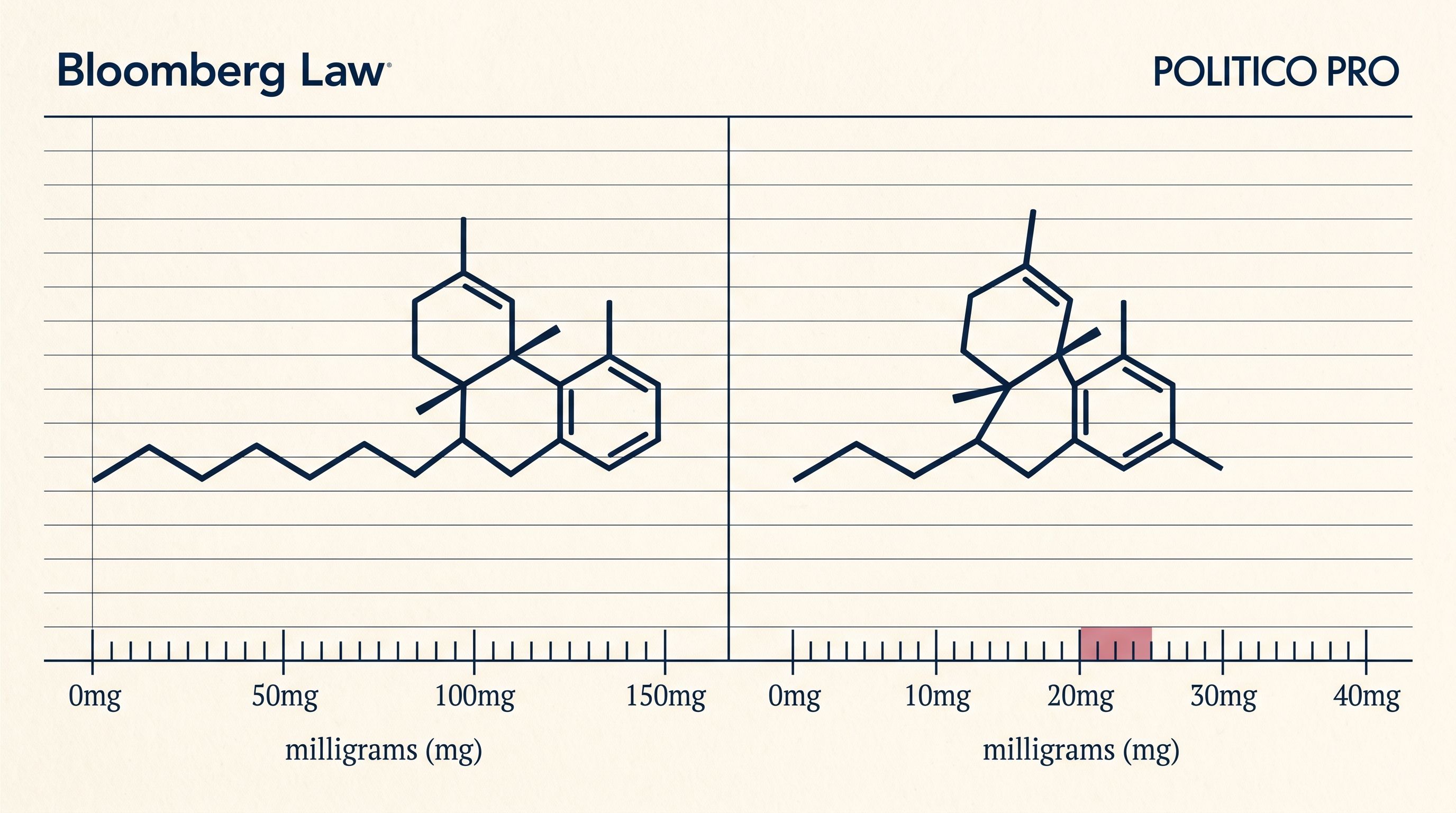
THCP vs THCA is one of the few cannabinoid comparisons where potency and legal exposure run in opposite directions. THCP is the more intoxicating compound and has historically carried the lighter regulatory burden. THCA is non-intoxicating in the package and carries the heavier one. The reason is that the federal hemp test has never measured how a cannabinoid feels — it measures a specific molecule, and on November 12, 2026 it starts measuring a different number entirely.
Tetrahydrocannabiphorol, or THCP, was first identified in 2019 by a research team at the University of Modena and Reggio Emilia, published in Scientific Reports. Its distinguishing feature is a longer alkyl side chain than delta-9 THC, which the researchers associated with substantially higher CB1 receptor binding affinity. It occurs naturally in cannabis only in trace amounts, so essentially all commercial THCP is produced by chemical conversion from other cannabinoids.
Tetrahydrocannabinolic acid, or THCA, is the acidic precursor to delta-9 THC. It is not intoxicating in the form you buy it. Apply heat — smoking, vaping, baking — and it decarboxylates into delta-9 THC. That single chemical fact is the whole reason THCA flower became a national product category and the whole reason it is now the most legally exposed one.
The 2018 Farm Bill defined hemp as cannabis with a delta-9 THC concentration of not more than 0.3 percent on a dry-weight basis. Read it literally: it counts delta-9, and only delta-9. THCA flower could test compliant because THCA is not delta-9 until you heat it. THCP could be sold because THCP is not delta-9 at all. Two very different products exploited the same drafting choice.
P.L. 119-37 §781 replaces that test effective November 12, 2026. Two changes matter:
The Senate voted 90-6 to move the effective date to December 11. The House has not acted, so November 12 remains operative. The November 12 deadline and the proposed delay tracks where that stands.
Under the old test, THCA flower was the product most likely to fail on a technicality and THCP was the product least likely to be measured at all. Under the new test, both are captured — but by different mechanisms.
THCA is captured directly. The 0.877 conversion is written into the definition, so a flower lot that passed on delta-9 alone will not pass on total THC. Most THCA flower loses federal hemp protection on November 12, and there is no grandfather clause in Section 781.
THCP is captured two ways. On the milligram side, a per-container total-THC cap does not ask which cannabinoid contributed the milligrams. On the sourcing side, whether the THCP in a product was extracted from the plant or synthesized in a lab is what decides its treatment under synthetic-cannabinoid provisions — and that question sits outside the concentration test entirely. How minor cannabinoids are being treated covers the broader category shift; the compound-specific state picture is in the state analog-ban map for HHC, THCP and THC-O, and current status by jurisdiction sits on the THCP legality page. For a full side-by-side on potency claims, testing and the federal date specifically for THCP against delta-9 THC, see THC-P versus THC.
Here is the part most comparison pages miss. After November 12 the useful question stops being "which cannabinoid is this" and becomes "how many total-THC milligrams are in this container, and where did they come from." A per-cannabinoid framework rewards knowing your molecules. A total-THC framework rewards knowing your arithmetic. Every SERP result ranking a potency chart is answering a question the law is about to stop asking.
| Question | THCP | THCA | Delta-9 THC | Delta-8 THC |
|---|---|---|---|---|
| Intoxicating as sold | Yes | No — converts on heating | Yes | Yes |
| Counted by the pre-Nov 12 federal test | No | No | Yes | No |
| Counted by the post-Nov 12 total-THC test | Via the per-container milligram cap | Yes — directly, at 0.877 conversion | Yes | Via the per-container milligram cap |
| Typical commercial sourcing | Chemical conversion; trace natural occurrence | Naturally occurring in the plant | Naturally occurring in the plant | Chemical conversion from CBD |
| Common state treatment | Frequently captured by analog and synthetic-cannabinoid bans | Captured by total-THC and per-package states; permitted in delta-9-only states | Governed by the state's cannabis framework | Widely restricted or banned |
| Drug-test cross-reactivity | Possible; panels target THC metabolites | Yes after conversion | Yes | Yes |
For the adjacent pairs, how the law splits THCA from THC is the anchor comparison in this cluster, with THCA versus delta-8 under the 2026 cap, delta-8 versus delta-9, the three-way delta comparison, and HHC versus THC covering the rest of the shelf.
This is not legal advice, and analog-act analysis is state-specific. Talk to your counsel.
Virginia and Texas show why the federal question is only half the analysis.
Virginia's 2 mg total-THC per-package cap took effect August 15, 2026. It does not care which cannabinoid gets a product to 2 mg, so it captures THCP by construction and captured it before the federal definition changed. Virginia's cap, now in effect after a court declined to pause it, is what a total-THC state looks like in practice.
Texas took the other route. It recriminalized delta-8 and THCA products effective July 31, 2026, and the Department of State Health Services is detaining product over naturally occurring THCA — a posture now being challenged in three separate lawsuits against DSHS. A state that reasons by cannabinoid identity extends that logic to THCP readily; a state that reasons by total milligrams never needed to name the compound at all.
The operational takeaway: a single national SKU strategy stopped working some time ago. The state-by-state THCA guide is the fastest way to see which framework a given state uses.
Is THCP legal?
THCP's status depends on how it was made and which standard applies. Under the pre-November 2026 federal definition, hemp was measured by delta-9 THC content only, so THCP was not reached by the concentration test. The narrower definition effective November 12, 2026 uses a total-THC per-container standard that captures it by milligrams, and several states already ban it under analog or synthetic-cannabinoid provisions.
What is the difference between THCP and THCA?
THCP is intoxicating as sold and has a longer alkyl side chain associated with higher CB1 receptor binding. THCA is non-intoxicating until heated, at which point it converts to delta-9 THC — which is why total-THC testing counts it at a 0.877 conversion factor.
Is THCP stronger than THC?
Research reports substantially higher CB1 binding affinity than delta-9 THC. Binding affinity is not the same as consumer-experienced potency at a given dose, and dosing data in commercial products is limited.
Will THCP show up on a drug test?
Standard immunoassay panels target THC metabolites and may cross-react. Neither a negative nor a positive result should be assumed based on the cannabinoid's name.
Does the November 12 hemp rule ban THCP?
It changes the measurement standard to total THC per container rather than delta-9 concentration by weight, which brings products into scope that the old test did not reach. Whether a specific product remains sellable depends on its milligram content and its synthesis route.
Is THCA legal if it tests under 0.3% delta-9?
That was the operative test under the 2018 Farm Bill definition, and it is why THCA flower proliferated. States including Texas and Virginia have moved to total-THC or per-package standards that reach it regardless, and the federal definition changes on November 12, 2026.
This is regulatory journalism, not legal advice — talk to your counsel.
THCP vs THCA is one of the few cannabinoid comparisons where potency and legal exposure run in opposite directions. THCP is the more intoxicating compound and has historically carried the lighter regulatory burden. THCA is non-intoxicating in the package and carries the heavier one. The reason is that the federal hemp test has never measured how a cannabinoid feels — it measures a specific molecule, and on November 12, 2026 it starts measuring a different number entirely.
Tetrahydrocannabiphorol, or THCP, was first identified in 2019 by a research team at the University of Modena and Reggio Emilia, published in Scientific Reports. Its distinguishing feature is a longer alkyl side chain than delta-9 THC, which the researchers associated with substantially higher CB1 receptor binding affinity. It occurs naturally in cannabis only in trace amounts, so essentially all commercial THCP is produced by chemical conversion from other cannabinoids.
Tetrahydrocannabinolic acid, or THCA, is the acidic precursor to delta-9 THC. It is not intoxicating in the form you buy it. Apply heat — smoking, vaping, baking — and it decarboxylates into delta-9 THC. That single chemical fact is the whole reason THCA flower became a national product category and the whole reason it is now the most legally exposed one.
The 2018 Farm Bill defined hemp as cannabis with a delta-9 THC concentration of not more than 0.3 percent on a dry-weight basis. Read it literally: it counts delta-9, and only delta-9. THCA flower could test compliant because THCA is not delta-9 until you heat it. THCP could be sold because THCP is not delta-9 at all. Two very different products exploited the same drafting choice.
P.L. 119-37 §781 replaces that test effective November 12, 2026. Two changes matter:
The Senate voted 90-6 to move the effective date to December 11. The House has not acted, so November 12 remains operative. The November 12 deadline and the proposed delay tracks where that stands.
Under the old test, THCA flower was the product most likely to fail on a technicality and THCP was the product least likely to be measured at all. Under the new test, both are captured — but by different mechanisms.
THCA is captured directly. The 0.877 conversion is written into the definition, so a flower lot that passed on delta-9 alone will not pass on total THC. Most THCA flower loses federal hemp protection on November 12, and there is no grandfather clause in Section 781.
THCP is captured two ways. On the milligram side, a per-container total-THC cap does not ask which cannabinoid contributed the milligrams. On the sourcing side, whether the THCP in a product was extracted from the plant or synthesized in a lab is what decides its treatment under synthetic-cannabinoid provisions — and that question sits outside the concentration test entirely. How minor cannabinoids are being treated covers the broader category shift; the compound-specific state picture is in the state analog-ban map for HHC, THCP and THC-O, and current status by jurisdiction sits on the THCP legality page. For a full side-by-side on potency claims, testing and the federal date specifically for THCP against delta-9 THC, see THC-P versus THC.
Here is the part most comparison pages miss. After November 12 the useful question stops being "which cannabinoid is this" and becomes "how many total-THC milligrams are in this container, and where did they come from." A per-cannabinoid framework rewards knowing your molecules. A total-THC framework rewards knowing your arithmetic. Every SERP result ranking a potency chart is answering a question the law is about to stop asking.
| Question | THCP | THCA | Delta-9 THC | Delta-8 THC |
|---|---|---|---|---|
| Intoxicating as sold | Yes | No — converts on heating | Yes | Yes |
| Counted by the pre-Nov 12 federal test | No | No | Yes | No |
| Counted by the post-Nov 12 total-THC test | Via the per-container milligram cap | Yes — directly, at 0.877 conversion | Yes | Via the per-container milligram cap |
| Typical commercial sourcing | Chemical conversion; trace natural occurrence | Naturally occurring in the plant | Naturally occurring in the plant | Chemical conversion from CBD |
| Common state treatment | Frequently captured by analog and synthetic-cannabinoid bans | Captured by total-THC and per-package states; permitted in delta-9-only states | Governed by the state's cannabis framework | Widely restricted or banned |
| Drug-test cross-reactivity | Possible; panels target THC metabolites | Yes after conversion | Yes | Yes |
For the adjacent pairs, how the law splits THCA from THC is the anchor comparison in this cluster, with THCA versus delta-8 under the 2026 cap, delta-8 versus delta-9, the three-way delta comparison, and HHC versus THC covering the rest of the shelf.
This is not legal advice, and analog-act analysis is state-specific. Talk to your counsel.
Virginia and Texas show why the federal question is only half the analysis.
Virginia's 2 mg total-THC per-package cap took effect August 15, 2026. It does not care which cannabinoid gets a product to 2 mg, so it captures THCP by construction and captured it before the federal definition changed. Virginia's cap, now in effect after a court declined to pause it, is what a total-THC state looks like in practice.
Texas took the other route. It recriminalized delta-8 and THCA products effective July 31, 2026, and the Department of State Health Services is detaining product over naturally occurring THCA — a posture now being challenged in three separate lawsuits against DSHS. A state that reasons by cannabinoid identity extends that logic to THCP readily; a state that reasons by total milligrams never needed to name the compound at all.
The operational takeaway: a single national SKU strategy stopped working some time ago. The state-by-state THCA guide is the fastest way to see which framework a given state uses.
Is THCP legal?
THCP's status depends on how it was made and which standard applies. Under the pre-November 2026 federal definition, hemp was measured by delta-9 THC content only, so THCP was not reached by the concentration test. The narrower definition effective November 12, 2026 uses a total-THC per-container standard that captures it by milligrams, and several states already ban it under analog or synthetic-cannabinoid provisions.
What is the difference between THCP and THCA?
THCP is intoxicating as sold and has a longer alkyl side chain associated with higher CB1 receptor binding. THCA is non-intoxicating until heated, at which point it converts to delta-9 THC — which is why total-THC testing counts it at a 0.877 conversion factor.
Is THCP stronger than THC?
Research reports substantially higher CB1 binding affinity than delta-9 THC. Binding affinity is not the same as consumer-experienced potency at a given dose, and dosing data in commercial products is limited.
Will THCP show up on a drug test?
Standard immunoassay panels target THC metabolites and may cross-react. Neither a negative nor a positive result should be assumed based on the cannabinoid's name.
Does the November 12 hemp rule ban THCP?
It changes the measurement standard to total THC per container rather than delta-9 concentration by weight, which brings products into scope that the old test did not reach. Whether a specific product remains sellable depends on its milligram content and its synthesis route.
Is THCA legal if it tests under 0.3% delta-9?
That was the operative test under the 2018 Farm Bill definition, and it is why THCA flower proliferated. States including Texas and Virginia have moved to total-THC or per-package standards that reach it regardless, and the federal definition changes on November 12, 2026.
This is regulatory journalism, not legal advice — talk to your counsel.