
August 13, 2026


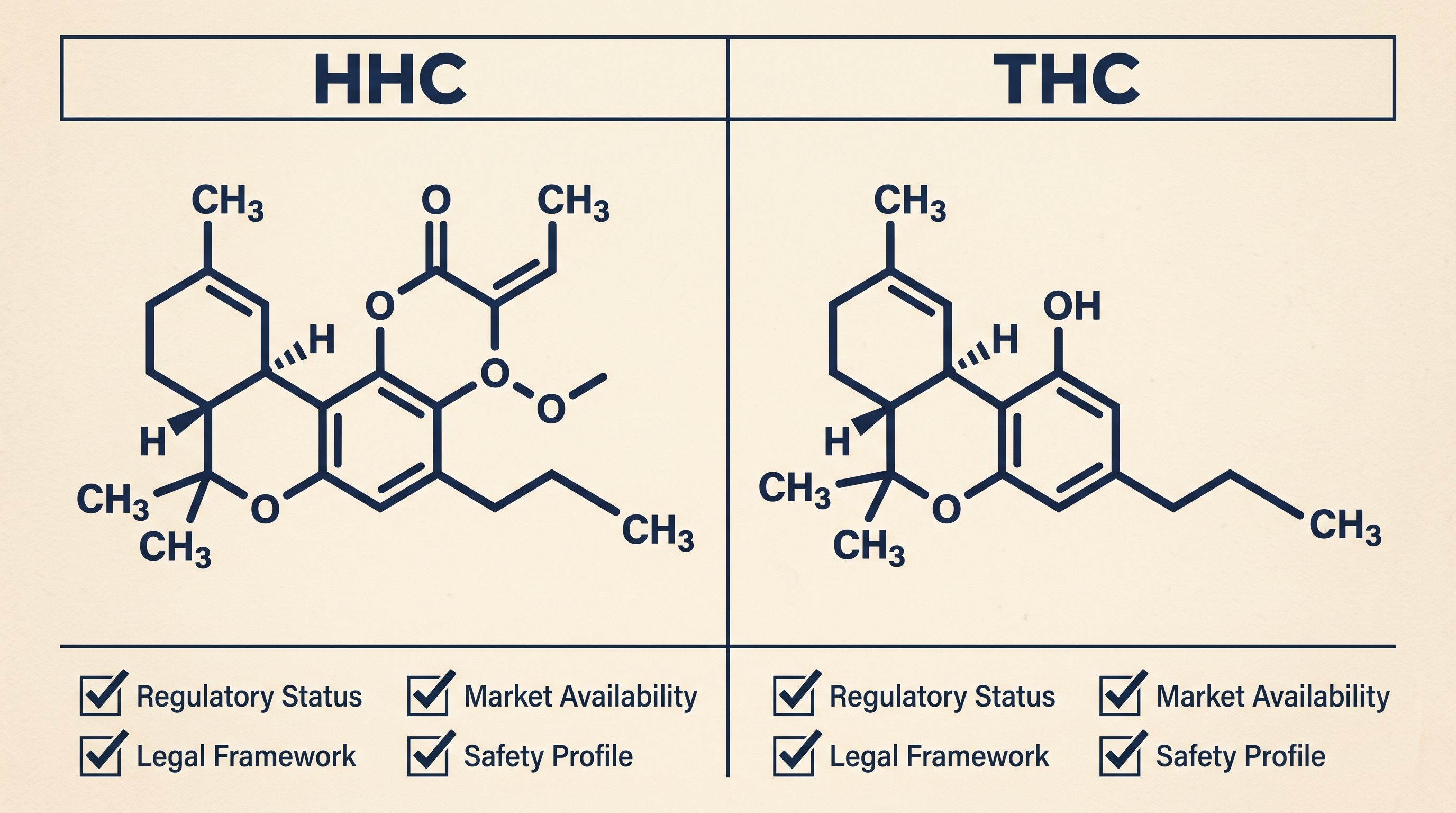
The short answer: HHC and THC differ by a single chemical step — HHC is hydrogenated THC, meaning hydrogen atoms have been added to the molecule. That one step is why the two are treated differently under US law. THC in marijuana is a Schedule I controlled substance. HHC has been sold as a hemp-derived product under the 2018 Farm Bill. And in 2026, the hhc vs thc question stopped being academic: the federal hemp redefinition recriminalizes cannabinoids that cannot be naturally produced by the cannabis plant, and most commercial HHC falls into exactly that category.
This guide covers the chemistry, the effects, and — the part that decides what you can actually sell — the legal difference.
HHC, or hexahydrocannabinol, is made by adding hydrogen to THC in a process called hydrogenation, the same chemistry that turns liquid oils into solid fats. Trace amounts occur naturally in cannabis, but not in quantities anyone could extract commercially. Effectively all HHC on the market is produced in a lab, typically starting from CBD derived from hemp.
That production route is the whole legal argument. Because the starting material is hemp and the finished cannabinoid is not delta-9 THC, sellers have positioned HHC as a federally legal hemp derivative. Regulators have increasingly answered with one word: semi-synthetic.
The word matters because the 2018 Farm Bill legalized hemp and its derivatives by reference to delta-9 THC concentration — no more than 0.3 percent by dry weight. It did not contemplate cannabinoids manufactured through chemical conversion. Whether a converted cannabinoid inherits hemp's legal status has been the central unresolved question, and 2026 resolved a large part of it against HHC.
Delta-9 THC in marijuana remains a Schedule I controlled substance under federal law. State-legal adult-use and medical markets operate under state regimes that do not change the federal classification. The rules are strict but settled: licensed cultivation, licensed retail, seed-to-sale tracking, testing, and no interstate commerce.
Hemp-derived delta-9 has been federally lawful when the finished product stays under 0.3 percent delta-9 THC by dry weight. That threshold is what made high-milligram gummies and beverages possible — a heavy enough product can carry meaningful THC and still clear a concentration test.
That changes. Under the law signed in late 2025, only finished hemp-derived cannabinoid products containing no more than 0.4 milligrams of total THC per container remain federally legal. Total THC counts THCA, delta-8, delta-10 and other isomers. The Senate voted 90–6 on August 8, 2026 to delay most of this to December 11; the House has not agreed.
HHC is where the two timelines split. The Senate's delay bill carves out cannabinoids "that are not capable of being naturally produced by a Cannabis sativa L. plant" — those are recriminalized November 12, 2026 regardless of whether the broader delay is enacted.
Commercial HHC is hydrogenated in a lab from a CBD starting material. It is not produced by the plant at commercially relevant levels. Regulators are widely expected to apply the synthetic carve-out to it. That means HHC likely faces the earlier date while conventional hemp-derived delta-9 products may get the later one.
This is the practical answer to hhc vs thc for anyone holding inventory: they are not on the same clock.
HHC's classification is also being contested directly in court. See our coverage of the DEA lawsuit over HHC's Schedule I treatment for what a ruling there would mean for operators still holding stock.
THCA is the acidic precursor that converts to delta-9 THC when heated. It is naturally produced by the plant, which puts it on the other side of the synthetic line from HHC. But THCA is captured by the total-THC math in the new federal definition, so a THCA product can be plant-derived and still fail the 0.4 mg per-container test. See our breakdown of THCA vs THC: the legal difference.
The distinction to hold onto: naturally produced determines which date applies. Total THC per container determines whether the product clears at all. HHC has a problem with the first test. Many THCA products have a problem with the second.
For the adjacent comparisons in this series, see Delta-8 vs Delta-9 vs Delta-10 compared and THCA vs Delta-8: legal status and testing.
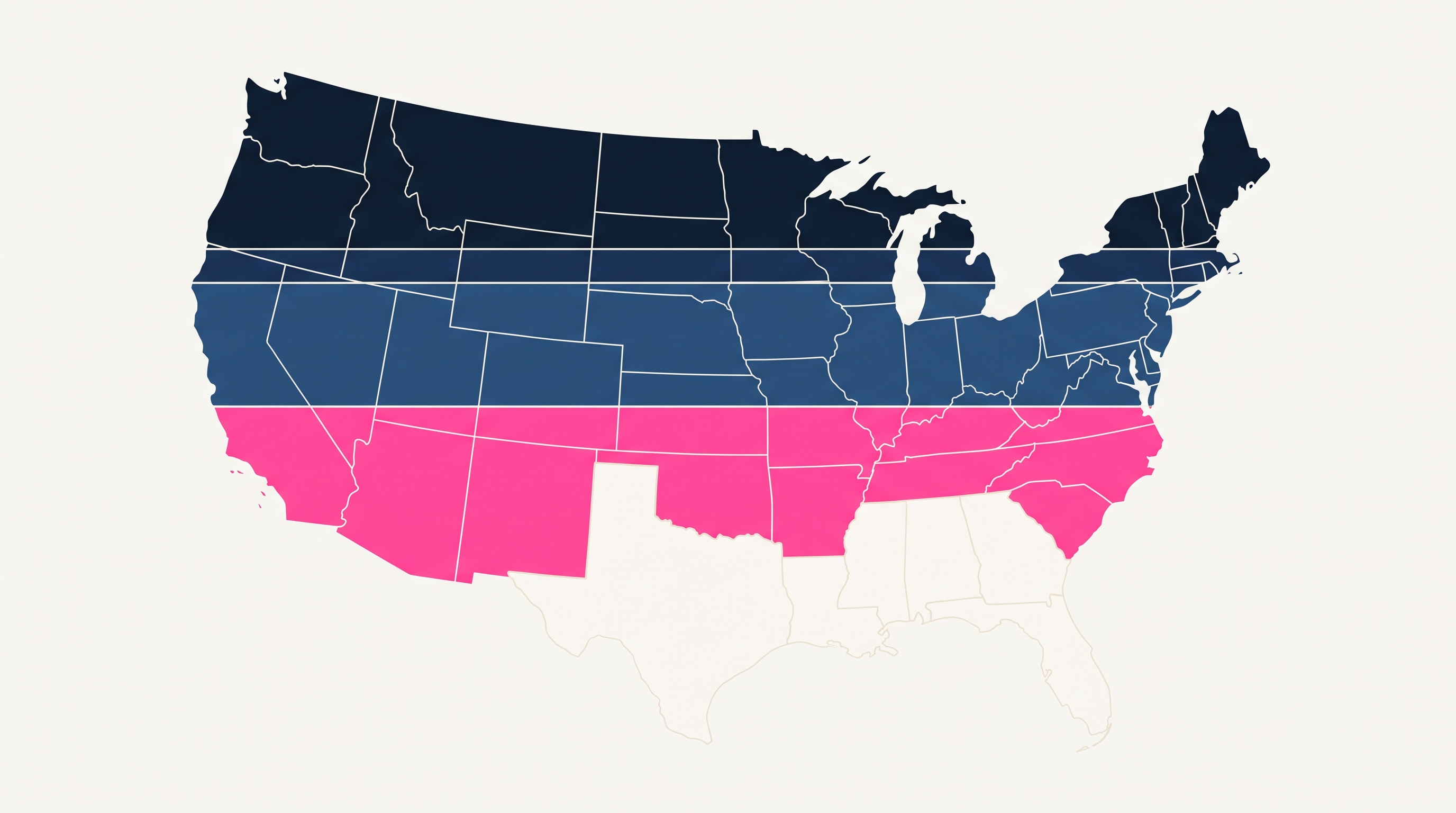
State law diverged from federal law on HHC long before 2026, and a number of states restrict HHC even where hemp-derived THC products remain available. States have taken three broad approaches:
The practical consequence for multi-state operators is that an HHC SKU can be lawful in one state, scheduled in the neighboring one, and about to become federally unlawful in both. Our state-by-state THCA legality guide maps the same divergence for the adjacent cannabinoid family, and the comparison logic transfers.
HHC's international status moved faster than its US status. HHC has been placed under international control, and several EU member states — including the Netherlands — have scheduled it as a narcotic. The European Union Drugs Agency has tracked HHC as part of its semi-synthetic cannabinoid monitoring since the compound appeared on the European market.
For exporters, this means an HHC product that clears a US state test may be a controlled substance at the destination. Our guides to HHC legality in the UK and Europe and Europe's semi-synthetic cannabinoid crackdown cover the country-by-country status.
Reported potency places HHC below delta-9 THC and near or above delta-8. Controlled comparison data is limited, and much of what circulates online is marketing rather than research. No product claim about relative potency should be treated as established, and none should be made on a label.
On drug testing: HHC metabolites are similar enough to THC metabolites that standard immunoassay tests may flag them. Claims that HHC is undetectable are not supportable.
Neither of these is a basis for a health or wellness claim. Talk to your counsel before making any product representation — this is regulatory journalism, not legal advice.
| HHC | Delta-9 THC (hemp-derived) | Delta-9 THC (marijuana) | |
|---|---|---|---|
| Origin | Hydrogenated in a lab, usually from CBD | Extracted from hemp | Extracted from marijuana |
| Naturally produced by the plant? | Only in trace amounts | Yes | Yes |
| Federal status pre-2026 | Sold as a hemp derivative; contested | Lawful under 0.3% dry weight | Schedule I |
| Key 2026 date | November 12 (synthetic carve-out) | November 12, or December 11 if delayed | Unchanged |
| Governing threshold | Likely prohibited as non-natural | 0.4 mg total THC per container | N/A — Schedule I |
| International | Under UN control; scheduled in several EU states | Varies widely | Varies widely |
Operators holding HHC inventory should not plan against December 11. The carve-out is written to exclude exactly this category.
Is HHC legal? HHC's federal status turns on whether it counts as naturally occurring in hemp. Under the pending federal changes, cannabinoids not capable of being naturally produced by the cannabis plant are recriminalized November 12, 2026 — a category regulators are expected to apply to most commercial HHC. Several states already restrict it independently.
Is HHC stronger than THC? Most reports place HHC's potency below delta-9 THC and near or above delta-8. Controlled comparison data is limited, and details are still emerging.
Does HHC show up on a drug test? It can. HHC metabolites are similar enough to THC metabolites that standard tests may flag them. No product claim can guarantee otherwise.
What is the difference between HHC and THC chemically? HHC is hydrogenated THC — hydrogen atoms are added to the THC molecule, which removes a double bond and makes the compound more stable. The conversion is done in a lab.
Where is HHC banned in the US? A number of states schedule HHC by name or capture it under total-THC or synthetic-cannabinoid rules. Because approaches differ by state, check the current status in each jurisdiction you sell into.
Is HHC legal in Europe? HHC has been placed under international control, and several EU states including the Netherlands have scheduled it as a narcotic.
This is regulatory journalism, not legal advice — talk to your counsel.
The short answer: HHC and THC differ by a single chemical step — HHC is hydrogenated THC, meaning hydrogen atoms have been added to the molecule. That one step is why the two are treated differently under US law. THC in marijuana is a Schedule I controlled substance. HHC has been sold as a hemp-derived product under the 2018 Farm Bill. And in 2026, the hhc vs thc question stopped being academic: the federal hemp redefinition recriminalizes cannabinoids that cannot be naturally produced by the cannabis plant, and most commercial HHC falls into exactly that category.
This guide covers the chemistry, the effects, and — the part that decides what you can actually sell — the legal difference.
HHC, or hexahydrocannabinol, is made by adding hydrogen to THC in a process called hydrogenation, the same chemistry that turns liquid oils into solid fats. Trace amounts occur naturally in cannabis, but not in quantities anyone could extract commercially. Effectively all HHC on the market is produced in a lab, typically starting from CBD derived from hemp.
That production route is the whole legal argument. Because the starting material is hemp and the finished cannabinoid is not delta-9 THC, sellers have positioned HHC as a federally legal hemp derivative. Regulators have increasingly answered with one word: semi-synthetic.
The word matters because the 2018 Farm Bill legalized hemp and its derivatives by reference to delta-9 THC concentration — no more than 0.3 percent by dry weight. It did not contemplate cannabinoids manufactured through chemical conversion. Whether a converted cannabinoid inherits hemp's legal status has been the central unresolved question, and 2026 resolved a large part of it against HHC.
Delta-9 THC in marijuana remains a Schedule I controlled substance under federal law. State-legal adult-use and medical markets operate under state regimes that do not change the federal classification. The rules are strict but settled: licensed cultivation, licensed retail, seed-to-sale tracking, testing, and no interstate commerce.
Hemp-derived delta-9 has been federally lawful when the finished product stays under 0.3 percent delta-9 THC by dry weight. That threshold is what made high-milligram gummies and beverages possible — a heavy enough product can carry meaningful THC and still clear a concentration test.
That changes. Under the law signed in late 2025, only finished hemp-derived cannabinoid products containing no more than 0.4 milligrams of total THC per container remain federally legal. Total THC counts THCA, delta-8, delta-10 and other isomers. The Senate voted 90–6 on August 8, 2026 to delay most of this to December 11; the House has not agreed.
HHC is where the two timelines split. The Senate's delay bill carves out cannabinoids "that are not capable of being naturally produced by a Cannabis sativa L. plant" — those are recriminalized November 12, 2026 regardless of whether the broader delay is enacted.
Commercial HHC is hydrogenated in a lab from a CBD starting material. It is not produced by the plant at commercially relevant levels. Regulators are widely expected to apply the synthetic carve-out to it. That means HHC likely faces the earlier date while conventional hemp-derived delta-9 products may get the later one.
This is the practical answer to hhc vs thc for anyone holding inventory: they are not on the same clock.
HHC's classification is also being contested directly in court. See our coverage of the DEA lawsuit over HHC's Schedule I treatment for what a ruling there would mean for operators still holding stock.
THCA is the acidic precursor that converts to delta-9 THC when heated. It is naturally produced by the plant, which puts it on the other side of the synthetic line from HHC. But THCA is captured by the total-THC math in the new federal definition, so a THCA product can be plant-derived and still fail the 0.4 mg per-container test. See our breakdown of THCA vs THC: the legal difference.
The distinction to hold onto: naturally produced determines which date applies. Total THC per container determines whether the product clears at all. HHC has a problem with the first test. Many THCA products have a problem with the second.
For the adjacent comparisons in this series, see Delta-8 vs Delta-9 vs Delta-10 compared and THCA vs Delta-8: legal status and testing.
State law diverged from federal law on HHC long before 2026, and a number of states restrict HHC even where hemp-derived THC products remain available. States have taken three broad approaches:
The practical consequence for multi-state operators is that an HHC SKU can be lawful in one state, scheduled in the neighboring one, and about to become federally unlawful in both. Our state-by-state THCA legality guide maps the same divergence for the adjacent cannabinoid family, and the comparison logic transfers.
HHC's international status moved faster than its US status. HHC has been placed under international control, and several EU member states — including the Netherlands — have scheduled it as a narcotic. The European Union Drugs Agency has tracked HHC as part of its semi-synthetic cannabinoid monitoring since the compound appeared on the European market.
For exporters, this means an HHC product that clears a US state test may be a controlled substance at the destination. Our guides to HHC legality in the UK and Europe and Europe's semi-synthetic cannabinoid crackdown cover the country-by-country status.
Reported potency places HHC below delta-9 THC and near or above delta-8. Controlled comparison data is limited, and much of what circulates online is marketing rather than research. No product claim about relative potency should be treated as established, and none should be made on a label.
On drug testing: HHC metabolites are similar enough to THC metabolites that standard immunoassay tests may flag them. Claims that HHC is undetectable are not supportable.
Neither of these is a basis for a health or wellness claim. Talk to your counsel before making any product representation — this is regulatory journalism, not legal advice.
| HHC | Delta-9 THC (hemp-derived) | Delta-9 THC (marijuana) | |
|---|---|---|---|
| Origin | Hydrogenated in a lab, usually from CBD | Extracted from hemp | Extracted from marijuana |
| Naturally produced by the plant? | Only in trace amounts | Yes | Yes |
| Federal status pre-2026 | Sold as a hemp derivative; contested | Lawful under 0.3% dry weight | Schedule I |
| Key 2026 date | November 12 (synthetic carve-out) | November 12, or December 11 if delayed | Unchanged |
| Governing threshold | Likely prohibited as non-natural | 0.4 mg total THC per container | N/A — Schedule I |
| International | Under UN control; scheduled in several EU states | Varies widely | Varies widely |
Operators holding HHC inventory should not plan against December 11. The carve-out is written to exclude exactly this category.
Is HHC legal? HHC's federal status turns on whether it counts as naturally occurring in hemp. Under the pending federal changes, cannabinoids not capable of being naturally produced by the cannabis plant are recriminalized November 12, 2026 — a category regulators are expected to apply to most commercial HHC. Several states already restrict it independently.
Is HHC stronger than THC? Most reports place HHC's potency below delta-9 THC and near or above delta-8. Controlled comparison data is limited, and details are still emerging.
Does HHC show up on a drug test? It can. HHC metabolites are similar enough to THC metabolites that standard tests may flag them. No product claim can guarantee otherwise.
What is the difference between HHC and THC chemically? HHC is hydrogenated THC — hydrogen atoms are added to the THC molecule, which removes a double bond and makes the compound more stable. The conversion is done in a lab.
Where is HHC banned in the US? A number of states schedule HHC by name or capture it under total-THC or synthetic-cannabinoid rules. Because approaches differ by state, check the current status in each jurisdiction you sell into.
Is HHC legal in Europe? HHC has been placed under international control, and several EU states including the Netherlands have scheduled it as a narcotic.
This is regulatory journalism, not legal advice — talk to your counsel.
