

August 26, 2026

Thank you! Your submission has been received!
Oops! Something went wrong while submitting the form.

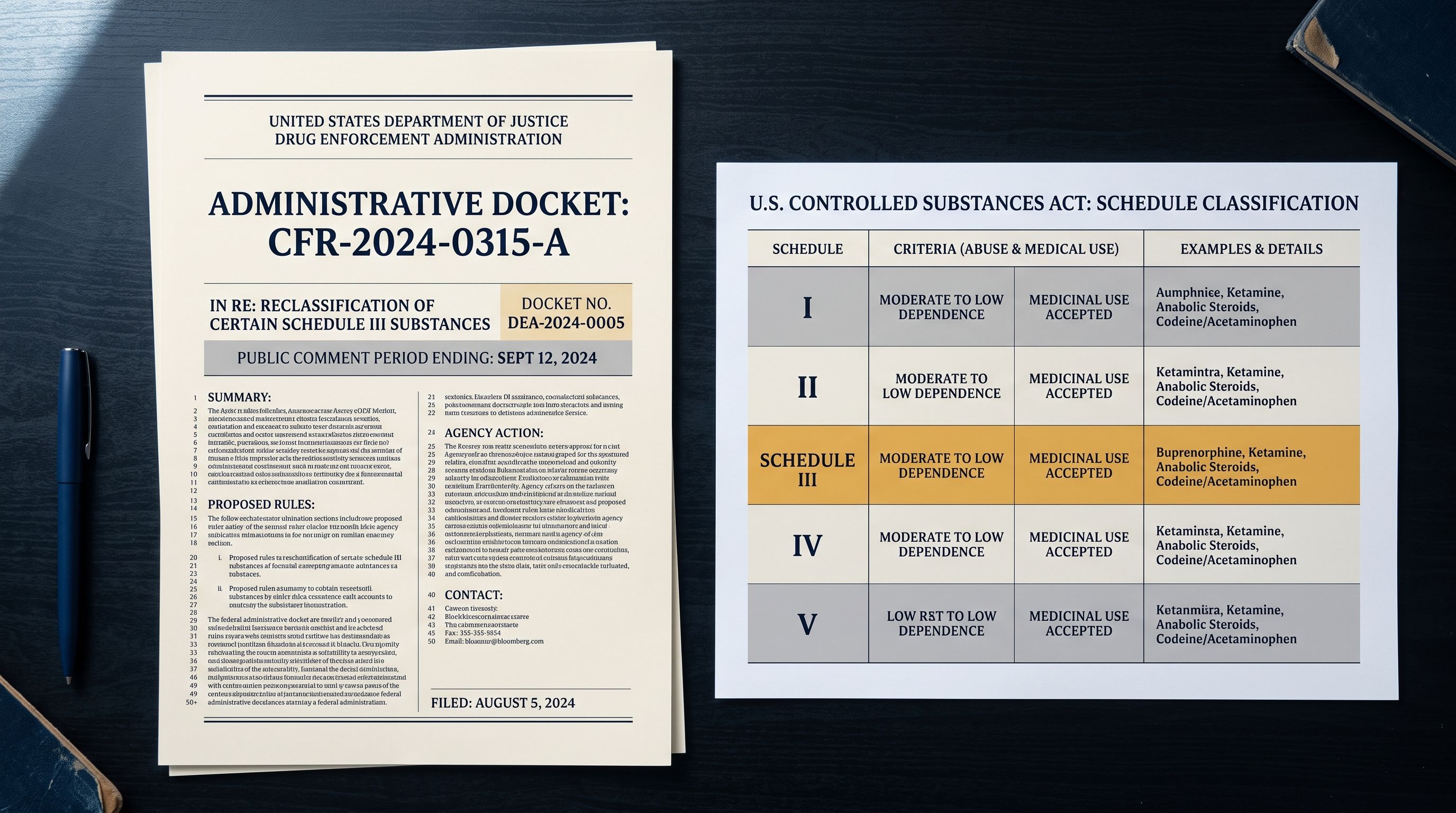
The Drug Enforcement Administration asked its own administrative law judge on August 17, 2026 to recommend moving marijuana to Schedule III, filing a post-hearing brief in DEA Docket No. DEA-1362 that argues the drug "no longer fits the statutory requirements for Schedule I because it has a currently accepted medical use within the United States and it has an accepted safety for its use under medical supervision." The brief asks Chief Administrative Law Judge Derek Julius to "expeditiously recommend" the transfer. A recommendation is not a decision, and the person who makes the decision has no deadline.
The filing closes an evidentiary record that took eleven days to build. Testimony ran from June 29 to July 15, 2026 in Arlington, Virginia, and produced a transcript of roughly 2,500 pages. On August 20, Judge Julius ordered 294 corrections to that transcript, with changes marked in red and deletions shown as strikethroughs, and directed that the corrected version be posted to DEA's website by August 26. DEA has since released the full corrected transcript, which clears the last procedural step before Julius turns to his recommendation.
DEA's brief leans on the Department of Health and Human Services' ten-month scientific and medical evaluation, and on practice data describing more than 30,000 practitioners treating over six million patients across 43 U.S. jurisdictions. That is the agency's evidence that marijuana has a currently accepted medical use — the specific statutory finding that Schedule I placement forecloses.
The opposing briefs came from the hearing's only other invited participants: Smart Approaches to Marijuana, the states of Idaho, Indiana and Nebraska, the Tennessee Bureau of Investigation, and the drug-testing industry. All argued marijuana should remain in Schedule I. If you want the texture of how those arguments were built, week one of the hearing and the June 29 notice-of-intent filings track how each side framed its case going in.
Judge Julius issues a recommendation. DEA Administrator Terrance Cole makes the decision. The recommendation does not bind him, and no statute sets a clock on his response. Four paths are realistic: adopt the recommendation as written, adopt a narrower version, remand for further proceedings, or simply not act. There is no procedural mechanism that forces the fourth option to end.
A separate motion is also pending. The drug-testing industry has asked to freeze the proceeding outright — the posture is laid out in the stay motion filed against the rescheduling process. And none of this disturbs what already happened: the April 2026 final order moved state-licensed medical marijuana and FDA-approved marijuana products to Schedule III. The broader proceeding, which is what these briefs concern, remains open. The record closed in July; nothing has been decided since.
This is the part the wire coverage leaves out. Two federal processes are running at once, and only one of them has a deadline.
The rescheduling track has no fixed date and is entirely discretionary. The hemp track does not work that way. The narrower federal hemp definition in P.L. 119-37 §781 takes effect on November 12, 2026 by statute. The Senate voted 90-6 to push that date to December 11, but the House has not acted, so November 12 remains the operative date. The hemp clock running to November 12 is a different proceeding with different parties and a different legal basis.
Operators keep reading rescheduling headlines as good news for hemp inventory. They are unrelated. The proceeding with the actual deadline is the one nobody is writing about, and it lands first.
None of the above is legal advice, and the tax items in particular turn on facts specific to your entity. Talk to your counsel.
Illinois and Idaho show how little a federal schedule settles on its own. Illinois has been building out its medical channel — the Illinois Department of Financial and Professional Regulation opened a path in 2026 for adult-use dispensaries to add medical sales at the lower medical tax rate. A completed Schedule III move makes that medical channel more valuable, not less, because the tax and research advantages attach to the medical side first.
Idaho, Indiana and Nebraska filed briefs against rescheduling. All three prohibit marijuana under state law, and a federal schedule change does nothing to alter that. An operator in Boise sees no practical change from a Schedule III final rule. An operator in Chicago sees a repriced product line. The federal rule is identical in both places.
| Feature | Schedule I | Schedule III |
|---|---|---|
| IRC §280E applies | Yes | No |
| DEA registration required to handle | Research registration only, tightly limited | Standard registration, recordkeeping and security obligations |
| Research access | Restricted; separate protocol review | Substantially broader |
| FDA approval pathway | Available but heavily encumbered | Conventional drug-development pathway |
| Effect on state prohibition | None — state law governs independently | None — state law governs independently |
Is marijuana rescheduled now?
No. DEA's April 2026 order moved state-licensed medical marijuana and FDA-approved marijuana products to Schedule III, but the broader administrative proceeding is still open. The August 17 brief is DEA's argument to its own judge, not a final rule.
What is a DEA post-hearing brief?
A written closing argument filed after an administrative hearing ends. Each party summarizes the evidence and tells the administrative law judge what outcome it wants. Here, DEA asked Chief ALJ Derek Julius to recommend Schedule III.
Who makes the final rescheduling decision?
DEA Administrator Terrance Cole. Judge Julius issues a recommendation; the Administrator can accept it, reject it, or modify it, and no statute sets a deadline for that decision.
Does Schedule III end 280E?
Section 280E applies to trafficking in Schedule I and Schedule II substances, so a completed move to Schedule III would take marijuana outside it. Nothing has changed yet for most operators, and tax positions should be discussed with your CPA and counsel before anything is filed.
Does rescheduling affect the November 12 hemp deadline?
No. The narrower federal hemp definition takes effect November 12, 2026 under separate legislation, and the Senate's proposed delay to December 11 still awaits House action. The rescheduling proceeding does not touch it.
When will the DEA judge issue his recommendation?
No date has been announced. The last confirmed procedural milestone was the corrected hearing transcript, due on DEA's website by August 26, 2026.
This is regulatory journalism, not legal advice — talk to your counsel.
The Drug Enforcement Administration asked its own administrative law judge on August 17, 2026 to recommend moving marijuana to Schedule III, filing a post-hearing brief in DEA Docket No. DEA-1362 that argues the drug "no longer fits the statutory requirements for Schedule I because it has a currently accepted medical use within the United States and it has an accepted safety for its use under medical supervision." The brief asks Chief Administrative Law Judge Derek Julius to "expeditiously recommend" the transfer. A recommendation is not a decision, and the person who makes the decision has no deadline.
The filing closes an evidentiary record that took eleven days to build. Testimony ran from June 29 to July 15, 2026 in Arlington, Virginia, and produced a transcript of roughly 2,500 pages. On August 20, Judge Julius ordered 294 corrections to that transcript, with changes marked in red and deletions shown as strikethroughs, and directed that the corrected version be posted to DEA's website by August 26. DEA has since released the full corrected transcript, which clears the last procedural step before Julius turns to his recommendation.
DEA's brief leans on the Department of Health and Human Services' ten-month scientific and medical evaluation, and on practice data describing more than 30,000 practitioners treating over six million patients across 43 U.S. jurisdictions. That is the agency's evidence that marijuana has a currently accepted medical use — the specific statutory finding that Schedule I placement forecloses.
The opposing briefs came from the hearing's only other invited participants: Smart Approaches to Marijuana, the states of Idaho, Indiana and Nebraska, the Tennessee Bureau of Investigation, and the drug-testing industry. All argued marijuana should remain in Schedule I. If you want the texture of how those arguments were built, week one of the hearing and the June 29 notice-of-intent filings track how each side framed its case going in.
Judge Julius issues a recommendation. DEA Administrator Terrance Cole makes the decision. The recommendation does not bind him, and no statute sets a clock on his response. Four paths are realistic: adopt the recommendation as written, adopt a narrower version, remand for further proceedings, or simply not act. There is no procedural mechanism that forces the fourth option to end.
A separate motion is also pending. The drug-testing industry has asked to freeze the proceeding outright — the posture is laid out in the stay motion filed against the rescheduling process. And none of this disturbs what already happened: the April 2026 final order moved state-licensed medical marijuana and FDA-approved marijuana products to Schedule III. The broader proceeding, which is what these briefs concern, remains open. The record closed in July; nothing has been decided since.
This is the part the wire coverage leaves out. Two federal processes are running at once, and only one of them has a deadline.
The rescheduling track has no fixed date and is entirely discretionary. The hemp track does not work that way. The narrower federal hemp definition in P.L. 119-37 §781 takes effect on November 12, 2026 by statute. The Senate voted 90-6 to push that date to December 11, but the House has not acted, so November 12 remains the operative date. The hemp clock running to November 12 is a different proceeding with different parties and a different legal basis.
Operators keep reading rescheduling headlines as good news for hemp inventory. They are unrelated. The proceeding with the actual deadline is the one nobody is writing about, and it lands first.
None of the above is legal advice, and the tax items in particular turn on facts specific to your entity. Talk to your counsel.
Illinois and Idaho show how little a federal schedule settles on its own. Illinois has been building out its medical channel — the Illinois Department of Financial and Professional Regulation opened a path in 2026 for adult-use dispensaries to add medical sales at the lower medical tax rate. A completed Schedule III move makes that medical channel more valuable, not less, because the tax and research advantages attach to the medical side first.
Idaho, Indiana and Nebraska filed briefs against rescheduling. All three prohibit marijuana under state law, and a federal schedule change does nothing to alter that. An operator in Boise sees no practical change from a Schedule III final rule. An operator in Chicago sees a repriced product line. The federal rule is identical in both places.
| Feature | Schedule I | Schedule III |
|---|---|---|
| IRC §280E applies | Yes | No |
| DEA registration required to handle | Research registration only, tightly limited | Standard registration, recordkeeping and security obligations |
| Research access | Restricted; separate protocol review | Substantially broader |
| FDA approval pathway | Available but heavily encumbered | Conventional drug-development pathway |
| Effect on state prohibition | None — state law governs independently | None — state law governs independently |
Is marijuana rescheduled now?
No. DEA's April 2026 order moved state-licensed medical marijuana and FDA-approved marijuana products to Schedule III, but the broader administrative proceeding is still open. The August 17 brief is DEA's argument to its own judge, not a final rule.
What is a DEA post-hearing brief?
A written closing argument filed after an administrative hearing ends. Each party summarizes the evidence and tells the administrative law judge what outcome it wants. Here, DEA asked Chief ALJ Derek Julius to recommend Schedule III.
Who makes the final rescheduling decision?
DEA Administrator Terrance Cole. Judge Julius issues a recommendation; the Administrator can accept it, reject it, or modify it, and no statute sets a deadline for that decision.
Does Schedule III end 280E?
Section 280E applies to trafficking in Schedule I and Schedule II substances, so a completed move to Schedule III would take marijuana outside it. Nothing has changed yet for most operators, and tax positions should be discussed with your CPA and counsel before anything is filed.
Does rescheduling affect the November 12 hemp deadline?
No. The narrower federal hemp definition takes effect November 12, 2026 under separate legislation, and the Senate's proposed delay to December 11 still awaits House action. The rescheduling proceeding does not touch it.
When will the DEA judge issue his recommendation?
No date has been announced. The last confirmed procedural milestone was the corrected hearing transcript, due on DEA's website by August 26, 2026.
This is regulatory journalism, not legal advice — talk to your counsel.