


Sign Up
Ready to replace complexity with clarity?
Answer your real world compliance questions (limited time) and save thousands in legal fees and avoided fines.
Automate Compliance Today

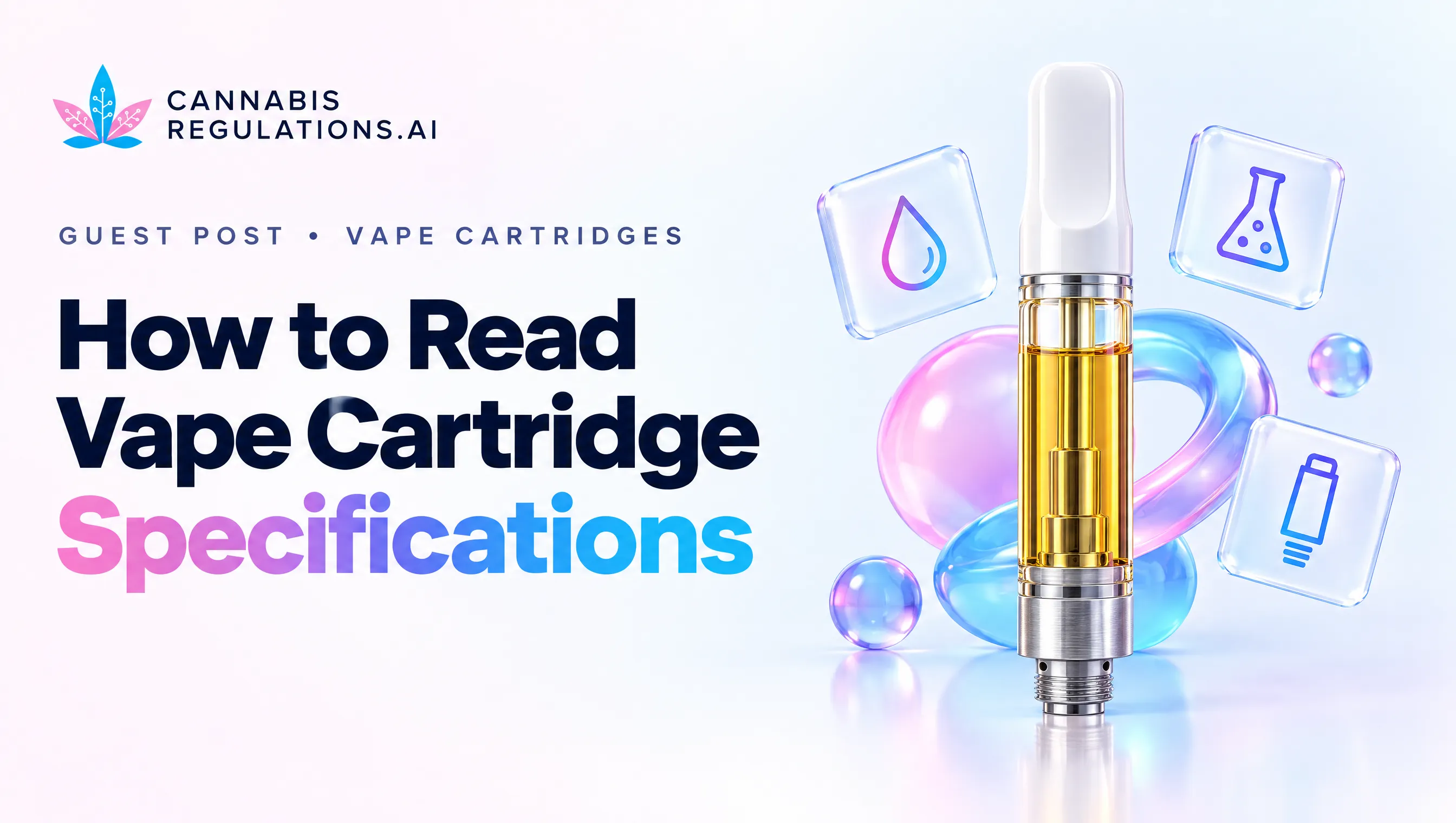
Collaborative content disclosure: This article is a paid guest post from a third-party advertiser, published under our advertising program. The five numbered sections were written by the sponsor, not by our editorial team, and links in them may be paid placements. Publication does not constitute an endorsement of any product, service, or company mentioned.
Editor's note: The numbers on a vape cartridge label also decide its federal legal status. On December 11, 2026, the federal definition of hemp switches to a total-THC test and caps final hemp-derived cannabinoid products at 0.4 milligrams of total THC per container. Carts built on cannabinoids the plant cannot naturally produce lose hemp status sooner, on November 12. Our compliance note at the end applies those rules to the figures this guide teaches you to read.
Choosing a cannabis vape cartridge is not always simple. Labels carry a lot of information about THC content, cannabinoid type, oil volume and hardware. Two products can have similar descriptions and entirely different specifications, and without knowing what each figure means, comparing them is hard.
Comparisons get easier once you know what each specification tells you. Cartridge capacity, cannabinoid concentration, oil composition and hardware compatibility each give you useful information to work with.
Here are five practical ways to interpret cannabis vape cartridge specifications, understand product labels, and check the important details before you buy.
Start with the cartridge's stated oil capacity. Manufacturers usually express it in grams or milligrams. One gram equals 1,000 milligrams by weight, so a 1-gram cartridge contains 1,000 milligrams of oil and a 3-gram cartridge contains 3,000 milligrams. These figures refer to the oil, not the complete device.
To learn about larger cartridge sizes, consider 3 Gram Carts. The 3-gram marking tells you the amount of oil. It tells you nothing about THC potency, so keep the two concepts separate.
Next, check whether the packaging lists net oil weight or total device weight. The cartridge body, mouthpiece and other hardware add weight to the finished product. Look for clear net-content information on the label. Comparing the same measurement across products helps you avoid confusion and understand exactly what each capacity figure represents.
THC percentage tells you how much tetrahydrocannabinol is present in the oil. For example, oil labeled 80% THC contains approximately 800 milligrams of THC per 1,000 milligrams of oil, assuming the percentage is a weight-based concentration. That calculation shows the relationship between total oil quantity and THC content.
Look for other listed cannabinoids too, such as CBD, CBG and CBN. A label may list several cannabinoids with a concentration for each. Consider all of them rather than the THC figure alone. The concentration figures, in percentages or milligrams, give you a better picture of what the oil is made of.
Compare those figures with the product's lab test report. Check that the label and the Certificate of Analysis (COA) use the same units, and whether a listed percentage is total cannabinoid content or a single cannabinoid.
Check the oil type to understand how the extract was produced. Distillate is a refined extract with selected cannabinoids concentrated during processing. Live resin is made from fresh-frozen cannabis material. Live rosin is a solventless extract produced by mechanical separation using methods such as ice water, heat and pressure. These terms describe different extraction methods and formulations.
Next, review the terpene information. Terpenes are aromatic compounds found naturally in cannabis and other plants, and labels may list compounds such as limonene, myrcene and pinene. Check whether the terpenes are naturally derived or added during formulation.
Finally, read the complete ingredient list. Look for added flavorings, carrier ingredients and other substances. Do not assume every cartridge contains only cannabis extract and natural terpenes. If an ingredient is unclear, ask the manufacturer or seller for more information.
Start with the connection type. Many cartridges use a 510-thread connection, a common fitting designed for compatible vape batteries. Some products use proprietary connections or integrated disposable systems, so check the manufacturer's specifications instead of assuming every cartridge fits the same device.
Next, review the heating element and other hardware details. Manufacturers may list ceramic components, metal heating elements or specific coil designs. These descriptions explain the cartridge's construction, but material names alone do not establish product quality. Look for clear technical information and manufacturer documentation when comparing hardware.
Check the battery requirements before assessing compatibility. Look for the recommended voltage range, connection type and device dimensions where available. Some cartridges need particular hardware to work as intended, and a connection mismatch can prevent proper use. Follow the manufacturer's instructions and verify compatibility rather than relying on appearance or cartridge size.
Look for a COA when reviewing product information. A COA gives laboratory results for a specific product or batch. Check the laboratory name, report date, batch number and product details to confirm the document matches the cartridge.
Next, review the testing panels. Depending on the product and the regulations that apply, reports may cover cannabinoid concentrations, pesticides, heavy metals, residual solvents and microbial contaminants. Check which tests were actually performed rather than assuming the report covers every possible contaminant.
Finally, compare the COA with the packaging. Match the batch number, product name and cannabinoid figures. Check whether an independent laboratory issued the report and whether it is current. If details are missing or unclear, contact the seller or manufacturer.
Interpreting vape cartridge specifications takes more than checking oil capacity or THC percentage. Review cannabinoid content, extraction method, ingredients, hardware compatibility and lab results. Each detail explains a different part of the product.
Before comparing cartridges, check the net oil quantity and calculate the approximate cannabinoid content where appropriate. Match lab reports to package details and follow the regulations that apply where you live. A careful review leads to better-informed comparisons.
This section was written by the CannabisRegulations.ai editorial team, not the sponsor.
Short answer: the figures this guide teaches you to read (oil weight, THC percentage, cannabinoid type) are the same figures that decide whether a cart sold as hemp stays federally legal. From December 11, 2026, almost no THC vape cartridge sold as hemp will.
A cart sold in a state-licensed dispensary is a marijuana product under federal law, and its labeling, testing and packaging are set by the state that licensed it. A cart sold online or in a smoke shop as "hemp-derived" depends on the federal hemp definition in 7 U.S.C. §1639o. The rest of this note is about the second kind, because that is where the federal rules change this fall.
Use the guide's own example. A 1-gram cart labeled 80 percent THC holds about 800 milligrams of THC, which is 2,000 times the 0.4 milligram per-container cap. A 3-gram cart at the same potency holds about 2,400 milligrams, or 6,000 times the cap.
The cap reaches low-THC carts too. A 1-gram CBD cart that meets today's 0.3 percent delta-9 limit can still hold up to 3 milligrams of THC, which is 7.5 times the cap. For any hemp cart, multiply the net oil weight in milligrams by the total THC percentage on the COA. If the COA reports THCA separately, convert it first: Total THC = (0.877 × THCA) + delta-9 THC (7 CFR §990.1). Our 0.4 mg per-container cap guide works through more examples, and our THCA vs THC explainer covers why the two are counted together.
The guide's advice to read the complete ingredient list has a public health record behind it. In the 2019 outbreak of e-cigarette, or vaping, product use-associated lung injury (EVALI), CDC laboratory data found that vitamin E acetate, an additive in some THC-containing vaping products, was strongly linked to the outbreak. CDC and FDA advised against THC vaping products from informal sources and against adding anything the manufacturer did not intend. Treat any diluent or thickener you cannot identify as a reason to ask for the full formulation and the COA.
The hardware section above applies to testing as well as fit. When you read a COA's heavy metals panel, check whether the lab tested the filled cartridge or only the bulk oil before filling, since the metal parts are a separate variable. For the sourcing side, see our guide to lead-free vape hardware specifications.
Vape carts carry a shipping rule of their own. Since October 2021, USPS has treated vaping devices and their cartridges and liquids as nonmailable under the PACT Act when they deliver nicotine, flavor or any other substance, which includes hemp and CBD, outside narrow exceptions (Rod Kight). Private carriers set their own limits; see our guide to shipping hemp THC with UPS, FedEx and USPS.
What does the gram number on a vape cartridge mean?
It is the net weight of the oil. One gram is 1,000 milligrams of oil, so a 3-gram cart holds 3,000 milligrams. It says nothing about potency.
How do I calculate how much THC is in a cartridge?
Multiply the oil weight in milligrams by the THC percentage. 1,000 milligrams at 80 percent is about 800 milligrams of THC. If the COA lists THCA, use Total THC = (0.877 × THCA) + delta-9 THC.
Are hemp-derived THC vape carts federally legal after December 11, 2026?
Almost none will be. From December 11, final hemp-derived cannabinoid products are capped at 0.4 milligrams of total THC per container, and a typical THC cart holds hundreds or thousands of milligrams. Your state may already prohibit them.
What should a vape cartridge COA include?
The lab name, report date, a batch number that matches the package, cannabinoid results in the same units as the label, and the contaminant panels the product was tested for, such as pesticides, heavy metals, residual solvents and microbials.
Can I mail a vape cartridge?
Generally not through USPS. Its 2021 PACT Act rule treats vaping products that deliver any substance, including hemp and CBD, as nonmailable outside narrow exceptions.
This is a paid guest post. The five numbered sections and the bottom line are the views of the sponsoring contributor and do not necessarily reflect the views of CannabisRegulations.ai; the editor's note and compliance note are ours. Nothing in this article is legal advice. Cannabis and hemp laws change frequently, so verify the current rules in your jurisdiction before acting. Interested in publishing a guest post? Visit our advertising page.