
August 19, 2026

Thank you! Your submission has been received!
Oops! Something went wrong while submitting the form.

Reps. Beth Van Duyne (R-Texas) and Greg Landsman (D-Ohio) introduced the Beverage Regulatory Parity Act in August 2026, a bipartisan bill that would keep hemp-derived THC drinks federally legal by regulating and taxing them the way alcohol has been regulated since Prohibition ended. Within days, alcohol retailer and wholesaler trade groups endorsed it. That endorsement, not the bill text, is the news.
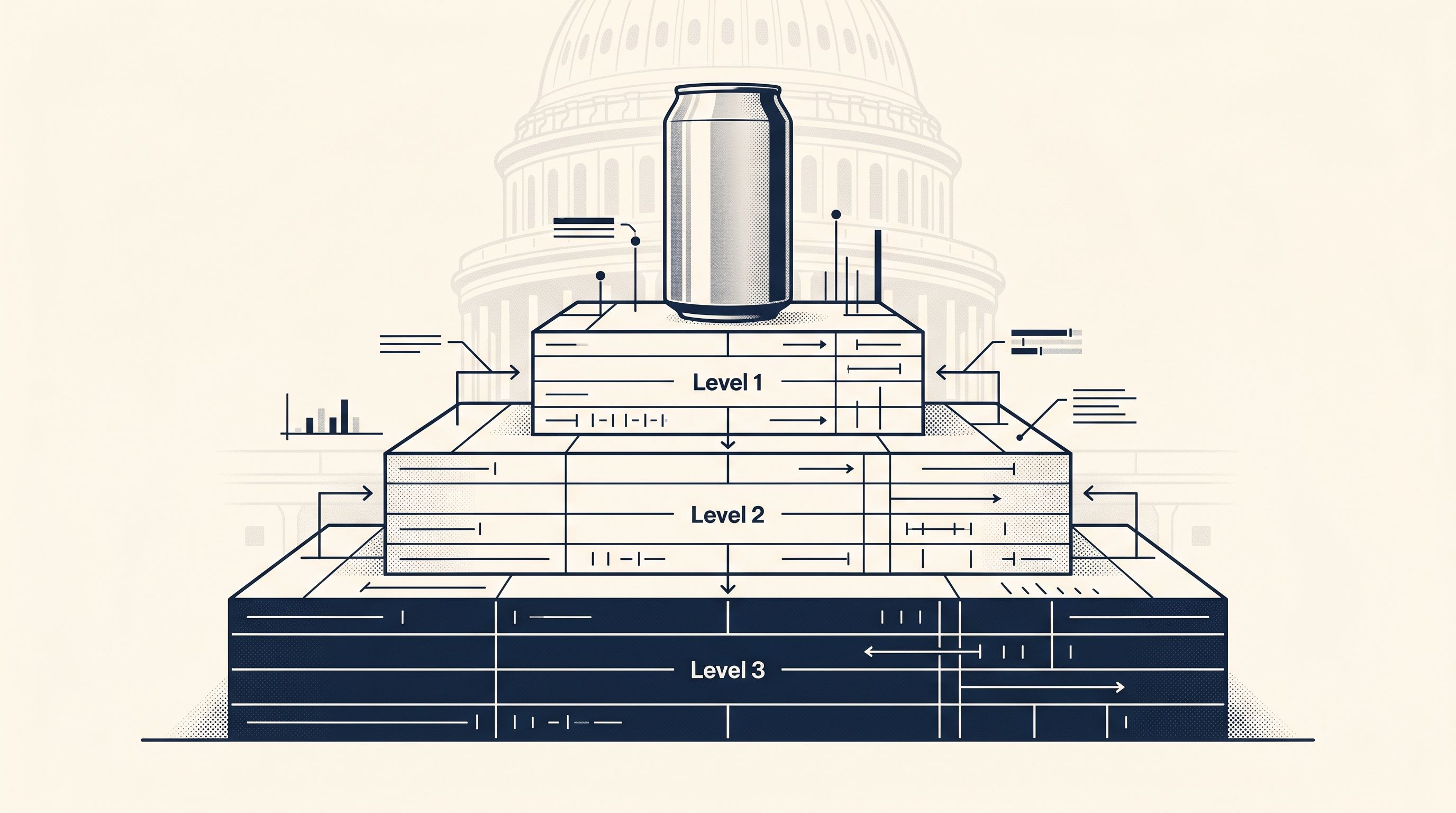
The Beverage Regulatory Parity Act would hand primary regulatory authority to the Alcohol and Tobacco Tax and Trade Bureau, in consultation with the Food and Drug Administration, and build a familiar structure around it:
Put those two numbers next to each other and the planning implication is immediate. A 12-pack of 5 mg cans carries $2.40 in federal excise. A brand selling at $18 wholesale per 12-pack is looking at a mid-single-digit percentage of gross revenue in a tax line that does not exist today.
This is where most coverage stops short. The bill sets 5 mg per serving. The federal standard currently scheduled to arrive sets 0.4 mg of total THC per container. Those are not two versions of the same rule; they are different units measuring different things.
A single-serving can at the bill's ceiling would hold 12.5 times the entire container allowance under the law already on the books. And because the bill measures per serving rather than per container, a two-serving bottle could legally hold 10 mg. Under the container standard, the same bottle is illegal at 0.4 mg regardless of how many servings the label declares. Any operator modeling the four possible outcomes needs to hold both units in mind, because the unit — not the number — is what decides whether a SKU survives. For the mechanics of the arriving standard and the delay fight around it, see the December 11 delay fight.
The bill has no committee date. It was introduced into a House calendar already consumed by the funding fight that carries the hemp delay provision, and the House has to act on that before the current deadline. Introduction with trade-association support is a starting position, not a forecast. The realistic paths are narrow: attachment to a larger vehicle, inclusion in a farm bill, or nothing this Congress.
What has changed is the lobbying map. Hemp THC drinks are the only category in this market with an organized, deep-pocketed, non-cannabis constituency defending them. Alcohol wholesalers and retailers already stock the product, already have the license infrastructure a three-tier system assumes, and would rather regulate a competitor's category than watch it disappear from their shelves. That is why a drinks-only carve-out is the most politically durable piece of the hemp market heading into the fall — and why beverage operators should plan differently from edible and vape operators, who have no equivalent ally.
While Congress debates, states are building the frameworks the federal bill imitates. Delaware's dual-channel regime takes effect October 21, 2026, putting THC drinks in both dispensaries and liquor stores. Kentucky already runs a three-tier THC beverage system, and Missouri has an alcohol-model initiative on the same logic.
The contrast worth watching is between states that regulate the category and states that cap it out of existence. Virginia's 2 mg per-package cap took effect August 15 and catches drinks along with everything else; a 5 mg can is illegal there today no matter what Congress does. Texas recriminalized converted isomers in July but left hemp delta-9 drinks at or under 0.3 percent standing. And Ohio's beverage ban was enjoined for some companies and not others, producing a split market inside one state.
| Framework | Limit | Unit | Regulator | Status |
|---|---|---|---|---|
| Beverage Regulatory Parity Act | 5 mg intoxicating THC | Per serving | TTB (with FDA) | Introduced, no committee date |
| Federal standard on the books | 0.4 mg total THC | Per container | FDA / DEA | Nov 12, 2026 (Dec 11 if delay enacted) |
| Virginia | 2 mg total THC | Per package | Virginia AG | In effect Aug 15, 2026 |
| Delaware | State-set | Per serving | State | Effective Oct 21, 2026 |
Travel rules are a separate patchwork again — see flying with THC drinks.
Are hemp THC drinks getting banned?
Under the law currently on the books, most would be recriminalized on November 12, 2026, or December 11 if the Senate-passed delay is enacted. The Beverage Regulatory Parity Act would instead regulate them under the alcohol framework, but it has no committee date.
What is the three-tier system for THC drinks?
The alcohol model: manufacturers sell to licensed wholesalers, who sell to licensed retailers. Each tier is separately licensed, and cross-tier ownership is restricted. Age limits, labeling, advertising rules and excise tax attach at defined points.
How much THC would a drink be allowed to contain?
Up to 5 milligrams of total intoxicating THC per serving, for buyers 21 and over, under the introduced bill.
What tax would apply?
A federal excise of 8 cents per milligram of intoxicating THC — 40 cents on a 5 mg serving — in addition to any state tax.
Why does the alcohol industry support hemp THC drinks?
Retailer and wholesaler groups already stock the category and hold the license infrastructure a three-tier system assumes. A regulated framework preserves a shelf line that prohibition would remove.
Which states already regulate THC beverages?
Delaware's dispensary-and-liquor-store regime takes effect October 21, 2026; Kentucky operates a three-tier structure; Minnesota built an early retail hemp drink market. Other states, such as Virginia, fold drinks into a general hemp THC cap instead.
This is regulatory journalism, not legal advice — talk to your counsel.
Reps. Beth Van Duyne (R-Texas) and Greg Landsman (D-Ohio) introduced the Beverage Regulatory Parity Act in August 2026, a bipartisan bill that would keep hemp-derived THC drinks federally legal by regulating and taxing them the way alcohol has been regulated since Prohibition ended. Within days, alcohol retailer and wholesaler trade groups endorsed it. That endorsement, not the bill text, is the news.
The Beverage Regulatory Parity Act would hand primary regulatory authority to the Alcohol and Tobacco Tax and Trade Bureau, in consultation with the Food and Drug Administration, and build a familiar structure around it:
Put those two numbers next to each other and the planning implication is immediate. A 12-pack of 5 mg cans carries $2.40 in federal excise. A brand selling at $18 wholesale per 12-pack is looking at a mid-single-digit percentage of gross revenue in a tax line that does not exist today.
This is where most coverage stops short. The bill sets 5 mg per serving. The federal standard currently scheduled to arrive sets 0.4 mg of total THC per container. Those are not two versions of the same rule; they are different units measuring different things.
A single-serving can at the bill's ceiling would hold 12.5 times the entire container allowance under the law already on the books. And because the bill measures per serving rather than per container, a two-serving bottle could legally hold 10 mg. Under the container standard, the same bottle is illegal at 0.4 mg regardless of how many servings the label declares. Any operator modeling the four possible outcomes needs to hold both units in mind, because the unit — not the number — is what decides whether a SKU survives. For the mechanics of the arriving standard and the delay fight around it, see the December 11 delay fight.
The bill has no committee date. It was introduced into a House calendar already consumed by the funding fight that carries the hemp delay provision, and the House has to act on that before the current deadline. Introduction with trade-association support is a starting position, not a forecast. The realistic paths are narrow: attachment to a larger vehicle, inclusion in a farm bill, or nothing this Congress.
What has changed is the lobbying map. Hemp THC drinks are the only category in this market with an organized, deep-pocketed, non-cannabis constituency defending them. Alcohol wholesalers and retailers already stock the product, already have the license infrastructure a three-tier system assumes, and would rather regulate a competitor's category than watch it disappear from their shelves. That is why a drinks-only carve-out is the most politically durable piece of the hemp market heading into the fall — and why beverage operators should plan differently from edible and vape operators, who have no equivalent ally.
While Congress debates, states are building the frameworks the federal bill imitates. Delaware's dual-channel regime takes effect October 21, 2026, putting THC drinks in both dispensaries and liquor stores. Kentucky already runs a three-tier THC beverage system, and Missouri has an alcohol-model initiative on the same logic.
The contrast worth watching is between states that regulate the category and states that cap it out of existence. Virginia's 2 mg per-package cap took effect August 15 and catches drinks along with everything else; a 5 mg can is illegal there today no matter what Congress does. Texas recriminalized converted isomers in July but left hemp delta-9 drinks at or under 0.3 percent standing. And Ohio's beverage ban was enjoined for some companies and not others, producing a split market inside one state.
| Framework | Limit | Unit | Regulator | Status |
|---|---|---|---|---|
| Beverage Regulatory Parity Act | 5 mg intoxicating THC | Per serving | TTB (with FDA) | Introduced, no committee date |
| Federal standard on the books | 0.4 mg total THC | Per container | FDA / DEA | Nov 12, 2026 (Dec 11 if delay enacted) |
| Virginia | 2 mg total THC | Per package | Virginia AG | In effect Aug 15, 2026 |
| Delaware | State-set | Per serving | State | Effective Oct 21, 2026 |
Travel rules are a separate patchwork again — see flying with THC drinks.
Are hemp THC drinks getting banned?
Under the law currently on the books, most would be recriminalized on November 12, 2026, or December 11 if the Senate-passed delay is enacted. The Beverage Regulatory Parity Act would instead regulate them under the alcohol framework, but it has no committee date.
What is the three-tier system for THC drinks?
The alcohol model: manufacturers sell to licensed wholesalers, who sell to licensed retailers. Each tier is separately licensed, and cross-tier ownership is restricted. Age limits, labeling, advertising rules and excise tax attach at defined points.
How much THC would a drink be allowed to contain?
Up to 5 milligrams of total intoxicating THC per serving, for buyers 21 and over, under the introduced bill.
What tax would apply?
A federal excise of 8 cents per milligram of intoxicating THC — 40 cents on a 5 mg serving — in addition to any state tax.
Why does the alcohol industry support hemp THC drinks?
Retailer and wholesaler groups already stock the category and hold the license infrastructure a three-tier system assumes. A regulated framework preserves a shelf line that prohibition would remove.
Which states already regulate THC beverages?
Delaware's dispensary-and-liquor-store regime takes effect October 21, 2026; Kentucky operates a three-tier structure; Minnesota built an early retail hemp drink market. Other states, such as Virginia, fold drinks into a general hemp THC cap instead.
This is regulatory journalism, not legal advice — talk to your counsel.